Editor’s note: This post was originally published in July 2016 and has been updated for 2026 with new research on how B2B buyers use social media, peer reviews, and AI to research vendors.
When we first wrote this post, the big news was that B2B buyers had started using social media to research vendors. That’s no longer news. Today’s buyers move between LinkedIn, YouTube, peer reviews, industry communities, and AI tools like ChatGPT before they ever talk to a salesperson. And by the time they do reach out, most have already decided who they like.
Here, we walk you through what the latest research says about how B2B buyers research vendors, which channels matter most, and what supply chain, logistics, and manufacturing companies should do about it.
Quick answer: do B2B buyers use social media to research vendors?
Yes. Social media is one of several channels B2B buyers use to research vendors, alongside peer reviews, word of mouth, and increasingly AI tools. LinkedIn’s research found that nearly two-thirds of B2B buyers say social video helps shape their buying decisions. Buyers also do most of their research on their own, so your social presence is often how they first judge whether you’re credible.
Buyers do most of their research before they talk to you
Buyers made first contact with sellers about 61% of the way through their buying journey.
Buyers, not sellers, initiated 79% of engagements.
94% of buyers had already ranked their shortlist by preference before engaging sellers.
The vendor that won the selection phase went on to win the deal 77% of the time.
In other words, buyers are forming opinions about your company long before your sales team gets a chance to make its case. Social media, your website, reviews, and AI answers are doing that selling for you, whether you’re managing them or not.
How B2B buyers use social media today
LinkedIn is still the center of B2B social
For supply chain companies, LinkedIn is where buyers, partners, and future employees are most likely to see you. Buyers use it to check out your company page, see what your leaders are posting, find out who they know at your company, and get a feel for your expertise. A quiet or outdated LinkedIn presence sends a signal, and it’s not a good one.
Video is shaping buying decisions
Video has become one of the most influential formats in B2B. According to the LinkedIn B2B Institute, nearly two-thirds of B2B buyers say social video helps shape their buying decisions. The same research found that vendors known across the whole buying group from the start are 20 times more likely to be bought than those known only through an expert recommendation.
For supply chain companies, video is a natural fit: facility tours, equipment demos, customer stories, and short explainers from your own experts all help buyers see what working with you would actually be like.
Peers and reviews still carry weight
B2B buyers trust other buyers. TrustRadius’s 2026 B2B Buying Disconnect report found that most buyers consult customer reviews during their purchase journey and more than half speak with a peer along the way. Industry groups, LinkedIn conversations, and word of mouth from people buyers already trust remain some of the strongest influences on a shortlist.
AI is now part of the research process, too
The newest research channel is AI. Forrester reports that 94% of business buyers now use AI in their buying process. And in G2’s 2026 research, 51% of B2B software buyers said they start their research with an AI chatbot more often than with Google, up from 29% a year earlier.
That matters for social media, too. AI tools pull from what’s published about you across the web, including your LinkedIn presence, reviews, and mentions in industry publications. A consistent, active presence makes it easier for AI tools to understand and recommend your company. Here’s more on how logistics companies get recommended by ChatGPT and AI search.
What buyers expect when they find you
Whether a buyer finds you on LinkedIn, through a peer, or in an AI answer, they’re looking for the same things:
Proof you understand their world. Content that speaks to their specific industry, challenges, and terminology.
Real expertise. Insight from people at your company, not just promotional posts.
Evidence. Case studies, customer stories, and specifics that back up your claims.
Consistency. The same story on your website, LinkedIn, review sites, and sales conversations.
A fast response. When they finally reach out, they expect to hear back quickly. Here’s why lead response time matters so much.
How supply chain companies can show up where buyers research
Keep your LinkedIn company page current. Update your description, services, locations, and featured content so it matches your website. For logistics-specific guidance, see how to use social media in transportation and logistics.
Get your experts posting. Posts from real people at your company often reach more buyers than company page posts. Your team members can be some of your best brand ambassadors.
Invest in short video. Facility walkthroughs, project highlights, and quick tips from your team give buyers a reason to stop scrolling.
Ask happy customers for reviews and referrals. Make it easy for satisfied customers to vouch for you on Google, LinkedIn, and industry directories.
Show up in industry conversations. Comment on trade publication posts, participate in association groups, and share takeaways from trade shows.
Connect social to your pipeline. Track how social and AI referrals turn into website visits, leads, and opportunities in your CRM.
Questions we’ve gotten about B2B buyers and social media
Q: Which social media platform is best for B2B supply chain companies? A: For most supply chain, logistics, and manufacturing companies, LinkedIn is the top priority because that’s where buyers, partners, and candidates spend time professionally. YouTube is a strong second for video content like facility tours and demos.
Q: Do B2B buyers really make decisions based on social media? A: Social media rarely closes a deal on its own, but it shapes which vendors make the shortlist. Since buyers do most of their research before contacting sellers, your social presence often forms their first impression of your company.
Q: Should our employees post on LinkedIn or just the company page? A: Both. The company page is your official presence, but posts from real people, especially leaders and subject matter experts, tend to earn more engagement and trust.
Q: How does social media affect AI search? A: AI tools draw on information published across the web, including professional profiles, reviews, and industry mentions. A consistent, active presence helps AI tools understand what your company does and makes it more likely you’ll be recommended.
Want to reach more buyers where they research?
Fronetics works exclusively with supply chain, logistics, and manufacturing companies, and we help clients build a presence on LinkedIn, in search, and in AI answers that turns researchers into buyers. Get in touch to talk about where your buyers are finding you.
An application engineer has a problem to solve by Friday. She needs a component that holds tolerance at high temperature, ships in under eight weeks, and won’t trigger a requalification. She is not going to call your sales team to find out if you have it. She’s going to search, open three datasheets, download a CAD model, and maybe ask ChatGPT for a shortlist. If your company isn’t part of that research, you’re not part of the decision. That’s the first rule of marketing to engineers.
Engineers are some of the most thorough, skeptical, and self-directed buyers in B2B, and they reward suppliers who make their jobs easier. Here’s what they need from you, and how manufacturers can deliver it.
Key takeaways
Engineers do most of their supplier research online, before sales is involved.
Specs, data, and application proof beat polished brand claims every time.
Brand familiarity still matters: engineers lean toward suppliers they recognize.
Your website, technical content, and AI search visibility now do the work a sales rep used to do.
What is marketing to engineers?
Marketing to engineers is the practice of reaching design, application, and manufacturing engineers with the technical information they need to evaluate, specify, and recommend a product or supplier. It’s less about persuasion and more about removing friction: making specs easy to find, proving performance, and showing up wherever engineers research.
It’s a core piece of any B2B manufacturing marketing program, because in most industrial purchases the engineer is the person who puts your part on the drawing, or takes it off.
How do engineers research suppliers today?
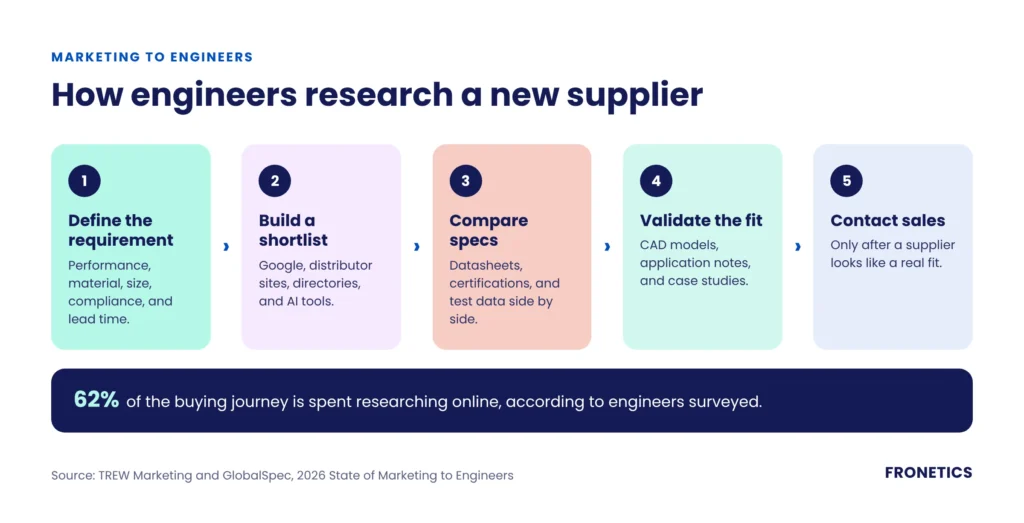
Engineers spend 62% of the buying journey researching online, according to the 2026 State of Marketing to Engineers study from TREW Marketing and GlobalSpec. That same research found technical publications and vendor websites are still their top sources of product information.
The broader B2B picture points the same direction. A Gartner survey of 646 B2B buyers, published in March 2026, found 67% prefer a rep-free buying experience, and 45% used AI during a recent purchase.
In practice, an engineer’s research usually looks like this:
Define the requirement (performance, material, size, compliance, lead time).
Search Google, distributor sites, industry directories, or an AI tool for candidate suppliers.
Compare datasheets, specs, and certifications side by side.
Download CAD models, application notes, or test data.
Reach out only once a supplier looks like a real fit.
By the time an engineer fills out your contact form, they’ve often narrowed the field to two or three options. Your marketing decides whether you’re one of them.
What do engineers want from supplier marketing?
Specs they can find in seconds
Hiding datasheets behind a form or a “contact us for details” button is one of the fastest ways to lose an engineer. Put key specifications on the product page in plain HTML text, not just inside a PDF. It helps engineers, and it helps search engines and AI tools understand what you make.
Proof, not adjectives
“High quality” and “industry leading” mean nothing to an engineer. Test results, tolerances, failure rates, certifications (ISO 9001, AS9100, IATF 16949), and application stories mean a lot. If you can’t prove a claim with a number or a standard, cut it.
Application context
Engineers want to know how your product performed in a situation like theirs. Short application notes and case studies that explain the problem, the constraint, and the result are some of the most useful content a manufacturer can publish.
Tools that save time
CAD downloads, configurators, cross-reference charts, selection guides, and calculators all earn repeat visits. They also signal that you understand how engineers actually work.
Direct access to expertise
When an engineer is ready to talk, they want to talk to someone technical. Make it clear how to reach an application engineer, and route technical questions to people who can answer them.
Why does brand still matter to engineers?
Engineers like to think they choose purely on specs, but familiarity plays a real role. In the TREW and GlobalSpec research, 53% of technical buyers said brand familiarity influenced their most recent purchase, and 70% said they were more likely to choose the better-known brand when evaluating technically similar solutions.
That’s the case for consistent visibility: publishing technical content, showing up in trade publications, being present at the right trade shows, and staying in front of engineers between projects. When two parts look equal on paper, the supplier they’ve heard of usually wins.
How is AI search changing how engineers find suppliers?
More engineers now start with questions like “Which manufacturers make PTFE seals rated for cryogenic service?” in ChatGPT, Perplexity, or Google’s AI Overviews. They don’t fully trust the answers yet (the same research put trust in AI answers at 4.7 out of 10), but they use them to build a starting list.
To show up in those answers, manufacturers need:
Product and capability pages that state clearly what you make, for which applications, and to what specifications.
FAQ-style content that answers the exact questions engineers ask.
Consistent company and product information across your site, distributor listings, and directories.
Mentions in trade publications and industry sites that AI tools treat as credible.
Marketing to engineers: what works and what doesn’t
What works
What doesn’t
Ungated datasheets and specs in HTML
Specs locked behind a form
Test data, standards, and certifications
Vague claims like “best in class”
Application notes and case studies
Generic brochures
CAD downloads and selection tools
“Call for details”
Access to an application engineer
Routing every question to sales
Steady presence in trade media and search
One big push per year
Where should manufacturers start?
If your team is small, start where engineers spend the most time: your website. Audit your top product pages and ask three questions. Can an engineer find the key specs without downloading anything? Is there proof behind every claim? Is it obvious how to get a technical answer?
From there, build a steady stream of technical content, starting with the questions your sales and application engineers answer most often. Then connect that content to a broader manufacturing lead generation program so that research turns into real conversations.
Make it easy to choose you
Engineers don’t want to be sold to. They want to be informed, quickly and accurately. Manufacturers that make specs easy to find, back up every claim, and stay visible where engineers research will earn more spots on more shortlists.
Give engineers the technical information they need without friction: ungated specs, test data, certifications, application notes, and CAD files. Then stay visible in search, AI tools, and trade publications so they recognize your name when it’s time to choose.
Should manufacturers gate datasheets?
In most cases, no. Engineers expect datasheets to be freely available, and gating them often sends engineers to a competitor. Gate deeper resources like design guides or calculators instead, if you gate anything.
Do engineers trust AI search results?
Not fully yet. The 2026 State of Marketing to Engineers research rated technical buyers’ trust in generative AI answers at 4.7 out of 10. Engineers use AI tools to build a starting list, then verify with datasheets and vendor websites.
How long does it take to see results from marketing to engineers?
Most manufacturers see early gains in search visibility and engagement within three to six months. Pipeline impact usually follows over six to twelve months, depending on sales cycle length.
In account-based marketing, a sales rep is rarely selling to one person. They’re working a short list of high-value companies, each with a buying committee that includes operations, procurement, finance, and IT. The ABM sales cycle is long, and every stage stalls for a different reason. The right content, handed to the right person at the right moment, is what keeps a target account moving.
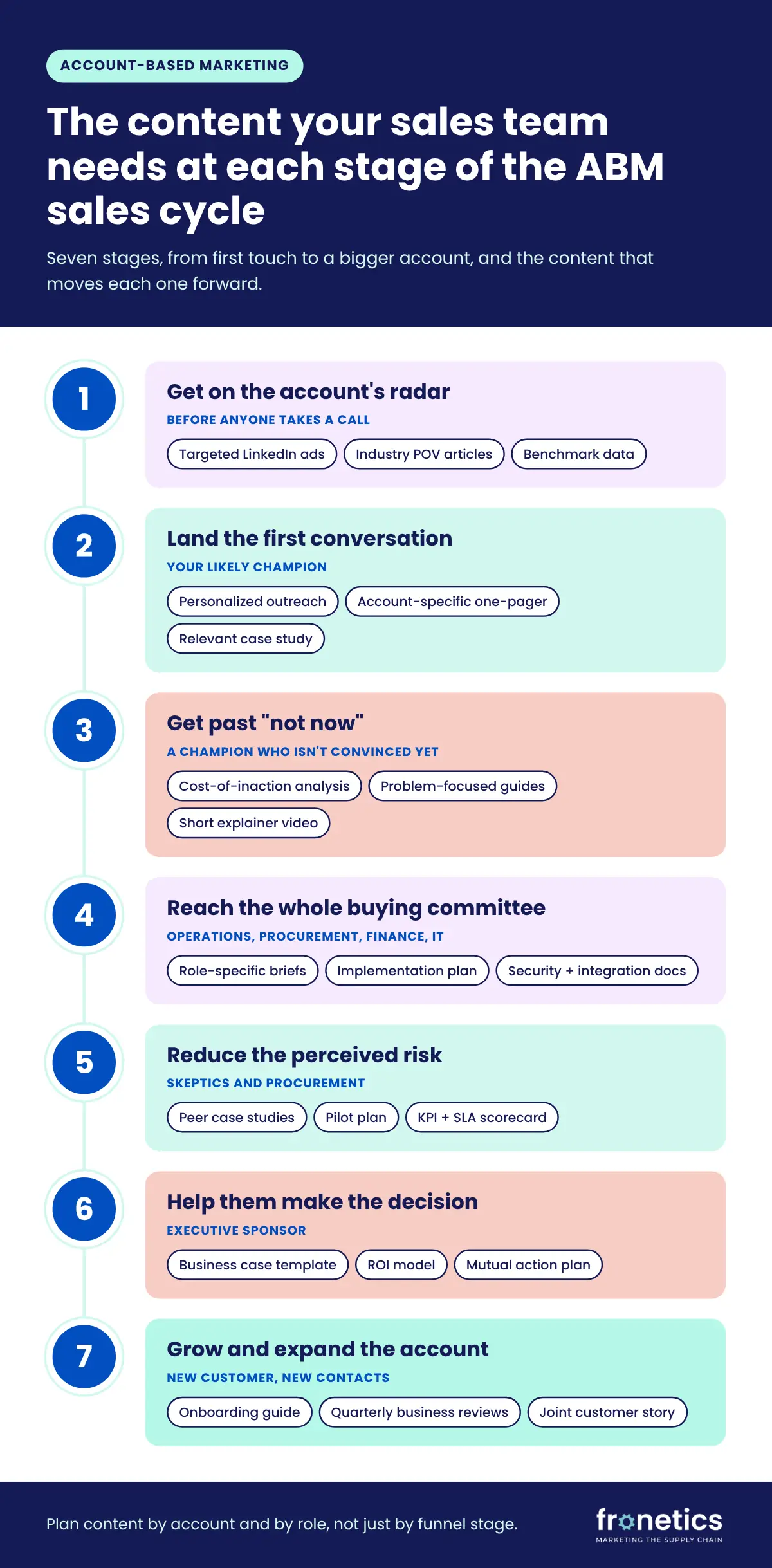
Below, we break the ABM sales cycle into seven stages and show the content that helps sales at each one. It’s the same framework we use when we build account-based marketing for supply chain companies, whether that’s a 3PL going after enterprise shippers or a manufacturer selling into national distributors.
What is the ABM sales cycle?
The ABM sales cycle is the path a target account takes from first awareness of your company to signed contract and, ideally, a larger relationship over time. Unlike a traditional funnel, which starts with a pool of leads and filters them down, an account-based sales cycle starts with a named list of companies. Marketing and sales then work together to reach every decision-maker inside those accounts.
That difference matters for content. In a lead-gen funnel, one ebook might serve thousands of prospects. In ABM, content has to speak to a specific industry, a specific account’s situation, and a specific role on the buying committee.
Why buying committees make content more important
B2B buying groups keep getting bigger. Forrester’s State of Business Buying, 2026 found that, on average, 13 internal stakeholders and nine external participants influence a purchase decision. The same research found procurement serves as a decision-maker 53% of the time, and more than 60% of buyers purchase some kind of trial before committing.
Your sales rep will never meet all 22 of those people. Content is how your message reaches the ones they don’t meet, and how your champion makes the case for you when you aren’t in the room.
Content for each of the 7 stages of the ABM sales cycle
1. Get on the account’s radar
Before anyone at a target account takes a call, they should have seen your name. Targeted LinkedIn ads aimed at the account list, industry point-of-view articles, and original benchmark data build familiarity with the people you’ll eventually ask for a meeting. The goal here isn’t a conversion. It’s recognition.
2. Land the first conversation
Generic outreach gets ignored. A short, account-specific one-pager that shows you understand the company’s network, volumes, or growth plans gives your rep a reason to reach out. Pair it with one case study from a similar company and the first email reads like it was written for them, because it was.
3. Get past “not now”
Most first responses are some version of “we’re fine with our current provider.” Problem-focused content helps your champion see the cost of staying put: a cost-of-inaction analysis, a guide to a challenge their peers are facing, or a two-minute explainer video they can forward internally.
4. Reach the whole buying committee
This is where account-based content earns its keep. Each role has different questions, so give each one its own answer:
Role
What they want to know
Content that helps
Operations
Will this disrupt my team or my customers?
Implementation plan, onboarding timeline
Procurement
Is the pricing fair and the contract sound?
Pricing structure overview, compliance and insurance summary
Finance
What’s the return, and when?
ROI model, total cost comparison
IT
Will it integrate and is our data safe?
Integration and security documentation
Executive sponsor
Does this support our strategy?
One-page executive summary
5. Reduce the perceived risk
Switching providers is risky, and buyers know it. Case studies from peer companies, a structured pilot plan, and a sample KPI and SLA scorecard show exactly how you’ll prove performance. Specifics beat promises: on-time percentages, order accuracy, dock-to-stock times, whatever the account will actually measure you on.
6. Help them make the decision
Your champion has to sell you internally. Make it easy with a business case template they can fill in, an ROI model built on their numbers, and a mutual action plan that lays out next steps and dates for both sides.
7. Grow and expand the account
In ABM, the signed contract is the start of the account, not the end of the cycle. An onboarding guide, quarterly business review reports, and a joint customer story keep the relationship strong and open doors to new sites, services, and contacts. Happy customers also become your best references for the next target account.
How do sales and marketing share ABM content?
None of this works if the content sits in a shared drive nobody opens. A few habits keep it in use:
Build the account list together. Sales knows which accounts matter. Marketing knows which ones are already engaging.
Map content to stage and role. A simple grid of the seven stages against the buying committee shows where you have gaps.
Give reps a short playbook. For each stage, list the one or two assets to send and a sample message to go with them.
Track engagement by account. Watch which people at each company open, click, and visit, and pass that to sales quickly.
Feed insights back. Objections reps hear on calls are your next pieces of content marketing.
Turning your target list into closed accounts
A strong ABM program gives your sales team something useful to say at every stage, to every person involved in the decision. If you already know the accounts you want to win, we can help you build the campaigns and content to reach them. Learn more about our ABM services for supply chain and logistics companies, or see how we approach supply chain marketing more broadly.
Frequently asked questions
How long is a typical ABM sales cycle?
It depends on deal size and complexity, but enterprise deals in supply chain and logistics often take six to 18 months. Larger buying committees, RFP processes, and pilots all add time. Content helps by answering questions before they become delays.
How is ABM content different from regular content marketing?
Regular content marketing is built to attract a broad audience. ABM content is built for a defined list of accounts, so it’s more specific to an industry, a company’s situation, or a role on the buying committee. Many programs use both: broad content builds awareness, and account-specific content moves deals forward.
Do we need personalized content for every account?
Not always. One-to-one ABM uses fully custom content for a handful of top accounts. One-to-few groups similar accounts, such as food and beverage shippers, and tailors content to each group. One-to-many uses lighter personalization across a larger list.
Which stage of the ABM sales cycle needs the most content?
Reaching the full buying committee usually needs the most, because each role has different concerns. If you’re starting from scratch, build role-specific briefs for operations, procurement, and finance first.
Supply chain buyers rarely call a vendor they have never heard of. By the time a 3PL, carrier, or software company gets the RFP, the buying group has usually done most of its research and already has a favorite. That is why it pays to measure brand awareness with the same discipline you apply to leads and pipeline, even though it will never fit neatly into a last-click report.
Below, we cover what brand awareness means for a B2B supply chain company, the four measures we rely on, the tools for each, and how to roll them into a simple quarterly scorecard.
What is brand awareness in B2B supply chain marketing?
Brand awareness is how familiar your target buyers are with your company and what you do before they start an active search. In supply chain and logistics, it comes down to one practical question: when a shipper, manufacturer, or operations leader needs what you sell, does your name come to mind, and does it show up when they search or ask an AI tool for options?
Awareness is not the same as reach. A post seen by 50,000 people outside your market does less for you than a webinar attended by 40 procurement managers at accounts you want. Good measurement focuses on the right audience knowing you, not the biggest possible audience seeing you.
Why brand awareness decides who makes the shortlist
Recent buyer research shows how early decisions get made. In its 2025 B2B Buyer Experience Report, 6sense found that 94% of buying groups ranked their preferred vendors before first contact, and they bought from that early favorite 77% of the time. The same report found that 94% of buyers used large language models during research, mostly to summarize reviews and analyze information.
Put simply, most of the competition happens before your sales team knows a deal exists. The vendors buyers already know and trust tend to get the first call. If you want to see how awareness fits into a broader plan, our supply chain marketing approach starts with exactly this problem.
How do you measure brand awareness? 4 metrics that matter
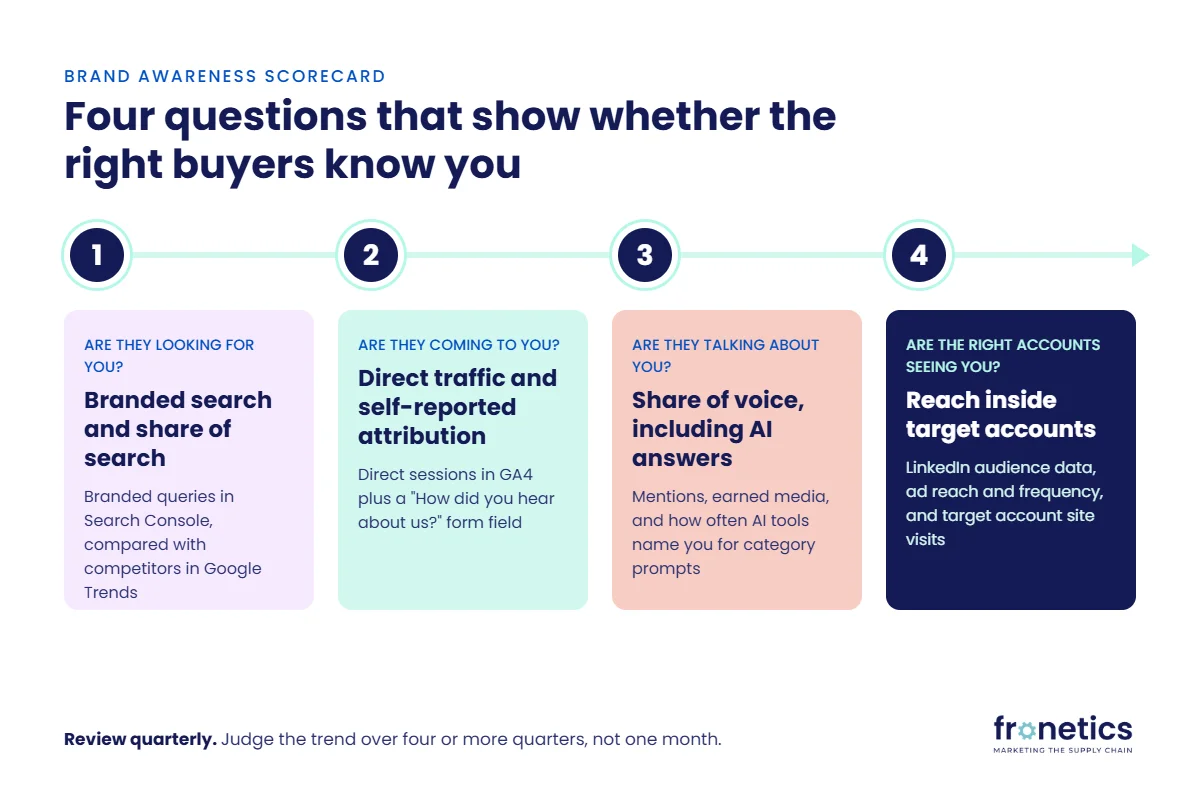
No single number captures awareness. We track four signals that, together, show whether the right buyers know who you are. Each answers a different question.
Each metric answers a different question about whether the right buyers know you.
1) Branded search and share of search
When more people search for your company by name, more people know it exists. Branded search is one of the cleanest awareness signals you have because nobody searches for a company they have never heard of.
Branded queries in Google Search Console. In the Performance report, filter queries with a regular expression that matches your company name and common misspellings. Track branded clicks and impressions month over month. Google explains the filters in its Performance report documentation.
Share of search. Compare search interest in your brand name with two or three direct competitors in Google Trends. Your portion of the total is your share of search. A rising share suggests you are gaining mindshare relative to the companies you compete against.
For smaller logistics brands, Google Trends may not have enough volume to show data. In that case, Search Console branded impressions are your best proxy.
2) Direct traffic and self-reported attribution
People who type your URL or come back without clicking an ad already know you. In GA4, watch direct sessions and returning users over time, and segment out internal traffic and existing customers logging into portals so they do not inflate the numbers.
Then ask buyers directly. Add an open text “How did you hear about us?” field to your contact and quote forms. Answers like “a colleague mentioned you,” “saw you at MODEX,” or “ChatGPT recommended you” reveal awareness channels that analytics tools miss entirely, including word of mouth, podcasts, and AI search.
3) Share of voice across social, earned media, and AI answers
Share of voice measures how often your company comes up compared with competitors. We look at three places:
Mentions and earned media. Set up Google Alerts for your brand and executives, and track coverage in trade publications your buyers actually read. A social listening tool helps if you have the budget.
LinkedIn conversation. Track how often your company and leaders are mentioned, tagged, or shared compared with competitors. For most supply chain companies, LinkedIn is where this happens.
AI answers. Build a set of 15 to 25 prompts your buyers would use, such as “best cold chain 3PLs in the Southeast” or “WMS options for mid-size distributors.” Run them monthly in ChatGPT, Perplexity, Gemini, and Google AI Overviews, and record whether you are named, how you are described, and which sources are cited.
AI visibility is quickly becoming one of the most useful awareness metrics because it reflects how often your brand shows up in the content AI tools learn from. Improving it overlaps heavily with SEO and AI search optimization.
4) Reach and engagement inside target accounts
Supply chain companies usually sell to a defined list of accounts, so the most meaningful awareness metric is whether those specific companies are seeing you. A few ways to measure it:
LinkedIn company page analytics. Review followers and visitors by industry, company size, and job function. Growth in operations, procurement, and supply chain titles matters more than total follower count.
Paid reach and frequency. For campaigns targeted to your account list, track unique reach and average frequency. If only 20% of your target accounts have seen an ad after a quarter, awareness has a coverage problem. Our paid ads team builds campaigns around this measure.
Target account website visits. Reverse IP tools and ABM platforms show which target companies are visiting your site and which pages they view. More accounts showing up over time is a strong signal.
Brand awareness metrics compared
Metric
What it tells you
Where to find it
How often to check
Branded search
Whether more people know your name
Google Search Console
Monthly
Share of search
Your mindshare compared with competitors
Google Trends
Quarterly
Direct traffic
How many people come to you without a prompt
GA4
Monthly
Self-reported attribution
Which channels actually created awareness
Form field responses in your CRM
Quarterly
Share of voice
How often you come up compared with competitors
Google Alerts, social listening, LinkedIn
Monthly
AI visibility
Whether AI tools name you for category questions
Prompt tracking in ChatGPT, Perplexity, Gemini, AI Overviews
Monthly
Target account reach
Whether the companies you want are seeing you
LinkedIn analytics, ad platforms, reverse IP tools
Monthly
Metrics that look like awareness but are not
Some popular numbers say little about whether buyers know you. Total impressions and follower counts can grow through audiences that will never buy. Social share counts have become unreliable as platforms stopped publishing them. Website sessions mix customers, job seekers, and bots. These numbers are fine as context, but they should not anchor your brand awareness reporting.
How to build a quarterly brand awareness scorecard
Set a baseline. Pull the last 12 months of branded search, direct traffic, and LinkedIn audience data so you can see seasonality, such as spikes around trade shows.
Pick two or three competitors. Use the same set for share of search, share of voice, and AI visibility so comparisons stay consistent.
Choose one metric per question. Keep the scorecard to four to six numbers. A short scorecard gets read. A 30-tab dashboard does not.
Annotate what you did. Note campaigns, trade shows, press coverage, and content launches next to the numbers so you can connect activity to movement.
Judge trends, not months. Awareness builds slowly in long sales cycles. Look for direction over four or more quarters before changing strategy.
Where to start if you have never measured awareness
Start with what you already have. Set up a branded query filter in Search Console, add a “How did you hear about us?” field to your forms, and run a first round of AI prompts this month. Those three steps take a few hours and give you a baseline you can build on.
What is the best way to measure brand awareness for a B2B company?
Combine several signals instead of relying on one. Branded search volume, direct traffic, self-reported attribution, share of voice, and reach inside target accounts each show part of the picture. Tracked together over several quarters, they show whether the right buyers know your company.
How long does it take to see brand awareness improve?
Expect at least two to three quarters before branded search and direct traffic show a clear trend. Sales cycles in supply chain and logistics are long, and awareness builds through repeated exposure, so short-term swings are normal.
Can you measure brand awareness in AI search?
Yes. Build a consistent list of prompts your buyers would ask, run them monthly in ChatGPT, Perplexity, Gemini, and Google AI Overviews, and record whether your company is mentioned, how it is described, and which sources are cited. Several SEO platforms now automate this tracking.
Is follower count a good brand awareness metric?
Only partly. Follower growth among your target industries and job titles is useful. Total follower count is not, because it often includes people who will never buy from you.
The benefits of a B2B blog are too important to overlook. Plus: Three companies that excel at content creation.
If your company blog has gone the way of the bears in winter, there is good reason to bring it back to life. That stale page on your website is more important than may realize. When months and even years go by without a single update, you’re missing out on company blog benefits.
Let’s cut straight to the stats:
70% of respondents in a Databox survey said SEO is better than pay-per-click (PPC) advertising for generating sales. (Can you guess what a leading driver of website SEO is?)
Blogs are among the top 3 tools used in content strategies (HubSpot 2020).
51% of companies say updating old content has proven to be the most efficient tactic implemented (SEMrush, 2019). (See our post on reworking content for SEO here.)
67% of companies use organic traffic to measure content success (SEMrush, 2019). (You guessed it: A blog is a key tool in boosting organic searchtraffic.)
72% of online marketers say content creation is their most effective SEO tactic.
Companies with blogs generate 97% more inbound links and 434% more indexed pages than those without.
In other words, a company blog brings benefits beyond just being a source of information, a tool to communicate with prospects, and to build brand. Despite new technologies, text will — as HubSpot points out in its 2020 State of Marketing Report — always be the foundation of search. And no place allows you to add descriptive text for improved search rankings as much as a company blog.
Not seeing company blog benefits? Here are 4 common pitfalls.
But as the significant number of hibernating company blogs shows, the pitfalls tend to come in spades. If your B2B blog is currently on snooze, let us guess the reason falls into one of the following categories:
Unforeseen events: The most recent example is, of course, the Covid-19 pandemic. Faced with massive upheaval, supply chain companies, in particular, had to reshuffle resources. Although a crisis could be the time to step up communication and position the company as a leader, some blogs went dark after releasing a statement on the pandemic and its impact on the business.
Unrealistic expectations: More than a few B2B blogs have run out of steam when immediate results fail to materialize. The disappointment tends to stem from unrealistic expectations. As much as everyone wants that first blog post to bring in a bucketload of leads, content marketing takes time to build momentum; but, done right, it is designed to turn into a tidal wave of improved search authority. Let patience rule and you will be rewarded.
Lack of resources: To stand out in a crowd of tough competitors is not accomplished in an afternoon. Managing a successful company blog takes time. Other than outsourcing, there really is no way around it. If the blog is run on the fly or is low on the list of priorities, the results will suffer along with the motivation to keep going.
Lack of strategy: Publishing for the sake of publishing will get you nowhere. Who are you writing for? What keywords are they using? How do you evaluate performance? Even well-written content can miss the target if it is not tailored around the audience you want to reach.
Lackluster content: Although we always stress the need for consistency and keyword optimization when it comes to blog content, there is yet another aspect that is just as important — quality. A company blog that does not benefit your target audience will not benefit you. The most successful B2B blogs combine SEO best practices with useful, high-quality content.
B2B blogging done right: 3 examples of great blogs
For inspiration, it always helps to look at the organizations that get it right. And there are many to choose from. Take a look at three that have realized company blog benefits with engaging and purposeful content. Although conceptually different, the visions of these blogs align with the goals of each company, whether it’s generating leads with persuasive analytics or carving out a niche in social responsibility.
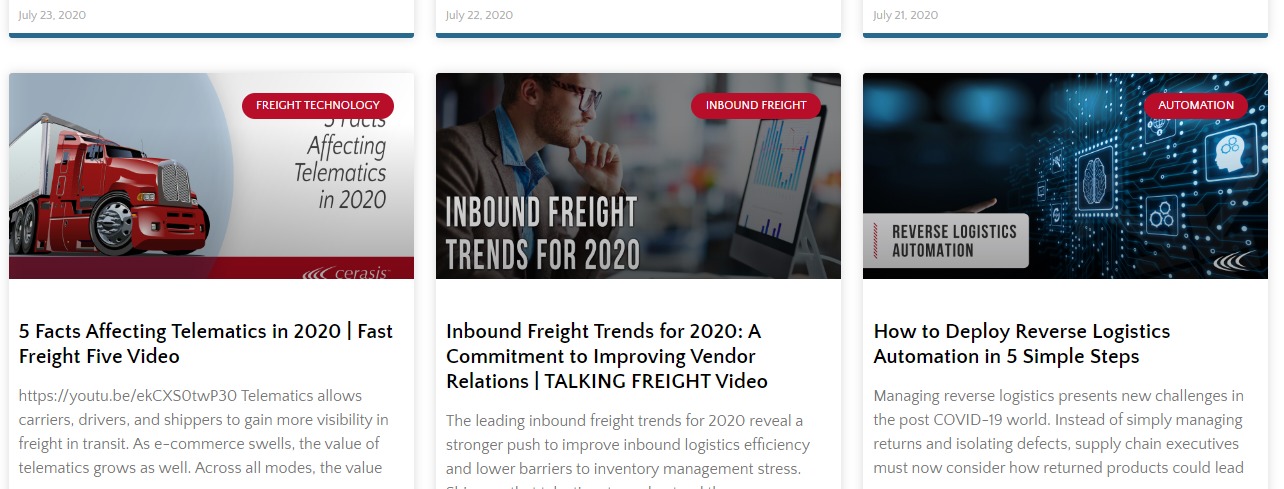
1. Cerasis: Market insights
The transportation management company was one of the early adopters of B2B blogging — and the results have been impressive. And Cerasis is not letting up. The company has published 15 blog posts in July alone, a pace few can — or don’t necessarily need to — match.
2. General Electric: Global vision
A multibillion-dollar corporation has the benefit of ample resources — and GE is putting them to good use. General Electric Reports intelligently humanizes the company with a stream of stories on the impact of GE products on global progress and employee spotlights that tie into current events.
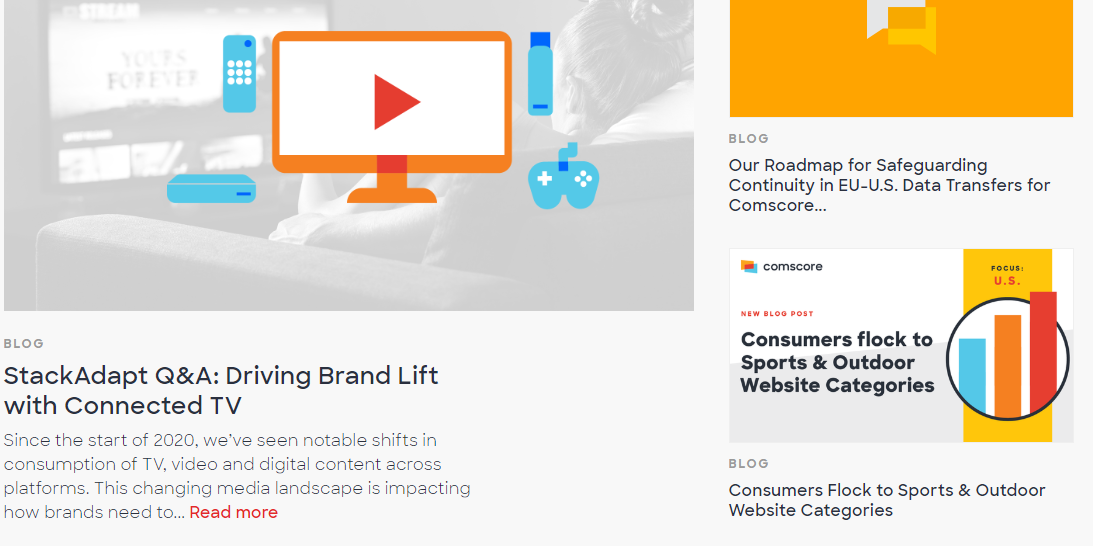
3. Comscore: Analytics first
A look at Comscore’s blog leaves no doubt about its specialty: the collection and analysis of internet data. Comscore draws upon its vast resources to create content that is found nowhere else. The ability to showcase such detailed expertise is sure to sway a target audience looking to leverage customer behavior online.
Time to crawl out
The impact of an effective B2B blog can be huge. It requires research and vision to get started, persistence to keep it up, and analysis to evaluate the performance. In the end, the benefits of a company blog contribute to the health of your entire organization.
Too busy? Don’t want to invest in-house? Here are 4 prime reasons organizations opt to outsource content marketing.
No other lead generation tactic is more important to technology marketers than content assets. The new Gartner research —trade shows come in second place — shows the importance of paying heavy attention to how your organization positionsitself online. If the Covid-19 repercussions left you no choice but to cut back on marketing or if you have been juggling more than ever, consider the case for outsourcing content marketingto stay competitive and excel.
At a time when some of the biggest supply chain trade shows have been either canceled or postponed, count on content assets to grow in significance.Is your organization up to the task?
In our work with both supply chain startups and multi-national corporations, we have noted a few returning reasons for outsourcing content marketing.
Do you recognize yourself or your organization in any of the following?
Outsourcing content marketing: 4 reasons organizations decide to seek outside help
Too much to do
When content marketing is the umpteenth task on an endless to-do list, the results will suffer. This scenario is particularly common among startups where everyone is wearing as many hats as possible in anticipation of the next round of funding.The haphazard approach to what is being published on social channels and on the blog does the company no favors and leaves the person in charge — frequently with limited marketing experience — feeling frustrated. Instead of letting keyword-optimized content carve out a brand niche and build website SEO, the effort goes nowhere although the will to succeed is strong.
The alternative:Partner with a content marketing agency and turn the focus on your core expertise.
No consistency
The effectiveness of content marketing relies on consistency.But being consistent is a major challenge for supply chain companies, especially when trying to recover from months of unprecedented disruption. As we explained in this post, consistency feeds SEO. Let it slip, and you lose in the online search race. In this case, sudden trade show cancelations may have forced the in-house marketing teamto a quick pivot, from executing the company marketing strategy to pouring all efforts into making trade show contingency plans. Add a product launch to the mix and chances are content production will come to a standstill.
The alternative:Keep SEO humming and your online presence strong with an outsourced marketing team invested in your success.
Desire to scale but costs are too high
Needs can arise quickly. There may be a trend that a company wants to jump on or a sudden change in the business environment that warrants the need to scale up content marketing quickly. Several of our clients have sought out Fronetics because they lacked certain marketing capabilities and did not necessarily wantor have the resources to make the investment in-house.That is particularly true under current circumstances when some organizations are battling budget constraints and disruption. If an organization wants to capitalize on video marketing, for instance, it can be both time-consuming and costly to train team members or go through a rigorous hiring process.
The alternative: Leverage a team out outsourced content experts to fill the gap without adding fixed costs.
Lack of analysis
The motions of content marketing are repetitive—researching, strategizing, executing, analyzing, revising— but they are so for a reason. Even the most well-intentioned content strategy can fail when an organization does not act on analytics. But for busy organizations, it is not uncommon for those last pieces of the puzzle — analyzing and revising — to be left undone.
What types of content worked well this quarter? How did the email messaging fare? What was the click-through-rate? During the past few months, when disruption ruled, it is hardly surprising if not every step was optimally performed. Yet, it can all the same be damaging to the overall success of the marketing effort if the metrics are allowed to go unnoticed for too long.
The alternative:Let content count with an outsourced marketing team that constantly needs to prove ROI.
Considering the significance of content assets, it pays to do it well. Is outsourcing content marketing right for you?