
In account-based marketing, a sales rep is rarely selling to one person. They’re working a short list of high-value companies, each with a buying committee that includes operations, procurement, finance, and IT. The ABM sales cycle is long, and every stage stalls for a different reason. The right content, handed to the right person at the right moment, is what keeps a target account moving.
Below, we break the ABM sales cycle into seven stages and show the content that helps sales at each one. It’s the same framework we use when we build account-based marketing for supply chain companies, whether that’s a 3PL going after enterprise shippers or a manufacturer selling into national distributors.
What is the ABM sales cycle?
The ABM sales cycle is the path a target account takes from first awareness of your company to signed contract and, ideally, a larger relationship over time. Unlike a traditional funnel, which starts with a pool of leads and filters them down, an account-based sales cycle starts with a named list of companies. Marketing and sales then work together to reach every decision-maker inside those accounts.
That difference matters for content. In a lead-gen funnel, one ebook might serve thousands of prospects. In ABM, content has to speak to a specific industry, a specific account’s situation, and a specific role on the buying committee.
Why buying committees make content more important
B2B buying groups keep getting bigger. Forrester’s State of Business Buying, 2026 found that, on average, 13 internal stakeholders and nine external participants influence a purchase decision. The same research found procurement serves as a decision-maker 53% of the time, and more than 60% of buyers purchase some kind of trial before committing.
Your sales rep will never meet all 22 of those people. Content is how your message reaches the ones they don’t meet, and how your champion makes the case for you when you aren’t in the room.
Content for each of the 7 stages of the ABM sales cycle
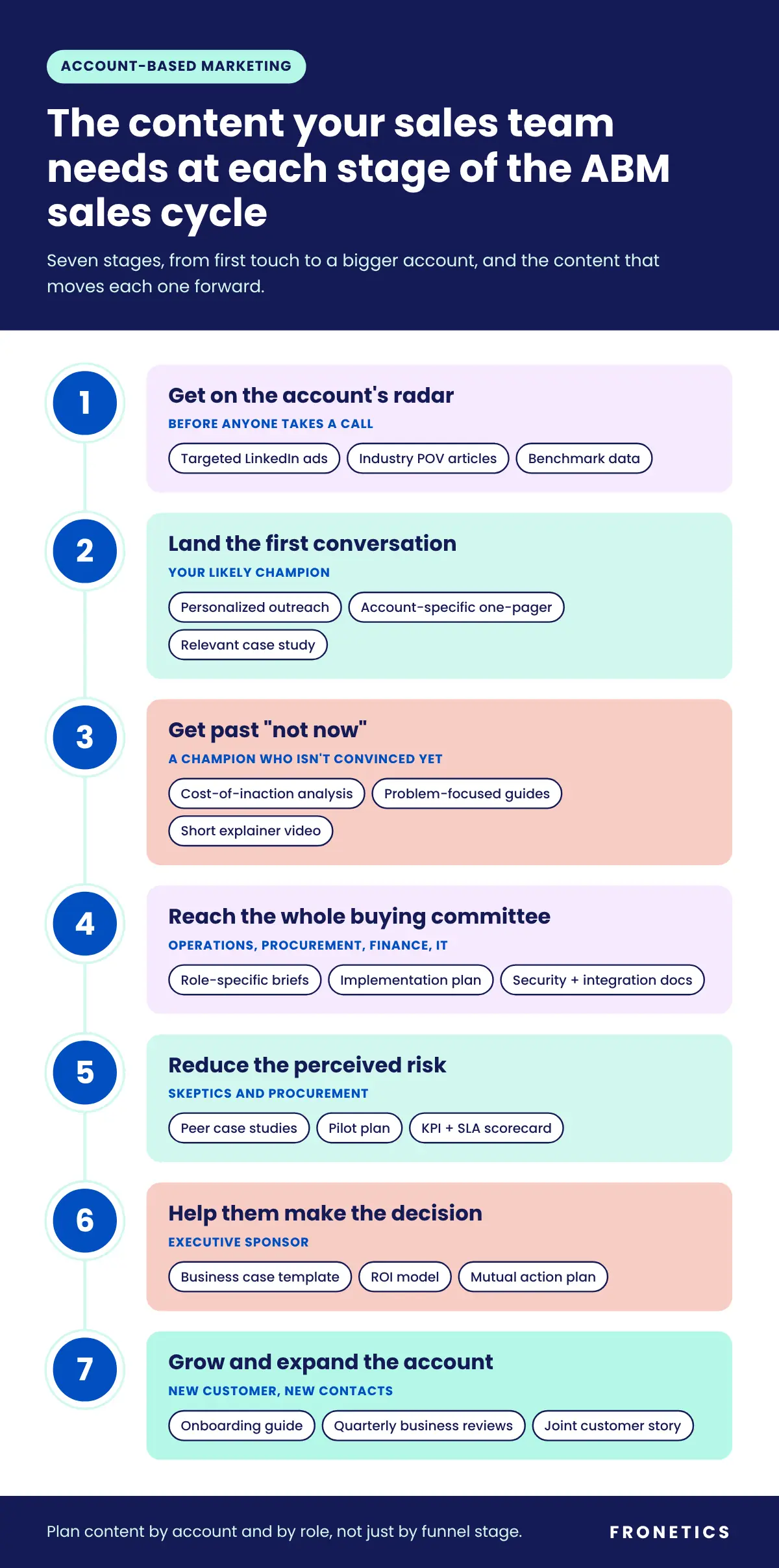
1. Get on the account’s radar
Before anyone at a target account takes a call, they should have seen your name. Targeted LinkedIn ads aimed at the account list, industry point-of-view articles, and original benchmark data build familiarity with the people you’ll eventually ask for a meeting. The goal here isn’t a conversion. It’s recognition.
2. Land the first conversation
Generic outreach gets ignored. A short, account-specific one-pager that shows you understand the company’s network, volumes, or growth plans gives your rep a reason to reach out. Pair it with one case study from a similar company and the first email reads like it was written for them, because it was.
3. Get past “not now”
Most first responses are some version of “we’re fine with our current provider.” Problem-focused content helps your champion see the cost of staying put: a cost-of-inaction analysis, a guide to a challenge their peers are facing, or a two-minute explainer video they can forward internally.
4. Reach the whole buying committee
This is where account-based content earns its keep. Each role has different questions, so give each one its own answer:
| Role | What they want to know | Content that helps |
|---|---|---|
| Operations | Will this disrupt my team or my customers? | Implementation plan, onboarding timeline |
| Procurement | Is the pricing fair and the contract sound? | Pricing structure overview, compliance and insurance summary |
| Finance | What’s the return, and when? | ROI model, total cost comparison |
| IT | Will it integrate and is our data safe? | Integration and security documentation |
| Executive sponsor | Does this support our strategy? | One-page executive summary |
5. Reduce the perceived risk
Switching providers is risky, and buyers know it. Case studies from peer companies, a structured pilot plan, and a sample KPI and SLA scorecard show exactly how you’ll prove performance. Specifics beat promises: on-time percentages, order accuracy, dock-to-stock times, whatever the account will actually measure you on.
6. Help them make the decision
Your champion has to sell you internally. Make it easy with a business case template they can fill in, an ROI model built on their numbers, and a mutual action plan that lays out next steps and dates for both sides.
7. Grow and expand the account
In ABM, the signed contract is the start of the account, not the end of the cycle. An onboarding guide, quarterly business review reports, and a joint customer story keep the relationship strong and open doors to new sites, services, and contacts. Happy customers also become your best references for the next target account.
How do sales and marketing share ABM content?
None of this works if the content sits in a shared drive nobody opens. A few habits keep it in use:
- Build the account list together. Sales knows which accounts matter. Marketing knows which ones are already engaging.
- Map content to stage and role. A simple grid of the seven stages against the buying committee shows where you have gaps.
- Give reps a short playbook. For each stage, list the one or two assets to send and a sample message to go with them.
- Track engagement by account. Watch which people at each company open, click, and visit, and pass that to sales quickly.
- Feed insights back. Objections reps hear on calls are your next pieces of content marketing.
Turning your target list into closed accounts
A strong ABM program gives your sales team something useful to say at every stage, to every person involved in the decision. If you already know the accounts you want to win, we can help you build the campaigns and content to reach them. Learn more about our ABM services for supply chain and logistics companies, or see how we approach supply chain marketing more broadly.
Frequently asked questions
How long is a typical ABM sales cycle?
It depends on deal size and complexity, but enterprise deals in supply chain and logistics often take six to 18 months. Larger buying committees, RFP processes, and pilots all add time. Content helps by answering questions before they become delays.
How is ABM content different from regular content marketing?
Regular content marketing is built to attract a broad audience. ABM content is built for a defined list of accounts, so it’s more specific to an industry, a company’s situation, or a role on the buying committee. Many programs use both: broad content builds awareness, and account-specific content moves deals forward.
Do we need personalized content for every account?
Not always. One-to-one ABM uses fully custom content for a handful of top accounts. One-to-few groups similar accounts, such as food and beverage shippers, and tailors content to each group. One-to-many uses lighter personalization across a larger list.
Which stage of the ABM sales cycle needs the most content?
Reaching the full buying committee usually needs the most, because each role has different concerns. If you’re starting from scratch, build role-specific briefs for operations, procurement, and finance first.
Related reading: Account-based marketing for the packaging industry | Warehouse RFPs: what buyers ask for and how 3PLs make the shortlist