Supply chain buyers rarely call a vendor they have never heard of. By the time a 3PL, carrier, or software company gets the RFP, the buying group has usually done most of its research and already has a favorite. That is why it pays to measure brand awareness with the same discipline you apply to leads and pipeline, even though it will never fit neatly into a last-click report.
Below, we cover what brand awareness means for a B2B supply chain company, the four measures we rely on, the tools for each, and how to roll them into a simple quarterly scorecard.
What is brand awareness in B2B supply chain marketing?
Brand awareness is how familiar your target buyers are with your company and what you do before they start an active search. In supply chain and logistics, it comes down to one practical question: when a shipper, manufacturer, or operations leader needs what you sell, does your name come to mind, and does it show up when they search or ask an AI tool for options?
Awareness is not the same as reach. A post seen by 50,000 people outside your market does less for you than a webinar attended by 40 procurement managers at accounts you want. Good measurement focuses on the right audience knowing you, not the biggest possible audience seeing you.
Why brand awareness decides who makes the shortlist
Recent buyer research shows how early decisions get made. In its 2025 B2B Buyer Experience Report, 6sense found that 94% of buying groups ranked their preferred vendors before first contact, and they bought from that early favorite 77% of the time. The same report found that 94% of buyers used large language models during research, mostly to summarize reviews and analyze information.
Put simply, most of the competition happens before your sales team knows a deal exists. The vendors buyers already know and trust tend to get the first call. If you want to see how awareness fits into a broader plan, our supply chain marketing approach starts with exactly this problem.
How do you measure brand awareness? 4 metrics that matter
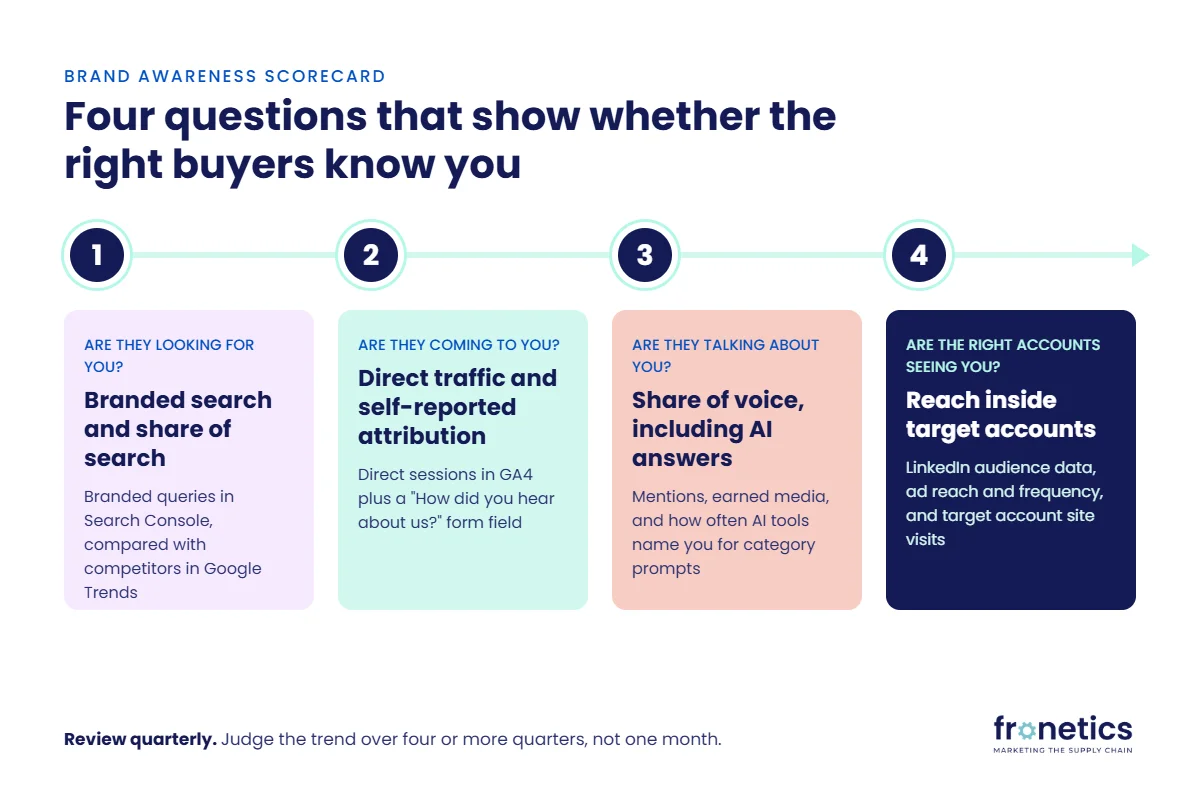
No single number captures awareness. We track four signals that, together, show whether the right buyers know who you are. Each answers a different question.
1) Branded search and share of search
When more people search for your company by name, more people know it exists. Branded search is one of the cleanest awareness signals you have because nobody searches for a company they have never heard of.
- Branded queries in Google Search Console. In the Performance report, filter queries with a regular expression that matches your company name and common misspellings. Track branded clicks and impressions month over month. Google explains the filters in its Performance report documentation.
- Share of search. Compare search interest in your brand name with two or three direct competitors in Google Trends. Your portion of the total is your share of search. A rising share suggests you are gaining mindshare relative to the companies you compete against.
For smaller logistics brands, Google Trends may not have enough volume to show data. In that case, Search Console branded impressions are your best proxy.
2) Direct traffic and self-reported attribution
People who type your URL or come back without clicking an ad already know you. In GA4, watch direct sessions and returning users over time, and segment out internal traffic and existing customers logging into portals so they do not inflate the numbers.
Then ask buyers directly. Add an open text “How did you hear about us?” field to your contact and quote forms. Answers like “a colleague mentioned you,” “saw you at MODEX,” or “ChatGPT recommended you” reveal awareness channels that analytics tools miss entirely, including word of mouth, podcasts, and AI search.
3) Share of voice across social, earned media, and AI answers
Share of voice measures how often your company comes up compared with competitors. We look at three places:
- Mentions and earned media. Set up Google Alerts for your brand and executives, and track coverage in trade publications your buyers actually read. A social listening tool helps if you have the budget.
- LinkedIn conversation. Track how often your company and leaders are mentioned, tagged, or shared compared with competitors. For most supply chain companies, LinkedIn is where this happens.
- AI answers. Build a set of 15 to 25 prompts your buyers would use, such as “best cold chain 3PLs in the Southeast” or “WMS options for mid-size distributors.” Run them monthly in ChatGPT, Perplexity, Gemini, and Google AI Overviews, and record whether you are named, how you are described, and which sources are cited.
AI visibility is quickly becoming one of the most useful awareness metrics because it reflects how often your brand shows up in the content AI tools learn from. Improving it overlaps heavily with SEO and AI search optimization.
4) Reach and engagement inside target accounts
Supply chain companies usually sell to a defined list of accounts, so the most meaningful awareness metric is whether those specific companies are seeing you. A few ways to measure it:
- LinkedIn company page analytics. Review followers and visitors by industry, company size, and job function. Growth in operations, procurement, and supply chain titles matters more than total follower count.
- Paid reach and frequency. For campaigns targeted to your account list, track unique reach and average frequency. If only 20% of your target accounts have seen an ad after a quarter, awareness has a coverage problem. Our paid ads team builds campaigns around this measure.
- Target account website visits. Reverse IP tools and ABM platforms show which target companies are visiting your site and which pages they view. More accounts showing up over time is a strong signal.
Brand awareness metrics compared
| Metric | What it tells you | Where to find it | How often to check |
|---|---|---|---|
| Branded search | Whether more people know your name | Google Search Console | Monthly |
| Share of search | Your mindshare compared with competitors | Google Trends | Quarterly |
| Direct traffic | How many people come to you without a prompt | GA4 | Monthly |
| Self-reported attribution | Which channels actually created awareness | Form field responses in your CRM | Quarterly |
| Share of voice | How often you come up compared with competitors | Google Alerts, social listening, LinkedIn | Monthly |
| AI visibility | Whether AI tools name you for category questions | Prompt tracking in ChatGPT, Perplexity, Gemini, AI Overviews | Monthly |
| Target account reach | Whether the companies you want are seeing you | LinkedIn analytics, ad platforms, reverse IP tools | Monthly |
Metrics that look like awareness but are not
Some popular numbers say little about whether buyers know you. Total impressions and follower counts can grow through audiences that will never buy. Social share counts have become unreliable as platforms stopped publishing them. Website sessions mix customers, job seekers, and bots. These numbers are fine as context, but they should not anchor your brand awareness reporting.
How to build a quarterly brand awareness scorecard
- Set a baseline. Pull the last 12 months of branded search, direct traffic, and LinkedIn audience data so you can see seasonality, such as spikes around trade shows.
- Pick two or three competitors. Use the same set for share of search, share of voice, and AI visibility so comparisons stay consistent.
- Choose one metric per question. Keep the scorecard to four to six numbers. A short scorecard gets read. A 30-tab dashboard does not.
- Annotate what you did. Note campaigns, trade shows, press coverage, and content launches next to the numbers so you can connect activity to movement.
- Judge trends, not months. Awareness builds slowly in long sales cycles. Look for direction over four or more quarters before changing strategy.
Where to start if you have never measured awareness
Start with what you already have. Set up a branded query filter in Search Console, add a “How did you hear about us?” field to your forms, and run a first round of AI prompts this month. Those three steps take a few hours and give you a baseline you can build on.
If the numbers are flat, the fix is usually more consistent visibility with the right accounts through content marketing and LinkedIn and social media. If you want help building awareness and measuring it, take a look at how we approach marketing for supply chain companies.
Frequently asked questions
What is the best way to measure brand awareness for a B2B company?
Combine several signals instead of relying on one. Branded search volume, direct traffic, self-reported attribution, share of voice, and reach inside target accounts each show part of the picture. Tracked together over several quarters, they show whether the right buyers know your company.
How long does it take to see brand awareness improve?
Expect at least two to three quarters before branded search and direct traffic show a clear trend. Sales cycles in supply chain and logistics are long, and awareness builds through repeated exposure, so short-term swings are normal.
Can you measure brand awareness in AI search?
Yes. Build a consistent list of prompts your buyers would ask, run them monthly in ChatGPT, Perplexity, Gemini, and Google AI Overviews, and record whether your company is mentioned, how it is described, and which sources are cited. Several SEO platforms now automate this tracking.
Is follower count a good brand awareness metric?
Only partly. Follower growth among your target industries and job titles is useful. Total follower count is not, because it often includes people who will never buy from you.
Related reading