

Key takeaways
- Only 20% of manufacturing marketers call their content strategy very effective. Most (67%) say it’s moderately effective.
- Video (74%) and case studies (45%) are the formats manufacturers rate most effective.
- In-person events, company blogs, and webinars are the top organic channels. Search ads lead paid.
- 76% of manufacturing marketers use generative AI, but only 7% have built it into daily workflows.
- B2B buyers are shifting to AI search, so manufacturers need content AI tools can find, trust, and cite.
Ten years ago, the big question was whether manufacturers would adopt digital marketing at all. That question is settled. Manufacturers now run blogs, post on LinkedIn, produce video, and use AI tools at roughly the same rate as other B2B marketers. The question for 2026 is whether all that content is actually moving buyers.
The latest manufacturing research from the Content Marketing Institute (CMI) and MarketingProfs gives a clear answer. Sometimes. Their Manufacturing Content Marketing Benchmarks, Budgets, and Trends report surveyed manufacturing marketers on strategy, formats, channels, measurement, and AI. The picture is an industry that has built the machine but hasn’t fully tuned it.
The infographic below sums up the findings. Underneath it, we break down what each one means for your 2026 plan.
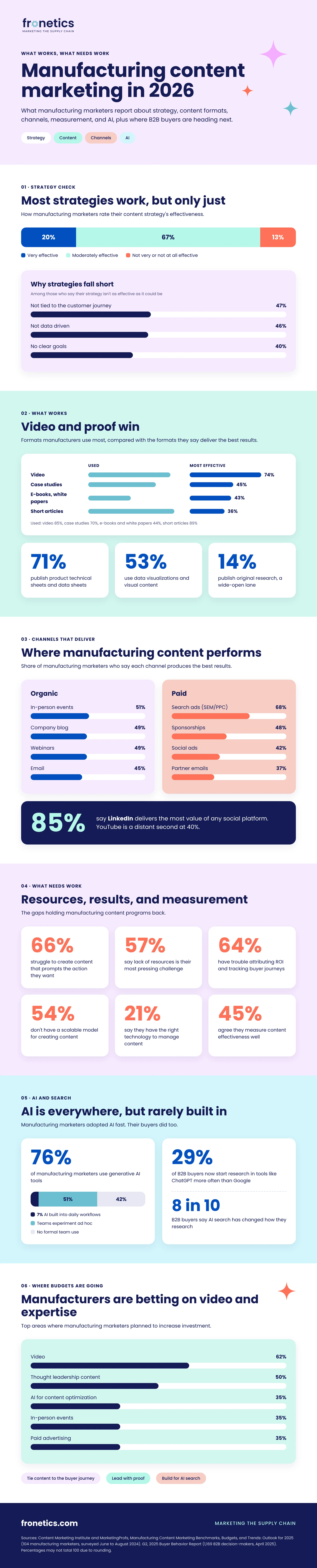
Only 20% of manufacturing marketers call their content strategy very effective. Video (74%) and case studies (45%) are the top-rated formats, and 85% say LinkedIn delivers the most social value. Data from CMI and MarketingProfs.
What is manufacturing content marketing?
Manufacturing content marketing is the practice of creating and distributing useful content, like technical articles, case studies, videos, data sheets, and webinars, that helps engineers, procurement teams, and distributors research, compare, and choose a manufacturer. Done well, it shortens long sales cycles by answering buyer questions before a sales conversation starts.
Most manufacturing content strategies work, but only just
Just 20% of manufacturing marketers say their content strategy is very effective. Another 67% say it’s moderately effective, and 13% say it’s not very or not at all effective.
When marketers explained why their strategy falls short, three reasons rose to the top.
- It isn’t tied to the customer journey (47%)
- It isn’t data driven (46%)
- It lacks clear goals (40%)
None of these are about writing better blog posts. They’re about planning. Industrial buying involves engineers, procurement, operations, and often distributors, and each group needs different content at different stages. A strategy built around a publishing calendar instead of the buying journey will produce content without producing pipeline.
What to do in 2026. Map your content to the questions each buyer role asks, from early problem research through spec review and vendor selection. Our manufacturing marketing work starts here for exactly this reason.
What works: video, proof, and technical depth
Manufacturers use plenty of formats. The ones that work best are a shorter list.
| Format | Used | Rated most effective |
|---|---|---|
| Video | 85% | 74% |
| Case studies and customer stories | 70% | 45% |
| E-books and white papers | 44% | 43% |
| Short articles and posts | 89% | 36% |
Short articles are the most-used format but rank near the bottom for results. Video and case studies do the heavy lifting because they show rather than tell. An engineer can watch a product perform, and a buyer can see how a similar company solved a similar problem.
Two other numbers stand out. 71% of manufacturers publish product technical sheets and data sheets, essential content for spec-driven buyers. Only 14% publish original research, which leaves a wide-open lane for any manufacturer willing to survey customers or share proprietary data. Original data is also one of the strongest ways to get cited by AI search tools.
What to do in 2026. Invest in fewer, deeper pieces. Turn your best customer results into case studies, film your products and processes, and consider one original research piece a year.
Channels that deliver for manufacturers
Here’s where manufacturing marketers say they get the best results.
Organic
- In-person events (51%)
- Company blog (49%)
- Webinars (49%)
- Email (45%)
Paid
- Search ads, SEM and PPC (68%)
- Sponsorships (48%)
- Social media ads (42%)
- Partner emails (37%)
Trade shows and events still matter in an industry built on relationships, and content makes them more productive before and after the booth. Our approach to trade show marketing connects the two.
On social, the gap is huge. 85% of manufacturing marketers say LinkedIn delivers the most value, compared with 40% for YouTube. If your buyers are engineers, plant leaders, and procurement teams, that’s where they are.
The blog also earns its spot. It’s the hub that search engines, AI tools, and your sales team all draw from, and it’s where your other channels should point.
What needs work: resources, results, and measurement
The challenges manufacturers report haven’t changed much in a decade, but the numbers are specific.
- 66% struggle to create content that prompts a desired action
- 57% say lack of resources is their most pressing challenge
- 64% have difficulty attributing ROI and tracking customer journeys
- 54% don’t have a scalable model for creating content
- Only 21% say they have the right technology
- Only 45% agree they measure content effectiveness well
Small teams, busy subject matter experts, and long sales cycles make content hard to produce and harder to measure. The fix usually isn’t more content. It’s a repeatable process for getting expertise out of engineers’ heads, plus tracking that connects content to real conversations and deals. Account-based marketing can help by focusing content on the accounts that matter most and making results easier to see.
What to do in 2026. Pick two or three metrics tied to pipeline, such as qualified form fills, demo or quote requests, and content-influenced opportunities, and report on those instead of traffic alone. Our manufacturing lead generation playbook goes deeper.
AI in manufacturing content marketing
AI adoption among manufacturing marketers is high but shallow. 76% use generative AI tools, but just 7% say AI is integrated into daily workflows. Another 51% experiment on an ad hoc basis, and 42% say their teams don’t formally use AI at all.
Meanwhile, buyers have moved faster. According to G2’s 2025 buyer research, nearly 8 in 10 B2B buyers say AI search has changed how they conduct research, and 29% now start research in tools like ChatGPT more often than Google.
That changes what good content looks like. AI tools pull answers from sources that are clear, specific, and credible. For manufacturers, that means:
- Answering real buyer questions directly, near the top of the page
- Publishing specs, tolerances, materials, and certifications in plain text, not only in PDFs
- Backing claims with case studies, data, and named experts
- Keeping key pages current, since AI tools favor fresh, accurate information
This is the idea behind AI optimization (AIO), and it builds on SEO rather than replacing it. Learn more about our approach to SEO and AI optimization.
Where manufacturing marketing budgets are going
Asked where they planned to increase investment, manufacturing marketers put video first (62%), followed by thought leadership content (50%). AI for content optimization, in-person events, and paid advertising tied at 35% each.
The pattern is clear. Manufacturers are betting on content that shows expertise and builds trust, which is exactly what both human buyers and AI search reward.
How to improve your manufacturing content marketing in 2026
- Tie every piece of content to a stage of the buying journey and a specific buyer role.
- Lead with proof. Make case studies, video, and technical detail the core of your program.
- Treat LinkedIn as your primary social channel, and put your engineers and executives on it.
- Build for AI search with clear answers, structured technical information, and original data.
- Measure what sales cares about so content earns its budget.
- Make AI part of the process, not a side experiment, for research, drafting support, and optimization.
Frequently asked questions
What is the most effective type of content for manufacturers?
Video is rated most effective by 74% of manufacturing marketers, followed by case studies and customer stories (45%) and e-books and white papers (43%).
What is the best social media platform for manufacturing companies?
LinkedIn. 85% of manufacturing marketers say it delivers more value than any other social platform. YouTube is second at 40%.
What is the biggest content marketing challenge for manufacturers?
Creating content that prompts buyers to take action is the top content challenge (66%). Lack of resources is the most pressing organizational challenge (57%).
How are manufacturers using AI in content marketing?
76% of manufacturing marketers use generative AI tools, but only 7% have integrated AI into daily workflows. Most teams are still experimenting.
How do manufacturers measure content marketing ROI?
Many struggle with it. 64% report difficulty attributing ROI. The best approach is to track pipeline-focused metrics such as qualified leads, quote requests, and content-influenced deals.
Need help building a content program that reaches engineers, buyers, and distributors? Talk to our manufacturing marketing team.
Sources. Content Marketing Institute and MarketingProfs, Manufacturing Content Marketing Benchmarks, Budgets, and Trends: Outlook for 2025 (104 manufacturing marketers, surveyed June to August 2024). G2, 2025 Buyer Behavior Report (1,169 B2B decision-makers, April 2025).