by Elizabeth Hines | Jan 22, 2025 | Marketing, SEO, Website Development
In a fiercely competitive market, standing out in search results is crucial for any supply chain website’s success. One powerful yet often overlooked tool in the SEO arsenal is FAQ schema markup. This guide will dive deep into what FAQ schema markup is, why it matters, and how to implement it effectively to enhance your search visibility.
In this post:
What is FAQ Schema Markup?
FAQ schema markup is a code snippet that helps search engines understand that a particular section of your webpage contains frequently asked questions and answers. When implemented correctly, it enables your content to appear in rich results on Google’s search engine results pages (SERPs), potentially displaying your FAQs directly in the search results.
This enhanced visibility can significantly increase your click-through rates and establish your website as an authoritative source of information in your industry.
Why Should You Implement FAQ Schema?
The benefits of implementing FAQ schema markup extend beyond just improved visibility:
1. Enhanced SERP Real Estate: Your content can occupy more space in search results through rich snippets, pushing competitors further down the page.
2. Improved User Experience: Users can find answers to their questions directly in search results, leading to better engagement when they click through to your site.
3. Voice Search Optimization: FAQ schema markup makes your content more accessible to voice search queries, an increasingly important factor in modern SEO.
4. Higher Click-Through Rates: Rich results tend to attract more clicks than standard search results, potentially driving more traffic to your website.
How to Create FAQ Schema Markup
Creating FAQ schema markup involves structuring your data in a way that search engines can understand. Here’s a step-by-step guide:
Step 1: Prepare Your FAQ Content
Before implementing the schema, ensure your FAQ content is well-organized and valuable to users. Each question should have a clear, concise answer that provides genuine value.
Step 2: Generate the Schema Code
Your FAQ schema should follow this basic structure:
“`json
{
“@context”: “https://schema.org”,
“@type”: “FAQPage”,
“mainEntity”: [{
“@type”: “Question”,
“name”: “What is your first question?”,
“acceptedAnswer”: {
“@type”: “Answer”,
“text”: “This is the answer to your first question.”
}
},
{
“@type”: “Question”,
“name”: “What is your second question?”,
“acceptedAnswer”: {
“@type”: “Answer”,
“text”: “This is the answer to your second question.”
}
}]
}
“`
Step 3: Implement the Markup
You have several options for adding the schema to your website:
1. Direct HTML Implementation: Add the schema directly to your HTML using a script tag with type=”application/ld+json”. Yes, it sounds scary, but a little HTML knowledge will get you really far.
2. Google Tag Manager: Implement the schema through GTM if you prefer a more manageable approach
3. CMS Plugins: If you’re using WordPress or another CMS, you can use plugins designed for schema implementation
Step 4: Validate the markup
After implementation, always validate your schema markup using Google’s Rich Results Test tool or Schema.org Markup Validator.
Best Practices for FAQ Schema
To maximize the effectiveness of your FAQ schema markup:
1. Keep Questions Focused
Each question should address a specific topic or concern relevant to your audience.
2. Provide Comprehensive Answers
Ensure answers are detailed enough to be helpful but concise enough to be digestible.
3. Maintain Consistency
The questions and answers in your schema should match the visible content on your page exactly.
4. Regular Updates
Keep your FAQ content fresh and updated as new questions arise or information changes.
Testing Your Implementation
Before going live, always validate your FAQ schema markup:
1. Use Google’s Rich Results Test tool to ensure your markup is correctly implemented
2. Check the Schema Markup Validator (schema.org) for additional validation
3. Monitor your Google Search Console for any schema-related errors or warnings
Common Pitfalls to Avoid
When implementing FAQ schema markup, watch out for these common mistakes:
1. Marking up content that isn’t visible on the page
2. Including promotional content in answers
3. Using the same FAQ markup across multiple pages
4. Failing to update schema when content changes
Measuring Success
Track the performance of your FAQ schema implementation through:
1. Google Search Console: Monitor rich result impressions and clicks
2. Analytics: Track changes in organic traffic and user behavior
3. SERP Tracking: Monitor your visibility for targeted keywords
And, because I love to be meta like that, I’ve created an FAQ section here as an example!
Frequently Asked Questions
Does FAQ schema markup work on all types of websites?
FAQ schema markup can be implemented on any website that provides informational content through a question-and-answer format. However, it’s particularly effective for service pages, product pages, and knowledge base articles where users commonly seek specific information. In other words, supply chain-related content is ideal!
How many FAQs should I include in my schema markup?
While there’s no strict limit, it’s recommended to include between 5-10 relevant questions per page. Focus on quality over quantity, and ensure each FAQ addresses a genuine user query. Too many FAQs might dilute the impact and could potentially be seen as spam by search engines.
Can I use FAQ schema markup on multiple pages of my website?
Yes, you can implement FAQ schema markup on multiple pages, but each page should have unique questions and answers relevant to that specific page’s content. Avoid duplicating FAQ content across different pages, as this could diminish its SEO value.
How long does it take to see results from FAQ schema markup?
The time to see results can vary depending on various factors, including your website’s authority, crawl frequency, and competition. Typically, you might start seeing rich results within a few days to a few weeks after implementation, assuming your markup is correctly implemented and validated.
Do I need technical expertise to implement FAQ schema markup?
While basic knowledge of HTML and JSON-LD is helpful, you don’t necessarily need deep technical expertise. Many content management systems offer plugins or tools that can help you implement FAQ schema markup without coding. However, it’s recommended to have a technical person review the implementation to ensure accuracy.
Can FAQ schema markup negatively affect my SEO?
When implemented correctly, FAQ schema markup won’t negatively affect your SEO. However, improper implementation, such as marking up hidden content or using irrelevant questions, could potentially lead to penalties. Always follow Google’s structured data guidelines and focus on providing valuable content to users.
Should I update my FAQ schema markup regularly?
Yes, it’s recommended to review and update your FAQ schema markup periodically. This includes adding new relevant questions, updating outdated answers, and removing irrelevant content. Regular updates help maintain the accuracy and effectiveness of your FAQ rich results.
FAQ schema markup is a powerful tool for improving your search visibility and providing value to users. By following these guidelines and best practices, you can effectively implement FAQ schema markup and gain a competitive edge in search results. Remember to regularly review and update your FAQ content and schema implementation to maintain its effectiveness and relevance.
Remember, while schema markup is important for SEO, the ultimate goal is to provide value to your users. Focus on creating high-quality, relevant FAQ content that genuinely addresses your audience’s needs, and the SEO benefits will naturally follow.
Read more:

by Elizabeth Hines | Jan 3, 2025 | Leadership, Supply Chain
From the rise of AI-driven logistics to sustainability challenges, supply chain professionals face unprecedented opportunities and obstacles. To help navigate this evolving landscape, we’ve curated five thought-provoking TED Talks for the supply chain industry that offer fresh perspectives and innovative solutions for the industry. Whether you’re a seasoned logistics expert or new to the field, these presentations deliver valuable insights into the future of supply chain management, featuring speakers who are reshaping how we think about everything from last-mile delivery to circular economy principles.
Here are 5 TED Talks for the Supply Chain
1) How to Fix Broken Supply Chains
By Dustin Burke
Supply chain challenges are real, but they’re not new, says global trade expert Dustin Burke. In the face of disruptions ranging from natural disasters to pandemics, how do we make sure supply chains can keep up? Burke offers a combination of solutions — from companies sharing risk to better forecasting disruptions — to help create a more resilient, efficient tomorrow.
Listen now >>
2) How Supply Chain Transparency Can Help the Planet
By Markus Mutz
Given the option, few would choose to buy products that harm the earth — yet it’s nearly impossible to know how most consumer goods are made or where they’re sourced from. That’s about to change, says supply chain innovator Markus Mutz. He shares how he used blockchain technology to track Patagonian toothfish on their journey from ocean to dinner plate — and proved it’s possible to offer consumers a product they can trust.
Listen now >>
3) Overcoming Fear in Manufacturing
By Katie Armstrong
Manufacturing has used relatively the same methodologies for improvements since the 1940s. There is a huge emphasis on quality in highly regulated industries such as semiconductor and automotive manufacturing. In recent years, these industries have struggled to keep up with the innovation pace that the market demands. These industries are starting to be driven by a fear of failure rather than a passion for creating value for the customer. What would the world look like if we stopped letting fear dictate our decision-making? Katie Armstrong is pursuing a part-time MBA at Bentley University and is the graduate winner of the 2022 BentleyU TEDx speaker competition. She currently works as a supplier quality engineer in the semiconductor industry and has experience working in automotive manufacturing as well. Katie is passionate about technological innovation and the positive benefits of change in manufacturing. When not working or at school, Katie enjoys hiking, rock climbing, backpacking, and anything else outdoors. This talk was given at a TEDx event using the TED conference format but independently organized by a local community.
Listen now >>
4) The Next Wave of Innovation in Freight
By Oren Zaslansky
Throughout the U.S., millions of freight trucks are buzzing goods across state lines, producing massive amounts of greenhouse emissions — and some of them are only half full. Working to make this 400-billion-dollar-a-year supply chain process as efficient and sustainable as possible, freight expert Oren Zaslansky digs into the logistics of filling these trucks to their maximum capacity through algorithmic carpooling (think: ride-sharing your freight) — bringing with it the potential of a more transparent and eco-friendly global supply chain.
Listen now >>
5) Why Rivals Are Working Together to Transform Shipping
By Bo Cerup-Simonsen
What would it take to make global supply chains cleaner and greener? Bo Cerup-Simonsen — who’s helping decarbonize the maritime industry as CEO of the Mærsk Mc-Kinney Møller Center for Zero Carbon Shipping — discusses why tenacious collaboration is key to orchestrating systemic change. In conversation with TED’s Lindsay Levin, he shares important lessons on collective problem-solving and decision-making that could benefit any industry making a green transition.
Listen now >>
Each of these TED Talks for the supply chain brings unique insights to the complex world of supply chain management. By incorporating these diverse perspectives – from technological innovation to human psychology – supply chain professionals can build more resilient, sustainable, and efficient operations for the future.
Read more:

by Elizabeth Hines | Aug 5, 2024 | Blog
Nearly ubiquitous in every day business conversation, artificial intelligence (AI) now touches virtually every market sector. However, its impact on supply chain management has been particularly interesting to watch.
AI isn’t just changing supply chain management; it’s revolutionizing it. Nearly three-quarters of supply chain companies reported using AI in some form in a 2024 McKinsey survey. From improved forecasting and optimization to enhanced risk management and sustainability, AI is helping businesses create more efficient, resilient, and responsive supply chains.
The AI Revolution in Supply Chain Management
Artificial intelligence isn’t just a buzzword in supply chain management; it’s a game-changer. It’s reshaping how businesses manage their supply chains. What is AI doing to transform supply chain management?
1. Unparalleled Demand Forecasting
One of the most significant advantages AI brings to supply chain management is its ability to predict demand with unprecedented accuracy. By analyzing vast amounts of historical data, market trends, and external factors, AI algorithms can forecast demand patterns more precisely than ever before. This enhanced forecasting ability helps companies:
- Optimize inventory levels
- Reduce waste
- Improve customer satisfaction by ensuring product availability
2. Intelligent Inventory Management
AI doesn’t stop at predicting demand; it also revolutionizes inventory management. Machine learning algorithms can:
- Continuously adjust inventory levels based on real-time data
- Optimize stock levels across multiple locations
- Reduce carrying costs while minimizing stockouts
This level of intelligent inventory management leads to significant cost savings and improved efficiency.
3. Predictive Maintenance: Reducing Downtime
In supply chain operations, equipment downtime can be costly. AI-powered predictive maintenance is changing this landscape by:
- Analyzing sensor data to predict when equipment is likely to fail
- Scheduling maintenance before breakdowns occur
- Extending asset lifespans through timely interventions
The result? Reduced downtime, lower maintenance costs, and improved operational reliability.
4. Route Optimization: Enhancing Logistics Efficiency
For businesses involved in transportation and logistics, AI offers powerful route optimization capabilities. AI algorithms can:
- Calculate the most efficient routes in real-time
- Factor in variables like traffic, weather, and fuel costs
- Reduce transportation costs and improve delivery times
This not only saves money but also enhances customer satisfaction through faster and more reliable deliveries.
5. Automated Warehousing: The Future of Fulfillment
AI is transforming warehouse operations through automation. AI-powered robots and systems can:
- Streamline picking and packing processes
- Improve order fulfillment speed and accuracy
- Reduce labor costs and human error
These advancements are particularly crucial in the era of e-commerce and same-day delivery expectations.
6. Proactive Risk Management
Supply chain disruptions can have severe consequences. AI helps businesses stay ahead of potential issues by:
- Analyzing various data sources to identify potential risks
- Providing early warnings about supplier issues, geopolitical events, or natural disasters
- Enabling proactive risk mitigation strategies
This proactive approach enhances supply chain resilience and business continuity.
7. Dynamic Pricing Strategies
AI algorithms can adjust pricing in real-time based on various factors, including:
- Current demand and supply levels
- Competitor pricing
- Market conditions
This dynamic pricing capability helps businesses maximize revenue and maintain competitiveness in volatile markets.
8. Enhanced Quality Control
Quality issues can be costly and damaging to a brand’s reputation. AI, particularly computer vision and machine learning, can:
- Detect product defects more quickly and accurately than human inspectors
- Identify patterns that may lead to quality issues
- Improve overall product quality and reduce recalls
9. End-to-End Supply Chain Visibility
One of the most valuable contributions of AI to supply chain management is its ability to provide comprehensive visibility. AI can:
- Integrate data from various sources across the supply chain
- Provide real-time insights into every aspect of operations
- Enable better-informed decision-making at all levels
This end-to-end visibility is crucial for identifying inefficiencies and optimizing the entire supply chain.
10. Driving Sustainability in Supply Chains
As businesses focus more on sustainability, AI is playing a crucial role. It can:
- Optimize operations to reduce waste and energy consumption
- Identify opportunities for more sustainable practices
- Help businesses meet their environmental goals while maintaining efficiency
The Future of AI in Supply Chain Management
The potential of AI in supply chain management is vast and still largely untapped. As AI technologies continue to evolve, we can expect even more innovative applications that will further transform the industry. The COVID-19 pandemic highlighted the need for more agile and robust supply chains, accelerating interest in AI solutions. Businesses that embrace AI in their supply chain operations are likely to gain a significant competitive advantage in the years to come.
In fact, as we move forward, the integration of AI in supply chain management will likely become not just an advantage, but a necessity for businesses looking to thrive in an increasingly complex and competitive global marketplace.

by Elizabeth Hines | Jul 23, 2020 | Blog, Content Marketing, Covid-19, Marketing, Strategy
The benefits of a B2B blog are too important to overlook. Plus: Three companies that excel at content creation.
If your company blog has gone the way of the bears in winter, there is good reason to bring it back to life. That stale page on your website is more important than may realize. When months and even years go by without a single update, you’re missing out on company blog benefits.
Let’s cut straight to the stats:
- 70% of respondents in a Databox survey said SEO is better than pay-per-click (PPC) advertising for generating sales. (Can you guess what a leading driver of website SEO is?)
- Blogs are among the top 3 tools used in content strategies (HubSpot 2020).
- 51% of companies say updating old content has proven to be the most efficient tactic implemented (SEMrush, 2019). (See our post on reworking content for SEO here.)
- 67% of companies use organic traffic to measure content success (SEMrush, 2019). (You guessed it: A blog is a key tool in boosting organic search traffic.)
- 72% of online marketers say content creation is their most effective SEO tactic.
- Companies with blogs generate 97% more inbound links and 434% more indexed pages than those without.
In other words, a company blog brings benefits beyond just being a source of information, a tool to communicate with prospects, and to build brand. Despite new technologies, text will — as HubSpot points out in its 2020 State of Marketing Report — always be the foundation of search. And no place allows you to add descriptive text for improved search rankings as much as a company blog.
Not seeing company blog benefits? Here are 4 common pitfalls.
But as the significant number of hibernating company blogs shows, the pitfalls tend to come in spades. If your B2B blog is currently on snooze, let us guess the reason falls into one of the following categories:
- Unforeseen events: The most recent example is, of course, the Covid-19 pandemic. Faced with massive upheaval, supply chain companies, in particular, had to reshuffle resources. Although a crisis could be the time to step up communication and position the company as a leader, some blogs went dark after releasing a statement on the pandemic and its impact on the business.
- Unrealistic expectations: More than a few B2B blogs have run out of steam when immediate results fail to materialize. The disappointment tends to stem from unrealistic expectations. As much as everyone wants that first blog post to bring in a bucketload of leads, content marketing takes time to build momentum; but, done right, it is designed to turn into a tidal wave of improved search authority. Let patience rule and you will be rewarded.
- Lack of resources: To stand out in a crowd of tough competitors is not accomplished in an afternoon. Managing a successful company blog takes time. Other than outsourcing, there really is no way around it. If the blog is run on the fly or is low on the list of priorities, the results will suffer along with the motivation to keep going.
- Lack of strategy: Publishing for the sake of publishing will get you nowhere. Who are you writing for? What keywords are they using? How do you evaluate performance? Even well-written content can miss the target if it is not tailored around the audience you want to reach.
- Lackluster content: Although we always stress the need for consistency and keyword optimization when it comes to blog content, there is yet another aspect that is just as important — quality. A company blog that does not benefit your target audience will not benefit you. The most successful B2B blogs combine SEO best practices with useful, high-quality content.
B2B blogging done right: 3 examples of great blogs
For inspiration, it always helps to look at the organizations that get it right. And there are many to choose from. Take a look at three that have realized company blog benefits with engaging and purposeful content. Although conceptually different, the visions of these blogs align with the goals of each company, whether it’s generating leads with persuasive analytics or carving out a niche in social responsibility.
1. Cerasis: Market insights
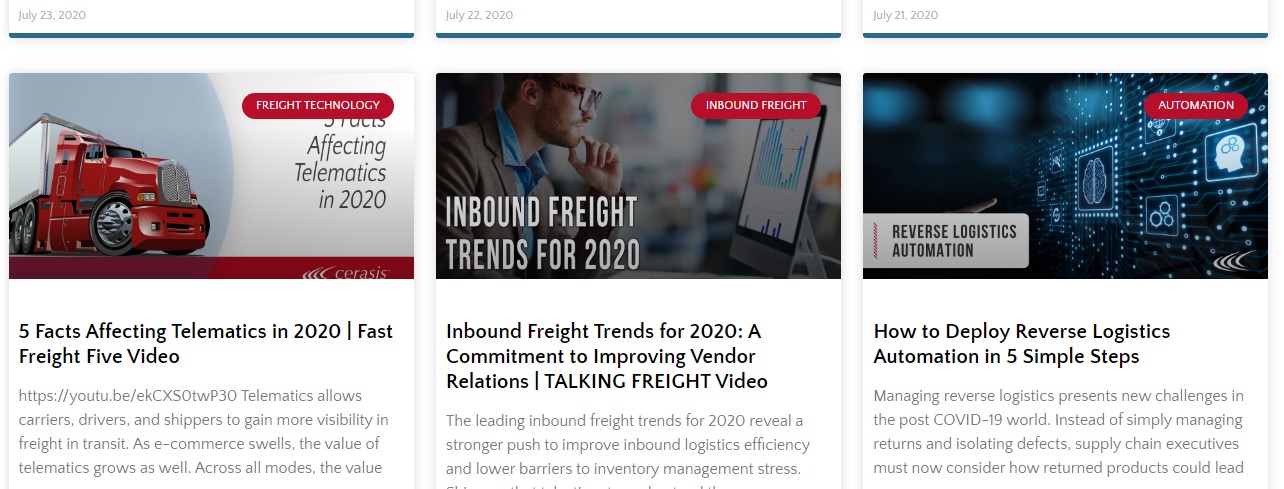
The transportation management company was one of the early adopters of B2B blogging — and the results have been impressive. And Cerasis is not letting up. The company has published 15 blog posts in July alone, a pace few can — or don’t necessarily need to — match.
2. General Electric: Global vision

A multibillion-dollar corporation has the benefit of ample resources — and GE is putting them to good use. General Electric Reports intelligently humanizes the company with a stream of stories on the impact of GE products on global progress and employee spotlights that tie into current events.
3. Comscore: Analytics first

A look at Comscore’s blog leaves no doubt about its specialty: the collection and analysis of internet data. Comscore draws upon its vast resources to create content that is found nowhere else. The ability to showcase such detailed expertise is sure to sway a target audience looking to leverage customer behavior online.
Time to crawl out
The impact of an effective B2B blog can be huge. It requires research and vision to get started, persistence to keep it up, and analysis to evaluate the performance. In the end, the benefits of a company blog contribute to the health of your entire organization.
How about waking that bear up again?
Read more:
Key step to moving beyond survival mode: Revising B2B buyer personas
Trade show cancellations call for contingency plans (It’s urgent)

by Elizabeth Hines | Jul 19, 2020 | Blog, Current Events, Supply Chain
As the popularity of podcasts grows, DC Velocity premieres a new supply chain podcast — Logistics Matters.
Our blog posts on supply chain podcasts consistently get a lot of views. Now, we can share news of another addition to the growing lineup of listen-worthy talks.
Logistics Matters With DC Velocity is a brand-new supply chain podcast designed to help logistics and supply chain professionals keep up with the most recent developments in this fast-changing industry. Considering the recent global disruption, there’s hardly a better time to add this insightful commentary to your list of podcasts.
At the mic, we find the editors of DC Velocity magazine: Editorial Director David Maloney, Senior News Editor Ben Ames, and Senior Editor Victoria Kickham. Every Friday, they post a new episode tackling the latest news and trends that supply chain professionals should understand to make informed decisions and stay abreast of the competition.
Logistics Matters With DC Velocity also invites industry experts to share their take on the issues that are driving conversations in distribution center management, freight transportation, material handling, and more.
Timely topics kick off new supply chain podcast
And this new supply chain podcast is off to a strong start with a range of timely topics. Take a look:
- What to watch out for in the United States-Mexico-Canada agreement — with David Henry of GlobalTranz.
- Keeping material handling equipment safe and sanitized — with Ken Raycroft of Briggs Equipment.
- Racism faced by Black delivery drivers — with Dr. Terry Esper, associate professor of logistics at the Ohio State University’s Fisher College of Business.
- Investments in logistics technology companies amid the pandemic.
- National Forklift Safety Day — with Brian Feehan of the Industrial Truck Association.
- IT infrastructure problems revealed by Covid-19.
- Martin McVicar of Combilift on how the company has adjusted its manufacturing operations and customer contacts in light of the pandemic.
- How layoffs are disproportionately affecting the logistics sector.
- How truck drivers are being shown a little love in the form of higher pay.
Easy listening wherever you are
Just like podcasts in general — they now number a staggering 850,000 — supply chain podcasts have grown in popularity in recent years, spurred by increased smartphone use and the ease they let you absorb new information. Some, like Talking Logistics, founded in 2015, and the Inbound Logistics Podcast, founded in 2016, are veterans in the group. Others, like The Digital Supply Chain podcast, premiered last year. But, clearly, there’s even more to say.
Logistics Matters With DC Velocity is available on Apple Podcasts, Spotify, Stitcher, TuneIn, Google Podcasts, iHeart Radio, and many other platforms, as well as at dcvelocity.com/podcasts. DC Velocity’s new supply chain podcast is produced by AGiLE Business Media, a leading publisher of business content for logistics, material handling, and supply chain executives.
It has never been easier to stay on top of the world of supply chain trends and news.
Happy listening.
Read more: