
An application engineer has a problem to solve by Friday. She needs a component that holds tolerance at high temperature, ships in under eight weeks, and won’t trigger a requalification. She is not going to call your sales team to find out if you have it. She’s going to search, open three datasheets, download a CAD model, and maybe ask ChatGPT for a shortlist. If your company isn’t part of that research, you’re not part of the decision. That’s the first rule of marketing to engineers.
Engineers are some of the most thorough, skeptical, and self-directed buyers in B2B, and they reward suppliers who make their jobs easier. Here’s what they need from you, and how manufacturers can deliver it.
Key takeaways
- Engineers do most of their supplier research online, before sales is involved.
- Specs, data, and application proof beat polished brand claims every time.
- Brand familiarity still matters: engineers lean toward suppliers they recognize.
- Your website, technical content, and AI search visibility now do the work a sales rep used to do.
What is marketing to engineers?
Marketing to engineers is the practice of reaching design, application, and manufacturing engineers with the technical information they need to evaluate, specify, and recommend a product or supplier. It’s less about persuasion and more about removing friction: making specs easy to find, proving performance, and showing up wherever engineers research.
It’s a core piece of any B2B manufacturing marketing program, because in most industrial purchases the engineer is the person who puts your part on the drawing, or takes it off.
How do engineers research suppliers today?
Engineers spend 62% of the buying journey researching online, according to the 2026 State of Marketing to Engineers study from TREW Marketing and GlobalSpec. That same research found technical publications and vendor websites are still their top sources of product information.
The broader B2B picture points the same direction. A Gartner survey of 646 B2B buyers, published in March 2026, found 67% prefer a rep-free buying experience, and 45% used AI during a recent purchase.
In practice, an engineer’s research usually looks like this:
- Define the requirement (performance, material, size, compliance, lead time).
- Search Google, distributor sites, industry directories, or an AI tool for candidate suppliers.
- Compare datasheets, specs, and certifications side by side.
- Download CAD models, application notes, or test data.
- Reach out only once a supplier looks like a real fit.
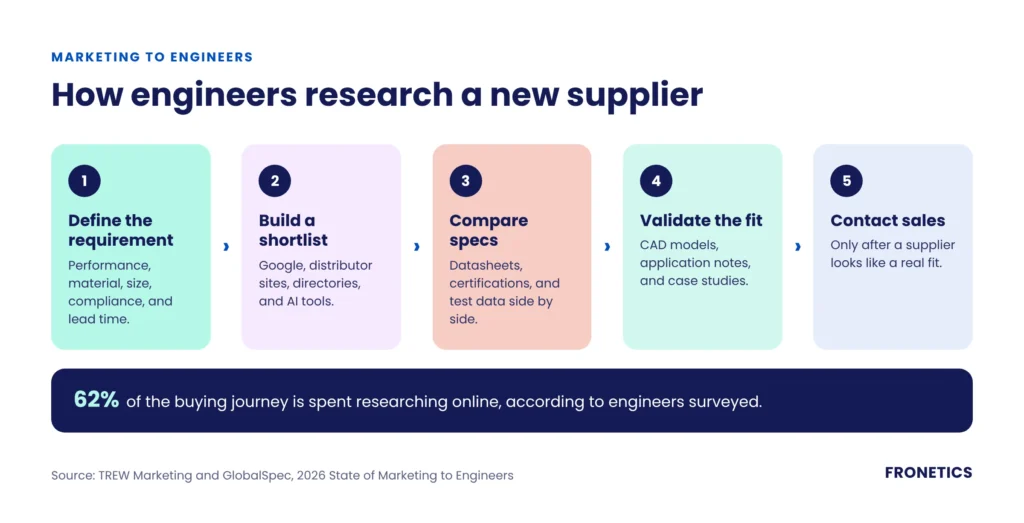
By the time an engineer fills out your contact form, they’ve often narrowed the field to two or three options. Your marketing decides whether you’re one of them.
What do engineers want from supplier marketing?
Specs they can find in seconds
Hiding datasheets behind a form or a “contact us for details” button is one of the fastest ways to lose an engineer. Put key specifications on the product page in plain HTML text, not just inside a PDF. It helps engineers, and it helps search engines and AI tools understand what you make.
Proof, not adjectives
“High quality” and “industry leading” mean nothing to an engineer. Test results, tolerances, failure rates, certifications (ISO 9001, AS9100, IATF 16949), and application stories mean a lot. If you can’t prove a claim with a number or a standard, cut it.
Application context
Engineers want to know how your product performed in a situation like theirs. Short application notes and case studies that explain the problem, the constraint, and the result are some of the most useful content a manufacturer can publish.
Tools that save time
CAD downloads, configurators, cross-reference charts, selection guides, and calculators all earn repeat visits. They also signal that you understand how engineers actually work.
Direct access to expertise
When an engineer is ready to talk, they want to talk to someone technical. Make it clear how to reach an application engineer, and route technical questions to people who can answer them.
Why does brand still matter to engineers?
Engineers like to think they choose purely on specs, but familiarity plays a real role. In the TREW and GlobalSpec research, 53% of technical buyers said brand familiarity influenced their most recent purchase, and 70% said they were more likely to choose the better-known brand when evaluating technically similar solutions.
That’s the case for consistent visibility: publishing technical content, showing up in trade publications, being present at the right trade shows, and staying in front of engineers between projects. When two parts look equal on paper, the supplier they’ve heard of usually wins.
How is AI search changing how engineers find suppliers?
More engineers now start with questions like “Which manufacturers make PTFE seals rated for cryogenic service?” in ChatGPT, Perplexity, or Google’s AI Overviews. They don’t fully trust the answers yet (the same research put trust in AI answers at 4.7 out of 10), but they use them to build a starting list.
To show up in those answers, manufacturers need:
- Product and capability pages that state clearly what you make, for which applications, and to what specifications.
- FAQ-style content that answers the exact questions engineers ask.
- Consistent company and product information across your site, distributor listings, and directories.
- Mentions in trade publications and industry sites that AI tools treat as credible.
Our SEO and AI optimization work focuses on exactly these signals.
Marketing to engineers: what works and what doesn’t
| What works | What doesn’t |
|---|---|
| Ungated datasheets and specs in HTML | Specs locked behind a form |
| Test data, standards, and certifications | Vague claims like “best in class” |
| Application notes and case studies | Generic brochures |
| CAD downloads and selection tools | “Call for details” |
| Access to an application engineer | Routing every question to sales |
| Steady presence in trade media and search | One big push per year |
Where should manufacturers start?
If your team is small, start where engineers spend the most time: your website. Audit your top product pages and ask three questions. Can an engineer find the key specs without downloading anything? Is there proof behind every claim? Is it obvious how to get a technical answer?
From there, build a steady stream of technical content, starting with the questions your sales and application engineers answer most often. Then connect that content to a broader manufacturing lead generation program so that research turns into real conversations.
Make it easy to choose you
Engineers don’t want to be sold to. They want to be informed, quickly and accurately. Manufacturers that make specs easy to find, back up every claim, and stay visible where engineers research will earn more spots on more shortlists.
If you’d like help building a program that reaches the engineers who specify what you make, see how we work with manufacturers.
FAQ
What is the best way to market to engineers?
Give engineers the technical information they need without friction: ungated specs, test data, certifications, application notes, and CAD files. Then stay visible in search, AI tools, and trade publications so they recognize your name when it’s time to choose.
Should manufacturers gate datasheets?
In most cases, no. Engineers expect datasheets to be freely available, and gating them often sends engineers to a competitor. Gate deeper resources like design guides or calculators instead, if you gate anything.
Do engineers trust AI search results?
Not fully yet. The 2026 State of Marketing to Engineers research rated technical buyers’ trust in generative AI answers at 4.7 out of 10. Engineers use AI tools to build a starting list, then verify with datasheets and vendor websites.
How long does it take to see results from marketing to engineers?
Most manufacturers see early gains in search visibility and engagement within three to six months. Pipeline impact usually follows over six to twelve months, depending on sales cycle length.
Related reading