
Ask most electronics manufacturing services (EMS) providers what makes them different and you’ll hear the same list: quality, flexibility, customer service, and a lineup of SMT lines. The problem is that every competitor says the same thing. To an OEM looking for a new contract manufacturer, the websites start to blur together. That’s the central problem in EMS marketing.
Solving it starts with a simple truth: OEMs aren’t choosing a commodity. They’re choosing a long-term partner that will build their product, protect their reputation, and keep their supply chain running. Here’s what OEMs really look for when choosing an EMS partner, and how to show them you have it.
What does EMS marketing actually involve?
EMS marketing is how electronics contract manufacturers attract and win OEM customers for PCB assembly, box build, and full product manufacturing. Effective EMS marketing positions a provider around specific strengths, such as industries, technologies, and volume ranges, and proves them to the engineers, supply chain leaders, and executives who choose manufacturing partners.
It’s a core part of the electronics industry marketing we do for manufacturers, distributors, and recyclers across the electronics supply chain.
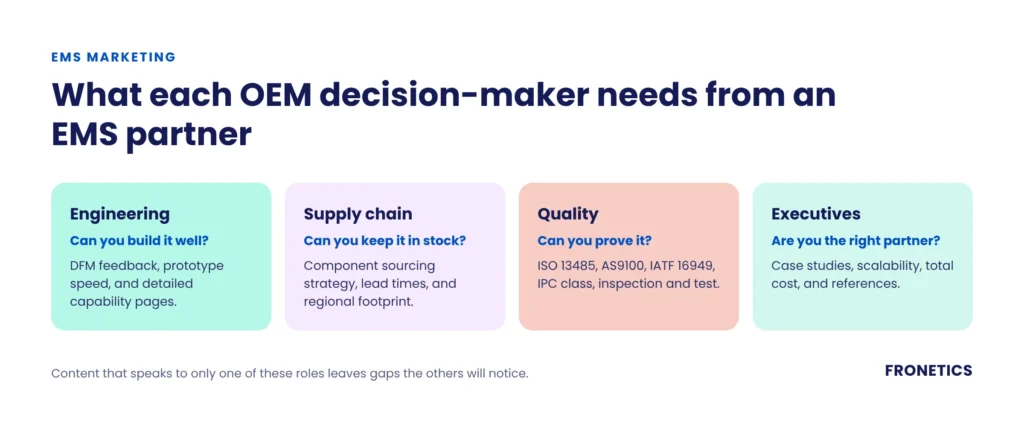
Who decides which EMS provider an OEM uses?
| Role | What they care about | Content that helps |
|---|---|---|
| Hardware and NPI engineers | DFM feedback, prototype speed, technical capability | Capability pages, DFM guides, NPI process overviews |
| Supply chain and procurement | Component sourcing, lead times, cost, resilience | Sourcing strategy, regional footprint, shortage case studies |
| Quality | Certifications, traceability, defect rates | Quality system pages, certifications, inspection and test capabilities |
| Executives | Risk, scalability, total cost, partnership fit | Case studies, company story, customer testimonials |
What do OEMs look for in an EMS partner?
OEMs consistently weigh five things: a clear fit for their industry and volume, proven technical capability, the right certifications, a smooth NPI process, and a resilient supply chain. Here’s how to prove each one in your marketing.
Pick your niches and own them
Very few EMS providers are truly best for everyone. Most are exceptional for a certain set of industries (medical, aerospace and defense, industrial, energy), a certain volume range (high-mix low-volume vs. high volume), or certain technologies (rigid-flex, RF, fine-pitch BGA). Build dedicated pages for each and say plainly who you’re the right fit for.
Get specific about capability
Replace “advanced SMT capabilities” with real details: smallest component size, BGA and micro-BGA experience, inspection methods (AOI, X-ray, ICT, functional test), conformal coating, and box build scope. Engineers compare these line by line.
Make certifications work harder
ISO 13485, AS9100, IATF 16949, ITAR registration, and IPC-A-610 class capabilities open doors in regulated industries. Pair each with a sentence about what it means for the customer.
Show your NPI process
OEMs often choose a partner during prototyping and stay for production. A clear, visual explanation of your NPI process, from DFM review to first article to ramp, tells engineers what working with you will feel like.
Prove supply chain resilience
After years of component shortages, OEMs ask hard questions about sourcing. Explain your component procurement strategy, distributor relationships, alternate-part process, and regional manufacturing footprint.
What marketing tactics work for contract electronics manufacturers?
- A capability-first website. Organize pages by industry, service, and technology so OEMs can quickly confirm fit. Our website design work starts with this structure.
- Search and AI visibility. OEM engineers search for things like “medical device PCB assembly ISO 13485” or ask AI tools for EMS providers in a region. Pages that answer those queries directly earn visibility. See our SEO and AI optimization approach.
- Case studies. Show a program from NPI to production, including the challenge, constraints, and measurable outcomes.
- Account-based marketing. Most EMS providers can name the OEMs they’d love to win. Targeted ABM programs keep you in front of those accounts until a program comes up for bid.
- Trade shows with a plan. Events like IPC APEX EXPO matter, but only with pre-show outreach and fast follow-up.
Specific beats generic
OEMs don’t choose a contract manufacturer because of a bigger list of adjectives. They choose the partner that clearly fits their industry, their technology, and their volume, and proves it. EMS providers that market with that kind of specificity win more of the right programs.
Want help sharpening your positioning and reaching more OEMs? See how we work with electronics manufacturers.
FAQ
What do OEMs look for when choosing an EMS provider?
OEMs look for a clear fit with their industry, technology, and volume, proven technical capability, certifications that match their regulatory needs, a well-defined NPI process, and a resilient component sourcing strategy. Each member of the buying committee weighs these differently.
What is EMS marketing?
EMS marketing is how electronics manufacturing services providers attract OEM customers for PCB assembly, box build, and product manufacturing. It focuses on positioning around specific industries, technologies, and volumes, and proving those strengths to engineering, supply chain, quality, and executive buyers.
How do contract electronics manufacturers find new OEM customers?
The most effective approaches combine a capability-focused website, search and AI visibility for industry-specific queries, detailed case studies, account-based marketing aimed at target OEMs, and well-planned trade show programs.
How can an EMS company differentiate from competitors?
Choose and own specific niches, such as industries, volume ranges, or technologies, and back them with concrete capability details, relevant certifications, a clear NPI process, and proof of supply chain resilience.
What certifications should EMS providers highlight?
Highlight the certifications that match your target industries, such as ISO 13485 for medical, AS9100 and ITAR registration for aerospace and defense, and IATF 16949 for automotive, along with IPC workmanship standards.
Related reading