by Elizabeth Hines | Jul 31, 2019 | Blog, Current Events, Marketing, Social Media
Also this month in social media news: Facebook strives to attract content creators, and Pinterest debuts new video tools for brands.
Highlights:
- Less than a month after Facebook released details of its new cryptocurrency, the project has met a stumbling block from Fed Chairman Jerome Powell.
- Newly released statistics highlight key growth metrics and lay out expectations for digital marketing in the second half of 2019.
- Pinterest’s new video tools as well as updates from Facebook are geared to content creators and brands.
It’s hard to believe it’s already July and 2019 is at its halfway point. It’s a time when organizations are evaluating their performance thus far, and setting goals for the second half of the calendar year. To that end, both Mobile Marketer and Marketing Dive published key digital marketing growth statistics, and we’ve got the highlights for you below.
Last month, Facebook made news by releasing details of its new cryptocurrency, Libra. Now the social media giant has hit a roadblock, in the form of Fed Chairman Jerome Powell calling for a halt until serious concerns are addressed. Facebook is also making news this month by taking a page out if its competitors’ books in its attempt to attract more online content creators. Read on for details on these social media news items from July 2019.
Fed Chief Calls for Facebook to Halt Libra Project Until Concerns Are Addressed
Following closely on the heels of Facebook’s releasing details of its planned Libra cryptocurrency, U.S. Federal Reserve Chairman Jerome Powell said that the project “cannot go forward” until serious concerns are addressed. “Libra raises many serious concerns regarding privacy, money laundering, consumer protection, and financial stability,” Powell said before the U.S. House of Representatives Financial Services Committee.
The Fed chief’s tough comments not only underscore the regulatory hurdles facing Libra, but put pressure on the project, and dented the price of Libra’s forebear, bitcoin. The price of bitcoin fell by around 7% during his 3-hour testimony. Powell also called for regulatory review of the project to be “patient and careful,” while pointing to the fact that existing rules don’t adequately fit digital currencies.
“It’s something that doesn’t fit neatly or easily within our regulatory scheme, but it does have potentially systemic scale,” said Powell. “It needs a careful look, so I strongly believe we all need to be taking our time with this.”
Facebook spokeswoman Elka Looks responded to the testimony in an email to Reuters: “We are very much aligned with the Chairman around the need for public discourse on this,” wrote Looks. “This is why we along with the 27 other Founding Members of the Libra Association made this announcement so far in advance, so that we could engage in constructive discourse on this and get feedback.”
2019 Key Digital Marketing Growth Statistics Released
The midyear release of statistics from Marketing Dive and Mobile Marketer are important for brands and marketers to pay attention to. In the ever-shifting world of digital marketing, these statistics and trends offer valuable insight into where resources and time are best devoted.
Highlights from the reports include:
- Global online advertising spend is on track to grow 7% this year. That’s up from the 4% forecast in December 2018.
- Location-based marketing will likely grow 14%, reaching $24.4 billion in advertising spending by the end of 2019.
- 43% of all advertisers plan to increase spending on influencer marketing by April of 2020.
- Social referral traffic to retail ecommerce sites has grown by 110% in two years.
Facebook Strives to Attract More Content Creators
In an effort to attract more content creators to its platform, Facebook is giving videos more ways to make money. Observers have noted that the reigning social media giant is “pulling inspiration from other platforms to let you throw cash at your favorite video creators in the form of subscriptions or tokenized ‘stars’ that pay them a penny.”
Facebook’s announcement of its new video developments comes just ahead of VidCon, the world’s biggest conference for online video creators. It follows on the heels of three years of investments in the network’s video services and is in line with consumer trends toward video consumption.
Pinterest Debuts New Video Tools for Brands
Image-curating platform Pinterest is ramping up its video capabilities, in line with a larger consumer shift in viewing habits and a boost from advertisers in spending on social video. New video features include an improved uploader, video tab, lifetime analytics, and Pin scheduling.
The updated video uploader “enables businesses and creators to seamlessly upload video directly to Pinterest to engage with new and existing audiences, and access latest metrics,” according to the announcement.
Pinterest’s announcement points out that unlike on other platforms, videos don’t disappear (as they do on Instagram and Facebook Stories after 24 hours). To that end, their video analytics tool will allow businesses to gain insight into a video’s performance over its lifetime.
Related posts:
by Elizabeth Hines | Jul 23, 2019 | Blog, Marketing, Social Media, Video Marketing
Videos drive greater conversion rates and increased leads. Here are four takeaways from Vidyard’s 2019 State of Video in Business Report.
Highlights:
- Over 82% of businesses reported greater investments in video last year
- Vidyard’s report stated that high-value video content has become a key factor in SEO and ranking.
- Aside from just tracking views, businesses will also track engagement time, drop-off rates, and reach across all channels, as well as the impact of video on lead generation and revenue.
Video Transcript:
Hi I’m Christy LeMire, the Director of Video Strategy at Fronetics, and today I’ll be sharing 4 takeaways from Vidyard’s 2019 State of Video in Business Report.
This report confirmed what us digital marketers already know, video is everywhere. Over 82% of businesses reported greater investments in video last year and it’s no surprise why. Videos drive more sharing, produce greater conversion rates and increase leads.
Here are the 4 key takeaways from the 2019 State of Video in Business Report
-
Video isn’t just for social media
Though Facebook and Snapchat saw over 8 billion video views every day on their platforms, video didn’t stop with social media. Video took center stage in digital marketing and brand awareness. Vidyard’s report stated that high-value video content has become a key factor in SEO and ranking. This trend will continue to grow as marketers begin using video for frequently asked questions and explanations of complex and intricate business details.
-
Short and sweet videos
Marketers used to create highly produced promotional videos for their websites and blogs. But now marketers are focusing on conversational and educational videos created specifically for social media. These casual videos give followers timely updates on industry trends, a behind the scenes look at projects, and interviews with clients and colleagues. The transparency created in these videos brings personality to your business. Marketers will continue to create video for social media, their blog and YouTube channels, resulting in a spike in short-form content like snackable video series.
-
Video experiences focus on engagement
New approaches to video—including series-based content, video podcasts, interactive video, and personalized video—are helping marketers boost engagement and expand audiences. Experts predict we’ll see these new approaches gain more traction as the tools to create them become more user-friendly and best practices become more widely understood.
-
Expanation of video analytics
As video has expanded, so have the needs of video analytics. Businesses will start making use of analytics tools to track video metrics that align with their digital marketing strategy. Aside from just tracking views, businesses will also track engagement time, drop-off rates, and reach across all channels, as well as the impact of video on lead generation and revenue. With more detailed reporting, businesses will see more efficiency and a higher ROI from their video content.
Check out the full report on our blog and find more digital marketing tips on our website at Fronetics.com.
Related posts:

by Elizabeth Hines | Jul 18, 2019 | Blog, Logistics, Marketing, Social Media, Supply Chain
Reading social media blogs is an excellent way to ensure that your business is on top of the latest industry trends, insights, and analysis.
Highlights:
- Subscribe to blogs using an RSS reader to make sure you’re keeping up with the latest.
- Social Media Examiner is a great all-around source, while Social Media Today is the best place to go for up-to-the-minute news.
- Duct Tape Marketing is specifically geared to social media for small businesses.
It’s an old adage, but it holds true: When it comes to social media marketing, the only constant is change. Platforms are constantly refining their algorithms, seeking to stay in line with ever-evolving user behavior, and trends and memes come and go in the blink of an eye. In order to be successful, businesses need to stay abreast of all these constant shifts. Becoming a voracious reader of social media blogs is one of the best ways you can stay on top of what’s going on in the social media marketing world.
These five social media blogs are our favorite go-to resources for the latest news, as well as keen insights and expert analysis. Use your RSS reader to subscribe, and you’ll be privy to free knowledge from some of the leading industry voices.
Fronetics’ 5 favorite social media blogs in 2019
1) Social Media Examiner
Social Media Examiner has been one of our favorite social media blogs for years. Widely known for providing consistently valuable content, the blog features articles from in-house social media experts, as well as regular guest contributors.
We recommend Social Media Examiner whether you’re a beginner at social media marketing or a seasoned expert. The blog frequently features beginner-friendly, step-by-step guides to leveraging social media for marketing purposes, as well as up-to-date coverage of all the most important happenings in the industry, along with terrific analysis.
Recent must-read posts:
2) Duct Tape Marketing
If you’re a small business, Duct Tape Marketing is a fantastic resource for social media marketing specifically geared to small and midsized corporations. Social media is one of the blog’s main focus points, but it also offers suggestions and insights for digital marketing in a broader sense, SEO, marketing automation, and more — all of which help inform a robust social media strategy.
We love the strategies Duct Tape Marketing offers, with small businesses top of mind. You’ll find tactics for leveraging social media to generate leads, expand reach, and grow your business.
Recent must-read posts:
3) Social Media Today
When it comes to social media news, no one does it better than Social Media Today. The team of regular contributors posts several times a day and is remarkably adept at staying on the cutting edge of all the latest happenings, algorithms, and releases in the social media industry.
You won’t just find news on this social media blog. It’s also a rich resource for analysis, opinions, and insights, as well as tips and how-to articles from experienced marketers.
Recent must-read posts:
4) Socially Sorted
Run by social media guru Donna Mortiz, Socially Sorted has been named one of Social Media Examiner’s Top 10 Social Media Blogs for three years in a row. Mortiz personally authors most of the articles that appear on her blog and carefully curates contributors who bring expert perspectives to complement her own.
Socially Sorted focuses heavily on visual content social media platforms, like Instagram and Pinterest, but offers value for readers looking to round out their strategy on any platform. These days, visual content has a tremendous amount of power, and Mortiz is a fantastic resource for boosting your visual game.
Recent must-read posts:
5) Convince and Convert
No list of social media blogs is complete without Convince and Convert. While it’s a general digital and content marketing blog, it boasts a heavy focus on social media marketing topics. Founder Jay Baer and other industry experts offer a steady stream of new content, primarily in the form of how-to guides, case studies, tips, tools, and opinion pieces.
Convince and Convert is a good place for beginners and advanced social media marketers alike. However, more advanced readers will be better to take advantage of the specific and often highly technical guides. The topics never fail to be engaging and often slant toward using strategies informed by human psychology to optimize social influence.
Recent must-read posts:
Which social media blogs are you reading these days?
Related posts:

by Elizabeth Hines | Jul 11, 2019 | Blog, Content Marketing, Current Events, Logistics, Marketing, Social Media, Supply Chain
Here are our most-viewed supply chain and logistics blog posts from this year as of July 1, 2019.
Throughout the year, we regularly write blog posts to help our readers stay on top of the latest news and trends happening in the supply chain and logistics industries, particularly in regards to digital marketing. We hope these posts provide insight, tips, and insider information on how to stay ahead of your competitors with the consistent publication of quality content.
We’ve covered some great stuff this year, from new trends in automation to the best places to distribute your videos. Here’s a look at our most popular posts so far this year.
Top supply chain and logistics blog posts from 2019 (so far)
1. Top 3 Logistics and Supply Chain Blogs of 2019
You voted, and the results are in! Cerasis is your number one blog of the year, with Women in Trucking and Hollingsworth coming in second and third. Read more
2. Digital Marketing for the Supply Chain and Logistics Industries
Today’s B2B buyers are researching, evaluating, and coming to conclusions about companies without a single contact with a team member or salesperson. This kind of B2B buying landscape requires cutting-edge marketing strategies to showcase nut-and-bolt industries that have survived without them for many years. Read more
3. Send in the Drones: How PINC & Amazon Have Optimized Inventory Management
It’s been five years since Charlie Rose interviewed Amazon CEO Jeff Bezos on 60 Minutes about new innovations that Amazon was working on. Bezos revealed that Amazon was on the brink of a supply chain revolution involving octocoptor drones transporting parcels: Amazon Prime Air. Read more
4. 4 Examples of AI for the Supply Chain
Artificial intelligence is not simply affecting supply chain management; it is revolutionizing it. With the power to drastically increase efficiency in all areas of the supply chain, McKinsey estimates that firms could gain $1.3 trillion to $2 trillion a year from using AI in supply chain and manufacturing. Read more
5. Infographic: 10 Companies that Are Getting Instagram for B2B Marketing Right
Instagram now boasts over 1 billion monthly active users, making it one of the most popular social media platforms out there. It’s a tremendous opportunity for businesses. In fact, recent research has shown that 66% of brands now use Instagram. But many B2B marketers are still struggling to find their footing on this highly visual platform. Read more
6. B2B Digital Marketing Trends, Budgets, and Benchmarks: Highlights for 2019
The Content Marketing Institute has published its ninth annual survey, giving insight into the most significant digital marketing trends and priorities for 2019. We’ll get into some key takeaways in detail, but perhaps the most striking finding was one that we’ve been talking about for years. Read more
7. Video: 4 Best Channels for Video Distribution
Knowing the right video distribution channels can go a long way toward driving traffic and getting your content to your target audience. Bottom line is using the right distribution channels helps you get the most out of your video marketing efforts. Here are the 4 best channels for distributing your videos. Read more
8. Video: 6 Digital Marketing Trends for the Supply Chain 2019
Digital marketing has become essential for creating brand awareness, educating audiences and building trust and credibility with your customers. Supply chain and logistics companies increasingly see the value in digital marketing. They’re increasing their budgets, and it’s important to understand what the trends are for the upcoming year. Read more
9. How Rogue Ales is Leveraging IoT to Revolutionize the Beer Brewing Industry
Rogue Ales believes that its “Ground to Glass, Grow your Own Revolution” is a key tenet to its success. The company leverages the Internet of Things (IoT) to ensure that the supply chain is able to deliver the highest-quality ingredients to its breweries just in time. Read more
10. 6 Content Marketing Trends for the Supply Chain in 2019
Content marketing is no longer optional. It’s essential in creating brand awareness, educating audiences, and building credibility. Here’s a look at the biggest digital marketing trends for 2019. Read more
Related posts:

by Elizabeth Hines | Jul 10, 2019 | Blog, Content Marketing, Current Events, Marketing, Social Media
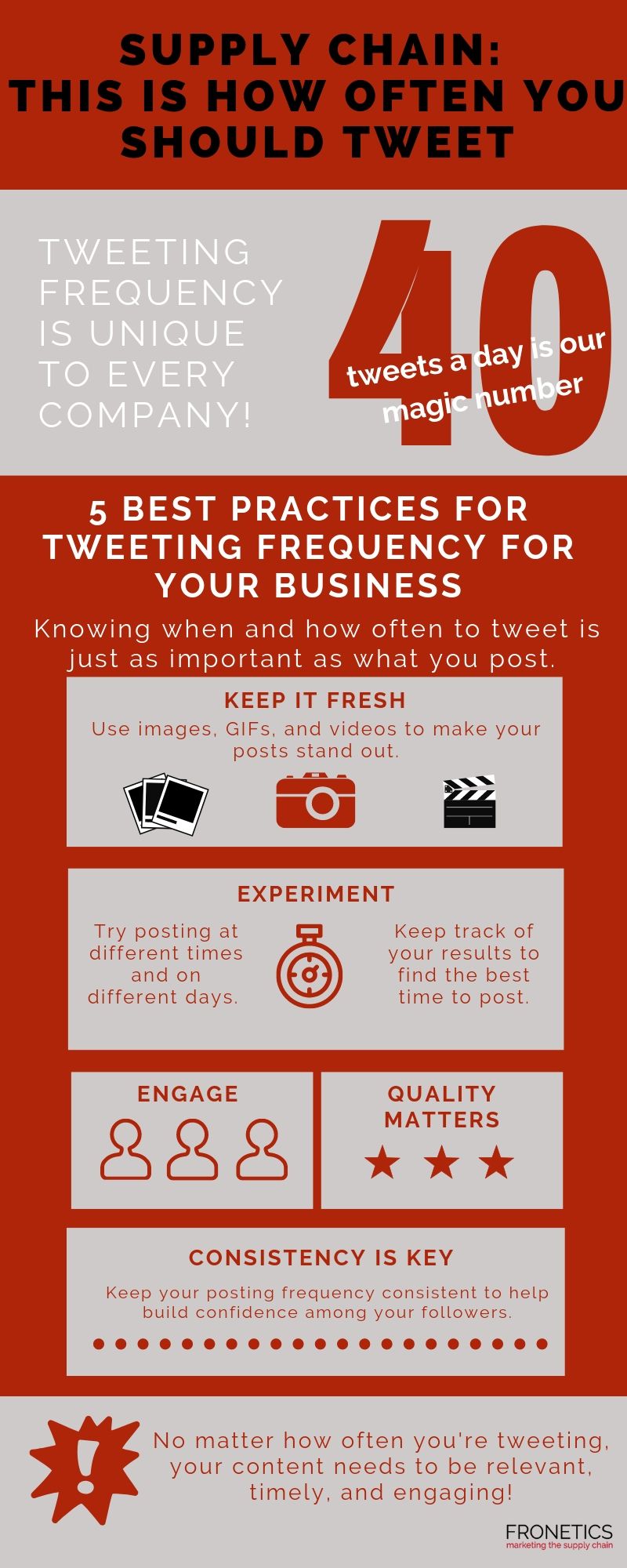
Knowing when and how often to tweet is just as important what you post. Here’s how often your business should be tweeting.
Highlights:
- Be consistent with your tweeting frequency, while keeping content fresh.
- To determine how often to tweet for your business, experiment with different posting frequencies, and use analytics tools to track your results.
- As with any digital marketing endeavor, quality is more important than quantity.
It’s a perennial question we get from our clients: how often should business be posting on social media? The answer varies widely from platform to platform, and the answer for how often to tweet has proved a controversial one.
Back in 2016, in response to a Socialbakers study that suggested that posting to Twitter three times a day is an ideal frequency for brands, Fronetics conducted a study of our own. We determined that for our business, tweeting around 40 times a day is optimal.
What these radically divergent results demonstrate is that the answer to how often to tweet is not a simple one. While the bottom line is that optimal tweeting frequency is unique to every brand, there are 5 best practices your business should be aware of.
5 best practices concerning how often to tweet for your business
(Made with Canva)
1) Consistency is key
Whether you’re tweeting once a day, or a hundred, being consistent about posting frequency will serve you best. Keeping your posting frequency relatively consistent lets your followers gain confidence that you will set and expectation and meet it. As social media algorithms become less friendly to businesses, it’s all the more important that you bring your followers to you.
2) Keep it fresh
It’s important to point out that consistency is key only when it comes to how often to tweet – not the content you’re publishing. Particularly on Twitter, varying your content is the best way to keep your audience engaged. Use images, GIFs, and videos to make your posts stand out, or ask questions to promote conversation and engage your followers.
3) Experiment
When it comes to how often to tweet for your business, you’ll find all kinds of divergent ready-made answers. But the truth is, there’s no magic number. Your business or your marketing partner needs to determine what works for your unique brand and audience. The best way to do this is to experiment with posting at different times and keep track of your results. In addition to Twitter’s internal analytics, these five tools can help you track and evaluate the results of your experiment.
4) Engage
As with any social media platform, publishing content shouldn’t be your only focus. Engaging with your followers, from comments to retweets, is crucial for generating an active and loyal audience.
In addition, using social media to interact with your audience can help inform your decisions about how often to tweet. When are your followers most active? What kind of content do they want to see from you? Having a conversation with your followers is one of the best ways you can answer this question.
5) Quality matters
There’s no amount of posting frequency that makes up for posting poor quality content. If your content is bad, you’d likely be better off not posting at all. Publishing content that doesn’t interest your audience will lose you followers and leads. No matter how often you’re tweeting, your content needs to be relevant, timely, and engaging.
Related posts:
by Jennifer Hart Yim | Jul 9, 2019 | Blog, Content Marketing, Logistics, Marketing, Social Media, Supply Chain
LinkedIn a great place for businesses to make relevant LinkedIn users aware of their brand. However, there are common mistakes that companies make on LinkedIn.
LinkedIn is a powerful social network to connect with industry professionals, especially for B2B(business to business). People use LinkedIn to connect with coworkers and industry peers, get business advice, and even find new jobs. It’s a great place for businesses to make relevant LinkedIn users aware of their brand. However, just like Facebook and Twitter, there are common mistakes that companies make on LinkedIn.
Here are 9 LinkedIn for business strategies to avoid, as well as how to remedy them.
1. You Don’t Answer Questions.
The “Answers” section of LinkedIn, where people go to ask their business-related questions, is a place where businesses establish themselves as industry experts and even find new customers. These questions are categorized by industry; anything from finance & accounting to marketing & sales. Avoiding answering questions because you’re too shy or don’t want to invest the time is such a missed opportunity. Take a few minutes each day to look at the new questions in your industry, and see if there is a question you can provide a helpful answer to.
2. You’re Overly Self-Promotional when Answering Questions.
If you were in a bind and reached out to a community of peers for help, would you want the only response to be “Give me your money”? Of course not. You’d hope for honest and valuable guidance. The “Answers” section of LinkedIn is a fantastic place to find potential customers who have publicly revealed that they have a problem your service/product would solve. Instead of proclaiming that they should hire or buy from you to reach a solution, offer useful advice and let them know to contact you directly if they have more questions. This way, you’ll be building a relationship that will gain their trust, and then they’ll be more likely to turn into a customer.
3. You Don’t Join or Participate in Groups.
If you haven’t joined any relevant groups on LinkedIn, you’re missing out on a few things. First, being in a group lets you share links with that group, so you can share links to your own blog or site (in a very non-spammy fashion, of course). Second, you can find out the latest industry news, because other professionals post helpful links to groups constantly. Also, they’re a great place to find industry peers to connect with, whether to find new customers or even find fellow industry bloggers who could potentially link to you.
4. Your Profile is Blank/Incomplete.
Since you’ll be answering Questions and joining Groups with your personal account, you should make sure your own profile is complete so that you can gain people’s trust and establish authority. If people can’t learn anything about you in your profile, they won’t want to connect with you. Describe your role at your current and previous companies, and provide links to your website and any relevant profiles (i.e. Twitter).
5. Your Company Page is Blank.
Your company page has the potential to gain LinkedIn followers who will see your blog posts, company profile updates, and job openings appear in their LinkedIn newsfeed. But if your company description isn’t filled in, it might prevent people from following you, or even from finding you in the first place. Make sure you optimize your company page by including relevant keywords and links to your website.
6. You Don’t Promote Your LinkedIn Page on Your Website.
Keeping your company’s LinkedIn profile page a secret from your website visitors isn’t a good idea since these are the people most likely to actually follow you. Add a LinkedIn icon to your website to increase awareness of your presence on LinkedIn. Make it easy for your visitors to find out how to connect with you on social media.
7. You Ignore Connection Invitations.
Once you provide value in Answers and Groups, people will start inviting you to connect with them on LinkedIn. Don’t just ignore these invitations. Unlike Facebook, don’t feel like you need to personally know everyone that you connect with. LinkedIn automatically sorts your connections based on how you know them; whether through a current or previous job, or through a group, so don’t be concerned about having a network that’s too big to keep track of.
8. You Don’t Post Status Updates
It might seem like overkill to post updates on Facebook, Twitter, and LinkedIn. But it’s not. LinkedIn is a more professional social networking site than Facebook and Twitter, so it’s likely that you’ll have different followers here who will benefit from seeing your updates. It’s ok to re-purpose content across all of the social channels, as long as you’re not duplicating the content.
What would be your #9? Let me know in the comments below!
This article was written by Diana Urban, marketing manager at BookBub and the former Head of Conversion Marketing in HubSpot. Diana is a results-driven marketer and content strategist who’s passionate about inbound marketing at startups.
Related posts: