by Elizabeth Hines | Jun 27, 2019 | Blog, Current Events, Marketing, Social Media
Also this month in social media news: Facebook releases details of its forthcoming cryptocurrency, and Instagram Pushes IGTV With Horizontal Video LinkedIn updates ad features.
Highlights:
- Facebook is removing several Information sections from business Pages, while also testing a feature that lets users preview posts.
- LinkedIn is increasing transparency for native advertising and boosting its data personalization capabilities with the acquisition of Drawbridge.
- Facebook’s new cryptocurrency, Libra, will enable fee-free fund transfers.
This month, Facebook is dominating the headlines when it comes to social media news. On the heels of its annual F8 developer conference last month, the social media giant is making several changes to its Business Pages, removing certain info sections and reportedly working on a new “Preview” option.
Meanwhile, LinkedIn is updating its ad features in several important ways for businesses. In addition to bringing more transparency to native ads, the social media site has acquired data personalization platform Drawbridge in a push to improve its ad targeting. In the world of Instagram and video, IGTV will now support horizontal video, as the platform seeks to make its IGTV feature increasingly appealing for users. Keep reading for more on these social media news items from June 2019.
Facebook makes key changes to Business pages
Facebook marketing has always been full of constant changes, but lately, as the platform responds to the fallout from Cambridge Analytica and other confidence-shaking scandals, it’s becoming increasingly more challenging for businesses.
Information sections are being removed
This month, changes to business Pages include the removal of certain information sections, effective August 1, including Company Overview, Biography, Mission, Affiliation, and Personal Interests. Prompts to Page admins inform them of the removals and encourage them to “consider adding this info to your Page’s description.” Theories abound as to why the social network is making this change. We think it’s likely that, as Social Media Today posits, Facebook is attempting to “reduce any unnecessary data collection in order to lessen its potential tracking and targeting issues.”
New “Preview” option is being tested
Meanwhile, Facebook is reportedly also testing a new “Preview” option for business Page posts, enabling marketers to see what a post will look like before hitting “Share,” with options to view in mobile or desktop format. In the flurry of more dismal news for businesses on Facebook, this feature would be a welcome bit of good news for social media managers. Being able to see exactly what your content will look like before you post it can help optimize your efforts on the platform and give you an extra failsafe when it comes to catching errors and typos before content goes live.
Instagram announces that IGTV now supports landscape videos
It’s been just over a year since Instagram rolled out its IGTV feature, making tweaks along the way, most notably allowing users to publish previews of IGTV content in the main Instagram feed. Instagram reports that since the launch of the improved publishing feature, “We’ve seen viewers spending more time with IGTV and a surge of new original content from creators of all sizes.”
IGTV is getting another makeover, as the platform responds to user requests to be able to upload landscape videos. Horizontal videos will now be supported in addition to vertical videos, both in the Instagram app and the IGTV standalone app. Viewers will be able to turn their devices sideways and view the content full screen. This is good news for marketers, as publishing video content on IGTV just got a little easier and more flexible. Rather than needing to adapt videos for the vertical format, marketers will now have an easier time integrating content straight from YouTube, for example.
Facebook releases details of its new cryptocurrency, Libra
This month, after extended speculation, Facebook has released the official outline and documentation for its forthcoming cryptocurrency, Libra. There aren’t a lot of surprises in the release. Libra will enable fee-free transfer of funds through Facebook’s “Calibra” crypto subsidiary.
According to Facebook, “From the beginning, Calibra will let you send Libra to almost anyone with a smartphone, as easily and instantly as you might send a text message and at low to no cost. And, in time, we hope to offer additional services for people and businesses, like paying bills with the push of a button, buying a cup of coffee with the scan of a code, or riding your local public transit without needing to carry cash or a metro pass.”
LinkedIn makes two updates to its ad features
In an effort to provide to bring more transparency to ads on LinkedIn, engendering trust among users, the network is introducing a new Ads tab on LinkedIn Pages. According to the platform’s announcement, “In this tab, members will be able to view all Sponsored Content (native ads running in the LinkedIn feed) that advertisers have run on LinkedIn in the past six months.” Clicking on the ads through the new tab won’t charge advertisers, and these engagements also won’t impact campaign reporting.
LinkedIn is also upping its game when it comes to data personalization. To help businesses better reach their audiences on the platform, LinkedIn is acquiring Drawbridge, Inc. “We believe Drawbridge’s team and technology will allow us to accelerate the capabilities of our Marketing Solutions platform, helping our customers better reach and understand their professional audiences and measure the ROI of their campaigns across mobile and desktop,” says LinkedIn’s Tomer Cohen.
What social media news are you following this month?
Related posts:
by Elizabeth Hines | Jun 25, 2019 | Blog, Leadership, Marketing, Social Media
The intersection of leadership and social media is receiving growing attention. A leadership expert has identified 3 surprising ways social media can create more effective leaders.
Highlights:
- Very few Fortune 500 CEOs are personally engaged in social media.
- Corporate leaders can get valuable unfiltered information through social media use and encourage a culture of free-flowing information.
- Social media’s transformative leadership effects can only come into play when leaders are personally engaged.
Social media is a nearly ubiquitous presence in our lives, both personal and professional. As the influence of these platforms extends, the connection between leadership and social media is increasingly gaining attention.
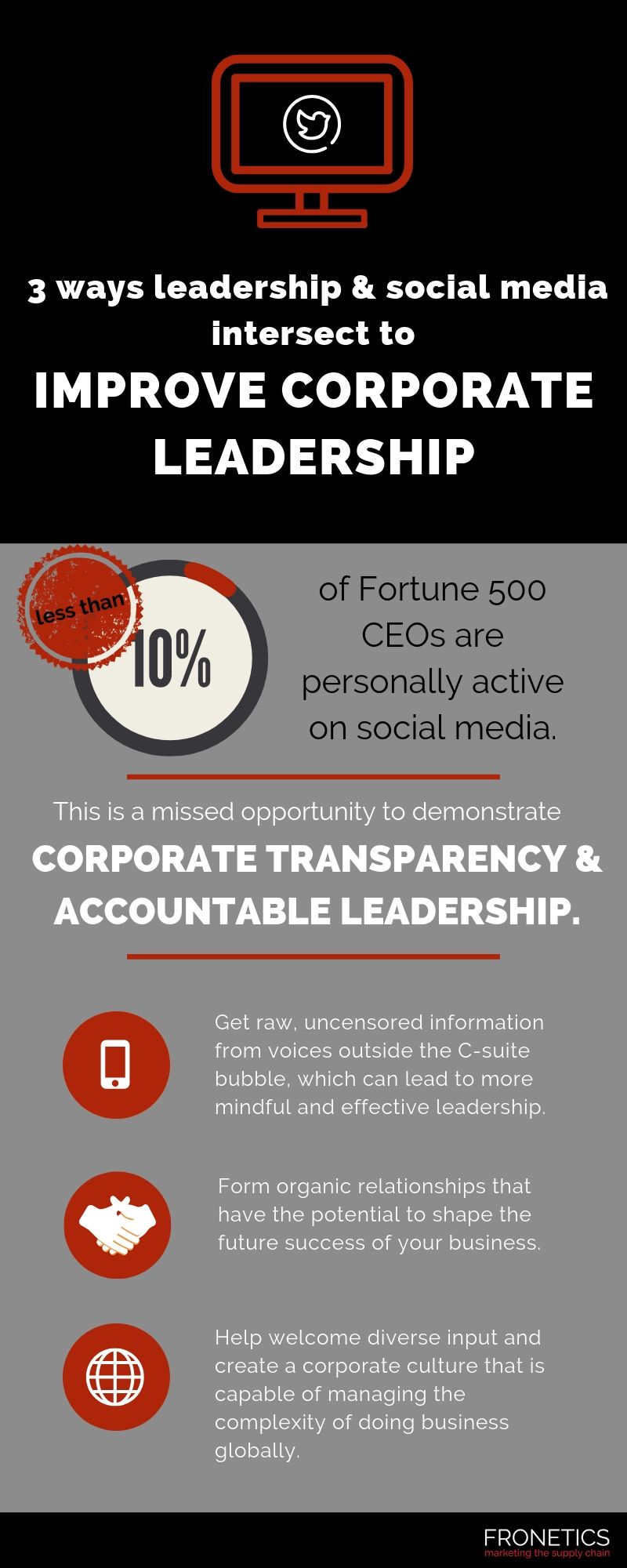
A recent report from Chief Executive found that the vast majority of American CEOs have no personal presence on social media, relying instead on ghostwriters or marketing staff to post on their behalf. Less than 10% of Fortune 500 CEOs are personally active on social media, despite growing public demand for corporate transparency and accountable leadership.
Engagement Leadership expert Céline Schillinger, in exploring the relationship between leadership and social media, has identified more than just the practical benefits (like strengthening brand, managing crises, and presenting a human face to the public) of CEOs on social media. Schillinger has identified three key ways that social media can actually create better leaders.
3 ways leadership and social media intersect to improve corporate leaders
(Made with Canva)
1) Access to unfiltered information
One of the biggest changes that social media has wrought on modern society is the widespread, unfettered dissemination of information, directly from its source. Boiled down to its essence, social media gives everyone a voice. For today’s corporate leader, access to unfiltered information comes at a premium: “Be it competent and well-intended, or self-protective and risk averse, CEOs’ entourage form a distorting bubble,” writes Schillinger.
What better way than social media to burst the bubble and get the raw, uncensored information that leads to mindful and effective corporate leadership? It’s an ideal way to combat the gap in perception between employees and managers, for example, or the service gap between customer expectations and the customer experience. Using social media gives leaders access to real-time, accurate information from the people their businesses serve.
Schillinger says that the informational benefits of leadership and social media extend further. “By role modelling curiosity for unfiltered information and by exchanging thoughts and ideas directly through social media, leaders give symbolic ‘permission’ to their organization to do the same,” she writes. Social media can help leaders create a corporate culture that encourages the free flow of accurate, uncensored information.
2) Relational engagement and enhanced business performance
Best-selling author Brian Solis, who explores the effects of technology on business, marketing, and culture, writes, “Brands are co-created by consumers through shared experiences.” That’s actually a pretty radical message. Particularly for those of us in the marketing world, it’s easy to get caught up with the idea that brands are purely created through the careful work of marketing teams, designers, and image consultants.
But, in fact, what Solis is saying is that thanks in large part to social media, the totality of what makes up a brand identity no longer fits in the frame of what businesses create themselves. Brands are relational. For this reason, corporate leaders need to embrace the idea that effective leadership is “contextual and relational.”
“Relationship building is now a required core competency for all professionals — and for senior leaders in particular,” writes Schillinger. Social media gives leaders the opportunity to form the kinds or organic relationships that have no less than the potential to shape the core of their brands. These are “connections that arise within communities, born from a shared sense of belonging, acknowledgment of emotions, and co-creation of work.”
3) Transformation through mindset change: where leadership and social media intersect
Social media usage has transformational potential: it leads to new modes of interaction and relating to others. As Schillinger points out, “This is why it is fundamentally experiential and cannot be delegated without dampening its impact.” For corporate leaders, social media can help welcome diverse input and create a culture that is capable of managing the complexity of doing business in a global economy.
Schillinger identifies a powerful example of the transformative power of social media on corporate leaders, resulting in unmatched improvement in output. Corporate leaders at Sanofi Pasteur, a vaccines manufacturer, chose to personally involve themselves in an internal online community, interacting on a weekly basis with their employees. Their “asking questions, sharing insights, recognizing achievements, and ‘liking’ posts… had a huge positive impact on their own perception, their leadership, and the flows of knowledge between employees.”
The connection between effective leadership and social media participation is a topic that we’re really only beginning to understand. But what’s clear at this point is that when leaders commit to personal engagement in social platforms, information flows are enhanced, brands are strengthened, and the businesses unlock the kind of transformative potential that leads to unprecedented success.
Related posts:
by Elizabeth Hines | Jun 20, 2019 | Blog, Content Marketing, Logistics, Marketing, Social Media, Supply Chain
Participating in social media is increasingly important for businesses in the supply chain. Here are the 3 steps to proving social media ROI.
Highlights:
- It may seem obvious, but too many businesses approach social media marketing with vague goals or none at all.
- Once you’ve set your goals and identified your key metrics, it’s time to implement a system that will track and measure your metrics.
- Once you’ve calculated ROI for your social media platforms, it’s time to think strategically about optimizing your content marketing resources in terms of allocation and timing.
Video transcript:
I’m Elizabeth Hines, Creative Director at Fronetics, and today we’re talking about three steps to prove social media ROI.
Participating in social media is increasingly important for businesses in the supply chain. But many clients tell us they have a hard time getting approval for the expense because it’s notoriously difficult to measure the return on investment.
Well it’s true that many of the benefits of social media — like greater brand awareness and improved communication with customers — are difficult to quantify, there are some ways to prove the ROI of your participation in social media.
Here are the 3 steps to proving social media ROI:
1. Set goals
I’m not talking “grow your business” or other vague benchmarks like that. I mean “increase web traffic from social by 10% over the next 90 days.” Really specific benchmarks and goals are important in measuring success.
2. Track and measure
Make sure you have means to accurately measure how you’re doing against your goals. All the social platforms have excellent analytics tools to help with this. We also use tools like Google Analytics and HubSpot.
3. React
Look at your metrics in the context of your goals. Once you figure out what’s helping you meet those objectives and where you’re falling short, you can tweak your efforts to be more successful and to make sure that you’re actually achieving your ROI.
For more information on social media and all things digital marketing, visit our website at Fronetics.com
Related posts:

by Jennifer Hart Yim | Jun 12, 2019 | Blog, Marketing, Marketing Automation, Social Media
Automation can make your social media marketing more efficient and effective, allowing you more time to develop and execute other marketing campaigns. Here are 11 social media marketing mistakes to avoid.
Social media automation is quite a controversial marketing topic. The critics cry, “Social media is supposed to be social!” The supporters retort, “It’s all about efficiency!” Surely, there’s a middle ground, right? Just look at those adorable little robot eyes. Automation can’t be all bad, right?
We certainly agree. Social media automation can be done right. Just avoid the following 11 awful social media automation mistakes, and you’ll be good to go.
11 Awful Social Media Automation Mistakes Marketers Should Stop Making
1. You’re Scared of It.
Are you one of those social media automation critics we mentioned in the intro? Stop being such a fraidy cat … you’re missing out! When done right, automation can make your social media marketing more efficient and effective, allowing you more time to develop and execute other marketing campaigns and promotions. We’ve even developed a simple, customizable social media scheduling template and blog post guide to help you organize and plan your social media updates for the most popular social networks. Just avoid the rest of the mistakes on this list, and you’re golden. Guilty social automation conscience begone!
2. You’re Using Way Too Much of It.
Remember: too much of anything is usually bad, and the overuse of social media automation is usually what makes the automation critics cringe the most. First, you need to find the right balance of updates for each of the social networks you’re participating in. This involves testing and optimization to determine your ideal publishing frequency, and it usually involves pushing the limit a little bit. Try increasing the number of updates you currently publish and gauge your fans’/followers’ reactions. You might be surprised that you can update more than you thought and that you get a nice little lead bumps as a bonus!
Remember, the half-life ( the time it takes a link to receive half the clicks it will ever receive after it’s reached its peak) of a link shared on Twitter is only 2.8 hours, which means it’s acceptable to publish fairly frequently. On Facebook, updates last a little bit longer, so you don’t need to publish quite as much. Our social media publishing template recommends starting with 8 tweets a day, 4 Facebook updates, and 3 LinkedIn updates. Which leads us to our next mistake …
3. You Leave No Room for Ad Hoc Updates.
Don’t automate so much content in social media that you’re really pushing it if something last minute pops up that you really want to post an update about on your social networks. Things come up. You’re behind on your leads goal and you just created an awesome new ebook that you want to promote via social? You shouldn’t feel guilty about popping in a tweet or two about it in addition to your scheduled, automated updates. Or maybe you did some awesome newsjacking and you want your fans and followers to know about it right away. Don’t overdo it with the scheduled updates that you have to sacrifice those last-minute opportunities that arise.
4. You’re Setting it and Forgetting It.
Schedule and automate your social media updates and there’s no reason to check your social media accounts until the next batch of updates needs to be uploaded to HootSuite, right? WRONG. Do this, and you should be subjected to the wrath of social media automation critics. Just because you’re automating some updates, doesn’t mean you’re off the hook for monitoring the conversation — and participating in it. You still need to monitor the discussion happening around your content, answering your fans’ and followers’ questions, and, that’s right … engaging. In real time, or close to it. And with all the social media monitoring tools available to make it easier to do, there’s no excuse not to.
5. You’re Hiring an Agency to Manage It and Not Properly Setting Expectations.
Let’s relive the story of a former HubSpot employee who fell victim to some very unfortunate, poorly executed social media automation. What happened was, AT&T hired a marketing agency to execute its Ticket Chasers Twitter campaign for March Madness. The intent of the campaign was to target people who would be interested in the content of the program with personalized tweets: bloggers (who would get the word out about Ticket Chasers), people who live in the cities in which the Ticket Chasers promotion is occurring, and people who mention basketball or March Madness. Except what ended up happening was the agency targeting people that fit these criteria even if they weren’t followers of AT&T — and a very spammy Twitter presence.
The lesson is this: If you’re going to outsource any type of automation, make sure you set some very clear and specific expectations with your agency up front — both for what constitutes proper targeting and automation, and how frequently the campaign should be monitored so there could be a quick response if something goes awry.
6. Your Scheduled Updates Even SOUND Robotic.
Just because you’re scheduling automated updates doesn’t mean it has to sound like a robot wrote the copy. Spend some time carefully crafting your social media updates, and for goodness’ sake, infuse some personality into them! It should sound like a human took the time to craft the update because a human did take the time to create them, right?
7. Your Content Is Stale or Unremarkable.
Nothing indicates a low-quality social media presence like unremarkable content. Whether you’re manually updating your social networks or using automation to make your social media marketing more efficient, it’s all about the content of your updates. Share awesome content that your audience cares about, and they won’t mind that you may have scheduled it in advance. If you’re using HubSpot’s free social media scheduling template, keep your content repository tab stocked with a mix of awesome evergreen content that never gets stale and can be re-promoted over time, as well as new content and offers you create over time.
8. Your Timing Is Way Off.
Just scheduling updates all willy nilly without strategizing about timing? Think about it. Should that online coupon you’re sharing really get tweeted on the 12th when it expires on the 11th? Probably not. Be careful — nothing smells like stinky automation more than careless planning and timing. Should that offer, which just so happens to be targeted at your international prospects in Mumbai, be posted to your Facebook business page at 5 PM ET? Remember, it’s 2:30 AM in Mumbai. Be sure you’re scheduling your updates for times that make sense for your audience, and don’t be afraid to do some testing and experimentation to determine exactly what that optimal timing is.
9. You Treat Scheduled Updates the Same Way on All Social Networks.
Not all social networks are the same, so don’t treat your updates like they’re one-size-fits-all. Each has its own guidelines, tone, and different types of users, so make sure you tailor your updates to appeal to each social network’s nuances. For example, your Twitter updates need to fit within 280 characters, but snippets that accompany links you share on LinkedIn and Facebook can be much longer. And LinkedIn caters to a much more professional audience than, say, Facebook. And remember, you can reuse a lot of the same content across social networks; it’s how you frame and position that content that should be tweaked.
10. You’re Not Measuring Results and Adjusting Accordingly.
Trying to pick your best content for your automated updates? Attempting to determine the optimal timing and frequency of your updates for each social network? You’re probably going to need to rely on your analytics for all those things, don’t you think? Make use of your marketing analytics to identify the content and offers that tend to perform well in social media so you can promote more of the types of content that work, and nix the types that don’t. Track your leads and referral traffic from social media, coupled with qualitative data on how your fans/followers react to timing and frequency, so you can optimize those techniques as well.
11. You’re Not Adding Sharing Links to Your Content.
That’s right — think of it as social media automation enablement. Adding social media sharing links/buttons to all your content, whether it’s a web/landing page, blog post, within an ebook, in an email, makes it easy for your audience to spread your content for you, and expand your reach. It’s sort of like automating evangelism! It might sound sneaky, but your audience will probably appreciate that you’ve done some of the work involved in sharing content for them. People are always looking for social sharing fodder, and if your content is awesome, it’ll make them look like a valuable social media connection who shares great stuff!
Are you making effective use of social media automation? What else would you add to this list of social automation mistakes?
This article was written by Pamela Vaughan. Pamela is a Principal Marketing Manager, Website CRO & Copywriting at HubSpot. She is best known for introducing the concept of historical optimization, which increased organic search traffic and leads for HubSpot’s blog by more than 200%.
Related posts:
by Elizabeth Hines | Jun 5, 2019 | Blog, Content Marketing, Logistics, Marketing, Robotics & Automation, Social Media, Supply Chain
When it comes to digital marketing, social media is here to stay. Here’s our four-step guide to leveraging social media for the robotics industry.
Highlights:
- Having a documented strategy is key to reap the benefits of social media marketing.
- Define your audience and establish concrete goals for social media campaigns.
- Set metrics and use data to adjust your strategy consistently over the long term.
The demand for high-performance robotic systems is growing steadily and showing no signs of slowing down. In fact, New Equipment Digest predicts that the robotics vertical within the materials-handling-equipment sector will grow by over 8%, reaching $20 billion by the year 2024. To capture the benefits of the sector’s growth, robotics companies need to invest in digital marketing. Social media for the robotics industry holds tremendous potential — if it’s leveraged properly.
In our work with clients across various verticals in the supply chain, including robotics, we frequently hear that they have been skeptical about the potential of B2B social media use. While social media management does require time and resources, robotics companies should absolutely be reaping the benefits of social media marketing.
Read on for tips on how to create a strategy and leverage social media for the robotics industry.
4 steps to developing a strategy for social media for the robotics industry
1) Define your audience.
For supply chain companies, one of the biggest predictors of success in a social media marketing campaign is a clearly documented strategy. A big part of that is defining your target audience. Chances are, you have some target buyer personas already. Keep these top of mind as you create your social media strategy.
What are the unique needs and challenges faced by your audience? Where do they go online for information? What are their goals? What do they value from you? The more you ask and answer questions about your audience, the better positioned you are to create a strong and effective social media strategy.
2) Determine your goals.
Next, consider what your goals are on social media. You’d be surprised how often this step gets skipped. Marketers are often pressed for time or resources and think of social media marketing itself as a goal, rather than defining specific, measurable objectives for their social media campaigns.
When it comes to social media for the robotics industry, common goals often include increasing brand awareness and authority, generating leads, or establishing thought leadership. But before you embark on a social media strategy, consider what your company specifically needs to achieve.
3) Define your metrics.
One of the best things about having documented goals for your social media strategy is that it helps you define what metrics you should be using to track your progress toward those goals. Measuring social media ROI is no easy task, but there are plenty of tools and strategies that can help. While your full list of metrics will be determined by the goals you set, robotics companies should be tracking at least these four metrics:
- Where traffic is coming from
- Revenue derived from posts
- Visitor behavior on your site
- Social media conversions
In addition to the analytics tools offered by social media platforms like Facebook, Twitter, Instagram, and LinkedIn, Google Analytics can give you a bird’s eye view of your social media efforts, as well as delving into detail on the metrics that matter most to you. For more, be sure to check out our guide to getting the most out of Google Analytics.
4) Choose your platforms.
Not all social media platforms are created equal. When it comes time to choose your social media platforms and create a strategy for each, it’s important for robotics companies to consider where their audience spends their time online (see step 1).
As you identify what social media channels are the best fit for your company, keep in mind that the characteristics of each platform should inform what content and how often you should be posting. Twitter, for example, lends itself to short-form, pithy content or links and frequent posting, while a more visual platform like Instagram only requires 1-2 posts per day.
Going forward: using your metrics to stay agile
Once your strategy is established, you can simply put it into place, start posting content, and forget about it, right? Wrong. Effective use of social media for the robotics industry requires ongoing evaluation and adjustment.
If you’ve defined the right metrics to track, the data you collect should help you determine where your efforts are successful and where your methods need to be adjusted. As you refine your strategy and learn the needs and preferences of your target audience, you’ll find that social media is an extremely effective tool for capturing leads, broadening your brand’s reach, and building your reputation.
Related posts:
by Elizabeth Hines | May 30, 2019 | Blog, Current Events, Marketing, Social Media
Also, this month in social media news: Facebook shows marketing decline; Instagram introduces unfollower statistics for creators; and YouTube adds still-image ads.
Highlights:
- Facebook announces a new redesign that puts Groups at the center – and brands on the outskirts.
- For the first time in 5 years, Facebook marketing is in decline.
- Instagram is testing small changes that could make a big difference for brands.
It’s been a big month in social media news. Kicking things off, Facebook held its annual F8 developer conference, giving the world some insights into the platform’s future, including long-term goals. Just one week later, Social Media Examiner released its annual Social Media Marketing Industry Report, which showed a decline in Facebook marketing in general.
In the meantime, YouTube is rolling out a new development for advertisers: still image ads. LinkedIn has updated its Job Search tools, and Instagram is empowering creator accounts with data about unfollowers and new likes. Read on for a roundup of social media news from May 2019.
Facebook Holds Its Annual F8 Developer Conference
From April 30-May 1 in San Jose, CA, Facebook gave developers some glimpses into its long-term goals and strategies. Perhaps the biggest news from the conference is the complete redesign of both its desktop and mobile versions. While the redesign has some aesthetic changes, the important thing for marketers to know is that Facebook is now structuring itself around Groups. As Facebook reported, the new design “puts your communities at the center.”
It’s official: Facebook is departing from the News Feed focus, and instead continuing to turn toward being a more friends-focused platform. In the wake of Cambridge Analytica, Facebook is continuing its push to restore user confidence — and in doing so, it’s clearly demonstrating that Facebook is a decreasingly friendly place for brands. Marketers need to stay abreast of the ongoing changes and shift their Facebook strategies accordingly. Keep an eye on our monthly social media news roundups for updates.
New Report: Facebook Marketing Decline
The Social Media Marketing Industry Reportis out, and its findings offer some surprises — at least on the surface. In a reversal of trends from the past 5 years, there is a clear indication that marketers are turning away from Facebook. While this doesn’t mean that marketers are turning away from Facebook entirely, it does mean that they are diversifying their social advertising. One in 10 marketers indicated that they’ll be decreasing their organic marketing on Facebook, and only 51% plan to increase their organic activities, down from 62% in 2018.
LinkedIn Updates Its Job Search Tools
LinkedIn is continuing to build quietly on its success as a highly respected, professional platform. According to LinkedIn’s announcement of recent changes to its Jobs tools, “We’ve grown from 300,000 to 20 million job postings in the past five years, with members applying to 25 million jobs every week and a new hire made every 8 seconds using LinkedIn.”
The network has redesigned its Jobs section, with the goal of catering better to user needs. The homepage is now more streamlined and less cluttered, and more focused on advertising roles, making it easier for users to scan quickly through available opportunities. The platform is also revamping its job alerts system, giving users instant, personalized alerts about available opportunities. It’s also making its Salary Insights data available to all members.
Instagram Separates New Likes on Posts and Adds Unfollower Stats for Creator Accounts
Instagram is testing out some options that will help businesses easily see activity and take actions based on it. The platform is now sorting the Likes section for creator accounts into “Earlier” and “New” sections, helping businesses easily distinguish the latest activity. The feature has been on Android for several months but is new for iOS.
Similarly, Instagram creator accounts now have access data on followers and, notably, unfollowers. This is valuable data for marketers, as it provides context on content and overall account performance.
YouTube Adds New Still Image Ads
YouTubehas announced that it will soon begin providing non-video advertisers with a new still-image option that will appear within YouTube home feeds. “For a long time, advertising on YouTube meant your brand had to have a video or app ad,” says the announcement. “We’re excited to announce today that’s no longer the case.”
YouTube is calling the feature Discovery Ads, and it will use audience targeting to display ads to relevant users based on their activity. “Discovery ads are a simple and effective way to tap into the power of YouTube — and you don’t even need a video. Just upload your best images from your social campaign, then we’ll optimize your media mix for maximum performance across Gmail, Discover and the YouTube Home feed.”
What social media news caught your eye this month?
Related posts: