
by Elizabeth Hines | Sep 18, 2019 | Blog, Marketing, Social Media, Video Marketing
Here are 15 social video marketing statistics that every supply chain marketer should be aware of in 2019.
Highlights:
- 87% of business use video as a marketing tool.
- 83% of marketers report that video gives them a good ROI.
- Social video marketing trends to be on the lookout for: live video and 1:1 personalized video.
If you believe everything you read, you might think that social video marketing has taken a bit of a hit in the past year or so. Largely thanks to Facebook’s well-publicized inflation of video view metrics, companies are naturally wary of investing in video creation and promotion on the platform.
But Facebook’s transgressions shouldn’t undermine marketers’ confidence in the future of social video marketing. Both expert analysis and hard numbers support the notion that video isn’t going anywhere. As digital media expert Michael Humphrey puts it, “All the major upward trends still wrap around video.”
According to Lux Narayan, CEO of independent social analytics company Unmetric, audiences “are longing for more interactive experiences as well as long-form storytelling that only video can best achieve.”
Here are 15 social video marketing statistics we think supply chain marketers should be aware of.
15 social video marketing statistics for 2019
- 47% of internet users have watched brand advertising videos on social media within the past 3 months. (Toluna)
- Of the social media users who have watched branded videos in the past 3 months, 43% watched on Facebook, 38% on YouTube, 18% on Instagram, and 13% on Twitter. (Toluna)
- 87% of businesses now use video as a marketing tool, up from 63% in 2017. (Wyzowl)
- 55% of people consume videos thoroughly – the highest percentage of any content type. (HubSpot)
- 30% of users prefer video ads to text or still image ads, while 52% report having no preference. (Only 18% prefer text or still image ads). (Toluna)
- 83%of marketers say video gives them a good ROI, up from 78% in 2018. (Wyzowl)
- 52% of consumers say that watching product videos makes them more confident in online purchase decisions. (Invodo)
- 68%of people say they’d most prefer to learn about a new product or service by watching a short video, over text-based articles (15%), infographics (4%), presentations and pitches (4%), and ebooks and manuals (3%). (Wyzowl)
- 48% of social media users have sought more information about a product or service based on social video marketing. (Toluna)
- 33% of survey respondents answered yes to having bought a product or service from a brand solely based on social video marketing. (Toluna)
- 88% of video marketers are satisfied with the ROI of their video marketing efforts on social media. (Animoto)
- 82% of social media users prefer live video from a brand to social posts. (Impact)
- 81% of marketers say video has helped them generate leads, and 84% say video has helped them increase traffic to their website. (Wyzowl)
- 61% of marketers have made more marketing videos in house in 2018 than they did in 2017. (Animoto)
- 67% of users said they would like to see more social video marketing in the future over other types of ads. The remaining 33% are indifferent, not opposed. (Toluna)
The future of social video marketing
Suffice it to say, the numbers bear out the fact that video marketing, and particularly social video marketing, is a trend that’s here to stay. Live video is increasingly popular, and savvy brands are incorporating it into their strategies.
In addition to live video, given the growing ease of shooting video on smartphones, another big trend is likely to be 1:1 video. Marketers can nurture leads via personalized video messages, rather than phone calls or emails, using video to offer additional content, product support, or simply to foster a relationship.
The bottom line is that video offers up the kind of engaging storytelling that users today want. And social media is the ideal distribution platform for video, making social video marketing a winning strategy.
Related links:

by Elizabeth Hines | Sep 12, 2019 | Blog, Content Marketing, Marketing, Social Media, Video Marketing
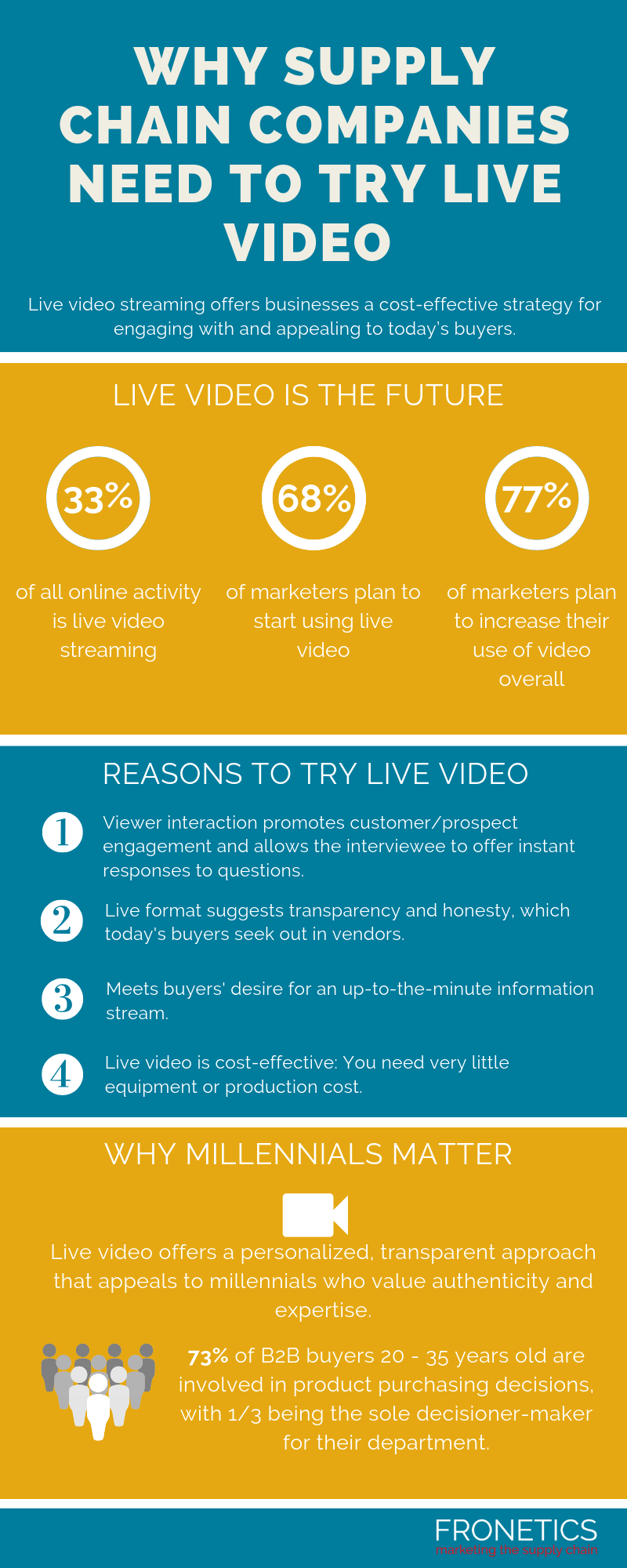
Live video streaming offers businesses a cost-effective strategy for engaging with and appealing to today’s buyers.
With YouTube emerging as the world’s second largest search engine and video becoming themost popular form of online content,it is no surprise that businesses are looking for ways to engage their target audience through video. And they’re even diving into a growing trend in video marketing: publishing content in real time. It makes sense, given live video streaming now represents 33% of all online activity.
Live video was used more for niche markets in its early days. But 68% of marketers plan to start using live video in the next year, and 77% of marketers plan to increase their use of video overall.
(Made with Canva)
How can live video work for the supply chain?
Live video is an increasingly popular content medium for the millennial generation, which is important for supply chain marketers to note as the B2B purchasing landscape skews younger. Consider that around 73% of 20 to 35 year olds are involved in product purchasing decisions at their companies, with one-third reporting being the sole decision-maker for their department. And a 2015 Google/Millward Brown survey of buyers found that about half of purchasing researchers were between the ages of 18 and 24 — and that percentage has only grown in the last few years.
Another important trait to note about millennials? They’re immediately turned off by overt sales pitches. Instead, they expect vendors to offer them value outside the sales funnel by way of education, entertainment, inspiration, or knowledge. So instead of creating video content to promote products, supply chain companies should use the opportunity to provide viewers with these elements of value they expect.
Live video streaming is the ideal medium for doing so, as it offers the transparency, emotion, and personal elements millennial buyers desire. Vendors can connect with buyers on an emotional level while simultaneously communicating their companies’ expertise, which directly impacts the buyers’ opinions of their solutions.
4 reasons to try live video streaming
Live video streaming offers real benefits for supply chain companies in addition to the increasing opportunity to connect with prospective buyers. When clients ask about whether they should try live video, I give them these four reasons:
1. Earn customer/prospect engagement and feedback
Most live video platforms have features that allow for viewer interaction, meaning customers and prospects can ask you questions and get instant responses. (Talk about excellent customer service!) That generates a positive experience that strengthens their relationship with your company. Also, you get the benefit of hearing feedback from a portion of your audience, which you can use to drive change and growth.
2. Promote transparency
Live video can be unpredictable, raw, and honest — which, admittedly, can be scary for the person filming. But today’s buyers crave this kind of transparency. When you go live, things may not always go as planned, but that will work in your favor more often than not.
3. Appeal to those who love to be in-the-minute
Social media users love to feel on top of their information streams. Live video offers that sense of insider, up-to-the-minute scoop that appeals to them.
4. Publish video in a cost-effective way
High-production videos can be costly and can take weeks to produce. One of the best parts about live video is that you need only a smart phone, a Wi-Fi connection, and someone willing to appear on camera (which is sometimes harder than it sounds). Publishing happens in real time, and then most platforms allow you to archive the footage for viewers to access later.
The takeaway
We’ve seen clients have great success with live video streaming. It’s one of those trends that’s not going away anytime soon. In fact, social platforms are increasingly adding “live” and “Stories-like” features to satisfy users’ seemingly insatiable appetite for this format.
That means if you haven’t tried live video, you should think about it. Pretty soon you’ll be one of the only ones among your competitors who is not — if you’re not already.
This post originally appeared on EBN Online.
Related posts:

by Elizabeth Hines | Sep 10, 2019 | Blog, Content Marketing, Current Events, Marketing, Social Media
As social media users increasingly prefer to share content and recommendations via private messaging apps, brands need to be aware of how to take advantage of this trend.
Highlights:
- Nearly two-thirds of social media users now prefer to share content and recommendations through private messaging apps.
- Facebook Messenger is by far the most popular of these platforms.
- Chatbots can help brands engage in conversations on messaging apps and capture leads.
A recent study has confirmed a trend we’ve long predicted: A significant majority (63%) of social media users now express a preference for private messaging apps for sending messages or recommendations to people in their circle, as opposed to posting publicly on social media.
Marketers need to be aware of the implications of this shift toward private messaging apps, or “dark social channels.” Recognizing that three out of five users now prefer to connect via a private channel rather than open social media platforms, brands can tailor content accordingly and create a strategy that capitalizes on this shift.
Private messaging apps by the numbers
GlobalWebIndex and WeAreSocial teamed up to conduct research on content-sharing preferences, looking at more than 3,100 internet users. They asked research subjects how they tend to share information like articles, photos, videos, and recommendations and received the following responses:
- Private messaging apps: 63%
- Social media accounts: 54%
- Word of mouth: 51%
- SMS: 48%
- Email: 37%
Next, researchers broke down the results further, to reveal which messaging platforms users prefer:
- Facebook Messenger: 82%
- WhatsApp: 56%
- Instagram: 34%
- Snapchat: 32%
These are striking numbers. Not only is the preference for messaging apps clear, but brands should take note of the dominance of Facebook Messenger as the preferred platform. It’s likely that this preference is accounted for by the prevalence of social media for content consumption and distribution. Therefore, private messaging apps within social media platforms, with Facebook Messenger chief among them, are an easy and convenient way for users to share information.
What brands need to know about private messaging apps
The trend toward content sharing via messaging apps is mixed news for brands. On the one hand, marketers are likely be dismayed that a significant percentage of website visitors will likely be coming from these untraceable sources. On the other hand, says Olivia Valentine of We Are Social, “it means that there are likely more brand advocates than you might think.”
Valentine is right. When users share content and recommendations on messaging apps, they are engaging in authentic, private conversations, making the recommendations all the more meaningful.
Not only are social messaging apps becoming the preferred content-sharing platform among users, but brands can use these apps directly to engage with their audience. Facebook Messenger now has over 1.3 billion active monthly users globally and offers businesses the opportunity to connect directly and authentically with their audience.
Chatbots
Perhaps you’ve been reading about the rise of private messaging apps for content sharing and despairing over the idea that to keep your business relevant, your marketing staff will now need to be spending every working hour responding to thousands of messages with prospects.
Don’t despair. This is where the latest trend in artificial intelligence for marketers can help. Chatbots are computer programs that simulate, with ever-increasing accuracy, human conversation. This software communicates with your prospects inside a messaging app, carrying on a conversation until a prospect is ready to move down the sales funnel.
When it comes to creating chatbots, we recommend platforms including HubSpot’s Chatflows, Chatfuel, ChatScript, and Facebook’s Bots for Messenger tool.
The takeaway: the shift toward messaging apps is a net positive for marketers
To take full advantage of the growing user preference for private messaging apps, marketers need to ensure that their content is easily shared, engaging, and generative of authentic conversations among their audience. Furthermore, using chatbots can help businesses capture leads and engage in direct conversations on these platforms.
As Valentine points out, while the increased use of private messaging apps does mean that a certain amount of web traffic will be coming from untraceable sources, brands should be celebrating the fact that this trend means that recommendations are far more meaningful and your audience is becoming increasingly empowered to advocate for your brand.
Related links:
by Elizabeth Hines | Sep 5, 2019 | Blog, Logistics, Marketing, Social Media, Supply Chain
Instagram Stories offers paid advertising delivering targeted content to B2B buyers and building brand awareness with potential customers.
Highlights:
- As the number of people using stories has grown, so has the number of businesses using the format to connect with their audiences on social media.
- As more people browse Stories, you can show your ad to the maximum number of people possible using this format.
- You can get more eyes on your video content by posting videos on Instagram Stories.
Video transcript:
I’m Elizabeth Hines from Fronetics and today’s topic is paid advertisements on Instagram Stories.
Instagram Stories are the latest social media trend. As the number of people using stories has grown, so has the number of businesses using the format to connect with their audiences on social media.
Story ads represent an alternative to News Feed ads, which, though still effective, had lost a bit of novelty. Here are 3 reasons to start using Instagram Story ads:
1) Brand reach: As more people browse Stories, you can show your ad to the maximum number of people possible using this format.
2) Traffic and conversions: Send more people to your website, where they can convert to a lead.
3) Video views: Stories are a great platform for video. You can get more eyes on your video content by using it in this channel.
The rise in popularity of Instagram Story Ads tells an interesting, ahem…story. People are interacting more and more meaningfully with brands on their mobile devices and they increasingly want to do so in a format that is easy, convenient, and engaging.
If you want help setting up your Instagram Ads, visit us at fronetics.com to learn more.
Related posts:

by Elizabeth Hines | Aug 29, 2019 | Blog, Content Marketing, Current Events, Logistics, Marketing, Social Media, Supply Chain
Also this month in social media news: Facebook adds Instagram scheduling to Creator Studio and Twitter launches 6-second video ad bidding.
Highlights:
- Facebook is adding an easy option for users to create a still-image slideshow in its Stories feature.
- LinkedIn’s new audience engagement insights will offer improved audience discovery, content recommendations, and industry benchmarking.
- Marketers can now use Facebook’s Creator Studio app to schedule posts on Instagram.
After a somewhat tumultuous July in the world of social media news, August has been calmer. Our updates this month are less concerned with reproaches of Facebook from the Fed and more with news that directly impacts marketers, particularly in the B2B sector. LinkedIn has partnered with third-party providers to offer a robust set of audience engagement insights, and Instagram made the welcome announcement that posts can now be scheduled the Facebook Creator Studio App.
As Stories’ popularity continues to grow, particularly on Instagram, Facebook is working diligently to make its native Stories feature an attractive place for users to post. As part of an ongoing series of updates, this month the social media giant rolled out two new Stories features geared to boost usage. Keep reading for more details on the social media news this month.
Facebook Announces Continued Updates to Stories
As the popularity of Instagram Stories continues to grow, Facebook remains tenacious in trying to encourage usage of its Stories feature. This month, the social network began testing a Stories update prompt displaying a split panel, encouraging users to share to their personal as well as business Page Stories.
Earlier in the month, Facebook added a slideshow option to Stories. The feature allows users to add a still image slideshow to their Story, providing a simplified way to add a stream of images that play out through Story frames. While it was previously possible to achieve the same result by selecting images one by one for each frame, the new option will make it easier.
Facebook believes that Stories are the future of social sharing. While reports indicate that Stories usage is growing, it remains to be seen whether the social media giant can position itself as the preferred platform for Stories content.
LinkedIn Adds New Audience Insights
As part of ongoing efforts by LinkedIn to develop more insight into central topics of interest among its users, the platform has rolled out a new expansion of its marketing partner program with new engagement insights. Responding to the challenge of “reaching and engaging the right audiences at scale,” LinkedIn is partnering with multiple third-party providers to offer a robust set of audience engagement insights.
According to the announcement from LinkedIn, “With these insights, you can better refine your content strategy and make smarter marketing decisions to help deliver better ROI for your LinkedIn ad campaigns and organic posts.” Benefits include audience discovery, content recommendations, and industry benchmarking.
LinkedIn has long been a preferred platform for B2B marketing, and this latest announcement strengthens the network’s credentials.
Facebook Adds Instagram Scheduling to Creator Studio
The latest addition to Facebook’s Creator Studio app is a welcome one for social media marketers. Earlier this month, users began to receive in-app notifications saying, “Instagram and IGTV publishing now available.” Since Instagram scheduling has proven a challenge for social media marketers, this update promises an improved experience.
The new option to schedule Instagram and IGTV posts through Creator Studio offers increased capacity, and it allows marketers to upload to Instagram from a desktop, rather than only through a mobile device. Needless to say, the new publishing and scheduling option will make Instagram marketing far easier. However, it remains to be seen whether posts coming through this process will receive less engagement, a concern in the past with third-party scheduling tools.
Twitter Launches 6-Second Video Ad Bidding
Twitter is launching a new video ad option, namely, 6-second video ad bidding. The ad bidding option means that advertisers will only be charged if their video ad is viewed for 6 seconds. According to the network, “With mobile video consumption at an all-time high, studies show brand impact happens almost instantaneously (within seconds) with video ads.”
Twitter cited the results of a study by EyeSee, which “determined short-form (under 6 seconds) sound-off videos with clear branding drive significantly better ad recall and message association on mobile than linear TVC style videos.” Advertisers will be able to publish on-platform video ads as in the past, but the new option means they can choose only to be charged when a video is viewed for 6 seconds.
Stay tuned for next month’s social media news.
Related posts:
by Elizabeth Hines | Aug 27, 2019 | Blog, Content Marketing, Current Events, Marketing, Social Media
Social media growth slowed for the first time, but marketers are still set to increase budgets in 2020. Here are three reason why they’re sticking with social.
Highlights:
- Social media promotes engagement, and can be used to reinforce ads and boost their performance.
- Brands can continually test campaigns on their platform, get immediate results, and scale successful outcomes.
- As followers like posts and engage with them, they help marketers build customer profiles and increase organic reach through shares and comments.
Video transcript:
Hi, I’m Elizabeth Hines, Creative Director at Fronetics, and today’s topic is 3 reasons why digital marketers are sticking with social.
Digital marketers have been using social media to deepen customer relationships and drive measurable business value. And social media investment remains high. If fact experts predict spending on social media marketing will increase over the next five years. But social media is not delivering on the goods. In fact, social media growth slowed for the first time this year since it started.
So why are digital marketers sticking with social?
1. Engagement
Traditional marketing methods have inundated the market. Consumers are exposed to 4,000 to 10,000 ads a day, most of which flash on a screen as an inherently passive activity. Social media, however, promotes engagement, and can be used to reinforce ads and boost their performance. Consistently publishing to your social media channels results in your brand remaining top of mind when a potential buyer is looking for your product or services and gives you accessibility to engage with audiences that are interacting with your social posts.
2. Cost
Marketers’ goal is always to capture leads and connect directly with prospects. Social media is a platform that companies can control at a relatively low-cost to operate. Brands can continually test campaigns on their platform, get immediate results, and scale successful outcomes. Whether it’s to network with industry professionals, provide customer service, or influence potential customers, social media provides a free, easily accessible way to do so. And more and more customers are expecting to be able to communicate on social media.
3. Mobile
The future of customer engagement is mobile. Social media, with its visual content and short text, is ideally suited for mobile engagement. Prospects engage with social media throughout the day due to its short-form nature, making it more likely you can connect with them. As they like posts and engage with them, they help marketers build customer profiles and increase organic reach through shares and comments.
For more information, please visit our website at fronetics.com.
Related posts: