These days there may be no such thing as “business as usual.” People no longer work for one company for decades and then retire with a pension. Most will work an average of 10 jobs before the age of 40, according to Bureau of Labor Statistics, and that number is predicted to increase over time. Given this fact, it makes sense that, even at the high levels, job consistency is not a given for any one person or any company.
Interim management is an opportunity for companies to handle transition in an optimal way. There are numerous benefits that are cost-effective and efficient.
Organizational continuity
A company can hire someone to come in and specify exactly how they would like to progress in the interim. Demanding status quo, in many ways, may be what the company needs until assessments and next steps are made. The interim manager’s experience can help stabilize public image and alleviate some employee fears.
Choose for specific needs
If continuity isn’t the desired route, the benefit of interim management is that a company can seek specific needs in interim management that fill the holes and address the challenges of outgoing management. If a change is needed, that is possible, too.
Independent thought & experience
Interim management companies work to benefit you and you alone. Of course they gain in some ways, but they are independent from allegiance to other companies and are hired to keep your best interests in mind. It benefits them, in the long run, to serve your specific needs. You can be assured that they aren’t in for a long-term position.
Flexible assignments
A company can hire interim management for however long is necessary. The flexibility of the engagement works well for everyone. Interim management are prepared to work themselves out of the job, genuinely equipped to find the best people for the support role positions and/or an executive replacement. An interim professional can also help navigate unique challenges, act as a board advisor, or offer expertise on special projects and initiatives. They provide effective and efficient talent for the necessary amount of time.
Time to search for candidate
Time, if nothing else, is to be gained here. If an executive becomes ill or leaves unexpectedly, interim management can come in swiftly and deftly take over, allowing for time and space to search for the best replacement candidate.
In a Forbes article about interim executive models in modern management, the author writes, “[G]iven all these benefits, I think companies should be a bit more creative about the way they move people into and out of executive roles.” Interim management is smart. It’s the way of the future in a fast-paced job market.
Fronetics offers management and leadership solutions to organizations within the supply chain and logistics industries during times of transition. Our Fronetics Interim Retained Management Service (FIRMS) is designed to provide specific executive, management, sales or operational expertise when and where you need it, for exactly as long as you need it. By using FIRMS for your interim management needs, you will be able to fill organizational knowledge gaps, minimize disruption, and create positive change for your organization during times of transition.
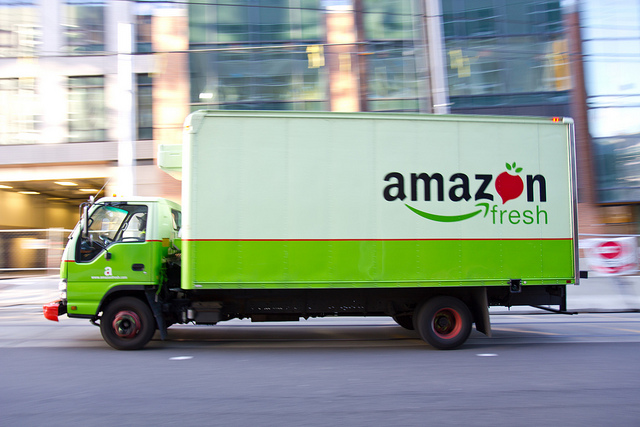
Amazon’s continued expansion into the logistics market seems to be seeping into all corners of the world, making more and more products available with a single click. Inversely, the time frame for delivery keeps dwindling, from two days to the forthcoming 30-minutes-or-less drone-delivery service Prime Air. And more options in less time happy customers make.
Amazon’s commitment to getting packages into the hands of customers as quickly as possible could be the driving force behind its recent foray into the logistics space.
Additionally, reports surfaced in early 2016 that Amazon is in talks with several cargo-aircraft lessors regarding a number of Boeing 767 jets, which can accommodate up to nineteen 88-by-125-inch pallets a piece. The Seattle Times speculates this move is an expansion of an existing trial operation out of Wilmington, Ohio, to determine whether Amazon should pursue a larger air-cargo operation.
Ocean freight and air cargo suggest an interest in controlling operations well beyond the last mile. Could this be the development of a full-scale, in-house logistics department that could independently manage Amazon’s fulfillment process? Or, perhaps, are these steps to manage something beyond the company’s own shipping and delivery?
Amazon hinted at such in a securities filing last Friday, referring to itself as a “transportation service provider” and “companies that provide fulfillment and transportation services for themselves or for third parties” as competition for the first time ever.
Amazon as a 3PL
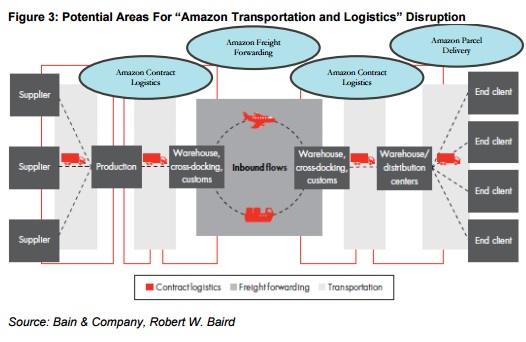
For some time now, the media has been speculating about Amazon‘s intentions to enter the transportation and logistics market as a third-party provider. That would certainly fit the existing pattern: 1) begin operations to better support core retail business, 2) grow and leverage that infrastructure to sell to other businesses.
A prescient October 2015 analysis by Baird Equity Research Analyst Colin Sebastian notes the “powerhouse potential” that Amazon has in the market should it “extend its increasingly complex and technology-centric logistics and delivery platform as a third-party offering.” The report cites the growth of Amazon Web Services (AWS) and Marketplace as templates for the expansion of logistics services to external clients.
Sebastian says the highly competitive global logistics market has yet to fully capitalize on web-based technologies to address supply chain inefficiencies — and Amazon’s wildly successful cloud computing platform, paired with its complex delivery network, may be the answer. The result would be a disruption of incumbent businesses, such as UPS and DHL. “We believe Amazon may be the only company with the fulfillment/distribution density and scale to compete effectively with global providers,” the report says.
The Baird report estimates the global fulfillment market as a $400-450 billion incremental market opportunity. Is this where Amazon has set its sights next?
Fronetics names the best of the best blogs in the logistics and supply chain industries.
The logistics and supply chain industries are catching on to how successful a blog can be as part of an inbound marketing strategy. Companies are creating content that not only fuels conversation about industry best practices, trends, and issues, but also helps drive business to their websites.
Fronetics conducted a survey in January 2016 to determine the top logistics and supply chain blogs in the industry. Here are the results:
Dallas, TX-based Transplace is a 3PL and technology provider serving manufacturers, retailers, and consumer and chemical packaged goods companies. Logistically Speaking is the company’s thought leadership blog. It tells “the latest and the greatest supply chain and transportation stories” through Infographics, interviews with logistics executives, and informative articles offering information and advice.
Readers love: the weekly “TIP list,” or Transportation Industry’s Progression, which curates a short list of articles concerning trending topics and advancements in the industry
Transplace’s CEO Tom Sanderson shares information, opinions, and analysis of factors affecting the supply chain — including company economic data, freight transportation regulation and legislation, and carrier and 3PL financial performance. The blog is rich with charts and graphs that offer big-picture insight on what’s going within the industry.
Readers love: Sanderson’s no-nonsense breakdown of the most pressing issues facing the supply chain
Jennifer Cortez, Director, Marketing Communications, is thrilled with Transplace being recognized by Fronetics and the industry:
“We are thrilled to be recognized as the top logistics and supply chain blogs in 2015. At Transplace, we pride ourselves on providing timely and relevant content to our customers and the industry. Our goal this year is to further connect Transplace and our thought leaders with emerging industry trends.”
Procurious is a UK-based online business network with news, education, discussion forums, and events for procurement and supply chain professionals. The blog goes beyond industry insights — it’s a savvy guide to career advancement and skill development. Articles are written for the modern-day professional, in sync with Procurious’s forward-thinking brand.
Readers love: original series like Life & Style and #firstmovers, which cover interesting, relevant topics in the procurement world.
Thank you to all who took our survey to find the top logistics and supply chain blogs!
Fronetics is a B2B marketing agency for supply chain and logistics companies. We create and execute successful strategies for growth and value creation. Unlike other firms, our approach is data driven. We know ROI is important, so we track and measure results to drive success. Read about our approach to inbound marketing, or get in touch.
Over the past year we have helped many clients both develop and execute social media strategies. We have also disseminated information on how companies can use social media as an effective business tool.
Here are the top 10 social media articles from 2015:
Leads are essential to the growth of your business, and your marketing strategy is built around finding and connecting with leads. So when 92% of all marketers indicate that their social media efforts have generated more exposure for their businesses, you should take note and make social media part of your prospecting strategy. Read the full article.
The supply chain makes the world go round. In order to be one of the leaders in the chain, it’s important to remember that internet users make up nearly half of the world’s population and that social media is on the rise. Don’t miss that boat. Read the full article.
Many transportation and logistics companies think about social media and how to use it, but cite a lack of time as a reason they haven’t explored the various platforms. Thinking about how social media can work for your logistics or transportation company is the first stop towards progress. Read the full article.
Social media is an ideal marketing platform for small businesses because it can be relatively inexpensive but have a high impact on growth. With a targeted strategy in place and a little time, your company can cultivate your brand, engage with customers, and form business relationships. And because small companies can be nimble, you can continually adjust your strategy to ensure the return on investment keeps paying off. Two companies that have seen social media to be effective: Coyote Logistics and Transplace. Read the full article.
The social economy is estimated to be $1.3 trillion U.S. dollars annually. Social media is more than a collection of personal commentary, photos, and inspirational quotes. Increasingly, social media creates an opportunity to gather information, and social media is becoming a useful tool for businesses to connect with other businesses and clients. Although Facebook is notorious for gathering information, social media companies are not the only companies who can gather intelligence. Read the full article.
Offering unparalleled access to leads and face to face communication with prospects and customers, trade shows prove to be a successful marketing strategy for many companies. But is your company making the most of trade shows? Companies that integrate modern digital communication practices into tired trade show routines are likely to increase lead to customer conversion rates while shortening lead and sales cycles. Read the full article.
Companies within the logistics and supply chain industries have been slower to participate in social media than other industries. The primary reason being because of a lack of understanding of what social media is and the role it can play for business. Unfortunately, companies who do not participate in social media miss out on opportunities – and revenue. Read the full article.
Using the information and intelligence gathered is essential. There is; however, another critical element: engagement. Engagement is a differentiator. Without engagement you are a lurker. You don’t want to be a lurker. Read the full article.
Through the use of social media you can enable consumers to make more informed purchase decisions. Additionally, you can use social media to answer questions and better educate consumers on how to use your product thereby reduce no fault found returns. Read the full article.
Social media is an incredible tool; however, for it to be effective it must be driven by strategy, be consistent, and must have someone managing the execution. At Fronetics, our social media strategists distribute content, curate content, engage your target audience, and monitor your social networks. We develop a social media strategy that aligns with your company’s goals. We analyze your competition, classify your target audience & cultural attributes, identify the influencers in your industry, recommend platforms, detail best engagement practices, create social media schedules, and identify specific tactics that deliver results. Through the proper execution of social media, your brand is given a voice and personality, and becomes more accessible to your target audience.
Fronetics is a B2B marketing agency for supply chain and logistics companies. Our industry and functional expertise enables us to fully support and guide our clients as they address critical business issues, take advantages of opportunities, and grow their company. Our clients rely on us to create and execute marketing strategies, capture value from their customer and channel strategies, identify opportunities for increased revenue, create and execute new organizational models, and lead transformational organizational change.
It’s difficult to accurately predict what Amazon will be doing fifteen years from now, but whatever they are doing, it will mostly likely continue to shape consumer expectations and impact the surrounding business and consumer markets in ways we had not thought of beforehand. Read the full article.
There is a common misconception that the majority of goods we purchase arrive via plane, or are transported via road. The reality is that 90% of everything we buy comes by ship — and it’s not likely that this number is going to decrease any time soon. Read the full article.
While many of us may be familiar with recent advancements in home automation, like the Nest thermostat, the real impacts of the Internet of Things (IoT) will be in supply chain management. Recent reports by Cisco, IDC and Gartner all claim that a significant increase in the number of devices making up IoT will have a profound impact on how future supply chains will operate. Read the full article.
Cathy Morris, senior vice president and chief strategy officer for Arrow Electronics, Inc., talks women in the supply chain and offers up career advice. Read the full article.
Regularly tracking your relationship with your suppliers and their performance toward your expectations is critical to ensure the success of your business. One mechanism for tracking this is the supplier scorecard — in essence, a report card for your supplier. Supplier scorecards, when used effectively, can help maintain a healthy supply chain and will benefit both parties. If not used effectively, supplier scorecards can damage the supplier relationship and hurt both businesses. Read the full article.
The pet food industry is a market that boasts $21.57 billion dollars in sales in the United States (2013). According to Trade Group, with 95.6 million cats and 83.3 million dogs owned in the United States, it is no wonder that there is such a large market for the food that the self-proclaimed “pet parents” feed them. However, it isn’t all good news for aspiring entrants, as they must first understand the supply chain that dictates this growing industry. Read the full article.
Uber, the on-demand driver-for-hire mobile service, has come to stand for disruption. The company has not only transformed the taxi industry, it has changed everything. Uber, Aaron Levie notes, is a “lesson in building for how the world *should* work instead of optimizing for how the world *does* work.” NY-based start-up Transfix is doing just this. With the launch of the company’s new app, Transfix is poised to disrupt the trucking industry. Read the full article.
“Man or woman, the Supply Chain of the future depends upon the perfect mix of talent. And, as we know, Supply Chain talent is experiencing a shortage.” Read the full article.
Looking at the manufacturing, supply chain, logistics, transportation, distribution and freight industries, there are a few companies that have emerged as leaders — companies that exemplify the business value of creating and executing digital, social media, and content marketing strategies. Cerasis, a freight logistics company, is one of them. Read the full article.
Companies within the logistics and supply chain industries are revolutionizing their marketing strategies by leveraging social media. They are using blogs, in particular, to establish their position as thought leaders and to drive business to their sites.
Fronetics is, once again, looking to uncover the top industry blog of 2015. We need your help by voting for your favorite blog in the logistics and supply chain industries. Vote here! Answers will be collected through January 15, 2016.
Your nominations are confidential and will be reported in aggregate with no identifiable information (individual or company) attached. Please contact [email protected] with any questions.