The talent gap represents a professional opportunity for motivated individuals looking to advance their supply chain career.
The global supply chain is continuously evolving, offering new opportunities as demands shift and new technologies are born. But how do you evolve with it?
The key is knowing where to look and how to leverage your talent and skills to fit demand. Opportunities are abundant now, but they are also growing, according to the U.S. Roadmap for Material Handling & Logistics. It predicts there will be 1.4 million new jobs in the logistics and supply chain field by 2018.
In fact, the number of supply chain employees is expected to double by 2017, with a high demand for managerial talent. That equates double the opportunity for you to move your career forward!
Here are 5 key actions to advance your logistics or supply chain career:
1) Consider all the skills in your wheelhouse.
Evaluate and take stock of your skills and experience. Know how to articulate exactly what you bring to the table when you consider a new position. Your skills may also be highly transferable, so it is wise to be open to new opportunities. Finally, expand those skills with certifications that will give you a competitive advantage. Look for certifications that enhance your operations and supply chain management skills, like those through the American Production and Inventory Control Society (APICS).
2) Network within the industry.
Employers seeking supply chain talent have to be able to find you. Join associations like APICS, the Institute for Supply Management (ISM), and the Council of Supply Chain Management Professionals (CSMCP). You will gain access to career advice and be a part of a network of supply chain professionals. Join online interest groups and professional networking platforms such as LinkedIn. Follow industry blogs and make connections that relate to, and promote, your career aspirations.
3) Expand your software and technology skills.
This is a constantly evolving area in the supply chain, with new software emerging and a growing demand for talent that knows how to use it. Educate yourself within the software and technology space, and you will open many new doors of opportunity.
4) Know how to promote your soft skills.
Do you have problem-solving experience? A background in communication? Leverage those skills on your resume. Recruiters typically have a list of about 30 job skills that they look at when reviewing job candidates. But soft skills take priority because they produce the most successful new hires. These include: knowledge of basic business ethics, problem-solving acumen, and solid communication skills.
5) Let your differences shine.
You may not see much young or female talent in today’s supply chain industry, but don’t let that discourage you. In fact, this signals opportunity. Many companies are ramping up efforts to recruit (and keep) young talent. And women tend to be strong in many of the soft skills needed for the future of SCM. According to Shanton J. Wilcox, vice president, North America, and lead for logistics and fulfillment at Capgemini, “Many so-called tactical jobs will be replaced by positions requiring more interpersonal and relationship management skills.”
With the present challenges in securing supply chain talent, recruiters are actively searching for specific skills and new employees. You can answer to this demand if you know how to leverage, expand, and promote your skill set to the right people.
As uncertainty pervades following Brexit, experts speculate about the impact a divorced U.K. and E.U. will have on the global supply chain.
As the Brexit vote roils markets across the globe, uncertainty looms in the air for many businesses. Even U.S.-based organizations without operations or suppliers in Europe are feeling the “significant economic repercussions” of the U.K.’s decision to leave the E.U.
Economists have been scrambling to determine the full impact of the referendum. It seems clear that all aspects of the supply chain will be affected in some way. But we won’t have a clear picture of precisely how prior to the conclusion of the two-year period of negotiation on Britain’s exit terms. Some experts speculate that it could take up to 10 years for new trading relationships with various countries to play out.
For now,“the overriding message for the European logistics and supply chain industry is one of ‘business as usual,’” says Transport Intelligence’s CEO, Prof. John Manners-Bell. “It will be in everyone’s interest to ensure that there is as little disruption to the movement of goods throughout the region as possible.”
In the meantime, here are 8 of the top analyses of Brexit’s impact on the logistics and supply chain industries.
Today’s customers expect value, quality, and speed. Focusing on how your can deliver on those promises is what will win you business.
Remember that great advice: focus on yourself, not on what others are doing. According to an article in Harvard Business Review, the greatest challenge your company faces today is not keeping up with your competitors, but keeping up with your customers’ expectations.
This is not to discount the importance of watching business trends and monitoring the competition. But, your primary focus should be on what your customers need and expect and if you are providing it.
What do customers expect?
In today’s digital age, your customers’ expectations wash away traditional boundaries. According to a report in The Economist Group, customers compare and contrast their digital experiences across all industries, even those that offer totally different products or services.
Do you stand out above the crowd? Ask yourself this:
Do you offer value, quality, and speed? Customers used to be willing to trade off one to get the other. Those days are gone. Today’s customer dictates that they want it all: lowest price, good quality, and fast delivery.
Do you offer what the “big guy” does in terms of product, service, and ease, but with the care of a small business people trust? The size of your business does not matter in a digital marketplace. But, you must offer the scope, scale, and influence associated with being big, while maintaining the creativity and personal service characteristic of smaller businesses.
Do you focus on helping customers to meet their objectives and needs? Do you share a purpose? According to an article in Harvard Business Review, what you provide ideally is not something you are going to do to them, or for them, but with them. It’s a journey you take together.
Do you offer an intuitive sales funnel? Customers expect you to be where they are, deliver what they want, when they want it, and how they want it. If they are shopping your site, leave, and come back later, they want to pick up where they left off. They demand intuitive ease and ultimate convenience while they shop.
Do you offer personalized customer experiences? Remember what happened every time Norm entered that television bar called Cheers? Your customers want you to know their name when they return, as well as their unique individual preferences, and they also want you to make relevant recommendations for products or services they may like.
Do your social media interactions inform and help customers? Your posts should not deliver a sales pitch. Social media content should be educational, entertaining, or support the needs and interests of your audience.
There are new rules businesses must follow today in creating the ideal digital journey for their customers. Focus your attention on exceeding customer expectations and answering to their unique needs, not on your competition.
Try writing about these topics on your supply chain blog to engage customers.
Content is an important part of many logistics and supply chain companies’ marketing plans. Yet nearly half (45%) say creating quality content on a consistent basis is their biggest challenge.
If your business is part of the 90% that produces some or all content in-house, you have likely struggled with this from time to time. You know that you shouldn’t pitch your products. But, then, what are you supposed to say on your blog?
Here are some thoughts on what to write about:
1) Offer something of value.
Do you have expert advice on a particular topic? Is there something about your products or your people that would be entertaining to your audience? Do you have access to top-of-their-field specialists that could discuss a particular issue?
2) Share your mission.
What is your company’s mission statement? Pick one aspect and describe why this is important to you/society, or illustrate how your company is living up to it. For example, a green transportation company might create an infographic about the industry’s impact on the environment.
3) Tell a story.
What anecdotes can you share about your business? Are their employees with exceptional stories to share? Customers whose narrative bears repeating? What stories illustrate something about your business? For example, Southwest Airlines’ Nuts About Southwest blog regularly shares customer stories — tugging at the heartstrings with nearly missed births, marriage proposals, and, of course, adorable animals — that illustrate the airline’s commitment to customer service and on-time arrivals.
Dear companies in the logistics and supply chain industries,
You have leveraged technology and innovation so that two-day shipping is becoming more of the norm rather than the exception. You have developed processes and standards for IT Asset Disposal (ITAD), which mitigate asset recovery management and increase data security. You have leveraged 3-D printing — disrupting the status quo.
Cathy Morris, senior vice president and chief strategy officer for Arrow Electronics, Inc., puts it well: “Products can be made, money can be invested, ideas can be brought to fruition, but without the supply chain everything stops. The supply chain provides routes to market; everything hinges on an effective supply chain.”
In short, logistics and supply chain — you are pretty damn awesome.
Given your awesomeness, I wonder why marketing firms have taken to courting your business by promoting that they do “content marketing for boring industries.” You are not boring (in the least). Why would you choose to partner with someone that finds you boring?
Content marketing can be an effective tool for your business. When aligned with your business objectives, content marketing can:
Build brand awareness
Position your company as a thought leader within the industry
Increase engagement with customers, partners, and stakeholders
Educate and inform customers, partners, and stakeholders
Build trust
Allow you to manage your reputation
Generate leads
Given the impact a successful content marketing strategy can have on your business, doesn’t it just make sense to find a marketing firm that recognizes the value of your industry and of your company; a firm that recognizes your awesomeness?
I lead the digital and content marketing arm of Fronetics. Our firm focuses on companies within the logistics and supply chain industries. Why do we do this? We do this because we have deep expertise in these industries, and because we believe in these industries. We stay up to date on industry trends. Phrases like: “Can you believe the capabilities of company x’s new forklifts?” and “Wow, the reverse logistics implications of that are going to be significant,” are daily conversations for us.
I am not saying that you need to choose our firm as your marketing firm, but, please, choose a firm that believes in you. When choosing an outsource partner, evaluate not just the firm’s marketing capabilities, but also their knowledge of your industry.
You do incredible work. Find a partner who recognizes this, not one who finds you boring.
As part of our series on trailblazing women in the supply chain industry, I interviewed Barbara Jorgensen, co-founder and managing editor, Electronics Purchasing Strategies (EPS). Jorgensen has more than 20 years’ experience as a journalist, working for leading electronics industry publications such as Electronic Business, Electronic Buyers’ News, and EDN.
As a freelance writer, Barb wrote and managed an award-winning custom publication for Sager Electronics; was a leading contributor to Avnet Global Perspectives magazine; was a regular columnist for the National Electronics Distributors Association monthly newsletter; and wrote for industry associations such as IPC. Barb was also a featured blogger on the B2B Website Allbusiness.com and helped launch Electronics Sourcing North America, a start-up magazine serving purchasing professionals in the Americas.
Prior to her freelance career, Jorgensen was a senior editor at Electronic Business, the pre-eminent management magazine for the electronics industry, featuring world-class manufacturing companies such as Dell, Hewlett-Packard, Cisco and Flextronics International. Before joining EB for the second time, Barb spent six years with Electronic Buyers’ News as managing editor, distribution, winning several awards for coverage of the distribution beat. A graduate of the University of Binghamton, Barb began her journalism career with the Gannett newspaper chain. She has worked for a number of local newspapers in the Greater Boston area and trade journal publishers Reed Business Information and UBM.
How long have you worked in the supply chain industry?
I’d measure my specific supply chain experience with the publication of my first feature on electronics distribution in 1989. After copy editing for a leading electronics industry magazine for a couple of years the editors suggested I use my journalism experience to do some writing. I profiled Marshall Industries, a top-tier distributor at that time, and its founder, Gordon Marshall, who passed away last year.
How did you choose (or end up) working within the industry?
In high school and college, I specialized in journalism and had been writing features and covering town government for a Boston-area daily newspaper. The schedule was grueling, so I applied for work at a trade magazine publisher. This eventually led to being assigned the electronics distribution beat. I made it my goal to understand the business inside and out, and that expertise helped establish my credentials in the industry.
Two of the leading distributors now generate revenue in excess of $20 billion per year; I was calling on them before they reached their first $1 billion.
Although I never expected to become an expert in the electronics supply chain, the growth of the industry and my expertise has enabled a solid career path.
Let’s talk about EPS. How did EPS come about?
Electronics Purchasing Strategies – soon to be called EPSNews – was driven by several external events taking place in trade publishing. A few years prior to EPS, which started publishing online in 2013, the last purchasing publication in the industry closed its doors. Trade publishers were also laying off editors as they moved more content online. My two colleagues and I – Gina Roos and Bolaji Ojo – found ourselves unemployed all at the same time.
Given the under-representation of purchasing in the trade media, we decided to come together and start an online publication. Our reputation in the electronics industry helped us secure our first advertisers. We have been fortunate enough to support the publication primarily through advertising and newsletters since.
Where is EPS today?
While we were assessing our business model after three years we discovered we weren’t keeping pace with some of the dynamics of online publishing. Although our content has always been well received we weren’t getting as much ‘bang for the buck’ as we should have vis-a-vis SEO because of the way we developed our site. Although our content won’t change—we are focused on deep analysis of the entire supply chain from design through recycling – emphasizing the news aspect of our coverage will attract a wider audience and result in better organic growth.
Revenue-wise we have grown every year since our inception; 2015 was our best year so far, growing in the mid-double-digits.
What goals do you have for the company?
We’d like to expand. Our audience has largely been based in the U.S. because that is the market we know best, but clearly electronics procurement in the Far East continues to expand. The electronics markets in Europe remains steady and, let’s face it, the supply chain is global. So EPSNews would like to devote resources toward building an audience in the EU, the Far East, and relevant geographies in between.
Have you seen a change in the number of women entering the industry and/or contributing to the industry?
Absolutely. When I began my writing career in the tech industry there were fewer women in trade publishing – most of the women I networked with then were in marketing and PR. But that changed pretty rapidly at least on the media side during the 1990s. I’d say by then there was a 50-50 split between women and men in key editorial positions. In the electronics industry, however, there were few women executives. The first woman CEO of a major distribution company was Harriet Green, named CEO of Premier Farnell in 2006. Prior to that there were a handful of women in C-level positions – I know if I mention names I will forget someone – which was extremely encouraging. These days I see more women at industry forums such as EDS and at the ECIA conference than ever before, and they are in management positions.
Have you seen a change in the positions women hold within the supply chain industry?
Again, absolutely. Women are holding higher positions in management within my ‘world’—electronics distribution – but even more so within the online/social media companies such as Yahoo that have become so important to all of us. I also recently attended a presentation by a woman who headed the high-tech entrepreneurial business within Foxconn – a Chinese EMS company – who has since moved to Flex.
Any advice for women considering entering the industry?
My advice would be the same for anyone—learn as much as you can upfront. In business journalism, I had to interview CEOs and MBAs and at the beginning that was intimidating. I finally overcame that fear by reading everything I could about the company, the industry and the executive in advance, and I also asked ‘dumb’ questions of people I trusted. I also found that admitting what I didn’t know never hurt me: even the highest executives in the industry were willing to take the time to explain many of the things that make this industry unique. I think in general people are always willing to give someone a ‘hand up.’ I also found that companies like to work with writers that took the time to learn about their business. Knowledge and professionalism are guidelines I’d recommend for anyone.
On a broader level, what trends do you see within the industry?
I think right now there is a lot of turmoil regarding the supply chain as we know it and the implications of conducting business digitally. This applies to how companies work internally and how they are going to market. The supply chain has done a pretty good job at adopting technology to improve internal operations – we haven’t had an inventory glut since 2001. Externally it’s another matter. E-commerce unintentionally set off huge problems in counterfeiting. We are still trying to figure out where social media fits: it looks like ‘free’ advertising – you can generate a lot of attention with a tweet – but you don’t always control your message. Look at the mistakes people make that go viral.
Then there is managing the supply chain online. Business practices within the electronics supply chain haven’t kept up with technology. For example, supplier franchises are still granted on a regional basis – less so than before – but online business doesn’t have any boundaries. I think we are going to see common supply chain practices change as technology accelerates. Geographic boundaries are already crumbling, and there are practices such as ship-from-stock-and-debit; inconsistent global pricing; and demand-creation compensation that are simply inefficient. There’s little room for inefficiency in the digital supply chain.


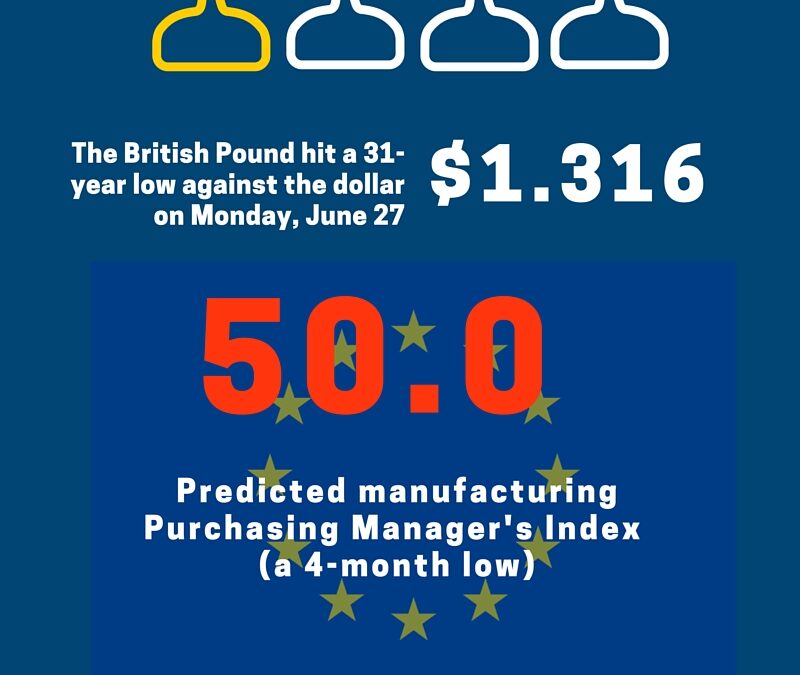
 As uncertainty pervades following Brexit, experts speculate about the impact a divorced U.K. and E.U. will have on the global supply chain.