Your buyers are locked into multi-year contracts, decisions run through five departments, and most B2B marketing advice assumes a short sales cycle and a single decision maker. That is why a supply chain marketing strategy has to be built differently.
We have been marketing logistics providers, manufacturers, and supply chain companies since 2011, and the ones that grow consistently plan around those realities instead of fighting them. Below, we cover where generic playbooks break, how to plan around contract cycles, how to win over a full buying committee, and how to tie marketing to pipeline.
Why generic B2B playbooks break in supply chain
Most B2B marketing playbooks fall short in supply chain because they assume a short sales cycle, a single decision maker, and a buyer who is happy to download an ebook. Supply chain deals rarely look like that. When you copy a generic playbook, you get plenty of activity and very few conversations with the people who sign contracts.
| Assumption in most B2B playbooks | What supply chain buying actually looks like |
|---|---|
| One department owns the decision | Operations, procurement, finance, IT, and executives all have a vote |
| Buyers move through a funnel in weeks | Buyers move when a contract renews, a peak season goes badly, or a new facility opens |
| Gated content generates leads | Operators want specs, capabilities, and proof without filling out a form |
| More traffic means more pipeline | The total market might be a few thousand accounts, so relevance beats reach |
| Brand is about awareness | Brand is about lowering perceived risk, because a bad vendor choice shows up fast in missed shipments or downtime |
The rest of this strategy is built around those realities.
How do contract cycles change your marketing plan?
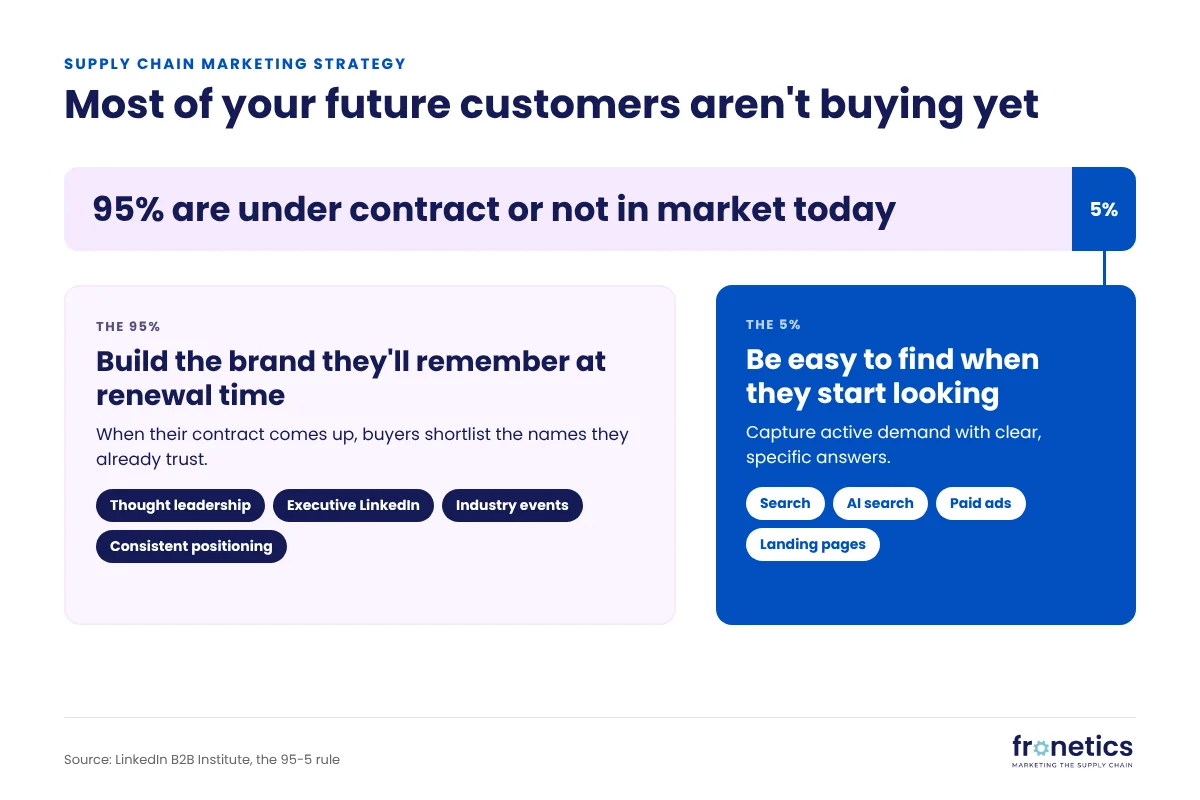
Because most of your future customers are under contract with someone else right now, your plan has to do two jobs at once. It needs to build familiarity before their agreement is up, and it needs to make you easy to find when they start looking. The LinkedIn B2B Institute’s 95-5 rule estimates that 95% of potential B2B buyers are not ready to buy today. In supply chain, where agreements often run for years, that feels conservative.
That has two practical consequences.
- You need to be known before the window opens. When a shipper’s warehouse contract is 90 days from renewal, they build a shortlist from the names they already trust. Brand work like executive thought leadership, consistent LinkedIn presence, and visibility at the right events is what gets you on that list.
- You need to be easy to find when it does open. Buyers increasingly research on their own first. In a 2026 Gartner survey of 646 B2B buyers, 67% said they prefer a rep-free buying experience and 45% said they used AI during a recent purchase. Search, AI search, and paid campaigns are how you show up during that research.
It also helps to know roughly when your target accounts’ current agreements come up, so you can time account-based efforts around those windows.
Who is on a supply chain buying committee, and what does each person need?
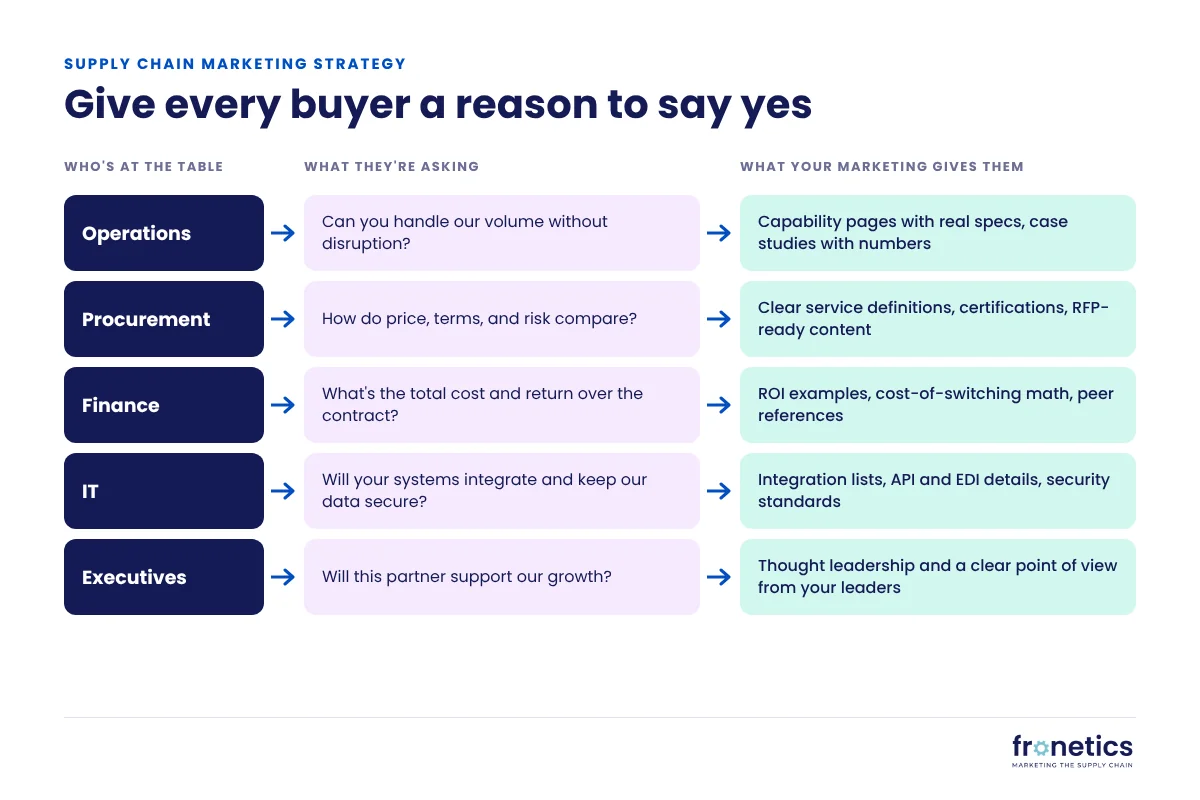
A typical supply chain buying committee includes operations, procurement, finance, IT, and executives, and each needs different proof before they will support a decision. Deals are rarely won by convincing one person. They are won when nobody on the committee has a reason to block it.
Here is what each group is asking, and the marketing assets that answer them:
- Operations wants to know you can handle their volume without disruption. Give them capability pages with real specs, case studies with numbers, and implementation timelines.
- Procurement wants to compare price, terms, and risk. Give them clear service definitions, certifications, insurance and compliance details, and RFP-ready content.
- Finance wants total cost and return over the contract. Give them ROI examples, cost-of-switching math, and references from similar companies.
- IT wants to know your systems will integrate and keep data secure. Give them integration lists, API and EDI documentation, and security standards.
- Executives want a partner who supports growth and protects their customers. Give them thought leadership from your leadership team and a clear point of view on where the industry is heading.
Most supply chain websites are built almost entirely for operations. If your site has nothing for procurement, finance, or IT, someone else’s site is answering their questions.
Why so many supply chain companies sound the same
Most supply chain companies sound alike because they lean on the same handful of claims. Read the homepages of ten 3PLs, ten contract manufacturers, or ten supply chain software companies and you will see the same words. Customer focused. Flexible. Reliable. End-to-end. Technology enabled. When every option makes the same claims, buyers fall back on price or on whoever they already know.
A quick test we use with clients is to swap your logo onto a competitor’s homepage. If the copy still works, you do not have positioning yet. Stronger positioning usually comes from one of these:
- A clear specialty. An industry, a mode, a region, a product type, or a problem you solve better than anyone else. A 3PL that is known for food grade fulfillment in the Southeast is easier to remember than one that does everything everywhere.
- Proof over adjectives. Square footage, on-time rates, certifications, tolerances, uptime, and named customers where allowed.
- A point of view. Something your leadership believes about the industry that not everyone agrees with.
- Visible people. Supply chain is a relationship business. Buyers want to know who answers the phone when a shipment goes sideways.
Once you land on it, the same positioning needs to show up everywhere, including your website, LinkedIn, sales decks, trade show booth, and proposals.
Which marketing channels work best for each supply chain segment?
The best channels depend on the segment. Logistics providers tend to get the most from search, LinkedIn, and account-based outreach, manufacturers from technical content and trade shows, and supply chain software companies from thought leadership and LinkedIn ads. Here is where we typically focus for each segment.
| Segment | Channels that usually carry the load | What to emphasize |
|---|---|---|
| Logistics and 3PL | Search and AI search, LinkedIn, account-based outreach, trade shows | Network, industry specialties, visibility technology, references |
| Transportation and intermodal | Account-based outreach, LinkedIn, industry events, paid search | Lane coverage, equipment, safety and on-time performance |
| Warehousing and fulfillment | Local and service search, paid search, location pages | Locations, square footage, certifications, peak season capacity |
| Manufacturing and industrial | Technical content, search, trade shows, email nurture | Specs, tolerances, quality certifications, application examples |
| Electronics, EMS, and ITAD | Technical content, search, account-based outreach | Quality and security standards, traceability, chain of custody |
| Supply chain software and technology | Content and thought leadership, LinkedIn ads, review sites, ABM | Clear positioning, integrations, time to value, ROI evidence |
A few notes on the channels themselves:
- Search and AI search. Supply chain searches are specific, like “cold chain 3PL in Dallas” or “R2 certified ITAD provider.” Pages that answer those exact needs with clear facts are what Google and AI tools pull from. That is the focus of our SEO and AI search work.
- Supply chain advertising. Paid search catches buyers who are ready now. LinkedIn ads let you reach a small, well-defined pool by title, industry, and company size. Trade publication sponsorships build familiarity with the right readers. Because audiences are niche, tight targeting and matching landing pages matter more than budget size. More on our approach to supply chain advertising and paid ads.
- Content and thought leadership. The best content answers the questions your sales team hears every week and gives each committee member something to forward. See how we approach content and thought leadership.
- LinkedIn. Posts from executives and subject matter experts usually travel further than company page posts. Consistency beats volume. Our LinkedIn programs are built around those voices.
- Account-based marketing. When your target list is a few hundred accounts, account-based marketing lets sales and marketing work the same accounts with tailored ads, content, and outreach.
- Trade shows. The return comes from what happens before and after the booth, including scheduled meetings and fast follow-up. Our logistics trade show list helps with planning, and our trade show marketing services cover the rest.
- Your website. Every buyer visits it. It needs specific service and industry pages, proof next to every call to action, and pages that search engines and AI crawlers can actually read. That is where our website design work starts.
How do you build a supply chain marketing strategy?
You build a supply chain marketing strategy in seven steps, starting with revenue goals and moving through your ideal customer, the buying committee, positioning, channels, content, and measurement. It does not need to be a 60-page document, just clear answers written down and agreed on with sales.
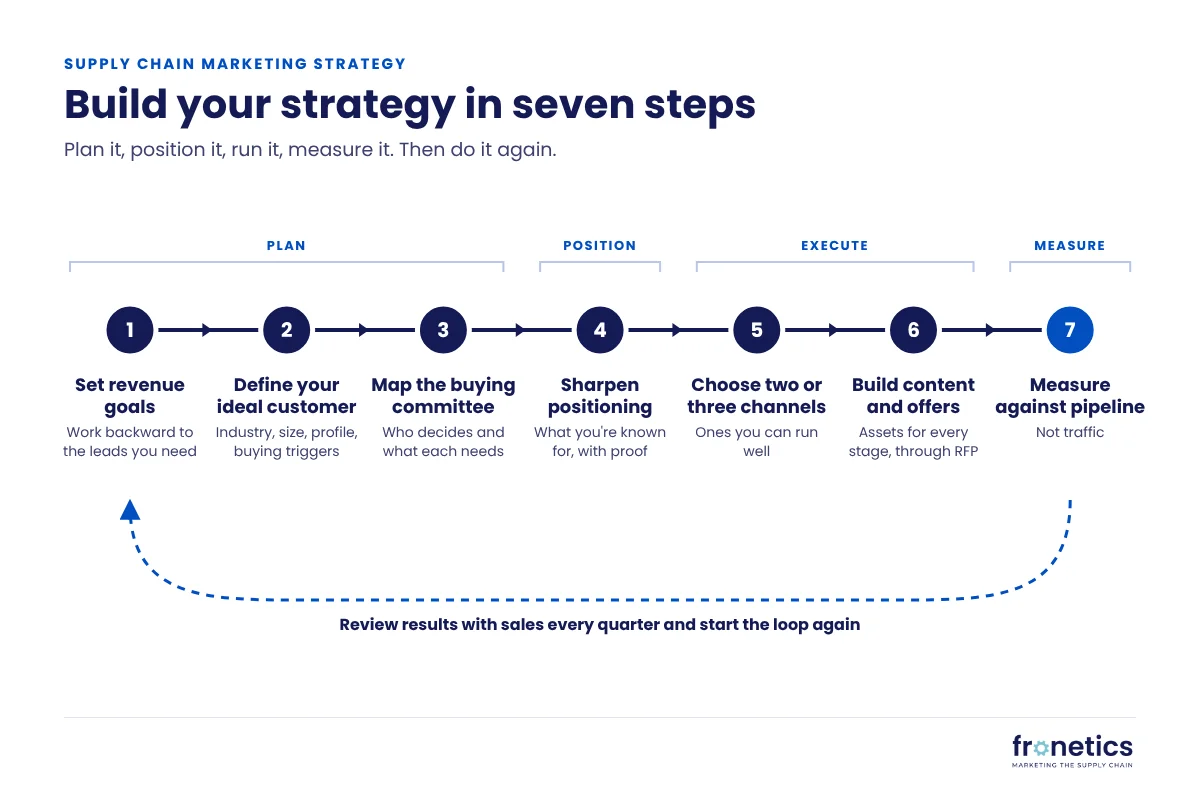
- Work backward from revenue. Start with the new revenue you need, then use your close rates and average deal size to estimate the opportunities and qualified leads it takes.
- Define your ideal customer in operational terms. Industry, company size, shipping or production profile, geography, and the triggers that make them start looking, such as a failed peak season, a new facility, or a contract renewal.
- Map the buying committee. Who is involved, what each person needs to see, and where they get information.
- Pressure test your positioning. Run the logo swap test, then decide what you want to be known for and the proof that backs it up.
- Pick two or three channels you can run well. Use the segment table above as a starting point. Add channels once the first ones are working.
- Build the assets each stage needs. Service and industry pages, case studies, technical content, and RFP support, so nobody on the committee is left without answers.
- Measure against pipeline and review with sales monthly. Adjust spend toward what produces conversations with the right accounts.
If you want help running the full program, our lead generation services follow this same process.
Measure what leadership actually cares about
The numbers that matter most are pipeline sourced and influenced, win rate, deal size, and sales cycle length, supported by early signals like branded search, target account engagement, and qualified inquiries. Traffic and engagement alone will not hold up in a leadership meeting.
| Stage | What to track | What it tells you |
|---|---|---|
| Brand | Branded search growth, LinkedIn engagement from target accounts, mentions in AI answers | Whether more of the right people know your name |
| Research | Non-branded rankings, visits to service and industry pages, repeat visits from target accounts | Whether buyers are evaluating you |
| Conversion | Quote and contact requests, meetings booked, cost per qualified lead | Whether interest turns into conversations |
| Revenue | Pipeline sourced and influenced, win rate, deal size, sales cycle length | Whether marketing is paying for itself |
One tip. Ask “How did you hear about us?” on every quote form and in every first sales call. Attribution software misses a lot in long, multi-touch deals, and self-reported answers often explain what the data cannot.
What we would stop doing
These are the habits we see hold supply chain marketing programs back most often.
- Leading with capabilities. “Full service solutions” does not match anything a buyer types or says. Lead with the operational problem you solve.
- Marketing only when sales slow down. Long cycles punish stop and start programs. By the time pipeline dries up, the shortlists for next year are already forming.
- Gating everything. Operators want to evaluate you quietly. Save forms for the moments that justify them, like quotes, assessments, and pricing conversations.
- Burying proof. Case studies on one page do little. Put proof next to every claim.
- Treating AI search as a future problem. Buyers are already building shortlists in AI tools. Vague or hard to crawl sites get left out.
- Planning without sales. Sales knows the objections, the renewal dates, and the accounts that matter. Build the plan with them.
See it in practice
Our supply chain marketing examples show programs we have built for logistics providers, manufacturers, and technology companies. If you are building your own proof, our guide on writing a 3PL case study walks through the structure we use.
Where to go from here
The supply chain companies that win consistently are not the ones with the biggest budgets. They are specific about who they serve, visible before buyers need them, easy to find when buyers start looking, and ready with proof for every person at the table.
If you want a second set of eyes on your plan, see how we help supply chain companies across every industry, or talk with our team.
Frequently asked questions
What makes a good supply chain marketing strategy?
A good supply chain marketing strategy starts with revenue goals and works backward. It defines the ideal customer in operational terms, maps the full buying committee, uses positioning backed by specific proof, focuses on two or three channels the team can run well, and measures results against pipeline rather than traffic.
How is supply chain marketing different from other B2B marketing?
Supply chain deals involve larger buying committees, longer sales cycles tied to contract renewals, and buyers who need operational proof such as capacity, certifications, and references before they engage. Channels like search, LinkedIn, trade shows, and account-based marketing tend to outperform broad awareness tactics.
Which marketing channels work best for supply chain companies?
It depends on the segment. Logistics providers and 3PLs usually get the most from search, AI search, LinkedIn, and account-based outreach. Manufacturers and electronics companies lean on technical content, search, and trade shows. Supply chain software companies rely more on thought leadership, LinkedIn ads, and review sites. Most companies do best by running two or three channels well before adding more.
How long does supply chain marketing take to show results?
Paid search and LinkedIn ads can produce inquiries within weeks. SEO, AI search visibility, and brand building usually take several months to build momentum. Because supply chain sales cycles are long, the full effect on closed revenue often takes six months to a year.
Should supply chain companies invest in brand or lead generation?
Both. Most potential buyers are under contract with another provider at any given time, so brand building keeps you on the shortlist when their agreements come up. Lead generation captures the smaller group that is actively evaluating options now. The right balance depends on your growth goals, deal size, and how long your contracts run.
Related reading