Supply chain deals rarely die in the demo. They die six weeks later, when procurement joins the thread and asks for a cost breakdown, insurance certificates, and three references your team has to scramble to find. Marketing to procurement means having those answers ready before anyone asks: a pricing explainer, total cost comparisons, current compliance documents, and case studies with numbers.
Below, we cover when procurement shows up in freight, 3PL, software, and EMS deals, what they evaluate, and the six assets that move them to yes. It’s written for sales and marketing leaders at supply chain companies whose deals stall after the shortlist.
Why procurement has more influence than it used to
Buying groups have gotten bigger and harder to align. In a Gartner survey of 632 B2B buyers published in 2025, 74% of buying teams showed “unhealthy conflict” during the decision process, and groups that reached consensus were 2.5 times more likely to report a high-quality deal. Procurement is frequently the function that forces that consensus, because they’re the ones comparing vendors side by side.
Buyers also want to do more of that comparison on their own. Gartner found that 61% of B2B buyers prefer a rep-free buying experience, and 69% report inconsistencies between what a vendor’s website says and what its sellers tell them. For procurement, an inconsistency is a red flag. If your rate sheet, your website, and your proposal don’t match, you’ve given them a reason to keep looking.
When procurement shows up in a supply chain deal
Timing varies by category, but the pattern is predictable. Here’s where procurement typically enters and what they’re looking for at each point.
| Deal type | When procurement joins | What they ask for |
|---|---|---|
| Freight and transportation | At the RFP or bid stage, often before you’ve met operations | Lane pricing, accessorials, fuel surcharge method, insurance, safety scores |
| 3PL warehousing and fulfillment | After site visits, during contract negotiation | Cost per unit or pallet, minimums, startup fees, SLAs, exit terms |
| Supply chain software | After a technical win, during security and commercial review | Total cost of ownership, implementation fees, SOC 2 report, data terms |
| Contract manufacturing and EMS | At RFQ, and again at supplier qualification | Unit cost by volume tier, certifications, capacity, quality history |
In freight, procurement may be your first contact. In software, they’re often your last. Your content needs to be ready for both.
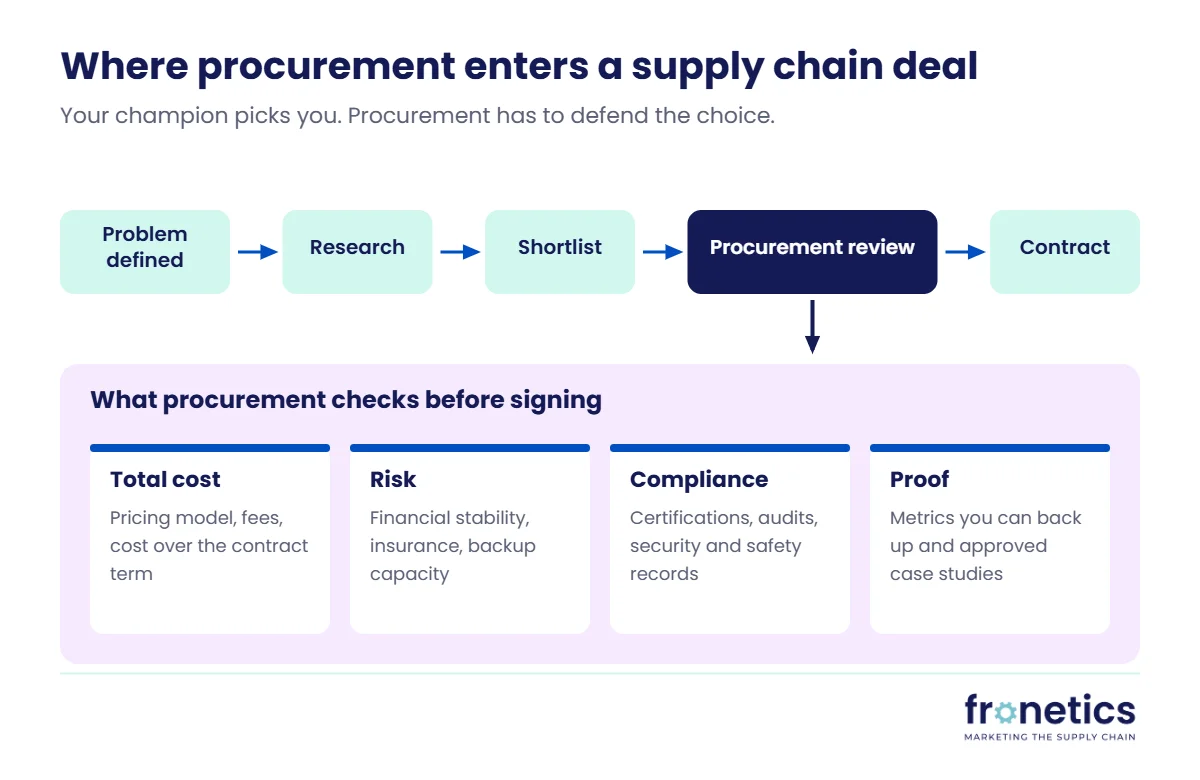
What procurement teams evaluate (and what to give them)
Total cost, not just price
A low rate that comes with accessorial surprises, change-order fees, or a six-month implementation isn’t low. Publish a plain explanation of how your pricing works: what’s included, what’s billed separately, and what typically drives the total up or down. A one-page “how we price” document saves your sales team weeks of back-and-forth and signals that you aren’t hiding anything.
Risk and continuity
Procurement is paid to imagine what goes wrong. Give them answers before they ask: financial stability, insurance coverage, backup capacity, business continuity plans, and how you’ve handled disruptions. A short case study about how you kept a customer running during a port delay or a peak-season surge does more than a paragraph of reassurance.
Compliance and documentation
Certifications, safety scores, audit reports, and security documentation should be easy to find and current. If a buyer has to email three people to get your SOC 2 report or your CSA scores, you’ve added friction at the exact moment you can least afford it.
Proof of performance
Procurement wants numbers they can repeat to their boss: on-time percentages, inventory accuracy, claims ratios, uptime. Use metrics you can back up, and state how you measure them. Vague claims like “industry-leading service” get ignored.
Marketing assets that help procurement say yes
You don’t need a separate procurement campaign. You need a handful of assets built for the evaluation stage, then a way to get them in front of the right people. These are the ones we see move deals forward most often:
- A procurement-ready one-pager. Company overview, capabilities, certifications, insurance, references, and key metrics on a single page. Sales should be able to attach it to any RFP response.
- A pricing explainer. How your pricing model works, what’s included, and the variables that change cost. You don’t have to publish rates.
- Total cost comparisons. Show how cost looks over a contract term, not just at signing. A simple table comparing your model to the common alternative works well.
- Case studies with measurable results. Lead with the business outcome (cost, accuracy, time) rather than the relationship story.
- A trust and compliance page on your website. Certifications, security documentation, safety data, and how to request audit materials, all in one place.
- Consistent messaging across every touchpoint. Your website, sales deck, and proposal should say the same thing about what you do and how you charge.
If you’re running account-based marketing, add procurement contacts to your target account lists. They should see your proof points before the RFP lands, not only after.
Marketing to procurement without spamming them
Procurement teams are buried in vendor outreach. Gartner’s research found that 73% of B2B buyers actively avoid suppliers who send irrelevant outreach. That rules out generic cold sequences.
Instead, make your evaluation content findable and shareable. Your champion is your best channel. Give them assets they can forward internally, and make sure your website answers the questions procurement will search for on their own. Content built for late-stage evaluation and a website that makes documentation easy to find do more for procurement than another email.
Paid and organic channels still matter for the earlier stages. Just measure them against pipeline and closed deals, not form fills, so you can see whether late-stage content is shortening your sales cycle.
Where to start this quarter
Pull your last five deals that stalled after the shortlist. Look at what procurement asked for and how long it took your team to respond. That list is your content plan. Build the one-pager and pricing explainer first, then publish a trust and compliance page.
If you want help building a go-to-market plan that accounts for every member of the buying committee, talk with our supply chain marketing team.
Frequently asked questions
What does marketing to procurement mean?
Marketing to procurement means creating content and sales materials that answer the questions sourcing and purchasing teams ask during vendor evaluation: total cost, risk, compliance, contract terms, and proof of performance.
What does procurement look for in a logistics provider?
Procurement typically evaluates total cost over the contract term, financial stability, insurance, safety and compliance records, service level agreements, and documented performance metrics such as on-time delivery or inventory accuracy.
When does procurement get involved in a supply chain deal?
It depends on the category. In freight, procurement often runs the RFP and may be your first contact. In 3PL and software deals, procurement usually joins after operations or IT has chosen a preferred vendor, during commercial and contract review.
How do you market to procurement without discounting?
Make total cost and risk easy to evaluate. A clear pricing explainer, total cost comparisons, current compliance documentation, and case studies with measurable results give procurement a reason to choose you that doesn’t depend on being the cheapest bid.
Should procurement contacts be part of an ABM program?
Yes. Including procurement in target account lists means they see your proof points and documentation before the formal evaluation starts, which can shorten the review once your champion brings you forward.
Related reading
How to build a supply chain marketing strategy that turns long sales cycles into pipeline
Lead response time: why the first vendor to respond often wins