by Elizabeth Hines | Sep 24, 2014 | Blog, Marketing, Social Media, Supply Chain, Talent
“Practice makes perfect.” This is what we have been told by our parents, our teachers, Malcolm Gladwell, and researchers. And, as pointed out by Fast Company, “There’s even a Macklemore song about it, so that makes it real.”
Here’s the problem – it’s not real. A 2014 study found that practice doesn’t make perfect. Instead, reaching a mastery level of whatever it is that you are trying to reach is dictated by your personality, intelligence, and a number of other factors.
Where does that leave us? For business it reaffirms the adage: “Do what you do best, and outsource the rest.”
During a Small Business Week panel discussion Gene Marke, Inc. columnist and owner of the Marks Group, discussed the importance of strategic partnerships and outsourcing:
“One of the smartest things I’ve been seeing companies do is that they do what they do best and outsource the rest. Companies are now thinking more about partners they can work with to provide the type of technologies, services, and solutions they cannot do or don’t have time to do.”
Dan Leberman, the vice president and general manager of PayPal’s North American online small and medium business unit, expressed similar sentiments:
“It’s all about knowing your company’s core competencies. As a small business, you need to decide what you’ll build and what you’ll give to a partner.”
The supply chain and logistics industries have been slower to adopt social media and inbound marketing than other industries. Reasons for this include: a lack of understanding of the benefits, lack of experience, and both time and budget constraints. In short, inbound marketing and associated activities including content creation and social media management are great examples of what companies within the supply chain and logistics industry should consider outsourcing.
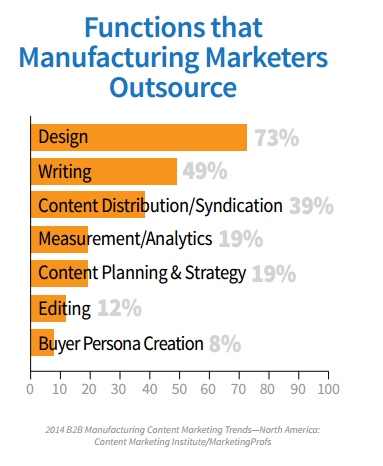
A 2014 study found that 86 percent of manufacturing marketers have adopted content marketing and that the majority (55 percent) of companies look to outsource partners for help.
As shown below, manufacturing marketers outsource a variety of content functions including writing, distribution, design, and editing.
Now that we know practice doesn’t make perfect – play to your company’s strengths and considering outsourcing the rest.

by Elizabeth Hines | Sep 4, 2014 | Blog, Marketing, Supply Chain
The temptation is obvious: You want to use your business blog to proclaim the virtues of your excellent products. You throw around words like “unique,” “outstanding,” “robust,” and “industry-leading.”
Perhaps you even add a blinking “Buy Now!” button at the end, convinced your reader simply can’t resist hitting it.
There is only one problem: Your sales pitch made your prospective customer tune out long before they reached the last paragraph.
Imagine the following scenario: You enter a car dealership and are greeted by an enthusiastic sales agent, grinning ear to ear. He launches into his pitch about mega sales and the best deal of the century. Any question from you is brushed aside as he has more to say about the car model that he has decided you must have. Turned off by his sales strategy, you make a quick exit.
Or think of another example: A sales representative from a company whose website you browsed a few days ago follows up with a call and leaves a voice mail. The message is friendly. She does her best not to sound pushy. She introduces her “leading” company, which offers “a wide range of services” and a “one-stop-shop” for all your needs. By the time she reaches, “I look forward to meeting you,” you’re still ready to hit the delete button. Again, the voice mail was loaded with sales lingo.
As strange as it may sound, being “salesy” is bad for business. HubSpot, a marketing consulting service and software developer, goes as far as calling it one of the “7 Deadly Sins of Inbound Marketing.”
It reads:
Sin 3: Gluttony – Don’t be gluttonous and stuff your content with information about your company products. Focus on solving problems and helping your customers and community first and not jamming your product pitch down their throats.
Let’s go back to the two examples above and transfer the line of thought to your blog. Rather than forcing your products on your prospective customers, take time to answer their questions. You are there for them. They may be in the beginning of their buyer’s journey and far from ready to sign off on a brand new car. Perhaps they entered that dealership to browse, to check out the view behind the steering wheel.
And what if that voice mail had been phrased differently? What if the sales representative had spent a moment talking about what your browsing history said about the problems you’re seeking solutions to and presented some real-life proof of how her company could help? Basically, she would have been more effective showing how her company can deliver value to you. The same goes for your blog.
Here’s what you should do:
- Stay informative and educational.
- Demonstrate market expertise.
- Sound like a business peer.
- Focus on topics and questions of crucial importance to your target audience.
The bottom line: If you want to make a sale, stop selling.

by Jennifer Hart Yim | Sep 28, 2026 | Blog, Content Marketing, Logistics, Supply Chain, Transportation & Trucking
There’s no shortage of supply chain content out there. The hard part is knowing which sources are worth your time. Between tariffs, freight market swings, labor challenges, and the rush to adopt AI, the people running supply chains need sources that are timely, credible, and actually useful.
Here, we share the logistics and supply chain blogs and publications our team reads to stay on top of the industry. We’ve been publishing lists like this since 2015, and we update this one regularly so it stays current. Every source below was actively publishing when we last reviewed the list in October 2026.
Quick answer: what are the best logistics and supply chain blogs?
The best logistics and supply chain blogs to follow in 2026 include Supply Chain Dive, FreightWaves, Logistics Management, DC Velocity, SupplyChainBrain, Supply Chain Management Review, Supply Chain 24/7, Inbound Logistics, CSCMP’s Supply Chain Xchange, Logistics Viewpoints, Supply Chain Shaman, The Loadstar, the Women In Trucking blog, and MIT CTL news.
Best blogs for supply chain news
Published by: Industry Dive (an Informa TechTarget publication)
What it covers: Daily news briefs and analysis on logistics, operations, procurement, tariffs, and trade.
Best for: Supply chain leaders who want fast, readable news without the fluff.
Visit Supply Chain Dive →
Published by: Peerless Media
What it covers: A daily news hub covering logistics, warehousing, transportation, and technology, pulling from sister publications like Logistics Management and Supply Chain Management Review.
Best for: Anyone who wants one feed that covers a lot of ground.
Visit Supply Chain 24/7 →
Published by: Keller International Publishing
What it covers: News, contributed thought leadership, and podcasts on supply chain strategy, planning, and technology.
Best for: Supply chain managers and senior leaders who like a mix of articles and audio.
Visit SupplyChainBrain →
Best blogs for freight and transportation
Published by: FreightWaves
What it covers: Freight market news across trucking, ocean, air, rail, and brokerage, plus earnings coverage of major carriers and 3PLs.
Best for: Carriers, freight brokers, 3PLs, and anyone watching rates and capacity.
Visit FreightWaves →
Published by: Peerless Media
What it covers: News and analysis on freight transportation modes, rates, fuel prices, industrial real estate, and logistics policy.
Best for: Shippers and transportation managers.
Visit Logistics Management →
Published by: The Loadstar (UK)
What it covers: Global freight news and commentary on ocean, air, freight forwarding, and rates. Some premium content requires a subscription.
Best for: Forwarders, carriers, and international shippers.
Visit The Loadstar →
Published by: Women In Trucking Association
What it covers: News and profiles focused on women in the trucking industry, workforce trends, and recruiting.
Best for: Fleets, carriers, and HR leaders working on recruiting and retention.
Visit Women In Trucking →
Best blogs for warehousing and operations
Published by: Agile Business Media
What it covers: Warehousing and distribution center operations, transportation, logistics technology, labor, and case studies.
Best for: Logistics and operations managers running facilities.
Visit DC Velocity →
Published by: Inbound Logistics
What it covers: Practical, shipper-focused guides and columns on transportation, 3PLs, technology, and supply chain practice.
Best for: Shippers evaluating logistics partners and practices.
Visit Inbound Logistics →
Best blogs for supply chain strategy and leadership
Published by: Peerless Media
What it covers: Strategy and management content, including research and a daily briefing. Some magazine content is reserved for subscribers.
Best for: Supply chain executives and senior managers.
Visit Supply Chain Management Review →
Published by: Council of Supply Chain Management Professionals (CSCMP)
What it covers: Practitioner, thought leader, and academic perspectives on supply chain strategy, operations, workforce, and sustainability. Formerly known as Supply Chain Quarterly.
Best for: Supply chain professionals and CSCMP members.
Visit CSCMP Supply Chain Xchange →
Published by: MIT Center for Transportation & Logistics
What it covers: Research news and expert commentary from one of the leading academic supply chain centers.
Best for: Leaders who want data-driven, research-backed insight.
Visit MIT Center for Transportation & Logistics →
Best blogs for supply chain technology
Published by: ARC Advisory Group
What it covers: Analyst commentary on logistics and supply chain technology, including AI, visibility, cybersecurity, and warehouse automation.
Best for: Teams evaluating supply chain software and automation.
Visit Logistics Viewpoints →
Published by: Lora Cecere, founder of Supply Chain Insights
What it covers: Long-form, opinionated commentary on supply chain planning, enterprise software, and leadership.
Best for: Planning leaders and technology buyers who want a candid, independent view.
Visit Supply Chain Shaman →
How we chose these blogs
Our team works with supply chain, logistics, and manufacturing companies every day, and these are the sources we actually read. To make the list, a blog or publication had to meet four criteria:
- Actively publishing. Every source on this list published new content in October 2026, when we last reviewed it.
- Original insight. We looked for original reporting, analysis, or expert opinion, not just reposted press releases.
- Useful for practitioners. The content helps people who run, buy for, or sell to supply chains do their jobs better.
- Credible and independent. We favored established publications, associations, research centers, and respected analysts, and we don’t accept payment for placement on this list.
How to get more out of supply chain blogs
- Subscribe to newsletters. Most of these publications offer free daily or weekly email newsletters, which is the easiest way to keep up.
- Pick a few, not all. Choose one or two news sources and one or two specialty blogs that match your role.
- Use them for content ideas. If you market a supply chain company, these sources show what your buyers are reading and worrying about right now.
- Look for guest contribution opportunities. Many of these publications accept contributed articles from industry experts, which is a great way to build credibility and earn links back to your site.
Questions we’ve gotten about logistics and supply chain blogs
Q: What is the best free source for supply chain news?
A: Supply Chain Dive, FreightWaves, and Supply Chain 24/7 are all free to read and publish daily, which makes them strong choices for staying current on supply chain news.
Q: Which blogs are best for freight and trucking news?
A: FreightWaves and Logistics Management are two of the most widely read sources for freight market news. The Loadstar is a strong choice for global ocean and air freight.
Q: How often is this list updated?
A: We review this list regularly and remove sources that stop publishing. Every blog on this list was actively publishing as of October 2026.
Q: How can my company’s blog get featured on lists like this?
A: Publish consistently, focus on your buyers’ real questions, and share original insight instead of generic content. Contributing articles to industry publications and earning mentions from respected sources also helps your blog get noticed.
Want your blog to be one buyers read?
Fronetics works exclusively with supply chain, logistics, and manufacturing companies, and content marketing is at the heart of what we do. Learn more about our supply chain marketing services or get in touch to talk about building a blog your buyers actually want to read.

by Elizabeth Hines | Sep 8, 2026 | Blog, Content Marketing, Marketing, Strategy
Editor’s note: This post was originally published in October 2015 and has been updated for 2026 with new research and guidance for supply chain, logistics, and manufacturing companies.
A procurement manager needs a new LTL partner before peak season. She fills out quote forms on four carrier websites before lunch. One company calls her back in 10 minutes with a few smart questions. Another emails the next morning. The other two get back to her two days later. By then, she’s already set up a call with the first one.
That’s how most B2B deals are won or lost now. Not on price, not on capabilities, but on who shows up first when the buyer is ready to talk.
Here, we walk you through what the research says about lead response time, why it matters even more for supply chain companies, and how to set up your sales and marketing systems so you’re the one who calls first.
Quick answer: how fast should you respond to a B2B lead?
As fast as possible, ideally within minutes and no later than an hour. Research published in Harvard Business Review found that companies that contacted a lead within an hour were nearly seven times as likely to qualify it as companies that waited even an hour longer. Every hour you wait, your odds drop and a competitor’s odds go up.
What the research says about lead response time
The most cited research on this topic is still some of the best.
- Most companies are slow. In a study published in Harvard Business Review, researchers audited 2,241 U.S. companies by submitting web leads. Only 37% responded within an hour, 24% took more than 24 hours, and 23% never responded at all. Among companies that responded within 30 days, the average response time was 42 hours.
- Speed drives qualification. The same research found that firms contacting leads within an hour were nearly 7 times as likely to qualify them as firms that waited an hour longer, and more than 60 times as likely as companies that waited 24 hours or more.
- Minutes matter. An earlier MIT and InsideSales study of more than 15,000 leads found that the odds of contacting a lead were 100 times greater when the call came within 5 minutes rather than 30, and the odds of qualifying the lead were 21 times greater.
Have things improved? Not much. A 2024 RevenueHero test submitted demo requests to 1,000 B2B companies. 635 never replied, and the ones that did took an average of more than 29 hours.
That’s bad news for buyers and good news for you. If most of your competitors are slow, a fast response is one of the easiest ways to stand out.
Why speed matters even more in supply chain
Supply chain buyers often reach out when they have a real, time-sensitive need: a carrier just fell through, a new product is launching, a warehouse lease is ending, or a production line needs a new supplier. They’re not browsing. They’re solving a problem, and they’ll go with whoever helps them solve it first.
Buyers are also doing more of their research on their own before they ever talk to a rep. For carriers and 3PLs, channels like social media for logistics companies are often where that research starts. A 2025 Gartner survey found that 61% of B2B buyers prefer a rep-free buying experience overall. But when it comes to deciding whether a solution actually fits their needs, buyers still want input from sellers. When a buyer finally raises their hand with a quote request or RFQ, they’re usually far along in their process. That’s the moment that counts.
Why sales teams respond slowly
The HBR researchers found that slow responses usually come from process problems, not lazy salespeople. The same issues still show up today:
- Leads get checked in batches. Someone reviews the CRM once a day instead of getting an alert the moment a lead comes in.
- Routing rules slow things down. Leads get assigned by territory or “fairness” and sit in the queue until the right rep is available.
- Reps are focused on their own pipeline. Inbound leads feel less urgent than the deals they’re already working.
- No one owns after-hours leads. A quote request that comes in at 6 p.m. on Friday sits until Monday.
- Forms go to a general inbox. Leads land in an info@ address that no one monitors closely.
How to respond to leads faster
The fix is usually a mix of process and automation. Here’s where to start:
- Send instant alerts. Push new lead notifications to reps by email, text, or Slack the moment a form is submitted.
- Route leads automatically. Use round-robin or rules-based routing in your CRM so every lead has an owner right away. In HubSpot, workflows and lead rotation make this simple.
- Let buyers book time themselves. Add a meeting scheduler to your thank-you page so high-intent buyers can book a call immediately.
- Send a useful auto-reply. Confirm you got the request, tell buyers when they’ll hear from you, and give them a direct phone number.
- Use chat on high-intent pages. Live chat or a chatbot on quote and contact pages can answer basic questions and capture details right away.
- Cover after-hours leads. Decide who responds to evening and weekend leads, or set expectations clearly in your auto-reply.
- Measure response time. Track average time to first contact by rep and by lead source, and make it part of your sales team’s regular review.
- Make your forms work harder. Ask for the details your team needs to respond well, like mode, lanes, volume, or timeline, without making the form so long that buyers give up.
Lead response checklist for supply chain companies
| Area |
What good looks like |
| Alerts |
Reps are notified within seconds of every new lead |
| Routing |
Every lead is automatically assigned to an owner |
| Response goal |
First contact within minutes, and never more than an hour during business hours |
| Scheduling |
Buyers can book a call directly from the form or thank-you page |
| After hours |
A clear plan for evening and weekend leads |
| Follow-up |
Multiple attempts across phone and email before a lead is closed out |
| Reporting |
Response time tracked by rep and lead source |
Questions we’ve gotten about lead response time
Q: What is a good lead response time for B2B companies?
A: Aim for minutes, not hours. Responding within five minutes is ideal, and within an hour should be the minimum during business hours. Most companies are much slower, so even an hour can put you ahead of competitors.
Q: Does an automated email count as a response?
A: It helps, but it isn’t enough on its own. An automated confirmation reassures the buyer, but a real person reaching out quickly is what moves the deal forward.
Q: How many times should sales follow up with a new lead?
A: More than most teams do. Many leads aren’t reached on the first attempt, so plan for several attempts across phone and email over the first week before closing a lead out.
Q: How can marketing help improve lead response time?
A: Marketing can set up instant alerts, lead routing, meeting schedulers, chat, and reporting in your CRM. Marketing and sales should also agree on what counts as a qualified lead and how fast each type of lead should get a response.
Want to turn more leads into customers?
Fronetics works exclusively with supply chain, logistics, and manufacturing companies, and we help clients connect marketing and sales in HubSpot so no lead goes cold. Get in touch and we’ll help you find where leads are slipping through the cracks.