by Elizabeth Hines | Nov 9, 2017 | Blog, Content Marketing, Customer Service, Marketing
Case studies have proven to be one of the most effective kinds of content in converting leads to buyers. Here are 4 strategies to getting customers to participate.
The 2017 Content Preferences Survey Report found that 78% of B2B buyers used vendor case studies as part of their purchasing decisions in the past 12 months. So why are customer testimonials and case studies so effective? Because buyers value the opinions of their peers and colleagues.
In fact, 89% of B2B marketers consider customer testimonials and case studies as the most effective kinds of content in converting buyers. It makes sense: User reviews offer an unbiased, credible experience regarding a company’s products or services. So potential customers do not have to rely exclusively on information the organization provides.
With stats like that, it is easy to see that case studies are compelling, but getting customers to participate in case studies can be very challenging. Here are 4 tips to help increase case study participation.
4 strategies to get customers involved in your case study
Create a formal process.
Start by getting support from your sales and marketing teams. With compelling stats about the success of case studies and customer testimonials, your internal teams will be jumping at the chance to help find participants. After all, these customers will help drive new sales.
Next you will need a formal submission process for sales and marketing team members to complete when they want to submit a customer’s name and information. You will also need a detailed document that explains to participants their level of involvement. People are busy! Keep case studies short and sweet so nominees are more likely to participate.
Be smart with your timing.
Case studies are most effective when you have happy, satisfied customers beaming about your products. Be smart with your timing and ask customers who just recently purchased your products or services. These customers are most likely excited about their recent purchase and may even go one step further in their reviews, offering tips and how-tos that will only add to the success of your case study.
Not sure if customers are happy with their recent purchase? Ask them! Send an email that asks if they’re satisfied. If their response shows excitement, ask if they’d be willing to participate.
Treat the case study as a mutual opportunity
Case studies can be beneficial to you and your participants, and should be treated as such. “Many customers already think doing business with you is a favor they did. You should not make them feel like they’re going to be doing you another favor by doing a case study,” writes Ayodeji Onibalusi for Effective Inbound Marketing.
Let customers see your case study as an opportunity for them. Explain the benefits, including publicity, they will achieve from participating. Post your case study to social media, link to your website, and send to existing and potential customers. A case study is something your participants can enjoy and won’t want to miss out on.
Find alternatives if customer polices prohibit case studies
Company policies that restrict or forbid some customers from participating in case studies are a big roadblock. Your company could have strict polices about customer testimonials, or customers might have restrictive company policies that limit their participation. These can be a challenge but don’t have to quash your opportunity to conduct successful case studies.
Get creative if you must! Conduct large group interviews and take samples of customer testimonials. Or use the average results from the interview to create an anonymous case study. If you’re still running into issues, simply ask customers for a one-sentence review that you can post without their information. These short reviews can still have a big impact on potential customers.
Case studies have proven they are worth their time and energy. Recommendations from actual customers are a powerful tool. Use these four strategies to conduct case studies that will help attract new customers and drive sales.
Related posts:

by Elizabeth Hines | Oct 3, 2017 | Blog, Content Marketing, Marketing, Social Media, Strategy
Learn how a mobile advertising network and an inbound marketing agency tried Quora as a marketing tool.
Last month, I gave you some tips on how supply chain and logistics marketers can use Quora to build their brands. If you’ve forgotten why you should be incorporating Quora into your marketing strategy, here’s a quick recap:
- Research: Quora offers amazing insight into what thought leaders in the supply chain and logistics industries are focused on. Just by tuning into the conversation, you can gain extremely valuable knowledge.
- Connections: This social media platform gives you a perfect space to connect with peers in your industry and with potential buyers, as well.
- Reputation building: Quora is one of the best tools out there for reputation building. It allows you to participate in and contribute to conversations that can shape the future of your industry. Using this platform effectively gives you the opportunity to become a resource for others in your industry and for your target buyers — and there’s no better reputation builder than that.
Plenty of business are already using Quora extremely effectively, seeing ROI and more. But supply chain and logistics companies have yet to jump on this untapped opportunity. Let’s take a look at a few success stories.
2 B2B companies successfully using Quora
Kiip
This mobile advertising network has a unique business model that “redefines how brands connect with consumers.” Back in 2014, the marketing team did a series of experiments — one of which was answering questions on Quora — to figure out which growth strategies would be most beneficial for the business model. Read about Kiip’s Quora experiment here.
Kevin Fishner, Kiip’s director of growth, said that his goal in answering Quora questions was to “build our brand presence in the mobile advertising space while driving quality leads to our site.” He offers the important insight that there is a fine line between offering valuable answers and blatantly pitching your product.
“If the question directly pertained to Kiip,” Fishner says, “I’d drop a link at the bottom of my answer. If it was a more generic mobile advertising question, I’d use insights from our campaigns at Kiip and leave it at that.”
Fishner points out that answering questions thoughtfully takes a significant time investment. But in the end, this investment is worth it for your business in all kinds of ways.
As you join the Quora conversation, keep Fishner’s insights in mind. Promoting your brand isn’t always about pitching your product. Becoming a thought leader can be just beneficial, if not more so, for your brand and, ultimately, for your bottom line.
IMPACT
Impact is an inbound marketing agency based out of Connecticut. Earlier this year, IMPACT blogger Carolyn Edgecomb wrote about how the company used Quora marketing to build brand awareness. Like Fishner, she points to following core advice for using this platform: “Hustling or selling is exactly what you shouldn’t be doing on Quora. Instead, aim to spread knowledge.”
Based on IMPACT’s experience on the site, she suggest that “by regularly engaging with other members, you’re able to gain key insights from leading experts, target your audience, and even repurpose your content while answering and asking questions.”
For IMPACT, Quora was less about generating ROI and more about “increasing brand awareness and establishing thought leadership.”
Supply chain and logistics companies can take inspiration and insight from these two Quora marketing success stories. The field is largely open. Start looking for questions you can answer, become a part of the conversation, and aim to become a thought leader.
Related posts:

by Elizabeth Hines | Jul 20, 2017 | Blog, Content Marketing, Marketing, Social Media
Recent surveys show video platforms are the next big focus for marketers in terms of content distribution channels.
Social media marketing can seem a bit like keeping up with the Joneses. Which content distribution channels are your competitors using? Where are they getting the most engagement? How often are they posting and when?
We’re big advocates of social benchmarking against your competitors. But, just as much, we are always thinking ahead, trying to figure out where the industry is going next. It’s important to get ahead of the trends so that you can be right there leading the pack.
The State of Inbound has been tracking global marketing and sales trends for the last eight years, with a particular focus on inbound marketing. (Content marketing is a form of inbound marketing.) The 2017 survey included more than 6,300 professionals at from 141 countries, so it offers a very comprehensive view of current trends in content marketing.
One part of the survey of particular interest involves which distribution channels marketers are planning to invest in next. It gives us an idea of where companies will be putting their time and money in terms of social media marketing. Let’s take a look at the results.
Content distribution channel investment
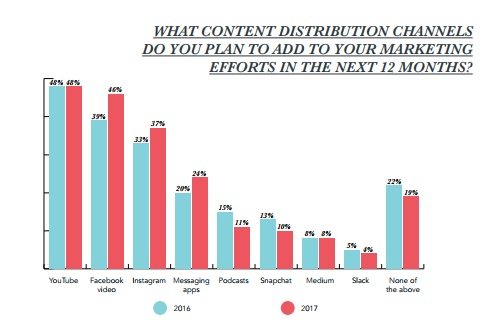
The more than 6,300 marketing professionals surveyed answered the following question: “What content distribution channels do you plan to add to your marketing efforts in the next 12 months?” The chart below shows responses from 2016 and 2017 surveys for comparison.
Source: State of Inbound 2017
Marketers will maintain or increase their investment on YouTube and Facebook video — focus on the latter jumping a significant 7% over 2016. Interest in Instagram and messaging apps has also grown significantly over the last year, while marketers’ investment in podcasts, Snapchat, and Slack has decreased.
I also want to note quickly that investment in Medium has remained steady at 8%. I plan to write more about Medium as an opportunity for supply chain and logistics businesses in the near future, so stay tuned!
Misaligned priorities
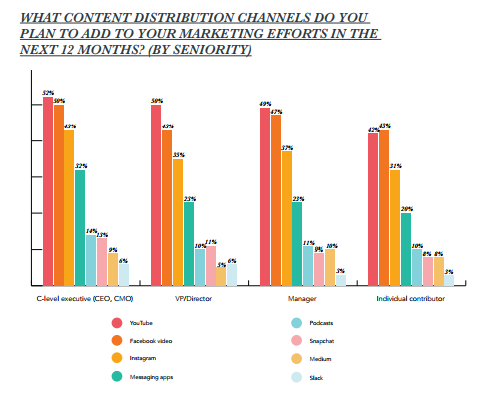
Another noteworthy aspect of this survey question is how respondents at various levels of the corporate ladder answered. Do the people who set company goals have the same priorities as those tasked with social media management and content distribution on a daily basis? Of course not! Take a look.
Source: State of Inbound 2017
Broken down by respondents’ roles, the data shows a division in the priorities of C-level executives versus individual contributors. Executives show a higher preference to expand to new channels of distribution such as messaging apps. The individual contributors responsible for the day-to-day oversight, however, offer a more conservative approach, favoring more tried-and-true distribution channels.
It is also interesting to note that individual contributors consider Facebook video a top priority slightly over YouTube, while executives, directors, and managers uniformly prefer YouTube.
Our takeaway: Video, video video
Across the board, companies are turning their content distribution focus to video platforms, and the supply chain should be, too. If you haven’t heard me say it before, I’ll tell you now: Yes, video can work for the supply chain.
Why? In a nutshell, YouTube reaches more adults ages 18-34 in the U.S. than any cable network. Users browse the platform for entertainment purposes, but also for tips, information, and ideas. And anywhere people are seeking solutions, businesses should be providing answers.
Live video, too, is a trend that is not going away anytime soon. According to the 2017 Social Media Marketing Industry Report, 61% of marketers plan on using live video services such as Facebook Live and Periscope, and 69% want to learn more about live video.
Live video helps businesses promote transparency, good communication, and relatability. It’s something that will do your business a world of good in the supply chain and logistics industries.
Related posts:

by Elizabeth Hines | Mar 28, 2017 | Blog, Content Marketing, Marketing, Social Media, Strategy
Follow these four steps ahead of the show to ensure you’re getting the most out of your lead generation efforts.
This is the first installment of a three-part series about generating leads around a trade show.
As thousands of us prepare for our travels to Chicago to attend ProMat 2017, many are wondering: How can I maximize my time? What can I do to stand out? What will help me generate the most new business?
These are important questions — ones that deserve careful thought and strategy. So we created a three-part series to help you make the most of your next trade show.
In this first part, we will focus on the prep work you can do before heading to your trade show that will set you up for success.
Pre-show prep in 4 steps
With over 850 exhibitors attending ProMat this year, it is important to start the work of nurturing leads before you even leave your office. Strategically planning for this event can help you get the most out of your trade show experience, and get you the leads to grow your business and increase your sales.
Here are four tips to get you started on the right track.
1. Set clear goals
Why are you attending ProMat? What do you hope to gain from your attendance, in addition to leads? Understanding why you are attending a trade show is the foundation for creating what you want to achieve from your presence.
For example, if your goal is to boost your social media presence, make sure every handout, landing page, and face-to-face interaction includes a request to like your company on Facebook (or other social media sites). Or if you are hoping to educate potential customers on a new product, work on creating exciting new marketing handouts and presentations that can be displayed during the trade show.
2. Research your audience
Focusing on who will be attending the show can give you invaluable insight into the motivation behind their attendance and how you can best capture their attention.
Performing prospect research using the list of attendees — including anyone who has given you their contact information through social media, your landing page, or website — provides added awareness about your target audience. You can also go one step further and reach out to high-value prospects on your social media sites to step up a meeting time during the show.
3. Advertise, advertise, advertise
Your company has spent valuable resources to attend the show, so make it known that you’ll be there. Reach out to customers, attendees, and contacts through your social media outlets. Most trade shows have event-specific hashtags (#ProMat) to help spread the word on Twitter, Facebook, Instagram and LinkedIn.
Make sure to include your booth number and location, if possible. Get creative with fun teaser videos to engage with potential customers and get them curious about your new products. Creating an event-specific landing page to channel your prospects into one location, giving you a place to answer questions, create a running list of leads, and continue to promote your presence at the trade show.
4. Create content to distribute
It’s imperative to have content (brochures, templates, etc.) that highlights your brand and products. You should create content that can be distributed during the show that supplements your booth staff, helping them to educate and answer questions.
For example, you can create copies of a presentation you are giving. This allows attendees that cannot attend the presentation to still obtain the valuable information and affords you the opportunity to expand upon the presentation. Preparing these handouts ahead of time allows you to skip the last-minute scramble and focus on being present at the show.
These four tips can get you started on your journey to a successful trade-show experience. Using inbound marketing and social media tools, you are already ahead of your competitors before you even arrive at the show.
Other posts in this series:

by Elizabeth Hines | Sep 29, 2016 | Blog, Content Marketing, Logistics, Manufacturing & Distribution, Marketing, Strategy, Supply Chain, Warehousing & Materials Handling
Content marketing can help your organization amplify its efforts to drive traffic, improve conversion rates, and increase sales.
A recent survey of over 4,500 marketers at organizations around the globe found that converting leads to customers (74%) and growing traffic to their websites (57%) were their companies’ top marketing priorities. Perhaps not surprisingly, these marketers also overwhelmingly reported that generating traffic and leads was their top challenge. Often our business priorities are the most difficult to achieve.
Enter, content marketing.
Content marketing is a form of inbound marketing in which businesses publish content to attract prospects who are interested in products in services like theirs. This marketing approach can be highly effective in growing brand awareness, generating leads, and increasing sales. In fact, according to the same survey, organizations using inbound marketing were four times more likely to rate their marketing strategy highly than outbound organizations.
Let’s look at one example from the warehousing sector.
Business was decent for Company X. It had experienced positive growth for over a decade, despite lacking a clear marketing strategy. But leadership started to wonder: Are we missing opportunities for growth?
Company X sought a multi-level digital marketing strategy that would help them increase web traffic, generate more leads, and convert prospects to customers. The team hired Fronetics to create and implement such a strategy.
After 24 months, the results were telling: Web traffic increased by nearly one-fifth (19%). Company X tracked 244 high-quality leads directly sourced from its new content marketing efforts. And new business grew by a remarkable 30%.
Content marketing was highly successful for Company X in achieving its business goals of driving traffic and new business. In fact, the organization realized many other positive benefits as well. You can read about more of them, as well as the strategy Fronetics used to get there, by downloading the case study below.

Want to increase traffic to your business’ website and generate more leads and customers? Have you tried content marketing? Here are a few resources to get you started.
Related resources:
Need more help? Contact Fronetics to request a free strategy session.