by Elizabeth Hines | Jul 24, 2017 | Blog, Content Marketing, Marketing, Social Media, Supply Chain
Sharing content from third-party sources establishes your company as a go-to resource for all things related to your industry, sector, products, or services.
When I hear the word “curate,” I think of an art gallery. I think of someone systematically picking pieces of art to display together. I think of the time and effort it takes to put these pieces together in a cohesive manor.
Curating content is no different. It is the process of finding, strategically piecing together, and sharing content that is relevant to your audience through your various distribution channels. Using third-party social media posts, blogs, videos, and more, supply chain companies can enhance their content marketing efforts by distributing information that is readily available.
Research shows content curation is a widely practice content marketing method.
- 82% of marketers curate content. (IMN Inc.)
- 83.3% of marketers curate/share content with their customers and/or prospects. (Curata)
Obviously if so many marketers are curating content, there’s a reason. Here are five benefits of content curation for your company.
5 benefits of curating content
1. Establish your expertise
By digging around industry websites or social channels to find interesting and relevant information, you are proving to your readers that you are an expert in your field. You know what’s important and where to find it. You’ll become the go-to company for the most cutting-edge content — all in one easy-to-find place (meaning your audience doesn’t have to scour the web themselves). This will increase your visibility and encourage visitors to trust you as an authority in your industry.
2. Offer a variety of content
Marketers work hard to create different types of content. From blogs to videos to white papers, everyone is trying to stand out and keep things fresh. But you may not be successful at every medium. By curating content from other sources, you can get around that. If you struggle with creating videos, for example, find a reliable source that is already successful in that arena and share with your audience. Your followers will appreciate the change in scenery and will want to come back to see what else is in store.
3. Engage with influencers
TopRank’s Caitlin Burgess writes, “By curating your influencers’ content, it can take less time to achieve your goals, such as developing a working relationship with them and borrowing their audience.” By sharing content from someone who is important and/or influential to your target audience, you can begin a relationship that can have benefits to both parties: Your audience enjoys the content, and the influencer gets free publicity (from you!).
4. Stay in the know
One of the major complaints about content curation is the time it takes to research and find reliable pieces to share. And though there are tools out there to help automate this process, there are major benefits to going through the motions yourself. You’ll not only discover content you can share with your audience, you’ll also keep your finger on the pulse of what’s going on. Consider curation part for your audience and part for you to stay educated on the news and trends in your industry.
5. Keep up the demand for constant content
The foundation of content marketing is to generate leads through the consistent creation and sharing of relevant material. Unfortunately, marketers often struggle to keep up with the demand for new content around the clock. With content curation, you don’t have to be the only one producing content. By sharing quality content from various sources, you are able to supplement your own content and publish more consistently.
Being able to identify, make sense of, and distribute relevant and helpful information makes you valuable to your customers. Over time, readers will come to know you as a trusted, reliable source of knowledge — someone who is not always trying to sell them something. You are an expert in your area of business, and you save your customers and prospects lots of time and effort distributing relevant information so they don’t have to go searching for it from independent sources.
Related posts:

by Jennifer Hart Yim | Jul 13, 2017 | Blog, Customer Service, Manufacturing & Distribution, Strategy, Supply Chain
Manufacturers who listen and focus on customer experience and service will win in the battle to increase revenue and company size.
This post comes to us from Kevin Jessop of Cerasis, a top freight logistics company and truckload freight broker.
Manufacturers have always struggled to know their customers. But, modern businesses have grown to encompass an omnichannel sales opportunity. Customers can place orders online, by phone, in person and in nearly any other means desirable. Unfortunately, this means manufacturers face an even greater challenge, as more customers translate into greater use of customer service.
In addition, customers are continuing to demand lower prices and free shipping. But, our predictions’ post noted how manufacturers are having trouble with transforming customer input into responsiveness and enhancements to the customer experience. Those who do achieve this feat can realize significant increases in revenue and high returns. But, how do manufacturers turn their focus to the customer experience?
1. Determine What Customers Want Today.
Modern technologies can give manufacturers real-time insight into the ways products are moving in retail and online environments. But, patterns today do not necessarily reflect the needs for tomorrow. As a result, manufacturers must be wary of overproduction and focus on providing the products customers want now, not tomorrow. In other words, manufacturers need analytics from point-of-sale systems, transportation metrics and more. Furthermore, companies must extend the buying cycle to get as much information as possible from consumers.
2. Lengthen the Buying Cycle Through Interaction.
Remember the catch-phrase, “Do you want fries with that?” Well, that concept holds true in the supply chain and for manufacturers alike. Consumers may not always go for what you are offering, but they want you to offer more than you have. Essentially, this creates a stronger level of customer service, and it can turn into additional purchases. More importantly, it gives manufacturers a chance to find out more about what the customer wants.
For example, a customer is a shoe store may purchase shoes, but if offered a new brand of socks, he or she refuses. During the ensuing conversation, the representative finds out that the socks have gathered a bad reputation on social media.
While this example is a bit extreme, it highlights how a longer buying cycle can translate into insights for manufacturers. In addition, a longer buying cycle naturally improves the company’s reputation.
3. Partner With Appropriate Businesses.
Businesses are often grouped into a broad category of competitors, but businesses can work to help manufacturers become more responsive to their consumers. This can include offering like products in package deals, compiling changes in like demographics or sharing information to reduce costs across the scope of both companies’ transportation networks. In fact, manufacturers can collaborate with third-party logistics providers (3PLs), like Cerasis, to realize the benefits of collaboration and taking advantage of business-to-business (B2B) sales through integration of systems, explains Louis Columbus of Supply Chain 24/7.
Essentially, every interaction with another business increases the possible customer base by both the number of employees in the new business and the number of customers working with that specific business. As you go through the chain of business, the opportunity for enhancing customer experiences grows.
4. Take Extra Care of B2B Partners.
B2B sales are more fickle than business-to-customer sales. According to a Gallup study, reports Chief Executive, more than 70 percent of B2B companies are facing setbacks and decreases among their B2B partners because of lacking customer engagement. Since B2B sales often take place behind the public’s perception of the economy, it is important that manufacturers work to create engaging relationships through content-driven, digital experiences. This can include videos demonstrating how products work, informative blog posts that provide something free and helpful to customers and beyond. Of course, the same concept of using digital technology to engage customers can be applied to B2C sales channels as well.
5. Be There for Customers After the Sale.
We have all experienced that disheartening feeling when calling customer service and getting lost or frustrated with the lack of service offered. Manufacturers need to be present to their customers after the sale because the level of customer service provided will be shared widely on social media. More importantly, poor customer service or inability to help customers with product issues or questions will gain a huge following much faster than a positive comment.
For example, manufacturers could send out emails for high-tech products that will require updates, or they may create online video banks to teach customers how to use the products easily. The opportunity for creativity in engaging current and future customers is only limited by your imagination!
Listening to What Customers Say is the Key to a Positive Customer Experience.
These steps go back to one thing, listening. Your company should listen to what internet-connected devices are saying about customers. You should listen to what your B2B partners are saying about your products and customers. Listen to what stakeholders, employees and B2C customers are saying. If you take the time to listen, you can meet the growing expectations of a modern customer base that wants a higher level of service than past generations. Ultimately, manufacturers who do listen and focus on customer experience and service will win in the battle to increase revenue and company size.
This post originally appeared on Cerasis’ blog.
Related posts:


by Elizabeth Hines | Jul 12, 2017 | Blog, Content Marketing, Logistics, Marketing, Social Media, Supply Chain
Here are our 10 most popular articles covering supply chain and digital marketing, based on our mid-year analysis.
If you ever read this blog, or are familiar with Fronetics, you know we’re big advocates of regularly measuring and analyzing metrics that help you assess your marketing efforts. We don’t just say that: We actually practice what we preach. In fact, I was recently a mid-year audit of our blog content for this very reason.
That’s why I know which articles have been the most read this year. And I know (from past analysis) that our readers really appreciate having curated lists of popular content, so I wanted to share with you our top 10 supply chain and digital marketing articles in 2017… so far.
Top 10 supply chain and digital marketing articles of 2017 (as of 7.1.17)
These are our picks for the best blogs in the logistics and supply chain industries. They cover a range of topics, from technology to strategy, and feature thought leadership by some of the brightest minds in the field. Read post
This guest post from Argentus Supply Chain Recruiting, a boutique recruitment firm specializing in Supply Chain Management and Procurement, includes an infographic shedding light on the differences between these often-confused functions. Read post
Buzzsumo’s Steve Rayson used data to analyze patterns the most popular content posted on LinkedIn in 2016. He identified headlines and topics that were most successful. The results are really interesting and say a lot about what content resonates with the general LinkedIn community. Read post
With social media networks changing daily, it’s hard to keep up with where to distribute content, much less how often. Countless studies have attempted to solve the social-media-frequency equation. And while audiences vary across industries, best practices give us some general guidelines. Here’s our assessment of social media posting frequency. Read post
Ellen Voie is successfully breaking down barriers and changing the perception of the trucking industry. As founder and president of Women In Trucking (WIT), Voie and her team work to promote the organization’s mission “to encourage the employment of women in the trucking industry, promote their accomplishments, and minimize obstacles faced by women working in the industry.” I interviewed her about her path to success. Read post
Every year we ask our readers to vote for the best industry blogs. The results are always interesting — there’s really a lot of great supply chain and logistics content out there, plus it’s great to see where our readers are finding value. This year, they voted Morai Logistics, Women in Trucking, and the Oracle Supply Chain Management Blog as the top 3 logistics and supply chain blogs of 2017. Read post
There is a lot of research out there that highlights the optimal time to post on various social media platforms. But, the truth is, there is no one-size-fits-all social media posting solution. You need to know the best time for your business to post content. You want more than just a general idea of when to post. You want specific information about your target audience — when they’re actively scrolling, reading, watching and liking your content. These tools can help. Read post
Instagram’s recently launched feature, Instagram Stories, offers marketers a new platform for content delivery that is wildly popular with millennials (who are shaping B2B buying). But unlike other networks with short-term video-sharing opportunities (ahem, Snapchat), Stories can have a polished, professional feel that well suits B2B brands. Here’s what they are and some ideas for how to use them. Read post
This article is part of a series of articles written by MBA students from the University of New Hampshire Peter T. Paul College of Business and Economics. Jacob Rossman discusses the inevitable rise of autonomous trucks and the social and economic factors driving the progression of their technology. Read post
Another article by an MBA student, Meghan Sargent looks at Starbuck’s often-studied supply chain management practices, which, according to some, make Starbucks’ coffee and customer experience superior to those of its competitors. She asks: What exactly is Starbucks doing differently than other international coffee retailers? Is its coffee truly better? Read post
Honorable mentions
I couldn’t leave out these posts, which almost cracked the top 10!
We strive to be a go-to resource for all things digital and content marketing for the supply chain and logistics industries. If there’s a topic you’d like us to cover, please let me know in the comments below, or feel free to email me directly.
And — shameless plug warning — subscribe to our blog to get the latest content delivered to your inbox on a weekly basis! (Sign up on the right.)
Related posts:

by Elizabeth Hines | Jul 10, 2017 | Blog, Consumer Electronics, Manufacturing & Distribution, Strategy, Supply Chain
With increasing consumer demands comes an increasing need for electronics manufacturers to adapt and change with the times.
Manufacturing operations strive to increase demand fulfillment and to reduce costs. But, too often these objectives seem mutually exclusive in practice. In fact, a 10-year study by Accenture of nearly 250 businesses across industries and sectors found that only 11% were meeting both goals.
So what are the 11% doing differently? Interestingly, the study found that operational flexibility was the common thread binding these companies together. What’s more, they were able to achieve flexibility, reduce costs, and increase demand by adhering to three key principles of operations.
3 pillars of operational flexibility
1) Keep it simple.
It can be difficult to keep up with the growing market demand for product customization while maintaining low overhead costs. But the answer is not fewer SKUs — in fact, quite the opposite. Successful manufacturers have increased product variants while reducing the number of components in each SKU, simplifying production.
A prime example of this is Toyota, which is transitioning from 100 different platform variants to five standard platforms across all its models. The brand will maintain design variation in accompanying components and interior choices. Toyota expects this will enhance the customer driving experience while reducing factory costs by 40% and manpower by about 20%.
2) Embrace digitization.
The supply chain is a series of steps toward getting the product in the hands of the end user. Digitization can break down barriers between steps so the supply chain becomes one integrated process. By offering faster responsiveness through digitalization, businesses can better meet consumer demand in timely manner.
Additionally, digitization can help reduce costs associated with production. An example of this is the use of 3-D printing. Traditional manufacturing processes for building a part are subtractive, creating a lot of scrap and wasted material as a byproduct. Not so with 3-D printing, an additive process using the minimum material necessary to fabricate a part. Less wasted material equals less wasted cost.
3) Develop multi-skilled labor.
Investing in a workforce that can adjust and handle multiple duties is an important aspect of operational flexibility. By cross-training employees, manufacturers are better able to optimize time and effort.
Honda’s ARC line, which trains line members across multiple tasks, offers a prime example. Not only are employees more capable of assessing and solving problems, Honda has been able to improve work efficiency by 10%.
Variables
With increasing consumer demands comes an increasing need for electronics manufacturers to adapt and change with the times. And there will always be unexpected variables and market fluctuations that require operational agility. But by being faster, more flexible, and cheaper, businesses can continue to increase demand fulfillment while effectively managing costs.
This article originally appeared on EBN Online.
Related posts:

by Elizabeth Hines | Jul 3, 2017 | Blog, Content Marketing, Current Events, Marketing, Supply Chain
Blog aggregation site Feedspot included Fronetics’ blog on its list of the best content for the supply chain.
Fronetics is honored to learn that our blog has been included on Feedspot’s list of the top 75 supply chain blogs and websites for supply chain professionals. The blog aggregation website has indexed thousands of supply chain blogs and pulled out the most popular using search and social metrics.
Feedspot explains its methodology. “These blogs are ranked based on following criteria:
- “Google reputation and Google search ranking
- “Influence and popularity on Facebook, Twitter and other social media sites
- “Quality and consistency of posts.
- “Feedspot’s editorial team and expert review.”
We are in excellent company on this list. And we love seeing friends and frequent content collaborators like Argentus and SCM Talent Group among the best of the best as well. These are the places where we turn for supply chain thought leadership, and are humbled to be included.
Fronetics strives to be a leading industry resource for information about digital and content marketing, so it is very exciting to be recognized in this way. Thank you to Feedspot, our contributors, and all of our readers who turn to Fronetics for the latest information about content marketing, social media, and more news and happenings in the supply chain industry.
Related posts:
![What’s the Difference Between Supply Chain Management and Logistics [Infographic]](https://fronetics.com/wp-content/uploads/2024/10/Supply-Chain-Managementvs.Logistics.jpg)
by Jennifer Hart Yim | Jun 29, 2017 | Blog, Logistics, Supply Chain
Argentus’ infographic sheds light on the differences between these often-confused functions.
This guest post comes to us from Argentus Supply Chain Recruiting, a boutique recruitment firm specializing in Supply Chain Management and Procurement.
Both Logistics and the wider Supply Chain are vital to how companies run today, but the two are still so often confused. We put together an infographic outlining some of the key differences and points of overlap between them. While it may be an obvious distinction to many pros across the field, there’s still a lot of ambiguity – sometimes within companies, as well – about what constitutes Logistics, and what constitutes Supply Chain Management. As a recruitment firm with over a decade of experience specialized in this area, we figure we’d weigh in!
In short, Logistics is a part of Supply Chain Management that deals with the physical movement of goods for just in time delivery. Supply Chain, as a field, grew out of Logistics in the 80s to encompass a wider strategic consideration of everything that’s involved in bringing a product to market.
Check out the infographic below, where we dive into the topic in more detail! We’ve stepped up our game, if we do say so ourselves.
Logistics vs. Supply Chain Management
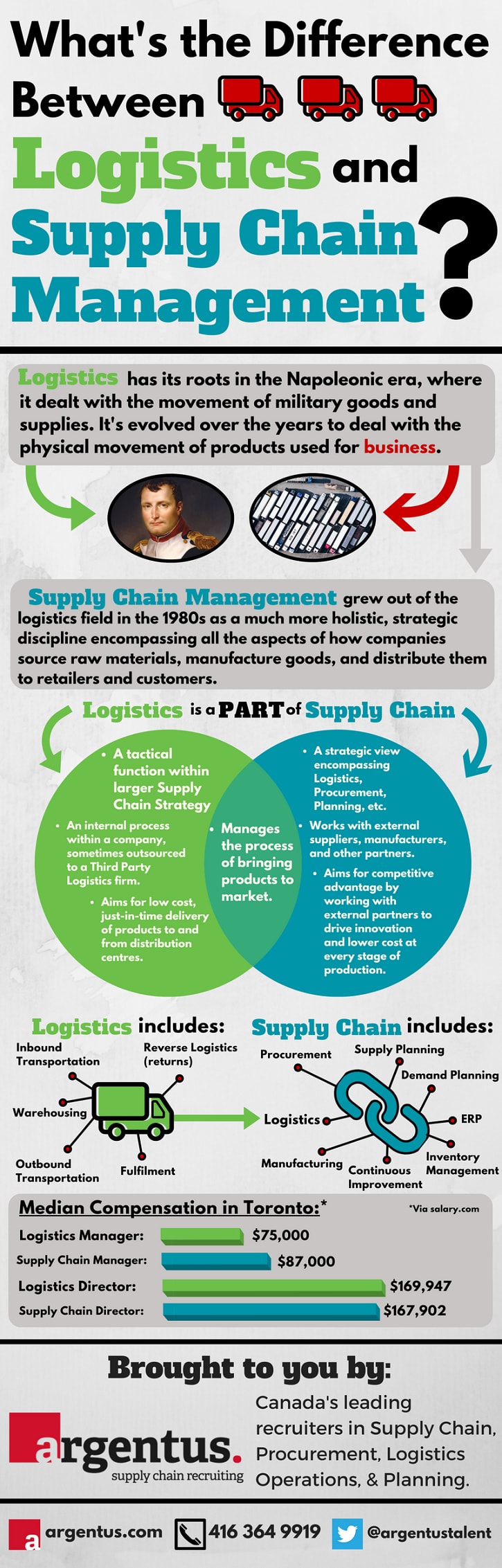
We hope you found the infographic informative! Weigh in down in the comments if there’s anything we missed, or more you have to add about the differences between these functions.
Related posts: