How will self-driving, autonomous stores impact the retail industry and the supply chain?
This guest post comes to us from Argentus Supply Chain Recruiting, a boutique recruitment firm specializing in Supply Chain Management and Procurement.
Here’s another dispatch from the far-flung realms of emerging technology that will transform the Supply Chain – how products are brought to market, and how customers acquire those products.
We’ve written before about the upheaval Amazon has wrought on the Retail industry – whether it’s the company’s move into brick and mortar retail, its acquisition of Whole Foods Market seeking to improve its Last Mile Delivery, or its proposed use of drones to deliver products. We’ve also written about some emerging technologies – like augmented reality – that are blending the world of eCommerce shopping and a more traditional brick and mortar experience.
Suffice it to say, the retail industry is going through some major convulsions. With dozens of major U.S. retailers shutting down, and tons of new startups entering the eCommerce market, the landscape looks different than it did even five years ago. Companies are looking to the bleeding edge of technology to revolutionize the last leg of the Supply Chain, imagining the best ways to deliver products to consumers in 2020, 2030, and beyond.
Now, an idea that’s been explored in theory is seeing testing in Shanghai, a city known for its leadership in the mobile payments space, as well as its Blade Runner-style futurism.
Self-driving, autonomous stores
Analysts have touted autonomous drones and self-driving trucks as disruptive technologies to Logistics and Retail. Now, a great recent article in Fast Company profiles a startup called Moby which is testing a model of autonomousstores that drive around, seeking customers based on traffic data. Customers can “order” a store to drive to them, similar to how we order Ubers today. They then enter the store using an app and pay for goods with mobile payments. When the store is out of products, it drives back to the warehouse, or connects with another store that has excess supplies of, say, milk, to restock. Like a food truck, but one that also sells toothpaste, and replacement phone chargers, and apparel – using only robots.
Check out the video:
Pretty cool, no?
Produced in partnership between Swedish-based startup Wheelys and China’s Hefei University, the Moby Stores are electric, solar powered, and allow customers to order products for their next visit based on voice activation. Wheelys’ background is in making mobile coffee carts for entrepreneurs, and it’s extending that manufacturing experience towards these new prototypes, hoping (perhaps optimistically) to eventually build the stores for $30,000. It’s planning to start commercial production of the stores by 2018.
It’s a wild idea, to be sure – with significant manufacturing and regulatory hurdles still to clear – but pie-in-the-sky technologies have transformed retail before.
There are a few cool implications for this model from a Supply Chain angle, beyond the obvious convenience of having a store that comes to consumers:
It potentially changes the approach to last mile logistics, possibly eliminating the human component in delivery – similar to drones, but with product selection.
These stores combine the convenience of eCommerce with the tactile experience that’s still brick and mortar’s strength in areas like apparel.
They will allow retailers to compete in the brick and mortar space without paying for rent / real estate, which is a huge barrier to entry and carrying cost making brick and mortar uncompetitive. Of course there are maintenance costs to consider, as well.
By allowing customers to “order” a mobile store to a nearby location similar to how one would order an Uber, this model can allow a very fast form of same-day delivery, something that’s been a “holy grail” for companies like Amazon.
We know that startups don’t always translate into industry-redefining enterprises, but even if Moby itself isn’t the future of Retail, it’s very possible that wandering stores will be a big part of the autonomous era.
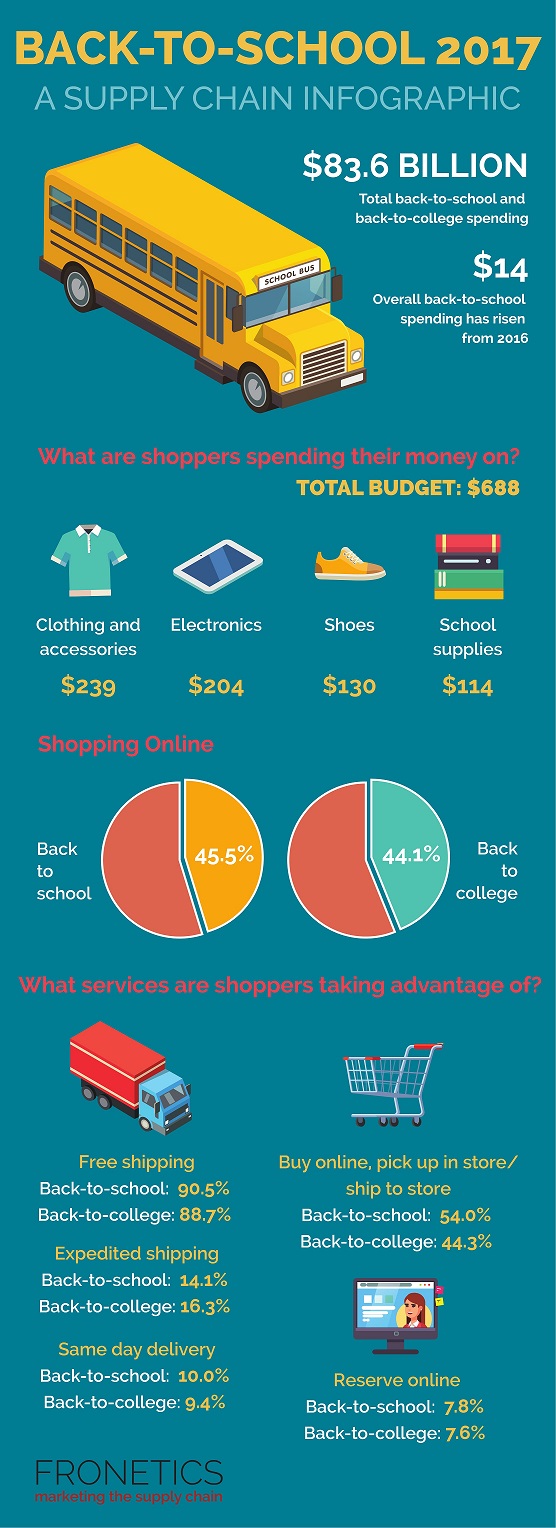
Record spending, online shopping, and free shipping are hallmarks of back to school 2017.
With consumer confidence on the rise, the National Retail Federation predicts that back-to-college and back-to-school spending will hit $83.6 billion in 2017. That whopping total is an all-time high for back-to-college dollars, and the second highest on record for back-to-school spending, and represents and increase of more than 10% from last year.
If you started your shopping three weeks to one month before school starts, you likely found the longest lines: 46.7% of shoppers report that that’s when they planned to hit the shelves for back-to-school shopping, and 34.6% for back-to-college.
The top destinations for back-to-school shoppers are department stores (57.1%), discount stores (54.1%), and clothing stores (46.0%), while back-to-college shoppers prefer online shopping (44.1%), with discount stores (40%) and department stores (38.5%) following in second and third place. A whopping 90.5% of back-to-school shoppers plan to take advantage of free shipping services, with 88.7% doing the same for back-to-college shipping.
Per household, overall back-to-school spending has risen from last year’s average of $674 to $688 in 2017. The NRF predicts that 64% of that total will be spent on apparel and electronics.
Check out our infographic with some interesting facts from the NRF’s 2017 survey below.
Here are seven tips for manufacturers to improve your email marketing strategy in the manufacturing and industrial sector.
This post comes to us from Adam Robinson of Cerasis, a top freight logistics company and truckload freight broker.
Email marketing is a powerful tool for growing and developing different types of businesses. However, many industries are still unaware of the power of using an appropriate email marketing strategy. Many manufacturers and industrial companies are still stuck in the one-off batch and blast mode of email marketing. That strategy is not likely to work very well in industrial marketing, where most of the purchases are expensive; complex products with long sales cycles, multiple decision-makers, and stakeholders are involved; and there is a much higher risk if a wrong decision is made.
7 email marketing tips for manufacturers
1. Avoid SPAM at all costs
The last thing that you want is for your emails to end up in someone’s spam folder or have your emails banned from someone’s inbox. Before you even start an email marketing campaign, you should print out the latest copy of the CAN-SPAM act to remind yourself of some email marketing principles, such as any recipient must have given their consent before receiving commercial email, have an option to unsubscribe from receiving further emails, do not mislead the recipient about the content or the origin of the email, and use approved methods to get a recipient’s email address.
2. Personalize your emails
You should avoid sending generic emails. Your recipients are not all the same, and you should make distinctions between them by segmenting your database. This means sending the same type of email diversified in some key aspects depending on the type of recipient. The content and filters of platforms such as Litmus and Reach Mail, which is based on personal data, geography, activity, and devices used, let you automate the entire process to narrow your focus and identify the ideal sub-section of your list.
3. Increase your traffic and clicks
By creating the perfect email marketing campaign, you will have the power to turn emails into clicks and traffic to your website. Sending relevant links to your subscribers will drive them to your website, and this increases the potential for new sales. If you want to give a real boost to your click-thru rates, you should keep in mind that you have to get rid of the clutter. Having an email that has too many graphics and banners will confuse your readers and leave them wondering what they are supposed to click on.
4. Offer quality content
You should always provide useful, quality content in an email and links to further information. Your emails should be more informative than sales-related, especially in the manufacturing industry. Talk about your company’s safety standards, advertise interviews with experts, and discuss pressing matters in your industry. Not presenting your information in a clear and accurate way will put off your recipients. You can take advantage of online tools to help you with your content writing. Use Australian Help and Oxessays as copywriting tools for writing your emails and Bigassignments to help you to edit your content. [Editor’s note: You can also partner with a third-party marketing firm to develop and execute an email marketing strategy for your business.]
5. Optimize your subscriber list
Do not rush out and buy an email list to get started with email marketing. You should grow your in-house subscriber list and get to know your customers and what they need from you.
6. Link your email platform with other channels
Email platforms, external databases, e-commerce, social media, and business intelligence systems can all be linked to optimize your business and reach more potential clients. Platforms such as Mail Chimp and Mad Mimi allow you to connect and integrate every system, synchronize the information on each, and have them communicate with each other.
7. Automation and tracking
You should try to make your email marketing strategy as efficient as possible with email marketing automation. Platforms such as the mentioned Litmus and Reach Mail will let you automate the entire process. Analyzing and tracking your campaigns’ performance is also essential. Using the analysis tools and reports available from the platforms we suggested will allow you to check and optimize your clicks, traffic, and sales.
Wrapping up the 7 email tips for manufacturers
There are many things to consider when creating an email marketing campaign. The main goal is to effectively connect with potential customers to persuade them to purchase your product by reminding them that you exist and that you are helping. Use these email tips for manufacturers to continually improve your sales and grow your industrial business.
Supply chain and logistics businesses need to be about more than themselves, and content marketing can help them get there.
While conventional wisdom tells us that content marketing is useful and important for any business, there are still some in the supply chain and logistics industries that remain unconvinced. It’s an understandable conundrum: Content marketing requires significant time, labor, and resources, and it can take quite some time to start reaping benefits.
The bottom line is that studies have shown that of companies with a documented content marketing strategy, 86% find their efforts to be successful in generating new leads, creating lasting relationships with customers, and increased ROI.
How can content marketing make my business better?
Consider this: Content marketing helps a company become more than just another business to customers — it can become a valuable resource for everything related to their products and services.
A good content marketing strategy is about understanding the questions and concerns that are particular to your customer base, and offering quality information and analysis that answers those needs. In the words of River Pools & Spas co-owner Marcus Sheridan, “The moment we stopped saying, ‘We’re pool builders,’ and started saying, ‘We are the best teachers in the world about Fiberglass pools and we just happen to install them as well,’…that was one of the most prosperous days of our lives.”
It’s worth noting that Sheridan was discussing his company’s turnaround from near bankruptcy to becoming a global leader in its field. He attributes this success to switching his company’s mission from selling its product to educating potential buyers — namely, content marketing.
Your business is more than its product.
Recognizing that your business has more to offer than its primary product or service is at the core of what content marketing is all about. Kirk Cheyfitz, CEO of Story Worldwide, puts it this way: “Like a decent human being, brands need to be about more than themselves.”
Start thinking about your business this way. You have a team of people with a tremendous aggregate of experience, expertise, and perspectives. That means that you can offer your audience far more than simply your primary product or service: You can offer them knowledge. Your audience is, in turn, far more likely to become buyers as you provide value — which builds trust and cultivates lasting, fruitful relationships.
What can I do to implement an effective content marketing strategy?
If you’re just jumping on the content marketing bandwagon, it’s an exciting time for your business. You might want to check out our Twelve-Step Guide to a Content Marketing Strategy and other resources to help you through the process.
A visual content audit is a solid first step. The main thing to keep in mind is that you have valuable resources at your disposal that you can offer your audience of potential buyers — start sharing!
The DoD is gravitating toward advanced authenticating technologies as a means to root out counterfeit electronics in the U.S. military.
Counterfeit electronic parts are a well-documented problem in the military supply chain. At the time of a 2012 Senate Armed Services Committee report that brought the issue to the forefront, over a million counterfeit electronic parts had entered the U.S. military supply chain. The year-long investigation behind the report found 1,800 cases of counterfeits within military systems, ranging from thermal weapon sights to computers to airplanes.
The dangers of fake parts go without saying: Counterfeits not only threaten U.S. national security, but also endanger the lives of servicemen. So what steps is the Department of Defense (DoD) taking to forestall this problem?
A number of firms have developed advanced technologies that aim to authenticate genuine parts and root out counterfeits. Let’s look at a few of the projects for which the government has chosen to see where we might be heading in terms of amelioration.
DNA marking
When you think of computer chips, the first thing that comes to mind probably isn’t plant DNA. But that’s where the Pentagon’s procurement arm, the Defense Logistics Agency, is turning. DLA has contracted biotechnology firm Applied DNA Sciences to rearrange DNA from plants into unique sequences that are encrypted and attached to chips and other electronic components to distinguish authenticity.
Users simply shine a light on the part in question, on which a mark will light up to confirm the existence of the DNA. A quick swab of mark is then submitted for DNA analysis, which determines whether the part is genuine.
If an individual attempts to tamper with the chip in any way, it will distort or remove the DNA mark. The smudged or missing mark should immediately trigger a red flag for whoever is inspecting the part.
Optical scanning
Sometimes the best innovations are the byproducts of other innovations. That’s what happened with optical scanning.
The army originally brought on ChromoLogic LLC for a separate project looking at DNA’s tagging and tracking capabilities. The goal of the research was to find out if a barcoding system could be used with the DNA to improve security.
However, ChromoLogic researchers discovered that optical scanning technology developed to tag and track the DNA code also was capable of distinguishing an authentic part from a counterfeit by reading the component’s surface layer. Because counterfeit parts are forged primarily by altering the surface layer, optical scanning takes as little as one second.
Manufacturers insert the dielet into a component during production without compromising the part’s performance or design. A user can later employ a hand-held probe to provide power to the dielet. The dielet’s serial number uploads to a server, which sends back an encrypted message and data that could indicate tampering.
The goal, according to DARPA Program Manager Kerry Bernstein, is to “build the world’s smallest, highly integrated computer chip.” Success for this program, he says, means that any untrained operator along any point in the supply chain would be able to check and authenticate any component used by the Department of Defense or the commercial sector.
These three advanced authenticating technologies offer promising solutions to this widespread problem compromising the U.S. military supply chain. Which will prevail — if any? With counterfeits infiltrating the system at an alarming pace, the firms developing these technologies have a weighty task in front of them.
Amazon’s foray into the grocery space has larger implications for its overall strategy, and the possible benefits for the eCommerce goliath are diverse.
This guest post comes to us from Argentus Supply Chain Recruiting, a boutique recruitment firm specializing in Supply Chain Management and Procurement.
Big news out of the grocery retail world as Amazon has announced its acquisition of major organic foods retailer Whole Foods Market – for an eye-popping $13.7 billion sale price that doesn’t look so massive given Amazon’s $136 billion sales volume in 2016.
Analysts across the retail industry are talking about the huge implications of this sale for a retail industry that many say is in the middle of a major meltdown, in part owing to Amazon’s massive growth in the eCommerce space. This foray into the grocery business is a big challenge to companies like Target, Wal-Mart, and others, and also a sign that reports of brick and mortar retail’s demise might be greatly exaggerated.
Anyone following the industry probably isn’t completely surprised by the acquisition, which serves as another example of Amazon’s constantly widening footprint across all aspects of Supply Chain. It follows on the company’s gradual conquest of the logistics space over the last few years, including the licensing of 20 Boeing 767 air cargo jets, the acquisition of wholesale shipping licenses, and forays into trucking. It shouldn’t be so surprising that the company is seeking to put one of the final puzzle pieces in place towards a completely vertically-integrated retail Supply Chain by buying brick and mortar stores – while also buying a major staging ground to improve its last-mile logistics, which is often said to be the “holy grail of eCommerce.”
It all fits into analysts’ understanding of Amazon’s quest for world domination.
That being said, the specific acquisition of a healthy lifestyle brand like Whole Foods is intriguing for sure. This is a brand with major goodwill and solid growth as consumers have looked to healthier choices over the past several years, so it makes sense from that perspective. But as many outlets have reported, Amazon’s foray into the grocery space has larger implications for its overall strategy, and the possible benefits for the eCommerce goliath are diverse. As Supply Chain 24/7 put it, this move is more than a disruption to retail – it could be a disruption to all of society.
Woah.
So let’s dive in: what is Amazon’s medium and long game with this acquisition? What are the possible benefits to the company and the potential disruption?
Amazon gets to reap the sales of a popular and upscale grocery brand.
It brings Amazon a step closer to perfecting its last-mile delivery strategy, which has been difficult to execute for high-turnover perishable items like groceries.
It allows Amazon to place pressure on food suppliers’ profit margins by being even larger.
It obviously gives the company more physical, brick and mortar presence, which allows it to eliminate some of its disadvantages compared to brick and mortar chains – for example the fact that people shopping online on Amazon can’t try on clothes or select fruit. The company has already dipped its toe into the brick and mortar waters with its Amazon Bookstores, now up to eight locations, but this represents a full-blown cannonball into that space, selling way more than just books.
It allows the company to digitize the strongest parts of Whole Foods’ brick and mortar experience, adopting a hybridized approach at the same time as Wal-Mart looks to become more like Amazon.
It allows the company a larger testing ground for its Amazon Go app, which allows customers to pay for grocery goods using a smart phone without ever interacting with a checkout counter. This has negative employment implications, obviously, for retail workers long-term.
It gives the company more “touch points” with shoppers and avenues to sell higher-margin goods such as Kindle devices in grocery stores.
It also delivers a massive new client to Amazon Web Services, a client who is currently using Microsoft’s Azure Cloud platform.
It puts a number of Amazon’s biggest retail rivals on notice, including Target, Wal-Mart, and others, that they can expect more price competition.
When this move was reported, it sent stocks for Canadian grocery companies into a conniption, with some companies losing 3.5% of their value in a day’s trading. American grocery companies didn’t do much better, with Target, Walmart and Kroger all losing value as well. Whatever the outcome, it looks like this year’s retail industry upheavals might just be a taste of what’s to come.