Supply chain buyers rarely call a vendor they have never heard of. By the time a 3PL, carrier, or software company gets the RFP, the buying group has usually done most of its research and already has a favorite. That is why it pays to measure brand awareness with the same discipline you apply to leads and pipeline, even though it will never fit neatly into a last-click report.
Below, we cover what brand awareness means for a B2B supply chain company, the four measures we rely on, the tools for each, and how to roll them into a simple quarterly scorecard.
What is brand awareness in B2B supply chain marketing?
Brand awareness is how familiar your target buyers are with your company and what you do before they start an active search. In supply chain and logistics, it comes down to one practical question: when a shipper, manufacturer, or operations leader needs what you sell, does your name come to mind, and does it show up when they search or ask an AI tool for options?
Awareness is not the same as reach. A post seen by 50,000 people outside your market does less for you than a webinar attended by 40 procurement managers at accounts you want. Good measurement focuses on the right audience knowing you, not the biggest possible audience seeing you.
Why brand awareness decides who makes the shortlist
Recent buyer research shows how early decisions get made. In its 2025 B2B Buyer Experience Report, 6sense found that 94% of buying groups ranked their preferred vendors before first contact, and they bought from that early favorite 77% of the time. The same report found that 94% of buyers used large language models during research, mostly to summarize reviews and analyze information.
Put simply, most of the competition happens before your sales team knows a deal exists. The vendors buyers already know and trust tend to get the first call. If you want to see how awareness fits into a broader plan, our supply chain marketing approach starts with exactly this problem.
How do you measure brand awareness? 4 metrics that matter
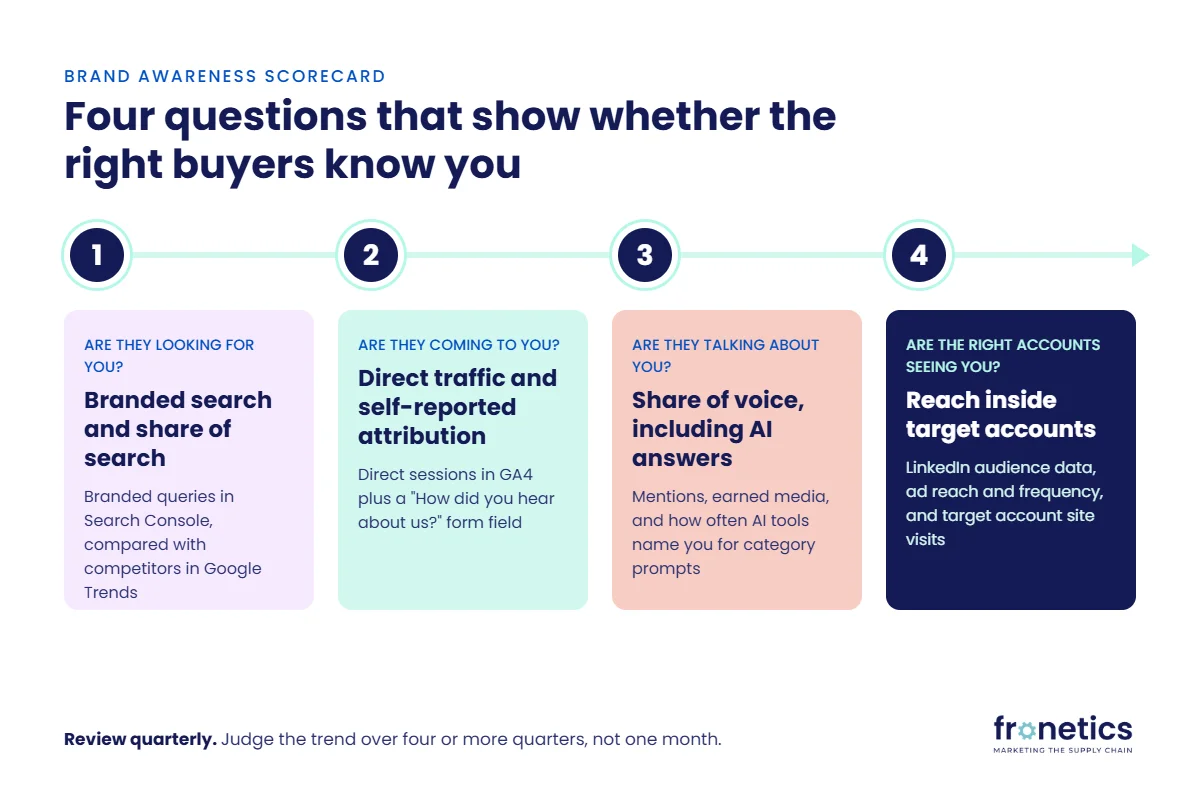
No single number captures awareness. We track four signals that, together, show whether the right buyers know who you are. Each answers a different question.
Each metric answers a different question about whether the right buyers know you.
1) Branded search and share of search
When more people search for your company by name, more people know it exists. Branded search is one of the cleanest awareness signals you have because nobody searches for a company they have never heard of.
Branded queries in Google Search Console. In the Performance report, filter queries with a regular expression that matches your company name and common misspellings. Track branded clicks and impressions month over month. Google explains the filters in its Performance report documentation.
Share of search. Compare search interest in your brand name with two or three direct competitors in Google Trends. Your portion of the total is your share of search. A rising share suggests you are gaining mindshare relative to the companies you compete against.
For smaller logistics brands, Google Trends may not have enough volume to show data. In that case, Search Console branded impressions are your best proxy.
2) Direct traffic and self-reported attribution
People who type your URL or come back without clicking an ad already know you. In GA4, watch direct sessions and returning users over time, and segment out internal traffic and existing customers logging into portals so they do not inflate the numbers.
Then ask buyers directly. Add an open text “How did you hear about us?” field to your contact and quote forms. Answers like “a colleague mentioned you,” “saw you at MODEX,” or “ChatGPT recommended you” reveal awareness channels that analytics tools miss entirely, including word of mouth, podcasts, and AI search.
3) Share of voice across social, earned media, and AI answers
Share of voice measures how often your company comes up compared with competitors. We look at three places:
Mentions and earned media. Set up Google Alerts for your brand and executives, and track coverage in trade publications your buyers actually read. A social listening tool helps if you have the budget.
LinkedIn conversation. Track how often your company and leaders are mentioned, tagged, or shared compared with competitors. For most supply chain companies, LinkedIn is where this happens.
AI answers. Build a set of 15 to 25 prompts your buyers would use, such as “best cold chain 3PLs in the Southeast” or “WMS options for mid-size distributors.” Run them monthly in ChatGPT, Perplexity, Gemini, and Google AI Overviews, and record whether you are named, how you are described, and which sources are cited.
AI visibility is quickly becoming one of the most useful awareness metrics because it reflects how often your brand shows up in the content AI tools learn from. Improving it overlaps heavily with SEO and AI search optimization.
4) Reach and engagement inside target accounts
Supply chain companies usually sell to a defined list of accounts, so the most meaningful awareness metric is whether those specific companies are seeing you. A few ways to measure it:
LinkedIn company page analytics. Review followers and visitors by industry, company size, and job function. Growth in operations, procurement, and supply chain titles matters more than total follower count.
Paid reach and frequency. For campaigns targeted to your account list, track unique reach and average frequency. If only 20% of your target accounts have seen an ad after a quarter, awareness has a coverage problem. Our paid ads team builds campaigns around this measure.
Target account website visits. Reverse IP tools and ABM platforms show which target companies are visiting your site and which pages they view. More accounts showing up over time is a strong signal.
Brand awareness metrics compared
Metric
What it tells you
Where to find it
How often to check
Branded search
Whether more people know your name
Google Search Console
Monthly
Share of search
Your mindshare compared with competitors
Google Trends
Quarterly
Direct traffic
How many people come to you without a prompt
GA4
Monthly
Self-reported attribution
Which channels actually created awareness
Form field responses in your CRM
Quarterly
Share of voice
How often you come up compared with competitors
Google Alerts, social listening, LinkedIn
Monthly
AI visibility
Whether AI tools name you for category questions
Prompt tracking in ChatGPT, Perplexity, Gemini, AI Overviews
Monthly
Target account reach
Whether the companies you want are seeing you
LinkedIn analytics, ad platforms, reverse IP tools
Monthly
Metrics that look like awareness but are not
Some popular numbers say little about whether buyers know you. Total impressions and follower counts can grow through audiences that will never buy. Social share counts have become unreliable as platforms stopped publishing them. Website sessions mix customers, job seekers, and bots. These numbers are fine as context, but they should not anchor your brand awareness reporting.
How to build a quarterly brand awareness scorecard
Set a baseline. Pull the last 12 months of branded search, direct traffic, and LinkedIn audience data so you can see seasonality, such as spikes around trade shows.
Pick two or three competitors. Use the same set for share of search, share of voice, and AI visibility so comparisons stay consistent.
Choose one metric per question. Keep the scorecard to four to six numbers. A short scorecard gets read. A 30-tab dashboard does not.
Annotate what you did. Note campaigns, trade shows, press coverage, and content launches next to the numbers so you can connect activity to movement.
Judge trends, not months. Awareness builds slowly in long sales cycles. Look for direction over four or more quarters before changing strategy.
Where to start if you have never measured awareness
Start with what you already have. Set up a branded query filter in Search Console, add a “How did you hear about us?” field to your forms, and run a first round of AI prompts this month. Those three steps take a few hours and give you a baseline you can build on.
What is the best way to measure brand awareness for a B2B company?
Combine several signals instead of relying on one. Branded search volume, direct traffic, self-reported attribution, share of voice, and reach inside target accounts each show part of the picture. Tracked together over several quarters, they show whether the right buyers know your company.
How long does it take to see brand awareness improve?
Expect at least two to three quarters before branded search and direct traffic show a clear trend. Sales cycles in supply chain and logistics are long, and awareness builds through repeated exposure, so short-term swings are normal.
Can you measure brand awareness in AI search?
Yes. Build a consistent list of prompts your buyers would ask, run them monthly in ChatGPT, Perplexity, Gemini, and Google AI Overviews, and record whether your company is mentioned, how it is described, and which sources are cited. Several SEO platforms now automate this tracking.
Is follower count a good brand awareness metric?
Only partly. Follower growth among your target industries and job titles is useful. Total follower count is not, because it often includes people who will never buy from you.
Digital marketing over social media is a trend that continues to grow, but it’s only effective if you’re doing it right. Here are social media mistakes supply chain brands are still making.
Highlights:
When it’s done right, there’s no greater tool for your company to increase brand awareness and generate leads than an engaged presence on social media platforms.
Knowing what content hits home with your followers and potential followers is crucial.
The most successful companies on social media are the ones that find innovative and creative ways to engage with users.
It’s no mystery why approximately 81 percent of small and medium businesses maintain a social media presence. With 3.5 billion users worldwide, social media is a dream come true for businesses looking to reach a ton of potential customers.
Digital marketing over social media is a trend that continues to grow, as more businesses jump on the social media bandwagon. When it’s done right, there’s no greater tool for your company to increase brand awareness and generate leads than an engaged presence on social media platforms. But it can be virtually useless if your company isn’t doing it right.
Traditional marketing strategies may be misleading for companies hoping to connect with customers over social media. And familiar ways of using social media for personal use can also lead marketers astray. The most effective use of social media for your business centers on knowing your audience and positioning your brand within the right conversations, rather than promoting your product or service.
Are you making social media mistakes? Check out our list of the most common blunders we see companies making to find out.
Mistake #1: Not knowing the audience
Everyone understands how a billboard works. It advertises something for sale where it can be seen by as many people as possible. But for companies looking to increase their effectiveness, that’s a big social media mistake. The most important thing a brand can do on social media is to engage dynamically with other users. And to do that, companies first have to figure out who their audience really is.
It’s surprising how often brands don’t have a clear idea of who they’re trying to connect with on social media. Knowing what content hits home with your followers and potential followers is crucial. And collecting followers and promoting your brand visibility with the right audience means figuring out what other interests your target demographics might have.
So, how do you develop a profile of who your audience is? The first step is to put together a detailed description of your target buyer persona. It’s important to consider details such as the location, education level, and role in the industry of the buyers you’re hoping to reach. Based on this profile, marketers can more precisely pinpoint the needs and concerns of their target audience. This is vital for being able to anticipate the groups to join where potential buyers are most likely to be found.
Bottom line: engage with your audience! Once you have figured out who that audience is, join groups, encourage and leave comments, and pay attention to what your followers care about.
Mistake #2: Using objectives instead of strategy
The best way to use social media for digital marketing involves developing a clear strategy for attracting followers, delivering content, and achieving an ROI. Unlike personal use of social media, effective digital marketing depends on maintaining a regular schedule of generating content. Knowing how often to post content or update profiles can make a huge difference for staying on the top of newsfeeds at key times of day.
Generating new content is crucial for keeping followers engaged and attracting the attention of potential new followers. A variety of different kinds of content prevents followers from tuning out or skimming past your company’s posts. Partnering with brand ambassadors and market influencers boosts the organic visibility of your brand: by working with prominent social media users, your company can benefit from dynamic interactions with brand ambassadors who your target audience follows and views as authentic.
Following a strategy can also help achieve and measure your ROI. It can be particularly difficult to prove the ROI of a company’s participation in social media, so it’s especially important to use analytics tools for tracking how your social media presence is doing. Social Media Examiner’s 2018 Social Media Marketing Industry Report found that only 44 percent of marketers agree that they know how to measure social media ROI, leaving two-thirds of marketers aren’t sure whether their efforts online are paying off. Measuring defined goals against analytics data can help your company identify and react to effective techniques, and improve your social media standing.
Mistake #3: Using the most popular social media platforms
Although the social media platforms with the most users may seem like the most effective platforms for digital marketing, platforms that allow you to engage with your audience can carry more weight than more popular platforms.
All social media channels have a differentiating quality that makes them appealing to specific audiences. So, start by identifying where your target audience is spending their time. For instance, if you are interested in reaching millennial buyers, then your social media efforts should definitely include platforms such as Twitter that millennials tend to use on at least a daily basis.
Once you’ve determined the most effective platforms for your company to concentrate on, be sure to tailor your content to those platforms. Although it’s easy to post the same content across all your accounts simultaneously, the foundation of social engagement is authenticity. Especially with automation tools, many companies post copied-and-pasted content on multiple platforms all at once. But this strategy risks undermining the authenticity of your brand. Work to create content—including video and images—that caters to specific platforms to build brand awareness and loyalty.
Mistake #4: Promoting instead of connecting
This is the big one! Social media platforms are all about fostering engagement among users. Users don’t want to engage with brands that push their products and services through standard marketing techniques. Instead, users will be drawn to companies that appear engaged with the same interests and objectives that they are. Users want informative, interesting, and, yes, even fun content.
The most successful companies on social media are the ones that find innovative and creative ways to engage with users. Brand loyalty arises from emotional bonds and trust that can form through social media interactions.
Greg Hadden, executive director of Motive Made Studios, sums up the power of connecting with users: “What often gets lost is the fact that good storytelling is potent stuff. It has the power to make people want to believe and to belong, which is the goal of all storytellers. We’re all selling something, be it an idea, an exploration of the human condition, or say, a vacuum cleaner. It’s no mistake perhaps that good stories often create products.”
Knowing how and when to respond to a social media crisis is crucial for reputation management and preventing future issues.
News travels at lightning speed thanks, in large part, to social media. With the ability to amplify news – both good and bad – you hear, almost daily, about brands battling a social media crisis. Look at Facebook, who is still managing the aftermath of the Cambridge Analytica scandal almost two years after the news broke.
When your company suffers from negative reviews on social media, it hurts. A single post can have a direct impact on your bottom line. That’s why it’s crucial for B2B brands to know how and when to respond to online reviews and comments. Here are four ways to help your company manage a social media crisis.
4 steps to managing a social media crisis
1. Establish policy
We recently wrote about the importance of a social media policy, and there’s never a better time to implement one than during a social media crisis (except for maybe before it happens). When you provide employees with guidelines on how to respond to negative feedback online, you minimize the risk of employees guessing the appropriate response. Because speed is critical in these situations, a social media policy allows your team to respond quickly and confidently.
2. Listen
You know customers are talking about your company, but is the tone a positive one? And if it’s not, how are you responding? Social listening gives you the opportunity to take a negative customer-service situation and not only correct the problem, but deescalate a situation from turning into a crisis.
Through consistent social listening, you’ll understand the difference between grumblings and a significant change in sentiment toward your brand. Though no company is perfect, a personalized response to negative comments on social media shows a genuine concern for your customers and an investment in customer satisfaction.
3. Engage
As we’ve said, time is of the essence. A short, initial response on social media is a must, but your brand needs to follow up with more in-depth messaging. Social media thrives on engagement, and responding to a crisis is no different.
Lauren Teague suggests, “Avoid getting pulled into a long discussion of what went wrong. Instead, try to move the conversation to a more personal channel, like private messaging. You could also offer a phone number, email address, or other means of communicating outside of social media.”
4. Learn
Deep breaths. Once you’ve survived a social media crisis, the experience isn’t over. Take the time to meet with your employees and examine what happened, what worked well, and what needs to change in the event another crisis occurs. Learning how to minimize the damage of a social media crisis will only benefit you when future issues arise.
Give your staff the opportunity to share their experience during the crisis. Insight from your different departments can help determine areas in your social media policy that need updating, including how to prevent similar crises in the future.
Has your company experienced a social media crisis? How did you put out the fire?
Whether you’re using social marketing or not, chances are your employees are active on social media platforms. Here’s why you need to create a social media policy.
Highlights:
A social media policy is your business code of conduct, letting people in your organization know how to act on social media.
Responses to negative comments should be met with patience, respect, and reflect the tone of the brand.
Employees’ activity on social platforms promotes your business, driving brand awareness and increasing customer loyalty.
Social media can be a powerful tool that helps B2B companies connect with audiences and turn leads into customers. And most platforms give you the ability to track and analyze your performance, increasing your chance of success.
But social media can also have a reverse effect. When used carelessly, it can ruin your brand image, change the public perception of your business, and even lose you customers. Even if your business is not active on social networks, there’s a good chance your employees, and even vendors associated with your brand, are. One misstep by any of these people can have a negative impact on your bottom line.
This is why it’s more important than ever to have a documented social policy that your employees understand and adhere to.
What is a social media policy?
A social media policy is your business code of conduct, letting people in your organization know how to act on social media. It should be a dynamic document that provides guidelines that are easy to use and cover all aspects of social media — including your business and employees’ social pages (personal and professional).
Benefits of a social media policy
Has your company suffered from a social media crisis? Or have one of your employees posted images that don’t match your brand’s image? There are lots of reasons to have a documented social media policy, including:
Maintaining your brand identity across social platforms
Quickly responding to a social media crisis
Straight-forward approach to employees’ personal social profiles
Encouraging brand ambassadors among employees
4 tips to include in your social media policy
Having a document that outlines your expectations when it comes to social platforms takes the guesswork out of what’s appropriate (and what’s not) for your employees. Your policy should include:
1. Defined roles
Here are Fronetics, we have profiles on several social sites. It’s important to define who takes ownership of each of those accounts and how often they are expected to monitor them. Some companies check social networks daily, others on an as-needed basis.
Comments? Questions? Each engagement with your brand should be responded to in a timely manner. A documented social media policy helps define all these details, including posting frequency, advertising, social listening, and even analytics around how your social channels are performing.
2. Responses to PR issues
When small issues arise on social media — for example, a negative comment or poor customer experience — they can quickly escalate if not handled promptly and effectively. The most important part of responding to these types of situations is to remember that employees are representing their brand first and foremost. Responses to negative comments or unhappy customers should always be met with patience, respect, and reflect the tone of the brand.
An effective way to deal with PR issues and to ensure responses align with your corporate brand is to create a ‘cheat sheet’ of responses to frequent issues or concerns. Employees can check the approved response list to have answers ready to post or know who to contact internally to help de-escalate a situation.
3. Staying within the law
Though this seems fairly obvious, policies should follow state and federal laws. If you’re unsure of these laws, it’s best to seek legal advice to make sure your company is in compliance.
Copyright isn’t a no-brainer, so it’s best to explain how to comply with copyright law on social media, especially when using third-party content.
Privacy is key. Do all of your employees know how to handle customer information, for instance?
Confidentiality refers to respecting your organization’s internal information. Whether you have your people sign non-disclosure agreements or not, they should be aware of the ramifications of disclosing information on social media that the organization considers private.
4. Personal account guidelines
Let’s face it: you can’t control everything your employees say on Facebook or any other social channel, but what they post does have an impact on your business. Outline basic guidelines for employees’ personal accounts that – at a minimum – create a level of respect for the company and other employees. These might include:
No speaking negatively about the business or its staff
No posting of harassing, hateful, or illegal content
Adidas, for example, has a document that specifically outlines the accepted behavior for employees’ online presence:
“You should also show proper consideration for others’ privacy and for topics that may be considered objectionable or inflammatory (like religion or politics) … we all appreciate respect.”
Final thoughts
A social media policy helps eliminate the “gray area” of your employees’ social profiles. Yes, your employees are active on social media sites. And yes, they are a direct reflection of your brand. By creating a social media policy that provides guidelines and expected behavior, you can feel confident in your employees’ online presence. You may even find that their activity on social platforms promotes your business, driving brand awareness and increasing customer loyalty.
LinkedIn has released a new guide to using video on its platform. Here’s what supply chain companies need to know to get the most out of video on LinkedIn.
Highlights:
Effective B2B marketing videos start with an analysis of your prospects’ unique purchasing journey and needs.
Videos for the awareness stage of the buyer’s journey should be concise and geared to forging an emotional connection.
Bottom-of-the-funnel video types include product demonstrations, welcome videos, webinars, and FAQ sessions.
Visual content, particularly video, is the future of social media marketing. And video on LinkedIn is no exception. A recent report from Kleiner Perkins indicates that 62% of B2B marketers rate video as an effective content-marketing tactic. Not only that, but, according to internal data from LinkedIn, users are 20 times more likely to share a video on the platform than any other type of content.
Thanks to a recent guide published by the platform, leveraging video on LinkedIn for the supply chain has never been more attainable. The Tech Marketer’s Guide to B2B Video is an invaluable resource. Whether you’re relatively new to B2B video marketing, or a seasoned video creator, the guide contains useful nuggets of information, as well as examples of effective video on LinkedIn, for marketers at any stage.
We’ve pulled out key points for you.
6 steps to approaching video on LinkedIn
It’s worth pointing out that the six steps that LinkedIn identifies to building an effective video strategy are applicable elsewhere as well. Your strategy for video on LinkedIn should likely also apply to your strategy for video content across your digital assets.
1) Analyze your buyer’s journey
Consider the unique buyer’s journey for your company. What content do prospects want to see at each stage, and what actions do you want them to take?
2) Set your marketing strategy
What medium is optimal for delivering content at each stage? Which stages are particularly conducive to video content?
At the stages where video content is the best way to deliver, what type of video is most effective?
5) Target your content
Use your understanding of your target audiences, in combination with the targeting capabilities of LinkedIn, to ensure that your video is reaching the right people at the right times.
6) Optimize your campaign
Keep track of your data. Note what’s working. Adjust what isn’t performing.
Using video on LinkedIn throughout the buyer’s journey
Awareness
The first stage of the buyer’s journey, the awareness stage, is particularly opportune for video on LinkedIn. At this point, your goal is to tell a story, evoke a response, and introduce your brand and products.
Videos at this stage should be concise and geared to connecting with your audience, demonstrating an understanding of their challenges, and how your company is positioned to address those challenges.
LinkedIn’s guide points out a major advantage of video: its measurability. As opposed to text-based marketing, where your knowledge of audience behavior is limited to downloads and time on page, video on LinkedIn comes with richer data. You can tell, for example, when someone has watched your video and when they stopped. This means you can adjust your video length suit the preferences of your audience.
At the awareness stage, important video metrics include how many times your video was viewed, how much of the video was watched, and how many viewers responded to your call to action.
Consideration
Using video on LinkedIn for the second stage of the buyer’s journey, the consideration stage, is about introducing your products and their features, as well as giving a sense of what it’s like to work with your business. Ideal video formats at this stage include explainers, case studies, webinars, how-to videos, and virtual tours. Your foremost goal is to be authentic and to represent your business and the solutions it offers.
Key metrics at this stage are about engagement. Keep track of the number of interactions your videos get (comments, likes, clicks, shares, etc.), compared to the number of views. Also keep an eye on your estimated cost per view (eCPV) to track the efficacy of your video budget.
Decision
Because the decision phase of the buyer’s journey is all about personalization, video has traditionally been used less here. But that’s starting to change. Authentic, trust-building videos can be a powerful asset for the decision stage, reassuring your prospects that they’re making the right decision, using testimonials from existing customers. Welcome videos, FAQ sessions, and webinars are also effective in the decision phase, as well as full-length product demonstrations.
If you’re using lead-generation forms with your video on LinkedIn, keep track of which generate the most leads, as well as the quality of those leads. Otherwise, track click-through rates to gain insights into your estimated cost per click (eCPC).
Metrics for video on LinkedIn
LinkedIn offers a robust set of metrics for videos on its platforms:
Views: At least one second of playback while the video is at least 50% on screen on desktop, or 300 milliseconds on mobile
Views at 25%: The number of times your video was watched at 25% of its length, including watches that skipped to this point
Views at 50%: The number of times your video was watched at 50% of its length, including watches that skipped to this point
Views at 75%: The number of times your video was watched at 75% of its length, including watches that skipped to this point
Completions: The number of times your video was watched at 97-100% of its length, including watches that skipped to this point
Completion Rate: Completions divided by views as a percentage
View Rate: Number of views divided by impressions, multiplied by 100
eCPV: Estimated cost per view
Full Screen Plays: Total number of clicks to view video in full screen
Do you use video on LinkedIn for your business? Let us know your experience in the comments.
As other social networks face unprecedented controversy, LinkedIn is still the best professional social media tool. But too many Supply Chain professionals aren’t getting the most from it.
This guest post comes to us from Argentus Supply Chain Recruiting, a boutique recruitment firm specializing in Supply Chain Management and Procurement.
Awhile back, following Microsoft’s acquisition of LinkedIn, we wrote an article asking “Is LinkedIn in Trouble?” In that post, we identified a few shortcomings that we thought threatened to detract from its user promise as being premier social network for professionals. It was full of spam content that had no relevance to anyone, let alone people looking to network, and it had a somewhat faulty search functionality.
A few years on, and the network is still thriving. A recent article in the New York Times caught our attention, and has us revisiting where LinkedIn stands in today’s social media landscape – for job candidates, hiring managers, and people looking to network in general. Titled, “Why Aren’ Talking About LinkedIn?”, it examines some of the controversies around other social networks, and how LinkedIn has managed to steer clear.
Twitter has gained a reputation for trolling and harassment. Facebook, for its part, has gained a reputation for allowing its data to be compromised, threatening users’ privacy, and for allowing foreign actors to influence the U.S. election. Meanwhile, LinkedIn soldiers on. It’s not the savviest, smoothest social network experience – not that it ever has been – but it’s still one of the most useful.
We’re recruiters who are highly active on LinkedIn (check out our page there, if you haven’t.) From our perspective, the social network is still highly relevant to the career world, whether it’s researching prospects, finding candidates, looking for a job, or networking.
LinkedIn has taken efforts to modernize, and those efforts have reinforced the network’s core promise – helping people connect in a professional capacity, and share thought leadership – while avoiding the disinformation and harassment scandals that plague other social media platforms of similar size. As the Times puts it, “the site hasn’t proved especially useful for mainstreaming disinformation, for example, nor is it an obvious staging ground for organized harassment campaigns.”
Why has Linkedin avoided these issues? A few things set it apart from other social networks:
Users communicate in a business-appropriate way. They realize that a future colleague, boss or hire could be reading what they post, so they’re less likely to post polarizing material.
Similarly, LinkedIn isn’t political. Because it’s restricted to professional or professional-like communication, it’s managed to avoid some of the political filter bubbles common to other social networks. Political ads are banned on the platform.
The majority (82%) of LinkedIn’s revenue comes from premium subscriptions, rather than advertising, which allows LinkedIn to rely less on mining user data for revenue. LinkedIn certainly holds a tremendous amount of its users’ data, but this might help explain why it’s had fewer data and privacy-related scandals than other social networks.
LinkedIn has been crisis free, and that’s allowed it to continue to chug along, owning the considerable niche that it’s owned since 2003. Other job sites and career apps have flourished – and floundered – in the meantime, but LinkedIn remains.
In 2019, the network has done a lot to address the biggest shortcomings we wrote about before. Spam posts are much reduced. The interface is lean and responsive, having worked out most of the kinks involved in its latest redesign. As the Times article describes, if you go on LinkedIn today, you see promotional content, but you also see a lot of people using the network for thoughtful professional communication. You see a lot of people who use its powerful content creation channels like LinkedIn Publisher and native video to boost their personal brand and generate career opportunities. It’s powerful not just when looking for a job: people use it to connect with possible suppliers, identify talent, learn best practices, network, and more.
Yet so many professionals still aren’t getting the most out of Linkedin.
In Supply Chain and Procurement, which is our area of recruitment specialty, some of the best candidates have highly inactive profiles. They don’t go into detail about accomplishments (e.g. major projects, cost savings, business transformation). Some of these candidates still don’t treat LinkedIn as a vital tool to build their personal brand, and see it more as an “online resume” to be updated whenever they’re looking for a job. Their profiles are almost empty.
We still find those candidates for our clients. Boolean searches are a powerful tool, as is the tried and true method of talking to as many people as possible. But we often wonder: how many other great Supply Chain professionals are out there who don’t put in the small amount of time required to get on our radar by being more active about their personal branding?
Consider your daily time allotted to social media. How much of it goes to networks like Facebook and Twitter? Isn’t it worth it to take a small chunk of that time and post about career-related topics in a more mentally healthy environment, and boost your brand in the process?
Say you’re a specialist. A Strategic Sourcing professional with expertise in facilities and real estate Procurement, or a Supply Chain analyst who’s highly skilled with SAP and other Enterprise Resource Planning (ERP) applications. Those are requirements our clients – some of the top companies in the world – have all the time. By getting more active on LinkedIn, you’re owning your niche, and rising to the top when people search for people with your speciality. Recruiters, but also suppliers, and colleagues. And trust us, people are searching. Every day.
So what small steps can you take to treat LinkedIn more like a marketing tool, and less like a “set it and forget it” online resume?
If you aren’t connected to many other Supply Chain professionals, expand your network. Most people are open to unsolicited connection requests if they’re not transactional. Reach out to connect with people at interesting organizations, and start conversations that aren’t about looking for a job.
Share relevant content with your network, with your comments, and attempt to start discussions. LinkedIn has a new “Top News” feature – on the sidebar of the homepage – which can give you some current topics. Pick things that make you think, and share your thoughts. Publications like Supply Chain Dive, SCMDojo, and Procurious have lots of great thought-provoking professional content to look at as well.
Think about publishing an article or two through LinkedIn Publisher. What big issues or changes are you facing in your Supply Chain practice? What are you most excited about? A longer-form article can help you organize your thoughts and show off expertise.
Make sure that your profile has relevant accomplishments, and detailed keywords related to your niche (e.g. the categories you work on in Procurement).
Be persistent, but not relentless. The LinkedIn algorithm – in our experience – tends to reward people who are more active. But don’t post all over the place indiscriminately – pick and choose topics about which you have something to say.
But this is just the tip of the iceberg. If you’re a Supply Chain or HR professional, how is LinkedIn is working for you in 2019, either in looking for jobs, or hiring? Let us know in the comments!