![Supply Chain: 4 Essential Year End Questions to Ask Yourself [Infographic]](https://fronetics.com/wp-content/uploads/2024/10/SupplychainSMARTgoals-1080x675.jpg)
by Elizabeth Hines | Jan 14, 2015 | Blog, Leadership, Strategy, Supply Chain

Don’t start the year without asking these 4 essential questions.
Well, another year has come and gone. Out with the old, in with the new, right? Wait, not so fast. Don’t overlook the valuable information you can glean from conducting a year end review. Use these four questions as a guide to thoughtfully assess the past year. Then, read on to see how a few simple tasks can help shape your best year ever.
1. What were my biggest accomplishments this year?
Twelve months can seem like a long time when you consider everything that happened over the course of the last 365 days. Setting aside some time to review successful projects, notes of thanks from clients, or a particularly positive performance review reminds us what we’re capable of achieving and gives us a renewed sense of accomplishment.
Try this: This year, designate a file folder near your workspace to collect any materials or notes related to your successes as they occur. Doing so will make it easier for you to recall your accomplishments and provide quick access to a list of your achievements – helpful for a healthy dose of motivation or last-minute performance reviews.
2. How satisfied are you with the past year?
Were you successful in meeting the majority of your goals? Do you feel that you worked to your highest potential? Would you have done something differently? What about missed opportunities? Examining what went right and identifying areas for growth and opportunity are powerful exercises that both prevent the recurrence of negative behaviors and reinforce our commitment to our priorities.
Try this: Adding some context to your experiences presents a more accurate picture of your year by tempering unusual highs and lows. Thinking about your experiences of the past year in sum, try to assign a value to your entire year. How would you rate your year on a scale from 1 to 10? 1 to 100? Why?
3. Is my current daily routine structured to optimize time for my priorities?
It’s easy to fall victim to time suckers, especially when they become ingrained into your routine. Has your daily 15 minute coffee break gradually morphed into 25 minutes? Are your 10 minute “headline scans” now closer to 30 minutes? These small, seemingly innocent extensions can snowball into major time loss, causing unnecessary panic as you scramble to meet deadlines.
Try this: The start of a new year is a great time to reset (or rethink) our daily routines. Build activities into your day. If you’d like to continue your now-daily 25 minute coffee break, think about extending your work day by 25 minutes. Feeling like you can’t absorb everything news-worthy in less than 30 minutes? Set your morning alarm 30 minutes earlier so you can arrive to work having already completed your scan of daily headlines. By taking a hard look at where your time is actually going and then spending a few minutes realigning your daily routine with your priorities, you’re intentionally and consciously assigning time to the things you find the most important.
4. What is it that I want to achieve next year?
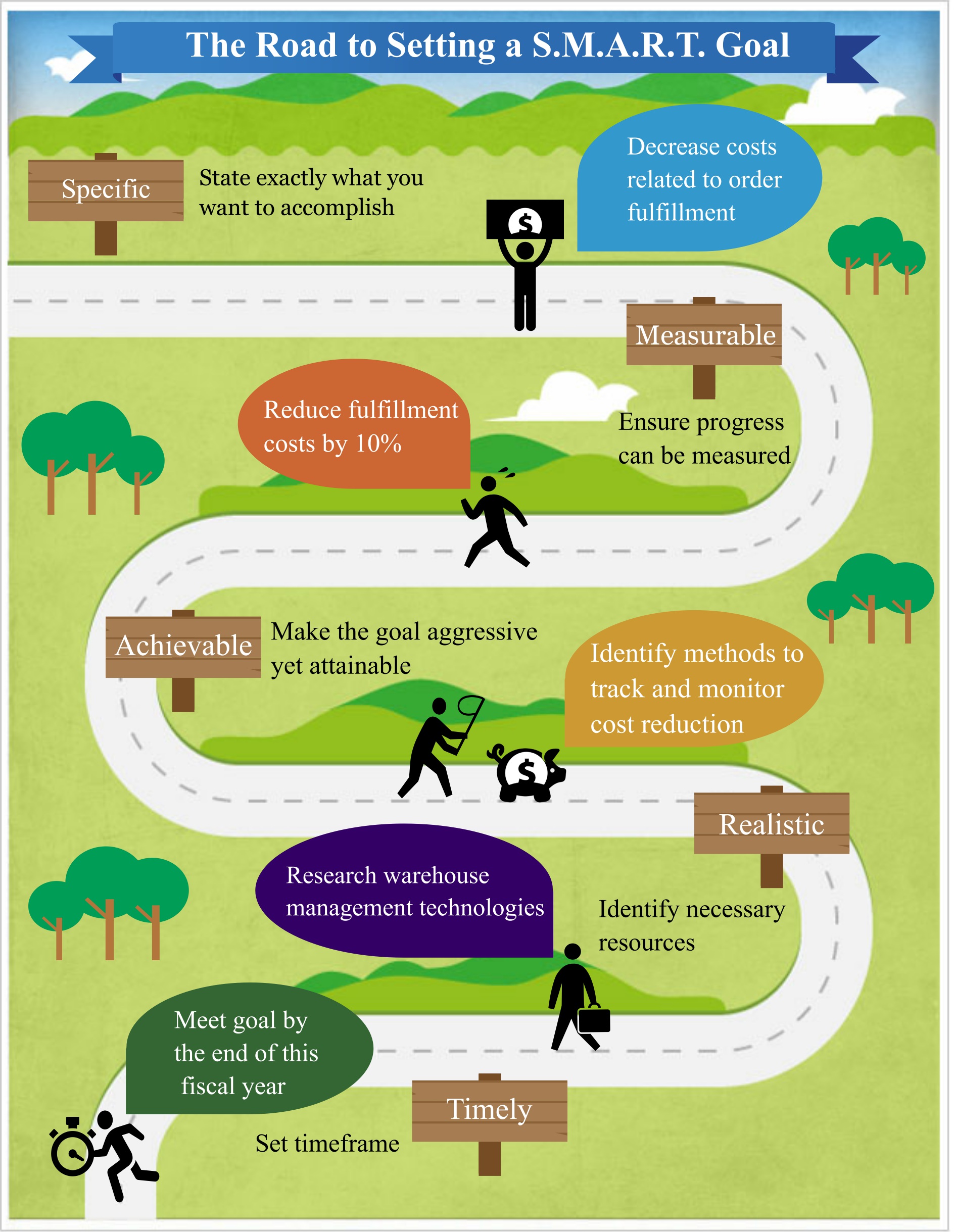
Each new year brings with it a renewed energy to being our best selves. In order to get started, we need to define our priorities and what our success will look like. Setting SMART goals, or goals that are specific, measurable, achievable, realistic, and timely, keeps us moving forward by providing detail and assigning accountability.
Try this: After reviewing your past year, set aside some time to consider what you’ll set out to achieve this year. Create a detailed roadmap to successful completion of your goals.
Use this infographic to help you set, and achieve your SMART goals.
How was your year in review? What were your biggest accomplishments? Are there any goals that you’ll carry over into the new year? Do you regularly set aside time at the close of a year to reflect? We’d love to hear what you do to reset for a new year.

by Elizabeth Hines | Jan 8, 2015 | Blog, Leadership, Logistics, Strategy, Supply Chain
Social media is driving a business revolution. Companies within the logistics and supply chain industries are beginning to take part in the revolution. Companies within the logistics and supply chain industry are adopting social media as a business strategy – and reaping positive results.
In December 2014 Fronetics Strategic Advisors conducted a survey to learn which industry blog is your favorite. The results are in.
The number one blog within the logistics and supply chain industries is: Cerasis
As a third party logistics company, the Cerasis mission is to decrease freight management inefficiencies and to provide maximum hard and soft cost savings for our customers in the process of shipping LTL (less than truckload) or truckload freight and small package freight by providing logistics solutions through our powerful and proprietary web-based proprietary transportation management system, the Cerasis Rater, and integrated managed transportation services.
The Cerasis blog is a wealth of information for those within the supply chain and logistics industries. The blog covers industry trends, educates, explains rules and regulations, busts myths, and has awesome infographics.
Other valued industry blogs include:

by Elizabeth Hines | Jan 7, 2015 | Blog, Leadership, Marketing, Social Media, Strategy, Supply Chain
The majority of companies within the logistics and supply chain industries are realizing benefits by participating in social media. The social network that provides the greatest business impact: Twitter. A survey found that 95% of respondents believe Twitter to be either “somewhat impactful” or “very impactful” on their business.
What are the must-follow Twitter accounts for the logistics and supply chain industries?
In December 2014 Fronetics Strategic Advisors conducted a survey to learn which industry Twitter account is your favorite. The results are in.
The number one must-follow Twitter account for the logistics and supply chain industries is: Quintiq
Quintiq’s vision is to transform the world’s supply chains. The company’s Twitter account speaks to this vision by sharing and providing industry knowledge and news. Additionally, Quintiq uses to Twitter to engage with others within the industry.
Other must-follow Twitter accounts include:

by Elizabeth Hines | Dec 10, 2014 | Blog, Leadership, Strategy, Talent
 Kate Lee, the senior director of research and strategy at Fronetics Strategic Advisors, has been named by Procurious as one of the 24 Most Influential People in Procurement.
The online business network for a new generation of procurement and supply chain professionals compiled the list to show who “you should be connecting with.”
Kate said she was “honored” by the recognition.
“The network and its members are not only industry leaders, but also leaders in innovation,” Kate said. “Procurious has more than 2,000 members from more than 70 countries and I’m thrilled to be part of such a niche social network.”
For the past 20 years Kate has worked with a range of people from senior executives at Fortune 500 companies to academics to refugees. At Fronetics Strategic Advisors, a management consulting firm focused on strategy and inbound marketing for the logistics and supply chain industries, Kate said she has been able to build a strong team which provides clients with unmatched service and value.
“I am proud of the team and our efforts in helping companies develop and implement inbound marketing and strategies that create results,” Kate said.
Kate is a newcomer on the Procurious list that also includes profiles such as ‘Local Producer’ AKA Brian Heinen, a driving force behind LinkedIn biggest groups for supply chain and sourcing professionals; Paul Snell, managing editor of Supply Management and Supply Business magazines; Hal Good, another LinkedIn power player in procurement with 13.5K followers on Twitter; and Tim Hughes, a top 35 UK blogger with 81.9K Twitter followers.
Procurious also cited the Fronetics Twitter account as a reason to welcome Kate into the mix.
The recognition of Kate read, in part: “The Fronetics’ Twitter account is both super-active and full of fascinating insights related to the profession.”
Kate again credited her team for the success:
“It comes down to the wonderful team at Fronetics,” she said. “We are committed to providing the industry with industry news as well as information on how to create and implement strategies that will create value.”
She continued:
“Additionally, we love engaging with individuals and companies within the industry via LinkedIn, Twitter, and our blog.”

by Elizabeth Hines | Nov 27, 2014 | Blog, Leadership, Marketing, Strategy
The Dunkin’ Donuts in Boston’s Back Bay Station is a well-oiled machine. The whole process – ordering a cup of coffee, paying, and receiving said coffee – takes seconds. The experience is something reminiscent to Seinfield’s Soup Nazi.
For customers who frequent this Dunkin’ Donuts expect this. They have timed their commute down to the minute and they know that if they can move through a line of 30 or so people in seconds – and make the train. For customers who don’t frequent this Dunkin’ Donuts the experience can be jarring.
On the other hand, there is a small coffee shop I visit in Maine. It takes minutes (think two digit numbers) to get a cup of coffee, and then more minutes to pay. Customers who frequent this coffee shop savor this time that it takes to get their coffee. The minutes waiting allow for conversations or quiet meditation.
Watching someone new enter the coffee shop is always interesting. There are those that start to wait in line and then leave when, after minutes, they are no closer to getting coffee. There are others who wait it out, checking their watch or smart phone every few seconds as if this will speed up the process. These people generally leave in cloud of frustration.
These two businesses know their customers. They have taken the time to understand what the needs are of the customer and they have tailored their business to address these needs.
To grow your business you need to take the time to determine who your target customer is, what their needs are, and how you can address these needs and bring value to the customer.

by Elizabeth Hines | Nov 19, 2014 | Blog, Leadership, Marketing, Social Media, Strategy, Talent

Networking is often thought of as a (dreaded) job search action item. However, thinking about networking in this manner will leave you at a disadvantage. Networking is an action item necessary for your professional and personal growth.
Those who view networking as more than just a job search must, gain a competitive edge over those who turn to networking only when they are making a job/career change. Glen Llopis puts it this way:
“The more you procrastinate, the more you will find yourself disconnected from the opportunities that may potentially advance your career or allow you to meet the right people.”
How and why does networking matter? Here are five reasons why networking is essential and why connections matter:
- Research has shown that the larger the network, the larger the salary
- Networks beget jobs
- Networks bring opportunities that benefit and feed your career, professional development, and personal interests.
- Networks make people smarter
- Networks make people happy
Moreover, Kathryn Minshew, founder and CEO of The Muse and The Daily Muse, points out that:
“Networks are powerful, and when done right leave you surrounded by a core of individuals who are all rooting for your success and happy to help you.”
One of the greatest networking tools for professionals is LinkedIn. So before you begin, make sure you optimize your LinkedIn profile for success.