by Jennifer Hart Yim | Nov 4, 2014 | Blog, Leadership, Marketing, Social Media, Strategy
Within five years social media literacy will be the single greatest factor distinguishing top performing procurement leaders from the rest.
Now don’t get me wrong – that’s not to diminish the importance of superior financial skills, sourcing, and/or change or people management abilities, but simply to say that social media will add a new dimension to these existing critical competencies.
For Roland Deiser and Sylvain Newton, authors of McKinsey Quarterly ‘The six social media skills every leader needs’, social media has created a dilemma for executives: “while the potential of social media is immense, the inherent risks create uncertainty and unease.”
For those schooled in 20th century management theories, social media’s unscripted approach to conversations, horizontal collaboration and fragmented power structures, is undoubtedly unsettling.
But the transformative power of social media is too big, too loud, and simply too pervasive to miss.
Today, Procurement Leaders are expected to ‘do everything.’ Is social media just ANOTHER thing to add to their To-Do list?
Yes and no – but that doesn’t mean it has to be a thorn in your side. Instead, why not utilize the seemingly transformational power that social media represents? Not only will it allow you to manage change more effectively and maintain costs, but it will also negate the risk of unruly online behavior.
If you’re hoping social media is really just an issue for the Chief Marketing Officer (or perhaps even just your teenage daughter and son), this next statement is going to hurt: Every leader – regardless of industry or profession – needs to be social media savvy, and the expectations for CPOs to be masterful (not just literate) are ever greater. Here’s why:
1. Procurement needs to create 360 degree visibility
Social media visibility will help position yourself as a connected thought-leader in the eyes of not just your team, but your Board and suppliers too.
You’re in a unique position – as the facilitator of connectivity you should rightly take the lead when it comes to all-things social. Suppliers can benefit from simple initiatives like creating private groups that can be used as discussion areas.
2. Procurement needs to be a Customer of Choice (and stay ahead of sales during negotiations)
Your marketing team has probably been using social media to connect with customers for years. Although the use of social media to connect with suppliers is still in its infancy (although eMarket places are rapidly growing), be assured that sales executives are already scanning social media to understand your industry (and you as a customer) better.
3. Procurement needs to mitigate the risk
So here comes the scary part – while the benefits of social media are real, so too are the risks when it comes to issues of commercial in confidence and defamation.
Procurement (and your suppliers) deal with highly sensitive issues on a daily basis. CPOS must understand social media in order to develop and manage an operational social media policy that stimulates collaboration, but adequately mitigates risk. And don’t even think about a social media blackout…your employees, your suppliers, your customers are online so it pays to stay one step ahead.
4. Procurement needs to upskill… or die
There has never been a more pressing time to engage, retain and upskill existing procurement talent.
The labor market is tightening, bringing with it new risks.
Luckily social media breeds collaboration, making approaches such as peer-to-peer learning a viable (and cost-effective) option to procurement professionals looking to develop.
What’s more, by its very nature online learning is highly accessible and available across a range of devices and form-factors. At the time of writing, all of Procurious’ training modules are free to members. So go and get them while they’re hot!
If the thought of social media literacy has you thinking fondly of the ‘good old days’ of cost-downs and low hanging fruit, there is good news: like any skill, social media can be taught so start by mastering the basics, start with understanding:
- The different social media platforms – start with: Procurious; LinkedIn; Facebook; YouTube; Twitter; and Instagram. Think about their intended purpose, how they differ; their reach and their impact
- Basic Twitter functionality
- Simple social media terminology – start with: hashtag; retweet; like; follow; mention; blog; podcast; RSS feed. I recommend checking out Buzz Billboard’s Social Media Glossary here: https://www.buzzbinpadillacrt.com/social-media-glossary/
Now if all this sounds time consuming, well it can be…but it doesn’t have to.
Much like exercise, learning to juggle or learning the guitar, the key is usually to start small and be consistent. At Procurious, we recommend ‘The Daily Habit’ – it takes 15 minutes and can be done as you sip your morning double-shot skim latte:
Scan the Headlines – 5 min
Check the latest news and blogs, keeping your eyes peeled for “water cooler moments”, mentions of your suppliers or competitors in the headlines and be ready to dazzle colleagues and stakeholders with the factoids and market intelligence you’ve found.
Share – 4 min
What did you find that was interesting? An article? A comment? A quote? Well, post it to social media and get people reading and talking.
As procurement people we in fact have access to great, shareable content – in fact many of the best stories come out of buyer/supplier relationships: weird categories sourced; inspiring social procurement stories; and photos from Supplier Awards days.
Ask (or be) an expert – 4 min
One of the busiest parts Procurious is our Discussions area. Most social media platforms will have similar groups or boards where you can throw out a question to the network…..you’ll be impressed by the willingness of people to share their learnings….or at the very least, realize you’re not alone in your challenges!
Grow your network – 2 min
To be the world’s best at procurement, you need to be the most connected. Be referred. Invite people to join your social media networks – on Procurious, you can narrow this down by geography, industry and category which means you can connect with like-minded peers from across the globe. Aim to connect with 10 new people a day across your networks.
Change management, financial literacy, sourcing, vendor and people management will always be core to procurement. Social media, however, allows you to approach these tasks with far greater reach, influence and a superior market intelligence.
Lisa Malone is the General Manager – Procurious – the world’s first online business network for procurement and supply chain professionals.
If you’d like to learn more about how to grow your social media literacy, connect with her on Procurious at (it’s free to join and participate) or follow on Twitter @lisajoymalone.

by Elizabeth Hines | Aug 28, 2014 | Blog, Leadership, Strategy, Talent
Most teams are able to fairly easily decipher what needs to be done. However, when it comes to the how, new or weak teams fall flat. Here is how you can optimize your team for success.
Define roles
Clearly define roles and make sure every team member understands not only their role, but the roles of others on the team. When roles are defined and understood the team can avoid overlap and can avoid the trap of “I thought someone else was doing that.” In short, by defining roles your team can be more efficient and more effective.
Establish a communication protocol
Take the time to establish a communication protocol. This protocol should not be a rulebook, but rather it should outline a set of decisions about how the team will message each other and stakeholders on the progress and needs of the team. If you leave this to chance you are, well — taking a chance. If you establish a communication protocol up front you will achieve better communication and it will be less likely the ball will be dropped.
Develop performance metrics
Develop performance metrics up front. If you don’t take the time to do this, how will you know if you are making progress? How will you know what to do if you are not making progress? How will you know when goals are achieved? How will you be able to reward team members? Take the time to develop performance metrics up front — and get everyone on the same page.
Provide your team with necessary tools
Provide your team with the tools that they need to succeed, or you will set them up for failure. For example, give them the go-ahead to make certain decisions without needing to go through 11 bureaucratic steps. Similarly, give the team access to the people and information that they need to get the job done.
By focusing on the best path forward, rather than the end goal, good teams can get even better.
A version of this post previously appeared on EBN.

by Elizabeth Hines | Aug 27, 2014 | Blog, Leadership, Strategy, Talent
Look across business, sports, entertainment, and the military, and identify the top performers. Next, take a step back at look at the characteristics of these individuals. What you will find is that there are at least three elements that they all have.
They know how to maximize through self-knowledge. Top performers have intimate self-knowledge. They know themselves — their strengths, weaknesses, challenges, and vices. They know how to use this knowledge to stretch and apply themselves. Furthermore, they know how to sustain themselves.
They know how to work with the environment. Top performers know and understand their environment. This enables leaders to work with and within the environment effectively, shape it, and be in tune with it.
They know (and use) the ingredients for a top performance. Top performers know what makes a top performance. They know that it requires planning, preparation, delivery, and evaluation. And they execute — each time.
They understand emotion. Top performers understand when and how to remove emotion from the equation. On the flip side, they know when not to table their emotions.
By focusing on these characteristics, you can be a top performer and encourage your team to do the same. In the end, maximizing the performance of each individual will maximize the performance of the team and, eventually, your company.
A version of this post previously appeared on EBN.

by Elizabeth Hines | Aug 21, 2014 | Blog, Leadership, Strategy, Talent
Want to advance? Stop whining. Whining won’t get you to the top.

Whining. Just writing the word makes me cringe. Whining is a truly unattractive characteristic. It is unattractive in children and it is even more unattractive when adults partake. One of the reasons why whining is just so unattractive is that it is ineffective and it can make a brilliant leader look like, well, like a blithering child.
Given this, why is there so much whining in the office? Ron Ashkenas, a senior partner at Schaffer Consulting and author of several books on organization change and effectiveness, wrote in a post for the Harvard Business Review:
The reality is that all of us whine, complain, blame others, and try to avoid responsibility. It’s part of the human condition. Nobody likes to clean up problems caused by others — or admit that they’ve created problems themselves. We also try to preserve a positive self-image and we go to great lengths to get others to perceive us positively as well. Given these basic human dynamics, most of which are unconscious, it’s often easier to talk to colleagues about what somebody else is doing wrong. At worst we’ll get sympathy. At best, we’ll convince someone else to take care of the problem.
Ashkens continued, noting that the current economic environment and organizational structures have made it so that “it’s tough to get things done — which leaves people feeling frustrated and in need of a sympathetic ear.” But let’s be honest. When your co-worker comes up to you whining (again) about this or her workload — do you really feel sympathy?
Let’s look a little closer at what Ashkenas said. Essentially, whining is used as a tool to “blame others” and “to avoid responsibility.” Neither blaming others nor avoiding responsibility are positive traits. Neither of these traits will get you hired nor will they get you promoted. The qualities that will get you that next job, which will get you recognized, and will get you promoted are stepping up, taking responsibility, and taking action — the antithesis of whining.
In his book The Last Lecture, Randy Paush astutely wrote:
If you took one-tenth the energy you put into complaining and applied it to solving the problem, you’d be surprised by how well things can work out… Complaining does not work as a strategy. We all have finite time and energy. Any time we spend whining is unlikely to help us achieve our goals. And it won’t make us happier.
Want to be taken seriously? Want to be effective? Want to be successful? Stop whining.

by Elizabeth Hines | Aug 20, 2014 | Blog, Leadership, Strategy, Supply Chain, Talent

Losing an employee is costly — very costly. Yet, many organizations don’t know how to ensure that its human resource assets don’t just walk away.
The US Department of Labor Bureau of Labor Statistics reports that more than 2 million people voluntarily leave their jobs each month. The Society of Human Resources Management has found that the cost of replacing an employee ranges from 50 percent of the employee’s annual salary to 400 percent of their annual salary. What do these numbers mean? They mean that the cost of replacing an employee with an annual salary of $45,000 could be between $16,000 and $160,000. And the cost of replacing your employee with an annual salary of $150,000 could range from $60,000 to $600,000. Not inexpensive.
In July 2013, Tompkins Supply Chain Consortium released its Supply Chain Talent Report. According to the report, the supply chain industry is expected to experience an increase in turnover within the next 18 months. Most impacted will be positions in planning, procurement, and manufacturing. Reasons include plant closures, outsourcing, and the need for specialized skillsets. There are other reasons as well. Accenture conducted a study (across industries) and found the top four reasons why employees quit their jobs are: a lack of recognition (43 percent), internal politics (35 percent), a lack of empowerment (31 percent), and because they don’t like their boss (31 percent).
For managers, several lessons are there to be learned. Let’s start with the simple lessons. These lessons involve flipping the negatives (the reasons for leaving) to the positive (creating reasons for staying). That is: recognize employees, empower employees, and take steps to remove from the work environment as much bureaucracy and internal politics as possible. By taking these steps the employee who is considering a move may change their tune. If not, it is reasonable to talk with an employee and determine what the issue is. If the issue is something that cannot be addressed and if it is impacting productivity and team morale, explore transferring the employee within the company.
Other keys to employee retention include buy-in and success. Specifically, it is important to gain buy-in from your employees. If an employee is going to be motivated to not just do their job, but to excel at their job — they need to buy-in. They also need to, regularly, succeed and realize progress. A great resource on achieving buy-in and enabling success is The Heart of Change by John P. Kotter and Dan S. Cohen.
While the time and expense of retaining an employee may seem daunting, the cost of losing an employee is much greater.
Want to learn more about improving employee retention and hiring top talent? At Fronetics we work with clients to understand and execute on talent acquisition, performance management, learning and development, and succession management. Additionally, we offer management and leadership solutions to organizations within the supply chain and logistics industries during times of transition.
A version of this post previously appeared on EBN.
by Elizabeth Hines | Aug 19, 2014 | Blog, Content Marketing, Leadership, Marketing, Strategy, Talent

By consistently creating, curating, and distributing valued and trusted content you can position your company as an industry leader.
What is valued and trusted content?
“Peer-power”
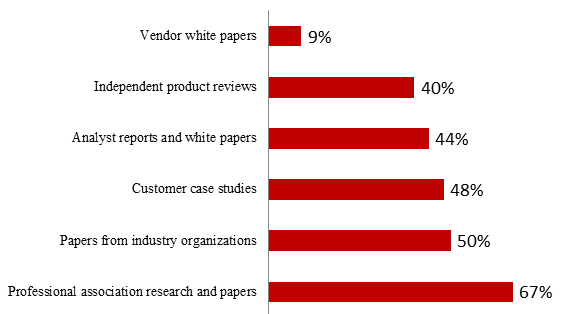
A survey by the CMO Council found that all content is not viewed equally by B2B buyers. “Peer-powered content” is more valued and trusted than non-peer content.
The survey found that professional association research and papers are the most valued and trusted content. Papers from industry organizations, case studies, and analyst reports and white papers were also reported to be valued. In contrast, vendor white papers were not found to be valued highly.
What type of content do you most value and trust?
Source: CMO Council
Depth not promotional
The characteristics that were found to be valued the most by B2B buyers were depth of the content (47 percent) and ease of access and readability (44 percent). Respondents reported that they do not like content that has too many requirements to download (50 percent) or is promotional or self-serving (43 percent).
Good content is shared
B2B buyers report that they share good content. Fifty-nine percent of survey respondents share content with 25 or more peers and associates, and 28 percent of survey respondents forward content on to 100 or more people.
Position yourself
To position your company as an industry leader you need to provide valued and trusted content. This means creating, curating, and distributing content that educates, informs, and addresses specific needs.
It also means avoiding the trap of self-promotion. Valued and trusted content is not content that is self-serving or promotional, rather valued and trusted content provides customers with answers, solutions, and education.
Blogging is essential, but additional content is necessary as well. Case studies and white papers are two go-to content solutions that can help you position your company as a trusted leader within your industry.
Remember that you don’t need to go it alone. More than 44 percent of B2B marketers report that they outsource content creation.