by Elizabeth Hines | May 15, 2019 | Blog, Content Marketing, Logistics, Marketing, Social Media, Supply Chain
Recent research aims to get the bottom of the biology behind social media engagement. There’s now scientific evidence to support the best time to post on social media.
Highlights:
- Researchers from Notre Dame have linked optimal social media post timing with human circadian rhythms.
- Emotional content performs best in the mornings.
- For think-pieces, afternoon is the best time to post.
We frequently remind our clients of a fundamental truth of digital marketing, summed up nicely by BuzzFeed’s Jonathan Perelman: “Content is king, but distribution is queen and she wears the pants.” Essentially, you need content of the highest quality, but that’s not enough. Knowing the best time to post on social media and to distribute content across your other digital channels is crucial to ensuring that your content goes to work for you.
As digital natives increasingly populate decision-making positions within the B2B marketplace, social media is increasingly becoming a space where buyers gain information for use in decision-making. In fact, 54% of all B2B buyers report that they rely heavily on social media to research vendor solutions.
Many marketers remain uncertain about how to time posts optimally for maximum engagement and ROI. For lack of clear information, social media managers often resort to a “spray and pray” strategy, in which they post frequently and spend increasingly on boosting their content.
There are some excellent tools out there, which we recommend, to help you determine the best time to post on social media for your business. Now, thanks to three pioneering researchers, there’s science to back up the logic on post timing.
The research
Three researchers at the University of Notre Dame — Vamsi K. Kanuri, Shrihari Sridhar, and Yixing Chen — investigated the question of the best time to post on social media. Among other findings, their research showed that “digital content platforms can increase traffic to their websites from social media and boost digital ad profits by at least 8%, simply by aligning their posting schedules with target audiences’ sleep-wake cycles, or circadian rhythms.” Their findings, entitled Scheduling Content on Social Media: Theory, Evidence and Application, were published in the Journal of Marketing.
The authors began by interviewing social media managers from major content platforms to understand how they make decisions about what and when to post, as well as investigating a year of Facebook post and boosting data. What they found is that managers have been relying not on science, but on personal experience and “gut feelings.”
“It turns out managers’ intuition on when audiences consume content was generally accurate, but the engagement rates for specific content categories (sports, local) and content types (high-arousal content and content requiring higher cognitive processing) and temporal variation in the effectiveness of boosting came as surprise to managers,” author Kanuri says. “The fact that firms can increase their engagement without spending an additional dime is jaw-dropping for most managers we interviewed.”
Working memory and social media post timing
The team’s findings hinge on the biological idea of human working memory, which “stores and manipulates information used in daily tasks.” Working memory capacity varies throughout the day, in accordance with circadian rhythms. The capacity is at its peak upon waking in the morning, reaches its lowest point mid-afternoon, and is at a moderate level in the evening.
“Higher working memory makes us feel alert and curious, meaning consumers are more likely to devour content in the morning,” says Kanari. “When working memory is resource-deprived, the brain prioritizes information to remain efficient and will better respond to boosted content, which legally must look different to consumers. The different look signals to the brain the information is important, thus, boosted content is most effective in the afternoon as working memory lowers.”
Perhaps most significantly, the research demonstrated that “articles that required deeper engagement with ideas — think op-eds and science-based articles — were more frequently clicked on when working memory was high.”
Using the science to find the best time to post on social media
The authors designed an algorithm that allows firms to automatically make profitable decisions about post timing and boosting spend. But, even without purchasing the algorithm software, the research offers extremely valuable, actionable insights for social media managers. Here are four main takeaways:
- In general, morning posts yield higher engagement.
- Spending money to boost posts is most effective when the target audience is at low working memory (afternoons and evenings).
- Content designed to elicit high-arousal emotions (like anger or worry) performs best in the morning.
- Deep-think content like op-eds and scientific research performs best in the afternoon.
Social media success doesn’t necessarily depend on high-dollar spending to boost posts. Paying attention to the science behind audience engagement is key. Aligning content types and post timing with the biological evidence presented will ensure that content performs optimally.
Related posts:


by Elizabeth Hines | May 14, 2019 | Blog, Content Marketing, Logistics, Marketing, Strategy, Supply Chain
As the performance gap between high and low digitally achieving companies widens, taking steps toward digital maturity is increasingly important.
Highlights:
- Increasingly, digital maturity is a predictor of overall market success.
- Benefits include reduced costs and time to market and improved product quality and customer satisfaction.
- Companies at any stage of digital maturity can take steps to improve.
Digital maturity, or the process of a company’s learning to respond appropriately to the emerging digitally competitive environment, is increasingly accounting for a widening performance gap among B2B businesses. And the gap will continue to widen: Companies who are adapting well to the digital age will increasingly outperform those who lag behind.
Boston Consulting Group’s second annual survey of nearly 2,000 companies in the United States and Europe found that while 25% of the companies surveyed qualified as “digital champions,” nearly one-third are significantly behind in their digital maturity. The study found that “increased levels of digital maturity significantly improved competitive advantage along multiple performance indicators, such as time to market, cost efficiency, product quality, and customer satisfaction.”
BCG’s study used the company’s respected Digital Acceleration Index (DAI) to make comparisons among companies. And it offers some hopeful takeaways for businesses at any point on the spectrum. For example, “an increase in digital maturity of 25 DAI points improves the likelihood of reaching a superior performance for time to market, and cost efficiency doubles.”
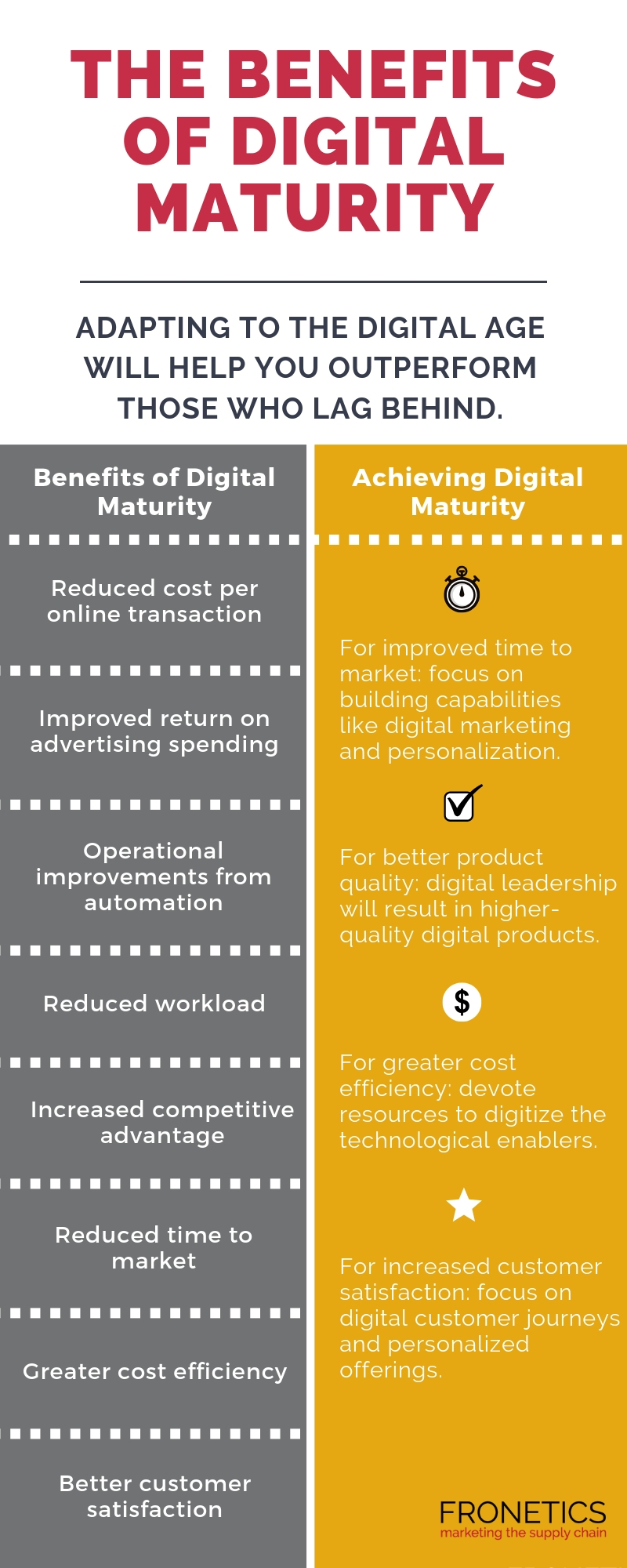
These are powerful numbers. And BCG also points out that very few companies have achieved full digital marketing maturity — which means that essentially everyone should be taking note. Our infographic below looks at why digital maturity is important, and how companies can take steps toward achieving it.
The benefits of digital maturity
(Made with Canva)
BCG’s study aimed to quantify the value of improving digital maturity to impressive results. Some of the most significant benefits the study found were:
- Reduced cost-per-action in online transactions
- Increased online transactions
- Improved return on advertising spending
- Operational improvements from automation
- Reduced workload
- Increased competitive advantage
- Reduced time to market
- Greater cost efficiency
- Improved product quality
- Better customer satisfaction
Achieving digital maturity
No matter where they are in the process of achieving digital maturity, companies can improve and accelerate their progress. In particular, companies should focus their efforts to reap the benefits of digital marketing maturity:
- For improved time to market: Focus on building capabilities like digital marketing and personalization.
- For greater cost efficiency: Devote resources to digitize the technological enablers, such as increased automation in everything from production to marketing.
- For better product quality: Digital leadership is key. Fostering a strong digital culture company-wide and investing in digital talent will result in higher-quality digital products.
- For increased customer satisfaction: Focus on digital customer journeys and personalized offerings.
The bottom line
Digital maturity will increasingly separate the herd. Digital drives performance across B2B industries. It’s time for the supply chain to stop looking at technology as a cost center and start seeing it as a profit driver and competitive advantage in the market.
Related posts:


by Elizabeth Hines | May 13, 2019 | Blog, Content Marketing, Marketing, Social Media, Supply Chain
Instagram Stories offer an on-trend platform for delivering targeted content to B2B buyers, and we’re joining the fun.
We’ve written extensively about the benefits of using Instagram as a part of your social media strategy. And, though we’ve been active on Instagram for over two years, we’re now taking on Instagram Stories.
Instagram Stories are sequences of content that a user (or business) posts to Instagram over a 24-hour period. Besides photos, Stories can include videos, live and prerecorded. The content plays as a continuous feed, creating a narrative about the user’s day — hence the term “Stories.”
Audiences can view the Stories of the users they follow within the 24-hour window after they are posted. They can find users with active Stories by scrolling the user icons at the top of the app. Or users can tell their followers that they’ve posted a story by tagging them, which notifies them through a direct message.
Fronetics’ Stories will be a fun mix of breaking news, highlights of upcoming events, and live video on the latest industry trends. Ideas for Stories you’d like to see us cover? Email me at [email protected].
Related posts:

by Elizabeth Hines | May 9, 2019 | Blog, Content Marketing, Logistics, Manufacturing & Distribution, Marketing, Supply Chain
Putting your audience’s informational needs first when publishing blog content is the only way to guarantee success in the modern marketing landscape.
Highlights:
- Audiences are increasingly ignoring promotional messaging.
- Buyers are seeking value from vendors outside the sales funnel.
- Information is your best asset — publish what you know.
The latest industry research from the Content Marketing Institute indicates that nearly all (90%) of the most successful B2B content marketers have one thing in common: they prioritize their audience’s informational needs over their sales/promotional message. And that’s compared with only 56% of the least successful B2B content marketers.
Materials-handling marketers should take note when making decisions about publishing blog content. We see companies in this sector making this mistake all the time. They want to fill their blogs with information about their products. But to achieve success in today’s B2B purchasing landscape, you need to be prioritizing your audience’s needs over promotional messaging.
Sales pitches get ignored
A large reason for shifting focus is because audiences are increasingly tuning out sales pitches. This generation of buyers has been heavily marketed to their entire lives, and they don’t hesitate to swipe left at the slightest hint of someone trying to sell them something.
Think for a moment about your own personal experiences with email, social media, and even phone calls. The truth is, most of us tune out overt sales pitches, either hitting delete or scrolling past them. We’ve moved beyond a time when marketing is about pushing your products.
Your blog, therefore, should not be another channel for selling. But, what kinds of information should you publish?
Provide value by putting customer needs first
The answer is actually quite simple. What information or expertise do your buyers want? Your most valuable commodity is your unique understanding of the challenges your audience faces. If you begin publishing blog content that answers their questions, they’ll be more likely to find you, remember you, and become your customer.
As you think about publishing blog content, take a step back and think about the questions your buyers ask, either of you, on social media, or elsewhere. Examine industry publications to determine the challenges faced by your target buyer persona.
Does your content answer those questions? Does it offer value in and of itself? And does it inform your audience about how you are there to help them? If the answer to these questions is yes, then you’re taking the right steps toward materials-handling marketing with today’s B2B buyers.
Related posts:
by Elizabeth Hines | May 8, 2019 | Blog, Content Marketing, Logistics, Manufacturing & Distribution, Marketing, Strategy, Supply Chain
Brand awareness is key in optimizing your content marketing efforts but can be challenging to quantify. Here are four metrics to help you measure brand awareness.
Highlights:
- Use tools, like SharedCount, to track the number of times a piece of your content has been shared across different social media platforms.
- Use the analytics from blog share bars to track the popularity of your posts and help shape content for your editorial calendar.
- Taking the time to measure brand awareness will ultimately help you in optimizing your digital marketing efforts.
Video transcript:
I’m Katie Russell and I’m a marketing strategist here at Fronetics. Today I’m going to talk to you about four ways to measure brand awareness for your packaging company.
Brand awareness is the extent to which customers – both potential and current – are able to recognize your brand. It is key in optimizing your digital marketing efforts, but it can be hard to quantify. Here are four metrics to help you start measuring brand awareness for your packaging company.
1. Social media reach
Social media reach is the total number of people that your content can reach across social media platforms. Use tools like SharedCount to track the number of times a piece of your content has been shared across different social media platforms, like Facebook, Instagram, and even LinkedIn. This can help you figure out what platforms perform best for your content and can also help you shape the kind of content that you’re putting on social media platforms.
2. Brand mentions
How people talk about your packaging company online? If they are, you need to know about it. Try tracking tools like Google Alerts or Hootsuite to make sure that you know every single time someone talks about your packaging brand or any of your products or services.
3. Blog shares
Here are Fronetics, we talk a lot about the importance of having a blog that posts valuable and informative content to your readers. What’s also important is giving your readers the ability to share this content. It’s as easy as adding a share tool to the side of your blog posts. This helps you reach a larger audience and gain views from people that normally wouldn’t see your content. You can also use the analytics from these share bars to track the popularity of your posts and help shape content for your editorial calendar.
4. Search volume
Use tools like Google Adwords or Moz to track searches for your brand, products, even your blog and social media posts. It can help in refining your keywords that you use throughout your content to know specifically what people are searching for when they’re searching for your packaging brand.
Taking the time to measure brand awareness will ultimately help you in optimizing your digital marketing efforts and will also help increase leads. IF you need more information or need help getting started measuring your brand awareness, visit us at fronetics.com.
Related posts:

by Elizabeth Hines | May 7, 2019 | Blog, Content Marketing, Logistics, Marketing, Social Media, Supply Chain
When it comes to social media, timing is everything. These 5 tools will help you determine the best time to post on social media for your business.
Highlights:
- Social media is playing an increasing role in B2B purchasing decisions.
- Even if you’re posting great content, if you’re doing it at the wrong times, you’re losing out.
- Social media management tools can help you understand your audience and make informed decisions about post timing.
If you’re a B2B marketer, chances are, you’re well aware of the importance of social media. But since, as BuzzFeed’s Jonathan Perelman famously put it, “Content is king, but distribution is queen, and she wears the pants,” simply posting your content is only half the battle. Knowing the best time to post on social media is nearly as important as what you post.
It’s difficult to overstate importance of an effective social media strategy. Not only do 78% of marketers who have used social media for 2 years or more report increased traffic to their websites, but B2B decision-makers increasingly report that they are influenced by social media when purchasing. According to Demand Gen’s 2018 B2B Buyers Survey Report, more than half (54%) of all B2B buyers rely on social media to research vendor solutions.
These are powerful numbers, and all signs point to social media playing an ever-increasing role in the B2B buyer’s journey. For your social media content to pack the biggest punch, you need to be posting at the optimal times. Luckily, there are a plethora of social media management tools that can help you refine your strategy. Here are our 5 favorite tools for determining the best time to post on social media for B2B brands.
5 tools for determining the best time to post on social media
1) Google Analytics
This robust analytical tool is among the most popular all-around web tools for B2B businesses, and for good reason. Google Analytics can help you determine how your audience is interacting with all your digital assets, and it offers some great insights about social media in particular. You can create various types of custom reports based on your business’ goals and results. We recommend three in particular to help you find the best time to post on social media:
- Best Days to Post on Social Media
- Best Time to Post on Social Network by Hour
- Social Media Traffic by Date and Hour
2) Buffer
A company with an impressive record when it comes to social media management, Buffer’s platform lets you easily manage all your social media platforms. Like its biggest rival, Hootsuite (more on that soon), Buffer offers among its features some useful insights for determining ideal post timing and frequency. For example, it analyzes follower activity and suggests the perfect moments to post on each social media platform.
3) Hootsuite
Hootsuite has been one of our favorite tools for a long time, and it truly offers a rich variety of features and insights to maximize the effectiveness of your digital assets. Not only is it effective at scheduling social media posts, it’s an excellent tool for measuring social media ROI — no easy task! Hootsuite’s AutoSchedule feature is one of its best assets. For each piece of content you plan to post on social media, it analyzes when similar content performed best in the past and determines the optimal post time. In addition, it considers the platform and publishes based on audience engagement on each network.
4) Followerwonk
Followerwonk is new to our list, and it’s different from most social media management tools. While it doesn’t offer the kind of scheduling and management features as the other platforms on our list, what it does do extremely well is help you gain valuable insights and understanding of your audience. For example, Followerwonk lets you analyze your current Twitter followers by things like location, post timing, engagement, accounts they follow, and more, as well as contrast those relationships with your competitors. Understanding your followers at this level will not only help you determine when your business should post on social media, but will allow you to analyze and adjust your strategy in all kinds of ways.
5) SproutSocial
Another perennial favorite, SproutSocial offers the whole menu of social media management tools: everything from monitoring to scheduling to analytics. The customized dashboard gives you a bird’s eye overview of how your social media channels are performing. You can find deeper insights, including individual statistics on each post, and customer data like gender, age, and location demographics. The platform’s ViralPost technology boasts impressive results at finding the best time to share your content.
Figuring out the best time to post on social media for your business is no easy task, but it’s key to getting your content to reach your target audience. There’s no one-size-fits-all solution, and any one, or a combination, of these tools can help you understand your audience better and get your content out to them at the right times.
Related posts: