How will self-driving, autonomous stores impact the retail industry and the supply chain?
This guest post comes to us from Argentus Supply Chain Recruiting, a boutique recruitment firm specializing in Supply Chain Management and Procurement.
Here’s another dispatch from the far-flung realms of emerging technology that will transform the Supply Chain – how products are brought to market, and how customers acquire those products.
We’ve written before about the upheaval Amazon has wrought on the Retail industry – whether it’s the company’s move into brick and mortar retail, its acquisition of Whole Foods Market seeking to improve its Last Mile Delivery, or its proposed use of drones to deliver products. We’ve also written about some emerging technologies – like augmented reality – that are blending the world of eCommerce shopping and a more traditional brick and mortar experience.
Suffice it to say, the retail industry is going through some major convulsions. With dozens of major U.S. retailers shutting down, and tons of new startups entering the eCommerce market, the landscape looks different than it did even five years ago. Companies are looking to the bleeding edge of technology to revolutionize the last leg of the Supply Chain, imagining the best ways to deliver products to consumers in 2020, 2030, and beyond.
Now, an idea that’s been explored in theory is seeing testing in Shanghai, a city known for its leadership in the mobile payments space, as well as its Blade Runner-style futurism.
Self-driving, autonomous stores
Analysts have touted autonomous drones and self-driving trucks as disruptive technologies to Logistics and Retail. Now, a great recent article in Fast Company profiles a startup called Moby which is testing a model of autonomousstores that drive around, seeking customers based on traffic data. Customers can “order” a store to drive to them, similar to how we order Ubers today. They then enter the store using an app and pay for goods with mobile payments. When the store is out of products, it drives back to the warehouse, or connects with another store that has excess supplies of, say, milk, to restock. Like a food truck, but one that also sells toothpaste, and replacement phone chargers, and apparel – using only robots.
Check out the video:
Pretty cool, no?
Produced in partnership between Swedish-based startup Wheelys and China’s Hefei University, the Moby Stores are electric, solar powered, and allow customers to order products for their next visit based on voice activation. Wheelys’ background is in making mobile coffee carts for entrepreneurs, and it’s extending that manufacturing experience towards these new prototypes, hoping (perhaps optimistically) to eventually build the stores for $30,000. It’s planning to start commercial production of the stores by 2018.
It’s a wild idea, to be sure – with significant manufacturing and regulatory hurdles still to clear – but pie-in-the-sky technologies have transformed retail before.
There are a few cool implications for this model from a Supply Chain angle, beyond the obvious convenience of having a store that comes to consumers:
It potentially changes the approach to last mile logistics, possibly eliminating the human component in delivery – similar to drones, but with product selection.
These stores combine the convenience of eCommerce with the tactile experience that’s still brick and mortar’s strength in areas like apparel.
They will allow retailers to compete in the brick and mortar space without paying for rent / real estate, which is a huge barrier to entry and carrying cost making brick and mortar uncompetitive. Of course there are maintenance costs to consider, as well.
By allowing customers to “order” a mobile store to a nearby location similar to how one would order an Uber, this model can allow a very fast form of same-day delivery, something that’s been a “holy grail” for companies like Amazon.
We know that startups don’t always translate into industry-redefining enterprises, but even if Moby itself isn’t the future of Retail, it’s very possible that wandering stores will be a big part of the autonomous era.
When it comes to social media news in August 2017, the words of Kanye West, “stronger, better, faster, stronger,” have never been truer.
August has seen a continued push to get more information to more people in real time. Pinterest is introducing mobile ads. YouTube is adding sharing and chat features to the app. Google is developing new software to rival Snapchat. And, of course, the social media giant Facebook is always working on new improvements to dominate its competitors.
Facebook Tests Custom Audiences Based on Interactions with Event Pages
Google Developing Rival to Snapchat Discover Feature
Back in 2016, Snapchat introduced ‘Discover,’ which allowed users to view news in the form of Snapchat Stories. At the time, this new technology allowed social media to combine news and television in short videos. Now Google wants a piece of the action. Google is working to allow publishers the ability to create media-oriented content. “The new publisher technology, called ‘Stamp,’ represents an escalation in the competition between tech platforms for publisher partnerships and access to media content, which they need to drive user engagement,” writes Erik Sass for Media Post.
Pinterest Rolls Out Mobile Video Ads to All Advertisers
Initially introduced a year ago to a limited amount of Pinterest advertisers, now all advertisers will have the ability to create mobile video ads. Using auto-play, the new type of promoted videos will begin playing as soon as users scroll across a brand’s feed and will also auto-play in Pinterest’s search results. Jenny Chiu, head of partnerships at Pinterest, said in a blog post, “Your Promoted Video sparks into action the moment a Pinner scrolls across it in their feed — no need to hit play. They can just sit back and watch your video unfold. And unlike on other platforms, where ads interrupt people as they’re trying to enjoy posts from friends, on Pinterest, people are actually looking for videos that inspire them to give ideas a try.”
Twitter Tests New Feature that Allows Brands to Automate Their Promotional Tweets
Twitter is in the initial testing of having brands pay ($99) to have their tweets automatically promoted on its app. Brands can tweet as they normally would, and the social network will automatically promote some of those tweets, but brands cannot customize which tweets are promoted. Twitter will create bi-weekly reports that will include information on audience insights, user growth and new user engagement. Companies were able to sign up on Twitter’s homepage to try to land a spot in the beta testing, which is now completely full. Stay tuned to see if Twitter rolls out this new feature to all users.
LinkedIn Rolls Out Quick Access to Samsung Users
LinkedIn and Samsung have teamed up to create the ultimate user experience. Now Samsung Galaxy S8 and S8+ owners can have access to LinkedIn’s content and calendar experience. Using Bixby, Samsung’s digital assistant, users can easily access LinkedIn’s Trending Storylines that include top news stories and scheduling details through My Schedule notifications.
YouTube Adds Chat and Sharing Features to Mobile App
YouTube has been working on ways to make sharing videos easier than ever. With the newest app features, users can share videos directly through the mobile app, as well as chat with other viewers in real time. YouTube announced on its blog, “Not only can you share and receive videos in the app, you can also chat about them right on YouTube, reply with another video, invite others to the conversation, and more. We think it’ll make sharing easier, faster and more fun on your phone. And if you want to continue sharing videos through other apps, you can still do that too.”
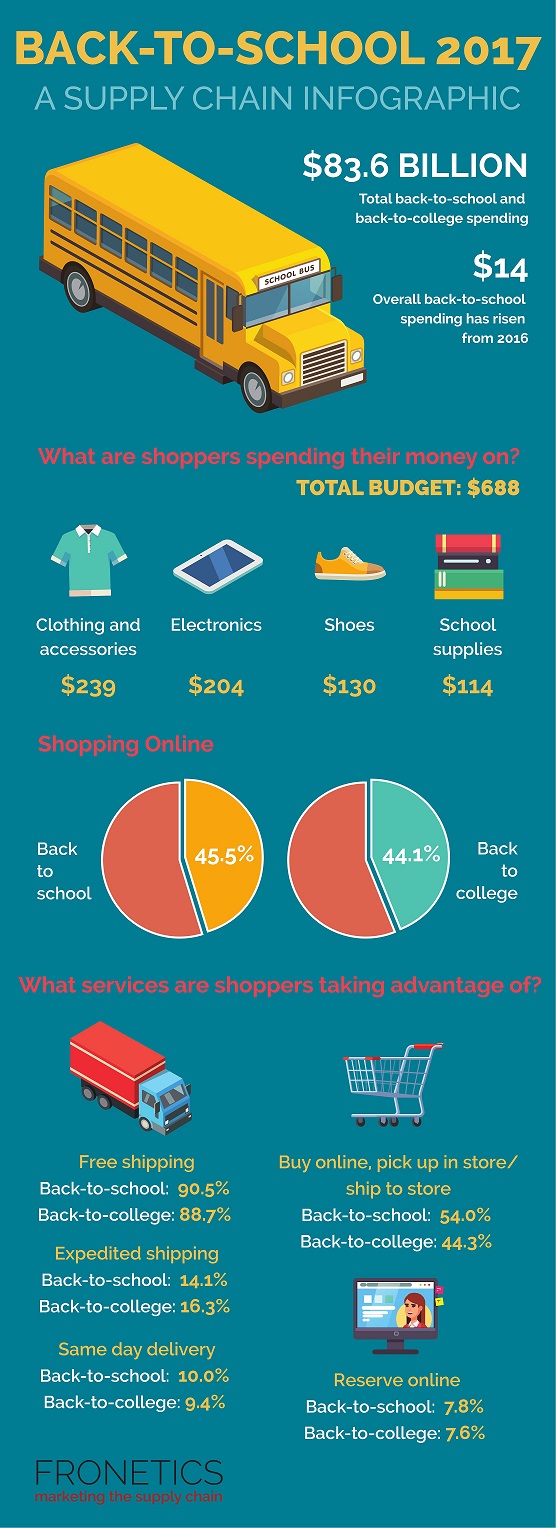
Record spending, online shopping, and free shipping are hallmarks of back to school 2017.
With consumer confidence on the rise, the National Retail Federation predicts that back-to-college and back-to-school spending will hit $83.6 billion in 2017. That whopping total is an all-time high for back-to-college dollars, and the second highest on record for back-to-school spending, and represents and increase of more than 10% from last year.
If you started your shopping three weeks to one month before school starts, you likely found the longest lines: 46.7% of shoppers report that that’s when they planned to hit the shelves for back-to-school shopping, and 34.6% for back-to-college.
The top destinations for back-to-school shoppers are department stores (57.1%), discount stores (54.1%), and clothing stores (46.0%), while back-to-college shoppers prefer online shopping (44.1%), with discount stores (40%) and department stores (38.5%) following in second and third place. A whopping 90.5% of back-to-school shoppers plan to take advantage of free shipping services, with 88.7% doing the same for back-to-college shipping.
Per household, overall back-to-school spending has risen from last year’s average of $674 to $688 in 2017. The NRF predicts that 64% of that total will be spent on apparel and electronics.
Check out our infographic with some interesting facts from the NRF’s 2017 survey below.
Here are seven tips for manufacturers to improve your email marketing strategy in the manufacturing and industrial sector.
This post comes to us from Adam Robinson of Cerasis, a top freight logistics company and truckload freight broker.
Email marketing is a powerful tool for growing and developing different types of businesses. However, many industries are still unaware of the power of using an appropriate email marketing strategy. Many manufacturers and industrial companies are still stuck in the one-off batch and blast mode of email marketing. That strategy is not likely to work very well in industrial marketing, where most of the purchases are expensive; complex products with long sales cycles, multiple decision-makers, and stakeholders are involved; and there is a much higher risk if a wrong decision is made.
7 email marketing tips for manufacturers
1. Avoid SPAM at all costs
The last thing that you want is for your emails to end up in someone’s spam folder or have your emails banned from someone’s inbox. Before you even start an email marketing campaign, you should print out the latest copy of the CAN-SPAM act to remind yourself of some email marketing principles, such as any recipient must have given their consent before receiving commercial email, have an option to unsubscribe from receiving further emails, do not mislead the recipient about the content or the origin of the email, and use approved methods to get a recipient’s email address.
2. Personalize your emails
You should avoid sending generic emails. Your recipients are not all the same, and you should make distinctions between them by segmenting your database. This means sending the same type of email diversified in some key aspects depending on the type of recipient. The content and filters of platforms such as Litmus and Reach Mail, which is based on personal data, geography, activity, and devices used, let you automate the entire process to narrow your focus and identify the ideal sub-section of your list.
3. Increase your traffic and clicks
By creating the perfect email marketing campaign, you will have the power to turn emails into clicks and traffic to your website. Sending relevant links to your subscribers will drive them to your website, and this increases the potential for new sales. If you want to give a real boost to your click-thru rates, you should keep in mind that you have to get rid of the clutter. Having an email that has too many graphics and banners will confuse your readers and leave them wondering what they are supposed to click on.
4. Offer quality content
You should always provide useful, quality content in an email and links to further information. Your emails should be more informative than sales-related, especially in the manufacturing industry. Talk about your company’s safety standards, advertise interviews with experts, and discuss pressing matters in your industry. Not presenting your information in a clear and accurate way will put off your recipients. You can take advantage of online tools to help you with your content writing. Use Australian Help and Oxessays as copywriting tools for writing your emails and Bigassignments to help you to edit your content. [Editor’s note: You can also partner with a third-party marketing firm to develop and execute an email marketing strategy for your business.]
5. Optimize your subscriber list
Do not rush out and buy an email list to get started with email marketing. You should grow your in-house subscriber list and get to know your customers and what they need from you.
6. Link your email platform with other channels
Email platforms, external databases, e-commerce, social media, and business intelligence systems can all be linked to optimize your business and reach more potential clients. Platforms such as Mail Chimp and Mad Mimi allow you to connect and integrate every system, synchronize the information on each, and have them communicate with each other.
7. Automation and tracking
You should try to make your email marketing strategy as efficient as possible with email marketing automation. Platforms such as the mentioned Litmus and Reach Mail will let you automate the entire process. Analyzing and tracking your campaigns’ performance is also essential. Using the analysis tools and reports available from the platforms we suggested will allow you to check and optimize your clicks, traffic, and sales.
Wrapping up the 7 email tips for manufacturers
There are many things to consider when creating an email marketing campaign. The main goal is to effectively connect with potential customers to persuade them to purchase your product by reminding them that you exist and that you are helping. Use these email tips for manufacturers to continually improve your sales and grow your industrial business.
In keeping with social media etiquette for businesses, you really shouldn’t do these things.
It’s easy to get bombarded with suggestions on how to interact with your customer base on social media. Amid the endless barrage of ideas for what to do, it’s worth remembering that not all social media engagement is equal — sometimes, it’s just as important to remember what not to do. (See for example #LeggingsGate.)
Let’s talk about the specifics of keeping your proverbial foot out of your business’ mouth online. Take a look at the list below of 6 don’ts for B2B businesses.
6 social media don’ts
1) Don’t assume that just because you’re online, offline rules of communication and conduct don’t apply.
It may seem obvious, but it’s all-too-often forgotten. This is a good rule, and an easy metric by which to judge any content before posting: Your interactions online should measure up to professional interactions you would have in person.
2) Don’t re-post, re-tweet, re-gram, or re-share external content without a thorough check first.
Re-posting content that’s of interest to your business’ audience is a great way to promote discussion and engagement. But don’t get sloppy. Remember that even if content didn’t start with you, if it’s posted on your company’s social media accounts, it represents your business. Make sure content is well-researched and from reliable sources. Want to re-post something controversial? Just be sure to include a disclaimer or explanation in your post.
3) Don’t forget that emotional intelligence is just as important for businesses as for individuals.
Never forget that behind every social media account is a human being. The bottom line: “bring emotional intelligence to your social media management. Take the time to address any issues with compassion and understanding.”
4) Don’t ignore comments.
Social media is all about engagement with your audience and potential customer base. Yes, responding to every comment takes time and resources, but it is well worth the effort. A comment ignored sends the message that you don’t feel that your customer’s question, concern, or observation is important. Use comments as the opportunity they are to interact with your followers, and show them that you are ready and willing to address any issues they may have.
5) Don’t delete negative comments.
Once it’s online, trust that people have seen it. Deleting a complaint will only make your business appear insensitive and evasive. Addressing negative comments demonstrates that your company is proactive about resolving issues and taking care of your customers.
6) Don’t forget the basic principals of common sense and good judgment.
This one comes from John P. David of David PR Group. It seems like another obvious one, but people and businesses violate this principle all the time. Always have at least two pairs of eyes on everything you are going to post, and anything remotely controversial should be thoroughly vetted by as many people as necessary. When in doubt, David says, don’t post.
If your company has committed any of these social media don’ts in the past, don’t panic. These platforms offer an ideal place for renewing and tweaking your image. Invest in the creation of a good social media policy. Don’t give the enormously important task of social media management to a summer intern. And, for goodness’ sakes, remember you’re a human talking to other humans.
Supply chain and logistics businesses need to be about more than themselves, and content marketing can help them get there.
While conventional wisdom tells us that content marketing is useful and important for any business, there are still some in the supply chain and logistics industries that remain unconvinced. It’s an understandable conundrum: Content marketing requires significant time, labor, and resources, and it can take quite some time to start reaping benefits.
The bottom line is that studies have shown that of companies with a documented content marketing strategy, 86% find their efforts to be successful in generating new leads, creating lasting relationships with customers, and increased ROI.
How can content marketing make my business better?
Consider this: Content marketing helps a company become more than just another business to customers — it can become a valuable resource for everything related to their products and services.
A good content marketing strategy is about understanding the questions and concerns that are particular to your customer base, and offering quality information and analysis that answers those needs. In the words of River Pools & Spas co-owner Marcus Sheridan, “The moment we stopped saying, ‘We’re pool builders,’ and started saying, ‘We are the best teachers in the world about Fiberglass pools and we just happen to install them as well,’…that was one of the most prosperous days of our lives.”
It’s worth noting that Sheridan was discussing his company’s turnaround from near bankruptcy to becoming a global leader in its field. He attributes this success to switching his company’s mission from selling its product to educating potential buyers — namely, content marketing.
Your business is more than its product.
Recognizing that your business has more to offer than its primary product or service is at the core of what content marketing is all about. Kirk Cheyfitz, CEO of Story Worldwide, puts it this way: “Like a decent human being, brands need to be about more than themselves.”
Start thinking about your business this way. You have a team of people with a tremendous aggregate of experience, expertise, and perspectives. That means that you can offer your audience far more than simply your primary product or service: You can offer them knowledge. Your audience is, in turn, far more likely to become buyers as you provide value — which builds trust and cultivates lasting, fruitful relationships.
What can I do to implement an effective content marketing strategy?
If you’re just jumping on the content marketing bandwagon, it’s an exciting time for your business. You might want to check out our Twelve-Step Guide to a Content Marketing Strategy and other resources to help you through the process.
A visual content audit is a solid first step. The main thing to keep in mind is that you have valuable resources at your disposal that you can offer your audience of potential buyers — start sharing!