
by Jennifer Hart Yim | Aug 5, 2020 | Blog, Covid-19
Editor’s note: This is the first in a series of three guest posts by Kate Began of Polycase.
The Covid-19 outbreak has changed the global business landscape in ways that would have seemed unbelievable just a few months ago. Businesses have been forced to reevaluate their approach to everything–from sourcing to operations. The manufacturing industry has seen particularly high levels of disruptions as plants are temporarily shut down and supply chains are disrupted.
A few months into the pandemic, trends have begun to emerge that allow the business community to begin to analyze Covid-19’s impact on American manufacturing. While supply has been constricted on everything from electronics enclosures to pharmaceuticals, demand has mutated in unpredictable ways, and businesses are scrambling to find new strategies for addressing these challenges.
These five aspects have already created major change in the manufacturing economy, and manufacturers will need to face them head-on to create a plan for surviving the continuing challenges of the post-pandemic business landscape.
1. Quarantines and shutdowns have caused some major hits to the bottom line for the American manufacturing industry.
Many U.S. manufacturers were forced to shut down as a result of the “stay-at-home” orders that their states imposed in March and April of 2020. Those that weren’t required to shut down often had to produce at reduced capacity, thanks to lower demand in many industries (as we’ll discuss later).
The result has been dramatic: an estimated 25 percent decrease in yearly profit predictions for the American manufacturing industry. While it’s true that manufacturers in some sectors, such as CPGs and medical equipment, have seen enormous spikes in demand, the overall financial picture for the manufacturing sector (particularly heavy industry) remains disturbing.
Having taken such a painful hit to the bottom line, many manufacturing businesses find themselves limping into Q3 and in need of a new plan for finishing out the year. Easy answers will be in short supply, but manufacturers will need to take decisive action to prevent a bad situation from becoming worse.
2. The devastating impact of lax safety procedures has become apparent.
American manufacturing businesses have to face the facts: During a pandemic, inaction is deadly. We’ve seen uncontrolled outbreaks sweep through meat-packing facilities across the nation, killing dozens and sickening thousands more. While it’s true that meat-packing plants are uniquely vulnerable to the spread of respiratory diseases, the risks apply to any facility in which workers are in close proximity to one another and/or share equipment.
Manufacturers owe it to their employees, their customers, and the world at large to ensure that their facilities don’t contribute to the spread of coronavirus. More than ever, practicing good workplace hygiene has become a matter of life and death. Businesses must be sure to follow the CDC’s guidelines for businesses and employers, and they must strictly enforce compliance among employees.
Steps as simple as requiring masks at work can significantly reduce the chances of disease spread. However, in order to truly reach the level of a responsible corporate citizen, manufacturers must commit to substantial reconfiguration of their processes to institute social distancing in the workplace.
3. Manufacturing supply chains have seen major disruptions.
The globe-crossing supply chains that characterize 21st-century commerce have had their reliability severely tested by the pandemic. China, in particular, has experienced major logistics problems, such as closed ports and grounded flights. With so many of the world’s manufacturing supply chains running through China, many businesses have had to find creative ways to keep their operations running.
Business experts say that this global supply chain chaos has been a major learning experience for manufacturers, who were often caught without sufficient options when their Chinese supply chains began to collapse in February and March. Going forward, these businesses will have to put a new focus on diversifying their supply chains to increase their resilience to globally disruptive events such as pandemics. Those low-priced Chinese components may do great things for the bottom line, but you can’t capture any of those benefits if you can’t get the materials in the first place.
4. Demand has plummeted in some sectors (and exploded in others).
With the Covid-19 pandemic has come an economic contraction that has suddenly plunged the U.S. economy into a recession. As a result, demand has massively decreased in many key American manufacturing sectors. Industry reports demonstrate that demand for everything from heavy equipment to electronics to metal fabrication continues to experience painfully intense contractions.
The silver lining for some manufacturers is that demand has actually increased rapidly in some sectors. Food, beverage, and other essential household CPG manufacturers have all seen massive surges in demand, as have medical supply manufacturers. The demand surge has even reached some unexpected corners such as the DIY home products industry as bored, homebound Americans take on home improvement projects.
These shifts in demand have produced some fascinating examples of the versatility and agility of leading American manufacturers. Top consumer fashion brands have begun production of surgical masks and gowns, while industrial manufacturers like 3M have used their state-of-the-art fabrication facilities to produce ventilators and other key healthcare equipment.
5. Cash flow will be a major priority moving forward.
In a turbulent economy, many manufacturers are reevaluating their cash flow strategies and prioritizing liquidity. By maintaining increased cash reserve levels, manufacturers can prepare themselves better to deal with the constantly shifting nature of the Covid-19 crisis.
Bolstering cash flow effectively requires applying a finance-driven mindset across all levels and departments of a manufacturing organization. The day-to-day practice of supply chain operations tends to be conceptually grounded in inventory management and customer relationships. While these are critical facets that can’t be sacrificed, supply chain operators need to become more practiced in thinking like a CFO and seeing the financial framework that underpins logistics decisions.
However, it’s important to remember that financial concerns should never take priority over the safety of employees and customers. The ultimate goal is to create a system of operations where both employment and physical well-being are safe and well-protected.
The novel coronavirus has given the U.S. economy a massive dose of that most dangerous economic toxin: uncertainty. For manufacturers to continue to thrive and compete, they must turn that uncertainty into innovation and seize the new opportunities that this rapidly changing economy presents to them.
Kate Began serves as the Sales and Marketing Manager for Polycase. She oversees the customer service representatives, assists with product development, and leads the marketing efforts from the Avon, Ohio headquarters. Kate is also an avid Cleveland Indians fan.
Read more:
Stop hibernating: You’re missing out on company blog benefits
When short on time, updating old blog posts for SEO makes a lot of sense
Key step to moving beyond survival mode: Revising B2B buyer personas

by Elizabeth Hines | Jul 23, 2020 | Blog, Content Marketing, Covid-19, Marketing, Strategy
The benefits of a B2B blog are too important to overlook. Plus: Three companies that excel at content creation.
If your company blog has gone the way of the bears in winter, there is good reason to bring it back to life. That stale page on your website is more important than may realize. When months and even years go by without a single update, you’re missing out on company blog benefits.
Let’s cut straight to the stats:
- 70% of respondents in a Databox survey said SEO is better than pay-per-click (PPC) advertising for generating sales. (Can you guess what a leading driver of website SEO is?)
- Blogs are among the top 3 tools used in content strategies (HubSpot 2020).
- 51% of companies say updating old content has proven to be the most efficient tactic implemented (SEMrush, 2019). (See our post on reworking content for SEO here.)
- 67% of companies use organic traffic to measure content success (SEMrush, 2019). (You guessed it: A blog is a key tool in boosting organic search traffic.)
- 72% of online marketers say content creation is their most effective SEO tactic.
- Companies with blogs generate 97% more inbound links and 434% more indexed pages than those without.
In other words, a company blog brings benefits beyond just being a source of information, a tool to communicate with prospects, and to build brand. Despite new technologies, text will — as HubSpot points out in its 2020 State of Marketing Report — always be the foundation of search. And no place allows you to add descriptive text for improved search rankings as much as a company blog.
Not seeing company blog benefits? Here are 4 common pitfalls.
But as the significant number of hibernating company blogs shows, the pitfalls tend to come in spades. If your B2B blog is currently on snooze, let us guess the reason falls into one of the following categories:
- Unforeseen events: The most recent example is, of course, the Covid-19 pandemic. Faced with massive upheaval, supply chain companies, in particular, had to reshuffle resources. Although a crisis could be the time to step up communication and position the company as a leader, some blogs went dark after releasing a statement on the pandemic and its impact on the business.
- Unrealistic expectations: More than a few B2B blogs have run out of steam when immediate results fail to materialize. The disappointment tends to stem from unrealistic expectations. As much as everyone wants that first blog post to bring in a bucketload of leads, content marketing takes time to build momentum; but, done right, it is designed to turn into a tidal wave of improved search authority. Let patience rule and you will be rewarded.
- Lack of resources: To stand out in a crowd of tough competitors is not accomplished in an afternoon. Managing a successful company blog takes time. Other than outsourcing, there really is no way around it. If the blog is run on the fly or is low on the list of priorities, the results will suffer along with the motivation to keep going.
- Lack of strategy: Publishing for the sake of publishing will get you nowhere. Who are you writing for? What keywords are they using? How do you evaluate performance? Even well-written content can miss the target if it is not tailored around the audience you want to reach.
- Lackluster content: Although we always stress the need for consistency and keyword optimization when it comes to blog content, there is yet another aspect that is just as important — quality. A company blog that does not benefit your target audience will not benefit you. The most successful B2B blogs combine SEO best practices with useful, high-quality content.
B2B blogging done right: 3 examples of great blogs
For inspiration, it always helps to look at the organizations that get it right. And there are many to choose from. Take a look at three that have realized company blog benefits with engaging and purposeful content. Although conceptually different, the visions of these blogs align with the goals of each company, whether it’s generating leads with persuasive analytics or carving out a niche in social responsibility.
1. Cerasis: Market insights
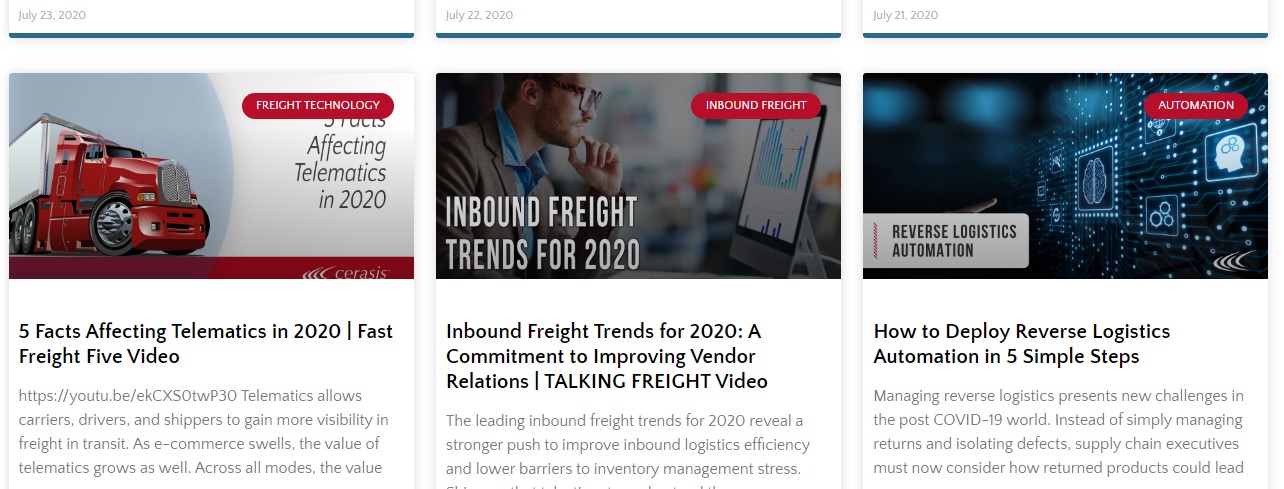
The transportation management company was one of the early adopters of B2B blogging — and the results have been impressive. And Cerasis is not letting up. The company has published 15 blog posts in July alone, a pace few can — or don’t necessarily need to — match.
2. General Electric: Global vision

A multibillion-dollar corporation has the benefit of ample resources — and GE is putting them to good use. General Electric Reports intelligently humanizes the company with a stream of stories on the impact of GE products on global progress and employee spotlights that tie into current events.
3. Comscore: Analytics first

A look at Comscore’s blog leaves no doubt about its specialty: the collection and analysis of internet data. Comscore draws upon its vast resources to create content that is found nowhere else. The ability to showcase such detailed expertise is sure to sway a target audience looking to leverage customer behavior online.
Time to crawl out
The impact of an effective B2B blog can be huge. It requires research and vision to get started, persistence to keep it up, and analysis to evaluate the performance. In the end, the benefits of a company blog contribute to the health of your entire organization.
How about waking that bear up again?
Read more:
Key step to moving beyond survival mode: Revising B2B buyer personas
Trade show cancellations call for contingency plans (It’s urgent)

by Elizabeth Hines | Jul 19, 2020 | Blog, Current Events, Supply Chain
As the popularity of podcasts grows, DC Velocity premieres a new supply chain podcast — Logistics Matters.
Our blog posts on supply chain podcasts consistently get a lot of views. Now, we can share news of another addition to the growing lineup of listen-worthy talks.
Logistics Matters With DC Velocity is a brand-new supply chain podcast designed to help logistics and supply chain professionals keep up with the most recent developments in this fast-changing industry. Considering the recent global disruption, there’s hardly a better time to add this insightful commentary to your list of podcasts.
At the mic, we find the editors of DC Velocity magazine: Editorial Director David Maloney, Senior News Editor Ben Ames, and Senior Editor Victoria Kickham. Every Friday, they post a new episode tackling the latest news and trends that supply chain professionals should understand to make informed decisions and stay abreast of the competition.
Logistics Matters With DC Velocity also invites industry experts to share their take on the issues that are driving conversations in distribution center management, freight transportation, material handling, and more.
Timely topics kick off new supply chain podcast
And this new supply chain podcast is off to a strong start with a range of timely topics. Take a look:
- What to watch out for in the United States-Mexico-Canada agreement — with David Henry of GlobalTranz.
- Keeping material handling equipment safe and sanitized — with Ken Raycroft of Briggs Equipment.
- Racism faced by Black delivery drivers — with Dr. Terry Esper, associate professor of logistics at the Ohio State University’s Fisher College of Business.
- Investments in logistics technology companies amid the pandemic.
- National Forklift Safety Day — with Brian Feehan of the Industrial Truck Association.
- IT infrastructure problems revealed by Covid-19.
- Martin McVicar of Combilift on how the company has adjusted its manufacturing operations and customer contacts in light of the pandemic.
- How layoffs are disproportionately affecting the logistics sector.
- How truck drivers are being shown a little love in the form of higher pay.
Easy listening wherever you are
Just like podcasts in general — they now number a staggering 850,000 — supply chain podcasts have grown in popularity in recent years, spurred by increased smartphone use and the ease they let you absorb new information. Some, like Talking Logistics, founded in 2015, and the Inbound Logistics Podcast, founded in 2016, are veterans in the group. Others, like The Digital Supply Chain podcast, premiered last year. But, clearly, there’s even more to say.
Logistics Matters With DC Velocity is available on Apple Podcasts, Spotify, Stitcher, TuneIn, Google Podcasts, iHeart Radio, and many other platforms, as well as at dcvelocity.com/podcasts. DC Velocity’s new supply chain podcast is produced by AGiLE Business Media, a leading publisher of business content for logistics, material handling, and supply chain executives.
It has never been easier to stay on top of the world of supply chain trends and news.
Happy listening.
Read more:

by Elizabeth Hines | Jul 14, 2020 | Blog, Covid-19, Marketing, SEO
Updated 1/21/25
Revitalizing Your Blog Archive: Modern SEO Strategies for 2025
Your company blog remains a valuable asset for search visibility, but the rules have evolved. Here’s how to breathe new life into your old blog posts using current SEO best practices — without overwhelming your team.
Why Update Old Content?
Search engines, particularly Google, have become increasingly sophisticated in evaluating content quality and relevance. While freshness remains important, it’s now just one factor among many. Google’s helpful content system and AI-driven algorithms prioritize comprehensive, authoritative content that genuinely serves user intent.
Our own data supports this evolution: a 2018 post about corporate social responsibility continues to perform well not just because it’s regularly updated, but because it thoroughly addresses the topic from multiple angles, matching the depth that today’s search engines expect.
The Modern Benefits of Blog Post Updates
Updating old blog posts delivers several key advantages in today’s search landscape:
- It signals to search engines that your site is actively maintained and authoritative in your field.
- It allows you to align content with current search intent patterns and semantic search capabilities.
- It helps maintain E-E-A-T (Experience, Expertise, Authoritativeness, and Trustworthiness).
- It provides opportunities to optimize for voice search and featured snippets.
- It enables you to incorporate new media formats that modern search engines favor.
Identifying High-Potential Posts for Updates
Rather than randomly updating old content, focus on posts with these characteristics:
Strong Existing Performance Signals
- Posts that already rank on page 2-3 for valuable keywords (these often have untapped potential)
- Content with high dwell time but low conversion rates
- Pages that earn consistent backlinks despite their age
- Posts that generate significant social engagement
Strategic Value Indicators
- Topics that align with current business priorities
- Content that addresses evergreen industry challenges
- Posts that target high-commercial-intent keywords
- Pages that compete with outdated competitor content
Modern SEO Update Strategies
1. Optimize for Search Intent
- Use tools like Google Search Console‘s search queries report to understand how users actually find your content
- Analyze the “People Also Ask” boxes for related topics
- Structure content to directly answer common user questions
- Consider adding FAQ schema markup for enhanced SERP visibility
2. Enhance Content Depth and Authority
- Expand sections that address key user pain points
- Include expert quotes and current industry statistics
- Add real-world examples and case studies
- Lnk to authoritative sources using targeted anchor text
3. Improve Technical SEO Elements
- Implement proper header hierarchy (H1, H2, H3)
- Optimize for Core Web Vitals (loading speed, interactivity, visual stability)
- Add structured data where appropriate (Article, HowTo, FAQ schemas)
- Ensure mobile optimization meets current standards
4. Enhance Media and Interactivity
- Add high-quality, original images with descriptive alt text
- Include interactive elements like calculators or assessment tools where relevant
- Embed relevant videos with proper schema markup
- Consider adding infographics or data visualizations
5. Internal Linking Strategy
- Create topic clusters linking related content
- Update anchor text to reflect current keyword targeting
- Remove links to outdated or redirected pages
- Add links to newer, relevant content
6. User Experience Optimization
- Break up long paragraphs for better readability
- Add table of contents for longer posts
- Include clear calls-to-action
- Optimize for featured snippet opportunities
7. Content Consolidation
- Identify and merge similar posts to create comprehensive resources
- Implement proper redirects for consolidated content
- Update internal links to point to new consolidated pages
- Maintain URL structure of the strongest performing page
Technical Implementation Best Practices to Update Old Blog Posts for SEO
When updating posts:
- Maintain the original URL to preserve link equity
- Update the “last modified” date in your CMS and XML sitemap
- Consider adding a “Last Updated” note for transparency
- Use proper schema markup to indicate the last update date
- Monitor Core Web Vitals before and after updates
Measuring Success
Track these metrics to evaluate the impact of your updates:
- Organic search traffic changes
- Featured snippet acquisition
- Position tracking for target keywords
- User engagement metrics (time on page, bounce rate)
- Conversion rates
- Core Web Vitals scores
The Bottom Line
While it’s valuable to update old blog posts for SEO, success in 2025 requires a more nuanced approach that considers user intent, content quality, and technical excellence. Focus on creating comprehensive, authoritative content that serves your audience’s needs while adhering to modern technical SEO best practices.
Regular content audits and updates should be an integral part of your SEO strategy, but remember that quality trumps quantity. Prioritize updates that add genuine value for your users and align with current search engine capabilities.
Read more:

by Elizabeth Hines | Jun 16, 2020 | Blog, Covid-19, Marketing, Strategy, Supply Chain
We conducted a quick audit of supply chain company pages — and found these examples of effective marketing strategies.
The country is step by step trying to return to a new normal, but uncertainty continues to throw a wrench into full supply chain recovery. What are some examples of effective marketing strategies during such a disruptive time? When a Zappos order takes two weeks to arrive rather than the usual overnight, even end customers cannot help but notice the impact of the global pandemic is far from over.
Group News Editor Jeff Berman reflects on the challenges in Logistics Management:
“We have emerged from the abyss, in the past, but things felt different, in the sense that perhaps there was more of a tangible or definitive endgame or objective that would bring some type of closure to these issues. But, unfortunately, as things relate to COVID-19 and the ongoing civil unrest, things remain far more loosely defined, or simply undefined or uncertain.”
Despite the disruption, organizations that can emerge as beacons of knowledge and stability can have a distinct advantage over the competition. While some supply chain companies have chosen — deliberately or not — to leave out references to the disruption in their external communication and on their websites, others have created elaborate resources directed at current customers and prospects.
So, what marketing strategies are others pursuing? We conducted a quick audit of leading industry publications and company pages to see who have decided to actively engage their audience and how they have gone about doing it. As you will see, returning features of these examples of effective marketing strategies during Covid-19 is the:
- Reframing of the sales language to suit the current environment
- Focus on being a source of help
- Effort to initiate meaningful conversations with prospects
4 examples of effective marketing strategies to take your company through Covid-19 uncertainty
Descartes — comprehensive resource page instills confidence

Descartes has created a text-book resource page. The multinational technology company leaves no question unanswered, skillfully weaving thought leadership resources and customer testimonials with gratitude to “logistics and supply chain heroes” and a running log of press mentions.
The product pitch has been reframed to answer the needs of the target audience. Descartes’ cloud-based logistics and supply chain solutions are not just good for any challenge but specifically brings the “flexibility needed to efficiently respond to challenges related to the global pandemic.”
The rest of the page is built to reinforce that point. Three calls-to-action urge readers to:
- Join an upcoming webinar on finding alternative supply sources in a disruptive time
- Speak to a Descartes expert on how to mitigate operational challenges
- Connect with a Domain expert
In addition, readers find as many as 11 whitepapers or Covid-19 Action Guides. Topics cover a range of challenges, from pivoting to no-contact deliveries and assessing the impact on supply sources with global trade data to dealing with import and export compliance issues. Descartes has also, in a short amount of time, compiled a list of case studies that serve as real-life examples of how the company has helped customers mitigate the impact of Covid-19.
Takeaway: The page instills confidence and enforces the impression this company is ready to lead customers through volatile times.
Quinyx — timely study starts relevant conversations
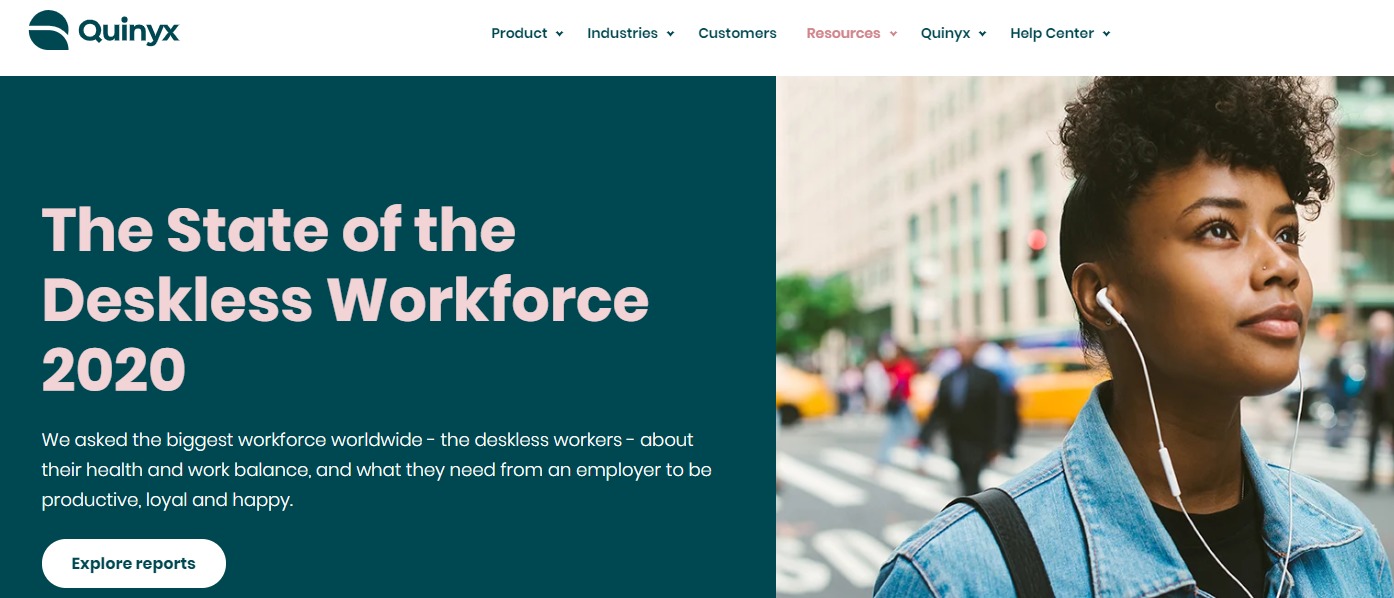
Quinyx, a global cloud-based, workforce management SaaS provider, astutely made the company part of relevant conversations by producing a study, The State of the Deskless Workforce, at just the right time. The study surveyed 12,000 deskless workers in a range of industries, including logistics and transportation, in March and, again, in April to understand the impact of the global pandemic.
Among the findings that generated a stir: 30% of logistics workers think it is a fireable offense to take more than one consecutive sick day; and nearly 20% of logistics professionals came into work sick during the Covid-19 outbreak.
The timely release of the study managed to both subtly promote the Quinyx solutions and highlight the newsworthy issue of workplace flexibility. A related blog post on the study concludes: “If 2020 has a silver lining, it comes in how it’s forcing businesses to react, respond and embrace technology to safeguard their futures.”
Takeaway: The study helps position Quinyx as a hands-on partner tuned into the needs of customers in a rapidly evolving work environment.
Kinaxis — virtual events fill trade show void

On May 29, Kinaxis issued a press release: The company was launching Kinaxis Live, a series of virtual conferences on the theme, “Planning for the New Normal.” In the release, Kinaxis, steered clear of the Wikipedia description of the company (“a supply chain management and sales and operation planning software company”), opting instead for action-driven language that captures the aim of its target audience (“the authority in driving agility for fast, confident decision-making in an unpredictable world”).
The events bring together Kinaxis experts as well as supply chain practitioners from other companies, including Merck, Flex, ON Semiconductor, Lippert Components, and Konica Minolta, and promise to discuss:
- Lessons learned on managing through COVID-19 and the future of supply chain planning
- Insights on how to prepare for the rebound and long-term impacts across industries
- Tips on how to build resiliency and agility into your integrated business and supply chain planning by leveraging AI, human intelligence, and concurrent planning
Takeaway: By bringing the conversation online, Kinaxis can reach prospects who missed out on the opportunity to connect during one of the now canceled or postponed trade shows. The events also help establish Kinaxis as a trusted and knowledgeable resource with a large ecosystem of high-profile partners.
Kibo — approachable resource center builds competitive edge
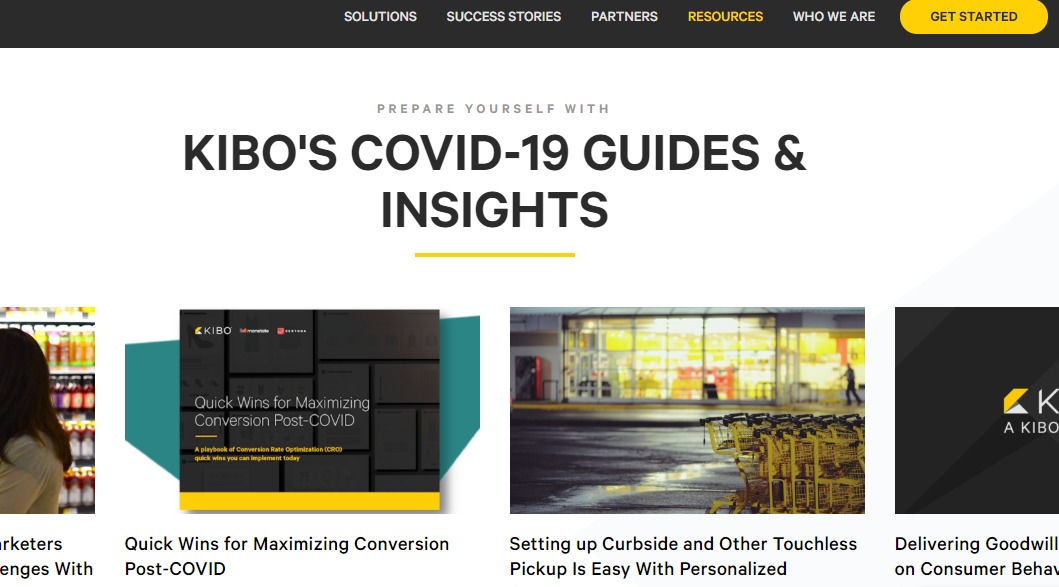
The rise of online shopping since the arrival of Covid-19 has — naturally — triggered interest in cloud-based technology. And Kibo has aptly seized the opportunity to raise the profile of its ecommerce platform with a clean-cut Covid-19 resource page.
Aiming to provide “tactical and empowering content to lean on,” Kibo has created a range of resources tightly focused on showcasing industry expertise and answering customer questions. Visitors can access webinars, a whitepaper, and blog posts on everything from personalizing your order management strategy in the Covid-19 era to setting up touchless pickup.
Takeaway: The conversational tone of the page strikes a balance between promoting the company product and sounding genuinely interested in helping clients navigate the Covid-19 crisis. In the intensely competitive market for ecommerce platforms, the page can set Kibo apart.
Many companies are still learning how to best conduct marketing in the midst of a global crisis. Examining examples of effective marketing strategies can generate ideas and inspire adjustments that help your organization rise above the pack.
Read more:
The case for outsourcing content marketing at a time of disruption
Supply chain marketing during Covid-19, the risk of cutting back
Covid-19 messaging strategy for supply chain companies: Getting the basics right

by Elizabeth Hines | Jun 9, 2020 | Blog, Content Marketing, Covid-19, Marketing, Strategy, Supply Chain
Too busy? Don’t want to invest in-house? Here are 4 prime reasons organizations opt to outsource content marketing.
No other lead generation tactic is more important to technology marketers than content assets. The new Gartner research — trade shows come in second place — shows the importance of paying heavy attention to how your organization positions itself online. If the Covid-19 repercussions left you no choice but to cut back on marketing or if you have been juggling more than ever, consider the case for outsourcing content marketing to stay competitive and excel.
At a time when some of the biggest supply chain trade shows have been either canceled or postponed, count on content assets to grow in significance. Is your organization up to the task?
In our work with both supply chain startups and multi-national corporations, we have noted a few returning reasons for outsourcing content marketing.
Do you recognize yourself or your organization in any of the following?
Outsourcing content marketing: 4 reasons organizations decide to seek outside help
Too much to do
When content marketing is the umpteenth task on an endless to-do list, the results will suffer. This scenario is particularly common among startups where everyone is wearing as many hats as possible in anticipation of the next round of funding. The haphazard approach to what is being published on social channels and on the blog does the company no favors and leaves the person in charge — frequently with limited marketing experience — feeling frustrated. Instead of letting keyword-optimized content carve out a brand niche and build website SEO, the effort goes nowhere although the will to succeed is strong.
The alternative: Partner with a content marketing agency and turn the focus on your core expertise.
No consistency
The effectiveness of content marketing relies on consistency. But being consistent is a major challenge for supply chain companies, especially when trying to recover from months of unprecedented disruption. As we explained in this post, consistency feeds SEO. Let it slip, and you lose in the online search race. In this case, sudden trade show cancelations may have forced the in-house marketing team to a quick pivot, from executing the company marketing strategy to pouring all efforts into making trade show contingency plans. Add a product launch to the mix and chances are content production will come to a standstill.
The alternative: Keep SEO humming and your online presence strong with an outsourced marketing team invested in your success.
Desire to scale but costs are too high
Needs can arise quickly. There may be a trend that a company wants to jump on or a sudden change in the business environment that warrants the need to scale up content marketing quickly. Several of our clients have sought out Fronetics because they lacked certain marketing capabilities and did not necessarily want or have the resources to make the investment in-house. That is particularly true under current circumstances when some organizations are battling budget constraints and disruption. If an organization wants to capitalize on video marketing, for instance, it can be both time-consuming and costly to train team members or go through a rigorous hiring process.
The alternative: Leverage a team out outsourced content experts to fill the gap without adding fixed costs.
Lack of analysis
The motions of content marketing are repetitive — researching, strategizing, executing, analyzing, revising — but they are so for a reason. Even the most well-intentioned content strategy can fail when an organization does not act on analytics. But for busy organizations, it is not uncommon for those last pieces of the puzzle — analyzing and revising — to be left undone.
What types of content worked well this quarter? How did the email messaging fare? What was the click-through-rate? During the past few months, when disruption ruled, it is hardly surprising if not every step was optimally performed. Yet, it can all the same be damaging to the overall success of the marketing effort if the metrics are allowed to go unnoticed for too long.
The alternative: Let content count with an outsourced marketing team that constantly needs to prove ROI.
Considering the significance of content assets, it pays to do it well. Is outsourcing content marketing right for you?
Read more:
