Should employers be monitoring or censoring employees’ social media?
Censorship is always a hot-button issue, and, when combined with social media, things can heat up even more. The topic is debated in law school classrooms, at dinner parties, and in courtrooms. What should be shared and written on social media? Should companies censor what their employees post?
The waters still seem murky. Many companies don’t have policies around social media, but, with over 70% of online adults using Facebook, and the Internet-crazed Millennial generation now outnumbering Baby Boomers, they should look into putting some guidelines and policies into place.
Who’s Digging?
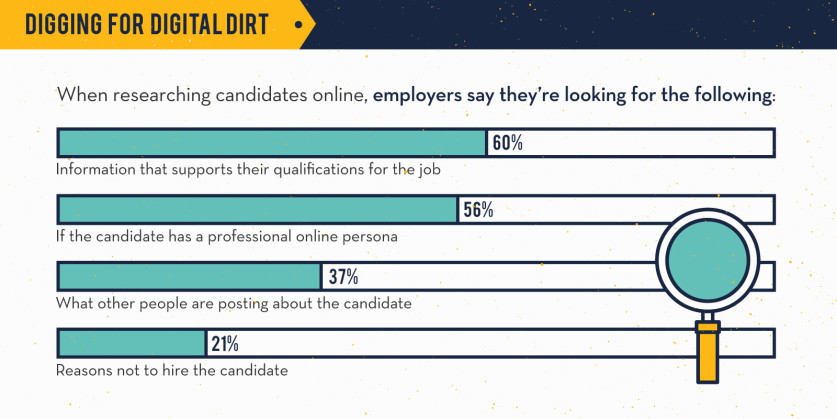
Many companies, up to 60%, now research candidates according to Career Builder. Up to 48% of companies who have researched candidates have found reasons not to hire them. According to the site, reasons range from provocative photos, references to drug or alcohol use, badmouthing a former employer or colleague, poor communication skills, and discriminatory comments.
Source: Career Builder
A New Generation
Although the retiring workforce does use the Internet (46% of those 65+, and 65% of those between ages 50-64), their numbers cannot compare to users in the younger, upcoming workforce (90% of those between 18-29).
The Millennial generation was born and raised in the digital age. Many of them have never heard of the Dewey Decimal System or know a life before cell phones. Their digital devices, and the Internet, have been their best way to research and connect. They are accustomed to throwing political views, photos, and personal experiences — good or bad — out into the cyber world. Many have already had the experience of poster’s regret, which might have taught them a lesson, but may also have blunted the idea of permanent mistakes. If one can delete a post and apologize, why not post away and worry later?
To Monitor or Not Monitor, That is the Question
Thinking carefully about what your expectations are of employees, and addressing those expectations in writing, is an important step to consider.
We assume that most employees know they shouldn’t post anything that damages the reputation of the company, its products, and employees, but it may be best not to assume. A case study in a recent Harvard Business Review provides a perfect example of what can happen if policies aren’t put into place.
In his Timepiece, “Why Monitoring Employees’ Social Media is a Bad Idea,” author S. Kumar argues that while monitoring candidates might make sense, monitoring current employees breeds a suffocating and intrusive atmosphere:
“By allowing workers to live their personal lives without intrusion, smart businesses can make a powerful statement; namely, that they accept them for who they are, treasure their professional contributions to the company, and want them to be happy and fulfilled outside as well as inside the office. This, in turn, would inspire loyalty and boost productivity in the workforce, and make those companies more profitable.”
However you feel about the topic of monitoring, and even censoring, it’s important to be clear with employees about expectations. A general statement about employee behavior and representation of the company might be enough to instill deeper forethought when employees post, comment, and like.
Do you monitor your employees’ social media accounts? Do you have a policy in place that covers personal social media activity?
Employees are much more than people you employ — they can be your best brand ambassadors.
A friend shared a story recently. He was chatting with a woman at a party years ago. While they were exchanging pleasantries and engaging in small talk, he asked where she worked. She told him that she worked for a certain bank, which happened to be his bank. He felt valued by the company and loyal to it, as it was where he opened his very first bank account when he was just starting college. When he cheerily told her that he was a customer, she promptly and dryly responded, “Oh, have we ripped you off yet?”
Soon after he changed banks.
Some companies are overlooking their greatest marketing tool: their employees. That woman made a big impression on my friend and actually effected change. Though not the ideal outcome and desired action that the bank would have wanted, it illustrates an interesting point. According to the 2013 Edelman Trust Barometer, “employees rank higher in public trust than a firm’s PR department, CEO, or founder. 41% of us believe that employees are the most credible source of information regarding their business.”
Employee influence is huge. They can be, in fact, your most influential brand ambassadors.
The hope is, of course, that employees share the positive aspects of the business and become vocal champions, providing current and potential customers an interesting perspective that can’t be found in traditional ads and other marketing tools. Employees as assets, not people who punch in, work, and punch out. They can represent and reflect the best aspects of a company.
How can companies introduce and integrate this concept of brand ambassadors into their practices?
Communication
To grow a culture of brand ambassadors, it’s critical to communicate your vision, repeatedly, to your employees, your consumers, and the general public. It’s no longer a question of whether employees will share their experiences about working at your company, but rather whether they’re saying the things you’d prefer them to say.
By companies posting positive stories on Facebook and Twitter, employees can then share those inspiring posts in their own circles. One “I love working here!” post can deeply influence potential consumers. It may be the best marketing power out there.
When a company has a mishap, it’s easy fodder for conversation, but it won’t be the focus of loyal employees, who can redirect the attention to something more positive.
Choose a leader
Choose an employee who can act as a community organizer amongst peers. The leader should be: well-liked, diplomatic, encouraging, responsible, collaborative, and reliable. This is not someone who is demanding and barks orders, but someone who understands the nuances (think: your go-to star who possesses tact and grace).
The leader has many roles, least of which is a guide and role model. She can coach others on best practices and responsible strategies, suggest and review social media content, brainstorm new storylines to promote the company’s message. Sometimes, a simple reminder to update LinkedIn or suggestion to write an article about a positive aspect of the business can get the ball rolling and create regular posting habits.
Remember that the people who work for you are much more than hired help, much more than people you employ. They’re talent. Allow them the opportunity to stretch and use their talent to showcase your brand in new ways. Brand ambassador is not a bad title!
We see that women in manufacturing and the supply chain haven’t been faring as well as their counterparts in other sectors. The number of women working in manufacturing is the lowest it has been since 1971. In the supply chain, men hold between 70-80% of the jobs, and we see even more disparity at the higher levels — only 5% of women hold Fortune 500 supply chain top-level positions.
Beth Ford, executive vice president and chief supply chain and operations officer at Land O’Lakes, sees the positive in these numbers: “The representation of women in this area is not where it needs to be. At the same time, it could be viewed as tremendously exciting. The opportunities are there for women.”
Where opportunity lies
So what can be done to make changes that will benefit everyone, and the bottom line?
According to a Fronetics Strategic Advisors report on women in the supply chain, “it has been put forth that women are better suited for roles in supply chain management than men. Research conducted by SCM World found that the majority of men (63%) and women (75%) believe that the natural skill sets of women differ from those of men and that these differences are advantageous for supply chain management.”
There are several women (and men) working in the supply chain who are cheering for other women to join. According to an interview with Bravo Solution VP Mickey North Rizza, “While business has traditionally been a man’s world, more and more women are now in businesses. Most women by nature have been relationship-builders. They encourage, collaborate and innovate with others for the best outcome. It is only natural that these tendencies gravitate to the business world, and most importantly into supply chain.”
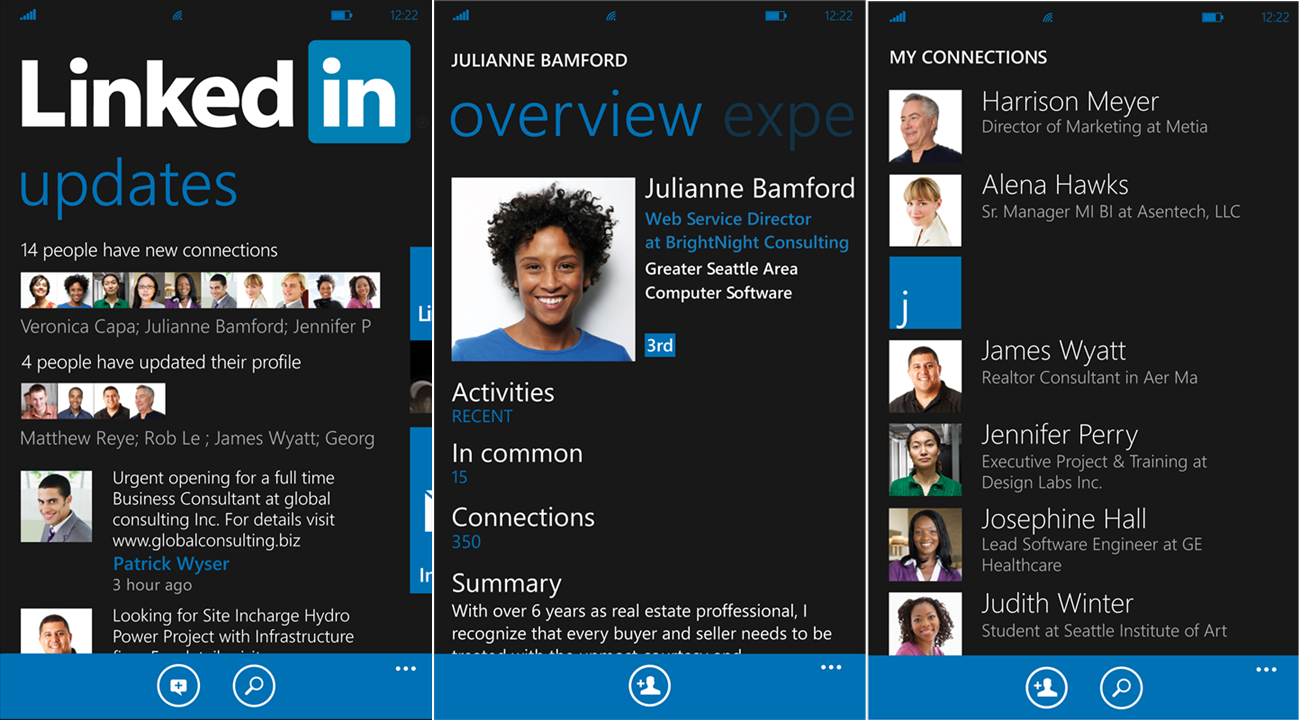
With the rise of mobile access and technology, people use phones in many of the same ways they use computers. You can scan, email, write, research, talk, bank, and — thanks to the LinkedIn Mobile App — apply for jobs, post articles, communicate, and engage with peers.
LinkedIn believes the app is “a faster way to tap into your professional world. Get news and info that matter for your professional day, a daily brief on what’s happening in your network, and a quick way to reach out and keep in touch.” Sounds good for those of us who rely heavily and increasingly on our phones.
Here are some ways in which you should be using the LinkedIn Mobile App to help your marketing efforts:
1. Update
A cornerstone of inbound marketing, writing updates and engaging daily (or hourly) with connections is important. Within an update you can include text, links, and photos and mention other LinkedIn members. You can also choose to share your update with your entire LinkedIn network and/or first-degree connections and/or your Twitter feed.
2. See who’s looking
Discover who has viewed, liked, or commented on your profile and content. The app lets you reply directly if you’d like.
3. Engage
Keep up with your network by finding, commenting, liking, and sharing. Repeatedly, we hear of the importance of engaging with connections and truly trying to value their posts, especially before sharing your own agenda.
4. Edit your profile
Notice a mistake on your company profile? Make an immediate change, even without your computer. Maybe you’re at a business meeting or out to dinner, and you notice that something hasn’t been updated on your company profile. You can fix it immediately.
5. Send & receive messages
This is a staple, and one that is critical. Again, if you’re at a business meeting, at a conference, or just without your computer and you need quick access to someone who you don’t have in your smartphone address book, you can find them and contact them through the LinkedIn Mobile App.
You can also access Lynda.com to watch tutorials and get training, get daily updates from LinkedIn Pulse, use LinkedIn Lookup to find connections, and use LinkedIn SlideShare to access over 18 million tutorials, infographics, and professionals.
There’s no need to cease connecting or marketing when you’re without your computer. The newly updated LinkedIn Mobile App can help you get the job done efficiently.
Grow your business with this 12-step guide to creating a content marketing strategy.
So, you’ve decided to give content marketing a go, but you’re not sure where to start. Or, maybe you have tried implementing some of the basic principles but haven’t had much success with your piecemeal approach.
Either way, without a documented strategy in place, you’re much less likely to reap the potentially enormous benefits inbound marketing can offer.
In fact, only 11% of companies without a documented content marketing strategy find their efforts to be successful, compared to 60% of companies with a strategy in place. And that number rises to 86% when the company designates someone to lead the strategy. The numbers speak for themselves.
Fronetics Strategic Advisors has developed a 12-step guide to developing a content marketing strategy specifically tailored to your business. This eBook provides insight into what makes good content, as well as tried-and-true measures your company can take to get the most out of your marketing efforts. By following these recommendations, you’ll be well on your way to developing a strategy that drives profitable customer action and helps you meet your business goals.
When it comes to marketing we work with our clients to create and execute strategies that drive success and elevate their brand position within the industry. Unlike other firms, we align marketing programs with business objectives and, through a data driven approach, are able to deliver results with a targeted ROI. Our team is comprised of strategists, marketing professionals, writers, designers, and experts in social media. Together we leverage our experience to increase brand awareness, position our clients as thought leaders, drive meaningful engagement with prospects and customers, and help businesses grow. Learn more about what we do.
The supply chain should prepare for future changes in the wake of the Paris Climate Agreement.
The 2015 Paris United Nations Climate Change Conference of the Parties (COP) was the 21st yearly meeting of its kind. It drew attention, coming off the heels of the Paris attacks. It also garnered attention because of growing concerns about storms and flooding, ice caps melting, and increasing temperatures. The twelve-day conference hosted 185 nations, and ended with major outcomes that will certainly have an impact on how supply chains will do business.
The biggest outcome from the talks is the agreement to reduce the world’s greenhouse gases significantly to keep temperatures from rising 2 degrees Celsius, and a longer-term agreement to reach net-zero emissions by the second half of the century. If this goal isn’t met, it could bring terrible outcomes globally, such as the loss of entire island nations that could go completely underwater.
Even if the goal is met, there are concerns about the irreversible damage that has been done in the past decades, which indicates the necessity of the plan. The agreement is described as, “probably the most important international agreement in history” by UN Executive Director Achim Steiner.
According to Adrian Gonzalez, president of Boston-based Adelante SCM, “It’s too soon to know what impact this will have on supply chain in the near term, but considering that the agreement is voluntary and there are no enforcement mechanisms in place, my sense is that very little will change over the next twelve months.”
Here are some things supply chain companies need to be considering in the wake of the Paris Climate Agreement, despite the future being unclear:
Assessment
According to James Allan, head of environment and climate change at risk analysis company Versik Maplecroft, “Many companies will have difficulty understanding their exposure to various climate risks, so they may need to bring new skillsets into the organisation, conduct internal studies, and update policies and internal processes.” This might be a new endeavor for companies, or one that wasn’t high on the priority list in the past.
Integration
Allan goes on to say, “A key step will be integrating climate change risks into strategic decision-making and operational risk-management processes.” We will have to wait to see what our congress decides in regards to making the Paris Agreement guidelines into law in the United States. Based on the requirements, companies may have many changes to implement into their business practices.
Partnering
Assessing how partners manage risk and plan to make changes is important, as companies will want to be on the same page. Forming new partnerships with others might also be crucial, particularly if those companies are ahead of the curve on environmental compliance. “Partnerships will also be crucial for successfully managing climate risks, including with supply chain partners, governments, business partners, civil society and the wider public,” says Allan.
We will see what comes from the Paris Climate Agreement and what it has in store for the supply chain and, on a larger scale, the world.


 Censorship is always a hot-button issue, and, when combined with social media, things can heat up even more. The topic is debated in law school classrooms, at dinner parties, and in courtrooms. What should be shared and written on social media? Should companies censor what their employees post?