Enticing potential customers with exclusive, high-value offers is an important component of lead nurturing and lead generation.
Your strategic marketing objectives boil down to one basic mission: to generate a high volume of quality leads. This will drive tomorrow’s revenue and an increase in sales and profits. Yet, only one in 10 marketing professionals feel they have an effective lead-generation strategy in place.
Since a productive lead-generation campaign consists of many interconnecting layers, it can be hard to pinpoint what is limiting your success. But, if you are seeking more leads for your business (and who isn’t?), consider these proven tactics for achieving successful lead generation.
First, for tactical reasons, your overall campaign must contain these components:
Something To Offer. An offer is content that is perceived to be high in value. Offers include ebooks, whitepapers, free consultations, product demonstrations, or discounts.
A Call to Action. This is either a small paragraph of text, an image, or a button that links the potential customer to a landing page to download what you have to offer.
An Awesome Landing Page. This is a specific page designed to allow the potential client to download your offer.
Forms to Gather the Lead Info. Essentially, they get the download; you get their contact information.
These four valuable components set the stage for capturing exponentially more lead information than ever before to grow your business.
Creating the Most Inspiring Offers
Just because you have identified leads does not mean they will convert to customers. Lead nurturing helps build a relationship with your potential customers, gain their trust, and raise their awareness about your business and products. The four steps above are critical to the lead nurturing process. But, unless you offer something that your potential customers want, you will not get past the first one.
So, what entices people to click “yes” to an offer?
The majority of us want anything that is considered exclusive, scarce, or in high demand. Suddenly, something becomes more desirable if it appears like we are getting the scoop on a special deal or valuable information.
The higher the perceived value of your offer, the more irresistible it becomes. So, whether your offer is whitepapers, downloads, free trials, memberships, or sales promotions, these irresistible elements can overcome a lead’s typical friction, doubt, or concern.
The elements to creating a feeling of exclusivity and special value in your offer include:
Limited-time offers. This creates scarcity to your offer.
Limited quantities. What you are offering is unique and has exclusive value, and procrastination may mean missing out.
“X number of people have seized this offer.” Human nature is to follow what others do. State how many people have downloaded your offer or benefited from your information to encourage others to do the same.
Content that matches current news trends. Content tailored to whatever is trending in the news (or to whatever is in high demand at the moment) is more relevant and relatable to potential customers, who are likely engaged with those trends in other ways as well.
A title that hooks interest. People actually do judge a book by its cover and will not want to see more if you bore them.
Several Call to Actions, offered at different stages. Pursue buyers at different levels of readiness with different CTAs. People often do their own research before even engaging with a sales rep, and every prospect is at a different stage of exploration. Develop different offers at different stages in the buying cycle, and include a primary and secondary CTA to these offers on various pages throughout your site.
Avoid professional jargon. Terms and phrases that have been over-used and abused are meaningless and won’t hook potential buyers. They include: groundbreaking, cutting-edge, scalable, flexible, and robust, just to name a few.
To further ensure enticing more leads, your offer should provide something that is considered of high-value. Not all offers are created equal. Some “formats” perform better than others at converting leads. Here are a few of the top-ranked offers, in order of performance, when it comes to generating leads:
There are many more ways you can capture successful leads and fine-tune your marketing plans in a way that turns leads into customers. For more proven tips, download The 30 Greatest Tips & Tricks That Will Change The Way You Nurture Leads, which offers dozens of other techniques marketers should follow to increase leads and revenue.
When it comes to leading during difficult times in the supply chain, planning is critical. So is flexibility.
Winter storm Jonas is estimated to have cost $1 billion USD, although some believe the cost could go as high as $3 billion USD, as it paralyzed a large swath of the mid-Atlantic and Northeast. Some 30 inches of snow touched down on several East Coast cities, which cancelled over 12,000 flights and kept people out of work for days.
When difficult times strike, having a plan is critical. For example, with electricity still working, business doesn’t need to come to a close for days on end. Researchers who did a study at Chinese company C-trip encourage people to work from home during storms: “We encourage companies to do a trial the next time an opportunity presents itself — like bad weather, traffic congestion from major construction, or a disruptive event (such as a city hosting the Olympics or the World Cup) — to experiment for a week or two. We think working from home can be a positive experience, both for the company and its employees, as our research with C-trip showed. More firms ought to try it.”
The supply chain can be disrupted in many ways: natural disaster, terrorism, fluctuation in materials. When the problem hits, it’s good to have a plan, but one can’t always be prepared for every scenario. According to the president of global public affairs for UPS, Laura Lane, who had her share of difficult times when she was a young foreign officer in Rwanda during the genocide in 1994, “You have to make decisions that will result in the greatest good — and from that perspective, every decision becomes crystal clear.”
Lane shared her thoughts about how to handle difficult situations in the supply chain with The Wall Street Journal recently.
Look for leaders everywhere
Lane believes that it’s not only C-suite managers who can handle disaster. Being open to ideas and letting specialists rise from the ranks could be a game-changer in critical situations. “Don’t judge people based on their years of experience. Greatness can emerge from anyone on your team — people with decades of experience, or those just starting out.”
Don’t let fear stop you
When you are ultimately responsible for a huge decision involving lots of people and money, fear can infiltrate the mind and body quickly. Remember that you’re in the position you hold for a reason. Don’t let self-doubt or uncertainty about how things will play out delay your decision making. See boundaries and obstacles are new opportunities to find alternatives. Lane says, “Challenge how things are done, and rewrite the rules, if needed,” she says.
Think of the larger vision
Remember what the goals of the company are, and that people have been put in specific roles for reasons. Remember that your situation most likely involves teamwork, and that you can rely on the support, ideas, and voices of others, especially when the vision of the company becomes foggy in the stress of the moment. “Delivering on your promises and grounding your actions in your values is what is needed to be a great leader. You have to believe in the greater good of what you’re doing and then bring others along with you in realizing the bigger vision.”
A blog post not only stays around longer than a print ad, it can better engage potential customers.
The 24-hour news cycle has evolved into the 24-second news cycle with the rise of online media outlets and social media. So, when it comes to advertising your business, generating leads, making sales, and being perceived as a thought leader, you must consider the lifespan of your print ad and its purpose, versus the lifespan of a well-orchestrated blog and its potential.
Though often confused, there is a distinct difference between advertising and marketing. With a print ad, you are obviously advertising your business concisely, with a limited number of words and images. But, this form of advertising has a limited lifespan (only as long as that piece of print media is in the hands of a reader). So, it should be only one small piece of your marketing puzzle.
In contrast, a blog bridges advertising with progressive marketing techniques. It reaches your target demographic in a different way by conveying knowledge and building trust. It works on improving your “image” as well as branding your company as a thought-leader. A blog makes a more personal connection with the reader, while an ad is very obviously trying to sell something — and consumers gravitate toward knowledge rather than a simple sales pitch.
Looking at Longevity
A blog can live on indefinitely. What you post today may still be relevant and a popular read several months from now. Because of this, your company can reach a larger number of consumers within its target demographic for a long period of time, surpassing a print ad’s capacity for results. A blog also reaches consumers in a more relevant, memorable way. Marketing experts would agree: Getting your clients or customers to remember you is half the battle.
Your company’s advertising can include the placement of an ad in print media like newspapers, magazines, or direct mail. Print ads through community newspapers or direct mail flyers are useful for specific purposes, like targeting customers in a localized area.
But, you will find that advertising of this kind comes with a sizable price tag and has limited benefits. According to a Marketing Profs digital report, print advertising ranks as the largest expense of most marketing plans, with public relations and marketing strategies rounding out the important trio.
So how long will a print ad live? According to a marketing study published by Fast Company, a newspaper ad has a maximum lifespan of 2-3 weeks, and an ad placed in a monthly magazine may live up to three months.
In contrast, when a blog post goes live, it may generate the most hits within the first week, but it will continue to serve as available content that consumers will access for months, or even years, down the road. If the blog is well constructed, you may find that a year later it is still ranking in the top five search results for certain targeted long-tailed keywords.
So, it is important to consider the “quality of life” of your blogs and print ads. A blog feeds consumers’ need for more information before they commit. In fact, prior to contracting your services or buying your product, your potential customers will research the topic online and read blogs posts that present information in a vendor-neutral format.
Successful businesses react to this by creating a constant stream of this fresh content, organized into a library of posts (that stand the test of time), then use that content as bait to attract potential prospects. One study revealed that when it comes to blogs, the combination of proper timing and useful insight can result in a 33% higher lead conversion rate and a 38% increase in revenue over the prior year.
Blogs’ Benefits and Social Media
When you publish a print ad, you’ll never really know what your readers think about it. With a blog, you get feedback and you engage the reader, who is also a potential customer. It creates a more viable connection and provides greater insight that you can leverage to garner more customers through:
Tracking and analytics: Feedback is a powerful tool. Google Analytics can tell you what types of articles are capturing your readers’ attention. You can learn how much time they spend on a page and how they share it. You can leverage this information to determine what sort of content you need to create to reach more customers and generate more leads.
Shares and comments: Readers love to interact with online content, reading and commenting to express their opinion or thoughts. The comment section of your blog can become a community of readers. If a reader found your blog insightful or inspiring, they may also share it with their contacts or friends through social media. Your business becomes a part of a larger community that is connected through dialogue.
Advertising in any form, digital or print, is only a single component of any complete, multi-level marketing process. Innovative marketing today must include several different components, like well-articulated blog posts that utilize SEO, and connect potential customers to your company by offering information they can use. Blogs are a long-lasting porthole to your business, the product or the services you offer, and your professional insight or vision.
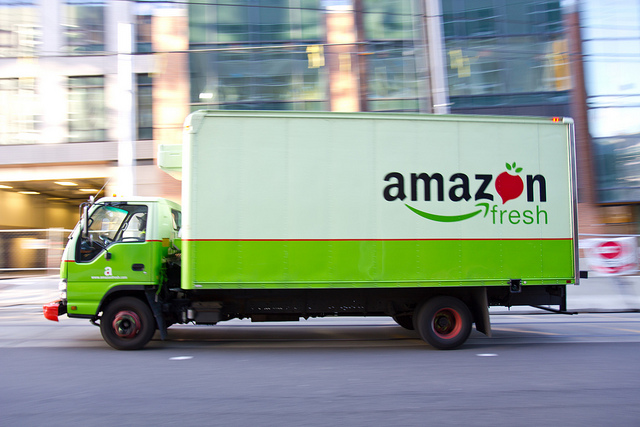
Amazon’s continued expansion into the logistics market seems to be seeping into all corners of the world, making more and more products available with a single click. Inversely, the time frame for delivery keeps dwindling, from two days to the forthcoming 30-minutes-or-less drone-delivery service Prime Air. And more options in less time happy customers make.
Amazon’s commitment to getting packages into the hands of customers as quickly as possible could be the driving force behind its recent foray into the logistics space.
Additionally, reports surfaced in early 2016 that Amazon is in talks with several cargo-aircraft lessors regarding a number of Boeing 767 jets, which can accommodate up to nineteen 88-by-125-inch pallets a piece. The Seattle Times speculates this move is an expansion of an existing trial operation out of Wilmington, Ohio, to determine whether Amazon should pursue a larger air-cargo operation.
Ocean freight and air cargo suggest an interest in controlling operations well beyond the last mile. Could this be the development of a full-scale, in-house logistics department that could independently manage Amazon’s fulfillment process? Or, perhaps, are these steps to manage something beyond the company’s own shipping and delivery?
Amazon hinted at such in a securities filing last Friday, referring to itself as a “transportation service provider” and “companies that provide fulfillment and transportation services for themselves or for third parties” as competition for the first time ever.
Amazon as a 3PL
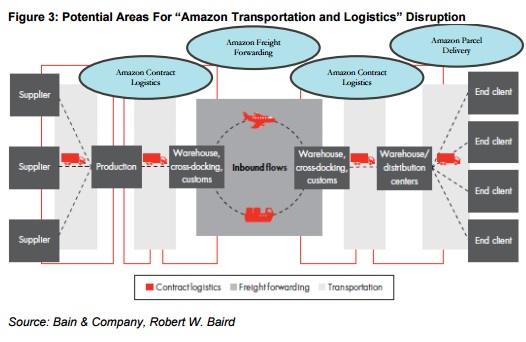
For some time now, the media has been speculating about Amazon‘s intentions to enter the transportation and logistics market as a third-party provider. That would certainly fit the existing pattern: 1) begin operations to better support core retail business, 2) grow and leverage that infrastructure to sell to other businesses.
A prescient October 2015 analysis by Baird Equity Research Analyst Colin Sebastian notes the “powerhouse potential” that Amazon has in the market should it “extend its increasingly complex and technology-centric logistics and delivery platform as a third-party offering.” The report cites the growth of Amazon Web Services (AWS) and Marketplace as templates for the expansion of logistics services to external clients.
Sebastian says the highly competitive global logistics market has yet to fully capitalize on web-based technologies to address supply chain inefficiencies — and Amazon’s wildly successful cloud computing platform, paired with its complex delivery network, may be the answer. The result would be a disruption of incumbent businesses, such as UPS and DHL. “We believe Amazon may be the only company with the fulfillment/distribution density and scale to compete effectively with global providers,” the report says.
The Baird report estimates the global fulfillment market as a $400-450 billion incremental market opportunity. Is this where Amazon has set its sights next?
Ikea, a company known for innovation, is facing the enigma of reverse logistics head on. As part of the company’s sustainability strategy, Ikea is challenging the perception that its products are disposable by creating opportunities to recycle and reuse products.
In a recent interview with Fast Company, Chief Sustainability Officer Steve Howard outlined several of the company’s initiatives. They include programs that allow consumers to return plastics, batteries, furniture, compact fluorescent light bulbs, mattress, and textiles to the store. These items are then sold “as-is” or recycled.
These programs have proven successful. For example, in just a few months, over 6 tons of batteries were collected in Moscow, and 25 tons of used textiles were collected in Norwegian stores last year.
Ikea is looking at other ways it can provide end-to-end supply chain solutions. One idea is to take returned products and recycle them into other products. In his interview with Fast Company, Howard shares: “We would basically be taking old bookshelves, old furniture, or an old door that’s finished its first life and sending it into new products. You’ll have a kitchen that used to be a bookshelf, without seeing any visible difference in them. It’s not a revolution, but you have to actually fundamentally change your supply chain to do that.”
Ikea has recognized that old, broken, and unwanted products are an opportunity. Through these innovative reverse logistics initiatives, Ikea is not only acting in a more sustainable manner and reducing the company’s environmental footprint, it is also increasing engagement with consumers and creating positive economic opportunities for the company.
Fronetics names the best of the best blogs in the logistics and supply chain industries.
The logistics and supply chain industries are catching on to how successful a blog can be as part of an inbound marketing strategy. Companies are creating content that not only fuels conversation about industry best practices, trends, and issues, but also helps drive business to their websites.
Fronetics Strategic Advisors conducted a survey in January 2016 to determine the top logistics and supply chain blogs in the industry. Here are the results:
Dallas, TX-based Transplace is a 3PL and technology provider serving manufacturers, retailers, and consumer and chemical packaged goods companies. Logistically Speaking is the company’s thought leadership blog. It tells “the latest and the greatest supply chain and transportation stories” through Infographics, interviews with logistics executives, and informative articles offering information and advice.
Readers love: the weekly “TIP list,” or Transportation Industry’s Progression, which curates a short list of articles concerning trending topics and advancements in the industry
Transplace’s CEO Tom Sanderson shares information, opinions, and analysis of factors affecting the supply chain — including company economic data, freight transportation regulation and legislation, and carrier and 3PL financial performance. The blog is rich with charts and graphs that offer big-picture insight on what’s going within the industry.
Readers love: Sanderson’s no-nonsense breakdown of the most pressing issues facing the supply chain
Jennifer Cortez, Director, Marketing Communications, is thrilled with Transplace being recognized by Fronetics and the industry:
“We are thrilled to be recognized as the top logistics and supply chain blogs in 2015. At Transplace, we pride ourselves on providing timely and relevant content to our customers and the industry. Our goal this year is to further connect Transplace and our thought leaders with emerging industry trends.”
Procurious is a UK-based online business network with news, education, discussion forums, and events for procurement and supply chain professionals. The blog goes beyond industry insights — it’s a savvy guide to career advancement and skill development. Articles are written for the modern-day professional, in sync with Procurious’s forward-thinking brand.
Readers love: original series like Life & Style and #firstmovers, which cover interesting, relevant topics in the procurement world.
Thank you to all who took our survey to find the top logistics and supply chain blogs!
Fronetics Strategic Advisors is a management consulting firm with a focus on inbound marketing. We create and execute successful strategies for growth and value creation. Unlike other firms, our approach is data driven. We know ROI is important, so we track and measure results to drive success. Read about our approach to inbound marketing, or get in touch.