

Warehouse operations leaders don’t want a new WMS. They want fewer mispicks, faster onboarding for seasonal labor, and a system that holds up at peak. The WMS marketing that reaches them leads with those problems, shows the workflow instead of the feature list, and takes the fear out of implementation before the first demo.
That’s harder than it sounds in a crowded category. MarketsandMarkets estimates the global WMS market at $4.57 billion in 2025, projected to reach $10.04 billion by 2030, and most vendors describe their product with the same feature list. Below are the five people in a WMS buying group and seven moves to reach them, all part of a broader plan for supply chain software marketing.
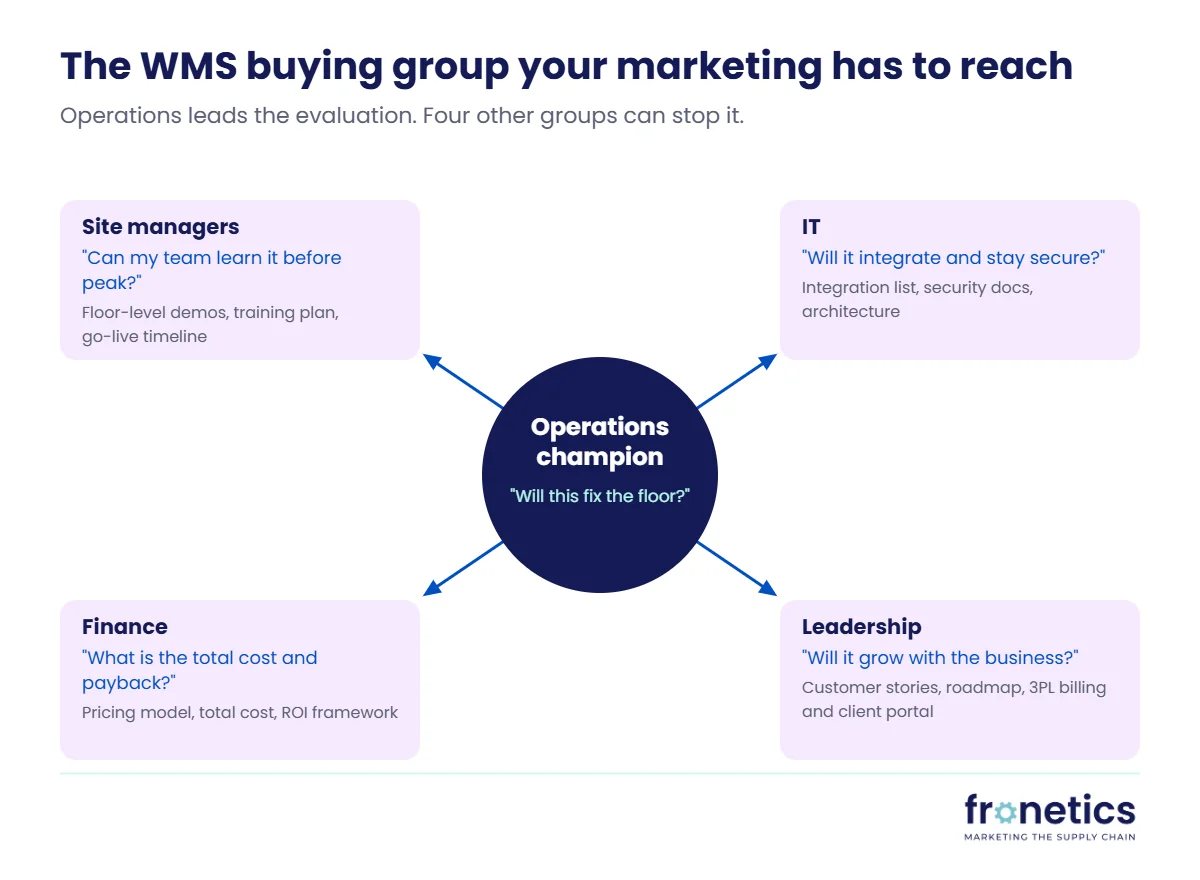
Who buys a WMS, and what each person needs
| Buyer | Main concern | Content that helps |
|---|---|---|
| VP or director of operations | Throughput, accuracy, labor productivity | Workflow walkthroughs, before-and-after metrics, customer stories from similar operations |
| Site or DC manager | Daily usability, training time, disruption during go-live | Floor-level demos, training approach, go-live timelines |
| IT | Integrations, security, support | Integration list (ERP, TMS, automation), security documentation, architecture overview |
| Finance | Total cost and payback | Pricing model explanation, total cost of ownership, ROI framework |
| 3PL leadership | Client onboarding, billing, multi-client visibility | Billing and client portal features, onboarding speed, examples from other 3PLs |
7 WMS marketing moves that reach operations buyers
1. Pick your warehouse, not every warehouse
A WMS that’s ideal for a high-volume ecommerce fulfillment center may be the wrong fit for a cold storage 3PL or an industrial parts distributor. Decide which operations you serve best (by industry, size, or complexity) and say so. Buyers trust a vendor that knows where it fits more than one that claims to fit everywhere.
2. Lead with workflows, not features
Operations leaders think in processes: receiving, putaway, replenishment, picking, packing, shipping, returns. Organize your website and sales content around those workflows. Show what happens on the floor, step by step, and where your system removes touches, travel, or errors.
3. Address implementation fear directly
Every operations leader has heard a WMS go-live horror story. That fear can stall a deal more than any competitor. Publish your implementation approach: typical timeline, what the customer’s team needs to provide, how you handle cutover, and what support looks like in the first 90 days. Honesty about effort builds more trust than promises of a painless launch.
4. Give buyers something useful before the demo
WMS buyers research for months before they talk to sales. Give them tools they’ll use whether or not they pick you: a WMS requirements checklist, an RFP template, a guide to calculating labor savings, or a comparison of deployment models. These assets also earn links and visibility in search and AI search when buyers ask how to choose a WMS.
5. Prove results with operations metrics
Case studies should use the metrics operations leaders already track: picks per hour, order accuracy, dock-to-stock time, inventory accuracy, and time to train new hires. State the baseline, the result, and the timeframe. Only use figures your customers have approved.
6. Show up where operations people learn
Warehouse leaders spend time at industry events like MODEX and ProMat, in operations-focused LinkedIn communities, and in trade publications. A booth with a live workflow demo and a pre-booked meeting plan does more than a giveaway. Our approach to trade show marketing covers how to fill your calendar before the show starts.
7. Market to the whole buying group
Your champion in operations can’t win the deal alone. IT, finance, and leadership each need their own proof. Account-based marketing lets you put role-specific content in front of each stakeholder at your target accounts, so the internal case is already half built when your champion brings you forward. Supporting that with a steady stream of content keeps you visible during long evaluations.
Common WMS marketing mistakes
- Leading with “AI-powered” or “next-generation” without explaining what changes on the floor.
- Gating every useful asset behind a form, so buyers go elsewhere to learn.
- Using the same message for a 3PL, a retailer, and a manufacturer.
- Measuring marketing by leads instead of opportunities and closed revenue.
Next steps
Audit your website against the five buyers in the table above. If operations, IT, and finance can’t each find what they need in two clicks, start there. Then pick one workflow to showcase and one customer story to publish.
For help building demand with warehouse and supply chain technology buyers, see how we approach marketing for supply chain software companies.
Frequently asked questions
Who buys a WMS?
A WMS purchase usually involves warehouse operations leadership, site managers, IT, and finance, and at 3PLs, executive leadership focused on client onboarding and billing. Operations typically drives the evaluation, but IT and finance have significant influence.
How long is the WMS buying cycle?
WMS decisions commonly take many months, with an extended research phase, formal demos and reference checks, and a commercial review. Implementation then adds additional months depending on complexity.
What content do warehouse operations buyers want before a demo?
They want workflow walkthroughs, implementation timelines, integration lists, case studies with operations metrics such as picks per hour and order accuracy, and practical tools like requirements checklists or RFP templates.
How should WMS vendors differentiate?
By specializing in specific operation types, leading with workflows instead of features, being transparent about implementation, and proving results with the metrics operations leaders already track.
Related reading
5 ways to market warehouse automation to skeptical buyers
Plenty of demos, not enough deals? Fix your supply chain software demo