
A distribution center general manager has seen the videos. Robots zipping across a clean floor, picking rates doubling, labor problems solved. He’s also heard from a peer whose automation project ran months late, needed constant babysitting, and never hit the promised throughput. Guess which story he remembers when your sales rep calls. It’s the story every warehouse automation marketing program has to overcome.
That’s the challenge at the heart of selling automation. Robotics and automation companies aren’t fighting for awareness anymore. They’re fighting skepticism. Here’s how to market automation to the operators, engineers, and executives who have to bet their operation on it.
The 5 ways, at a glance
- Make ROI concrete and conservative
- Show deployments, not renderings
- De-risk the rollout
- Lean on peers
- Address the workforce question directly
What is warehouse automation marketing?
Warehouse automation marketing is how robotics, AMR, AS/RS, conveyor, and automation software companies attract and convert warehouse, distribution, and fulfillment operators. It focuses on reducing the perceived risk of adoption, proving ROI in real operations, and supporting long, multi-stakeholder buying decisions.
It’s a specialty within our supply chain technology marketing work, which covers software, robotics, IoT, and logistics platforms.
Why are warehouse operators skeptical of automation?
Operators have good reasons for caution:
- Disruption risk. A failed go-live during peak season can cost far more than the system itself.
- Overpromised ROI. Many have seen projections that didn’t survive contact with a real facility.
- Integration worries. Will it work with the existing WMS, layout, and processes?
- Workforce concerns. How will associates react, and who will maintain it?
- Vendor viability. Will this company still be around to support the system in five years?
Your marketing should address each of these directly, not hope sales handles them later.
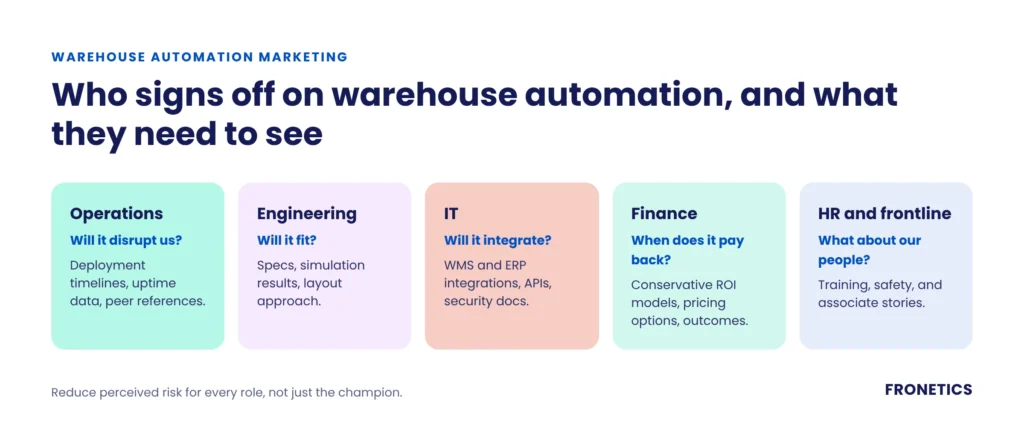
Who is involved in a warehouse automation purchase?
| Role | Main concern | Proof that helps |
|---|---|---|
| Operations and site leaders | Throughput, uptime, disruption during rollout | Deployment timelines, uptime data, peer references |
| Engineering | Fit with layout, volumes, and SKU profile | Technical specs, simulation results, design approach |
| IT | Integration with WMS and ERP, security | Integration lists, APIs, security documentation |
| Finance | Payback period, capex vs. robotics-as-a-service | ROI models, pricing options, case study outcomes |
| HR and frontline leaders | Training, safety, and workforce impact | Training programs, safety certifications, associate stories |
5 ways to market warehouse automation so operators trust it
1. Make ROI concrete and conservative
Replace “up to 3x productivity” with real ranges from real sites, and explain the assumptions behind them. An interactive ROI calculator that uses the prospect’s own volumes and labor costs is even better. Conservative numbers that come true build more trust than big numbers that don’t.
2. Show deployments, not renderings
Video from live customer facilities, time-lapse installations, and site tours outperform polished animations. Operators want to see your system working in a building like theirs.
3. De-risk the rollout
Publish your implementation process: site assessment, simulation, phased go-live, training, and support. If you offer pilots, flexible pricing, or performance guarantees, make them prominent.
4. Lean on peers
Operators trust other operators. Case studies with named customers, quotes from site leaders, and reference calls are some of your most valuable marketing assets.
5. Address the workforce question directly
Content about how associates are trained, how roles change, and how safety improves helps HR and frontline leaders become advocates instead of blockers.
What channels work best for warehouse automation marketing?
- Trade shows. MODEX and ProMat are still major buying events for material handling. Live demos plus strong pre-show and post-show programs turn booth traffic into pipeline.
- Content and search. Guides on topics like goods-to-person vs. person-to-goods, AMR vs. AGV, or how to build an automation business case capture buyers early. That content also feeds search and AI visibility.
- Account-based marketing. Automation deals are large and the target list is knowable. ABM keeps you in front of the right facilities and decision-makers over long cycles.
- LinkedIn video. Short clips of real deployments perform well with operations audiences.
Make adoption feel safe
Warehouse automation is a high-stakes decision, and operators know it. The companies that win aren’t the ones with the flashiest videos. They’re the ones that make adoption feel safe: realistic ROI, proven deployments, a clear rollout plan, and plenty of peer proof.
Want help building trust and pipeline for your automation solution? See how we help supply chain technology companies grow.
FAQ
How do you market warehouse automation solutions?
Focus on reducing perceived risk. Share conservative, real-world ROI data, show live customer deployments, publish your implementation and support process, and use peer case studies and references to build trust with each member of the buying committee.
Who makes warehouse automation buying decisions?
Decisions usually involve operations and site leaders, engineering, IT, finance, and HR or frontline leadership. Each has different concerns, from throughput and integration to payback period and workforce impact.
What content works best for robotics and automation companies?
Customer deployment videos, detailed case studies, ROI calculators, implementation process overviews, and educational guides comparing automation approaches tend to perform best with warehouse and distribution buyers.
Are trade shows still worth it for warehouse automation companies?
Yes. Events like MODEX and ProMat remain important for material handling and automation buyers, especially when paired with pre-show outreach, live demos, and fast follow-up.
Related reading