
When a port closes, a carrier goes down, or a supplier’s plant floods, your customers remember two things: how fast you recovered and how well you kept them informed. Only the second one is fully in your control. Supply chain disruption communication is a marketing and sales job as much as an operations one, and the companies that treat it that way keep accounts that quieter competitors lose.
Below, we cover why silence is so expensive, what a disruption communication plan needs, which channels do which job, and what to say at each stage.
Why supply chain disruption communication is a revenue issue
Disruptions are now frequent enough that how you handle them is part of your brand. Resilinc tracked a 38% increase in global supply chain disruptions in 2024, and in a 2025 Sphera survey of 200 chief procurement and supply chain officers, 73% said they experienced supplier disruption in the past year.
Your customers expect things to go wrong. What they judge is the response. When an affected customer goes hours without hearing from you, their team starts calling backup providers, and that list of alternates often turns into an RFQ once the dust settles. A clear, early update does the opposite. It shows competence under pressure, which is exactly what buyers want from a supply chain partner.
That’s why we treat disruption response as part of B2B marketing for supply chain companies, not a task operations handles alone.
What should a disruption communication plan include?
A disruption communication plan should name who speaks, who approves, what you’ll say for each type of event, and which audiences hear it first. Build it now, while no one is under pressure.
- Name an owner and a backup. Operations owns the facts. Marketing owns the words and the channels. One person approves every update.
- Set a fast approval path. Two approvers at most, with a target of 30 minutes from confirmed event to first update.
- Prewrite templates by event type. Weather or port closures, carrier or capacity failures, system outages and cyber incidents, supplier or production problems, and tariff or regulatory changes each need a different first message.
- Segment your audiences. Directly affected customers, all customers, open opportunities in your pipeline, carriers and partners, and your own employees.
- Define triggers. Decide in advance which events get a direct email, which get a status page update, and which also get a public LinkedIn post.
- Rehearse once a year. Forrester found that minimal rehearsal is one of the most common crisis communication breakdowns at B2B companies. A one-hour tabletop exercise exposes gaps before a real event does.
Which channels should you use during a disruption?
Use direct channels for affected customers first, then a single public source of truth for everyone else. Each channel has a different job, and mixing them up is how customers end up learning about their own delayed freight from a social post.
| Channel | Who it reaches | Its job during a disruption | Cadence |
|---|---|---|---|
| Direct email or account manager call | Customers with affected freight, orders, or sites | Gives specifics, options, and a named contact | First hour, then on a set schedule |
| Status page or website banner | All customers, plus anyone checking on you | Holds the current facts in one dated place everyone can check | Every update, with a timestamp |
| LinkedIn company page and leader posts | The market: customers, prospects, partners, recruits | Shows you are on top of it and sets the public tone | Once at the start, then at major changes |
| Sales talking points | Reps and account managers | Keeps every conversation consistent with the official update | Refreshed with each update |
| Website FAQ or blog update | Customers, prospects, and AI search tools | Answers repeat questions and gives search engines a factual source to cite | Once the scope is clear, updated after recovery |
Two details matter more than most teams expect. First, a dated status page or banner on your website keeps sales, support, and customers working from the same facts, so it’s worth building the template into your website before you need it. Second, buyers increasingly ask AI tools about active disruptions. A factual, timestamped update on your own site gives those tools something accurate to cite instead of a secondhand news summary.
On LinkedIn, the goal is tone and visibility, not detail. A short post from the company page or a senior leader that acknowledges the event and points to the status page signals control. If you need help setting rules for this, our social media team builds disruption protocols into LinkedIn programs.
What to say in the first hour, first day, and first week
Each stage of a disruption has one job: acknowledge, scope, hold the cadence, then close the loop.
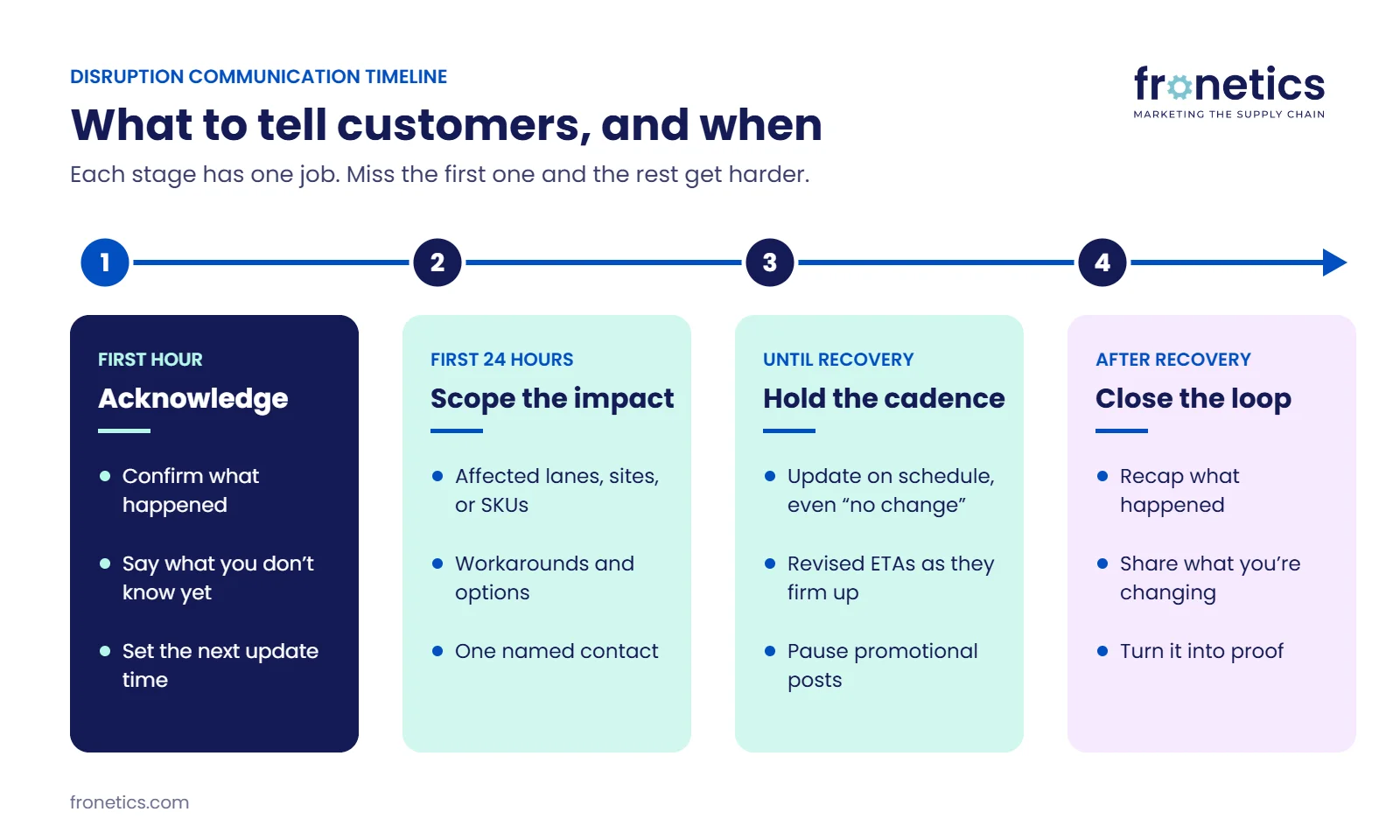
First hour: acknowledge
Confirm what happened, say what you don’t know yet, and set the time of the next update. Something as simple as “We’re aware the terminal closed at 6 a.m. and are confirming which shipments are affected. We’ll send a full update by noon” buys you the morning.
First 24 hours: scope the impact
Name the affected lanes, sites, orders, or SKUs. Share workarounds such as alternate routing, partial shipments, or substitute inventory, and give each affected account one named contact.
Until recovery: hold the cadence
Send updates on schedule even when nothing has changed. Revise ETAs only when they’re firm, because a second missed date costs more than a cautious first one. Pause scheduled promotional posts and campaign emails until service is back to normal.
After recovery: close the loop
Send a short recap covering what happened, what you did, and what you’re changing so it’s less likely to happen again. Then thank customers for their patience, specifically.
How do you turn a disruption into proof?
Once the event is over, your response becomes one of the most credible stories you can tell. Prospects evaluating providers want evidence of how you perform when things go wrong, and a well-handled disruption is that evidence.
- Write a short case story with real numbers, such as shipments rerouted, days of delay avoided, or on-time performance during the event.
- Have a senior leader share the lessons learned on LinkedIn.
- Add a slide to the sales deck and a paragraph to RFP responses about your disruption process.
- Turn the questions customers asked into a permanent FAQ on your site.
This is the kind of material that makes supply chain content marketing persuasive, because it is specific and verifiable rather than a claim about being “reliable.”
Mistakes that cost accounts
- Waiting until you have every answer before saying anything.
- Letting sales and operations tell different versions of the story.
- Leaving scheduled promotional posts running in the middle of an outage.
- Promising a recovery date you aren’t sure you can hit.
- Burying the update inside a general newsletter.
Get your team ready before the next one
The next disruption is a matter of when, not if. The plan, templates, status page, and LinkedIn rules take a few weeks to set up and pay off the first time something breaks. If you want help building them, talk with a marketing team that works only in supply chain.
Frequently asked questions
What is supply chain disruption communication?
Supply chain disruption communication is how a company informs customers, partners, and its own team when an event such as a port closure, carrier failure, cyber incident, or supplier outage affects service. It covers who speaks, what they say, which channels they use, and how often they update until the issue is resolved.
Who should own disruption communication, marketing or operations?
Both, with clear roles. Operations owns the facts: what happened, what is affected, and revised timelines. Marketing owns the words, the channels, and consistency across email, the website, LinkedIn, and sales. One named owner should approve every update so customers never hear two versions.
How often should we update customers during a disruption?
Send the first update within an hour of confirming the event, then commit to a fixed schedule, such as every 4 hours for a severe event or daily for a slower one. Keep the schedule even when nothing has changed. A short no change update builds more trust than silence.
Should we post about a disruption on LinkedIn?
Yes, when the event is public or affects many customers. Post a brief, factual statement that points to your status page, and never let LinkedIn be the first place an affected customer hears the news. Pause any scheduled promotional posts until the disruption is resolved.
What should a first disruption update include?
A first update should confirm what happened, say what you know and what you do not know yet, explain who is likely affected, give a named contact, and state exactly when the next update will arrive.
Related reading: How often should supply chain companies post on LinkedIn?