by Elizabeth Hines | Oct 20, 2015 | Blog, Leadership, Logistics, Strategy, Supply Chain, Talent
It’s common to think of the people who work for a company as “employees”, but reframing language and thinking could be critical to your supply chain. Start considering your employees as “talent”. The word employee has the connotation of working for someone or under someone. It implies being one of many, whereas the word talent has a positive connotation, implying that a person has depth, value, and potential. The term talent empowers both employees and companies to be the best and seek the best in their work and their search for other skilled people.
Reframing is an important step, but it doesn’t fix common problems that plague supply chain managers and human resource departments. It’s important to think about hiring processes as a long undertaking that extends beyond an ad, job interview, and offer letter. Companies should always be thinking about retention and promotion. This is called succession planning.
According to a study conducted by supply chain management researchers at Auburn University and Central Michigan University, 37.5% of surveyed companies had no engagement in succession planning, 27% had just started to work on planning, 23% engaged in informal planning, while only 12.5% engaged in formal succession planning.
Acquire
The supply chain is notorious for having a dearth of talent. The area is growing and more talent will need to be acquired for businesses to compete. As job titles expand and shift, due to the rapid changes in supply chain management and technological requirements, many people won’t be qualified for their own job title. Looking towards universities who are teaching supply chain management, and looking to other business sectors could be critical to find the right, flexible kind of talent the supply chain will need. Considering women for these traditionally male-dominant roles will also be important as women tend to be strong in many of the soft skills needed for the future of SCM. According to Shanton J. Wilcox, vice president, North America, and lead for logistics and fulfillment at Capgemini, “many so-called tactical jobs will be replaced by positions requiring more interpersonal and relationship management skills.”
Develop
As more and more money floods into the supply chain, it will be important to avoid the Silicon Valley problem of poaching, or talent leaving for larger and larger salaries elsewhere. Investing in current employees in a meaningful, attentive way, could make all the difference. Think about their future and next steps within your company. They probably have a plan for their future, and you should as well. Make sure those plans align and be open to assisting their journey to meet their goals.
Instead of conducting exit interviews, try conducting “stay” interviews. Ask specific questions about what it takes to create the environment that would help encourage your talents’ best performance. Ask what works, and also ask what doesn’t work. Be specific and ask what causes your talent anxiety or stress. You may find a trend and be able to fix it before people leave, rather than after. Investment is a big part of development. It helps talent feel like part of a bigger picture. If you invest in them they will invest in you.
Advance
Consider talent from within. According to a Forbes article, many companies are getting it wrong in trying to hire from outside. Internal candidates may not seem as appealing or exciting as the unknown, external candidate, but companies need to be clear-minded in these decisions. “Internal successors are in many ways lower risk than outsiders, yet surprisingly few promotions are awarded internally. That appears to be because boards often prefer the devil they don’t know to the devil they do. Also, some find it difficult to imagine someone at the top after seeing him operate in a lesser role for years.”
Internal talent may not appear to be ready for the next level if the position they’re seeking is a promotion, whereas an external candidate going for the same job may be making a lateral move and appear more “ready”. One thing to consider is the knowledge the internal candidate holds and brings to the job. Getting external talent up to speed can take months if not years.
Don’t sit back and assume your employees are willing to be passive about their careers. See your employees as assets. Have a strategy. Be part of their team, and make them part of yours. See their talent and invest in them, otherwise they’ll find another supply chain company who will.
You may also like:
Fronetics Strategic Advisors is a leading management consulting firm. Our firm works with companies to identify and execute strategies for growth and value creation.
We advise and work with companies on their most critical issues and opportunities: strategy, marketing, organization, talent acquisition, performance management, and M&A support.
by Elizabeth Hines | Oct 12, 2015 | Blog, Logistics, Strategy, Supply Chain

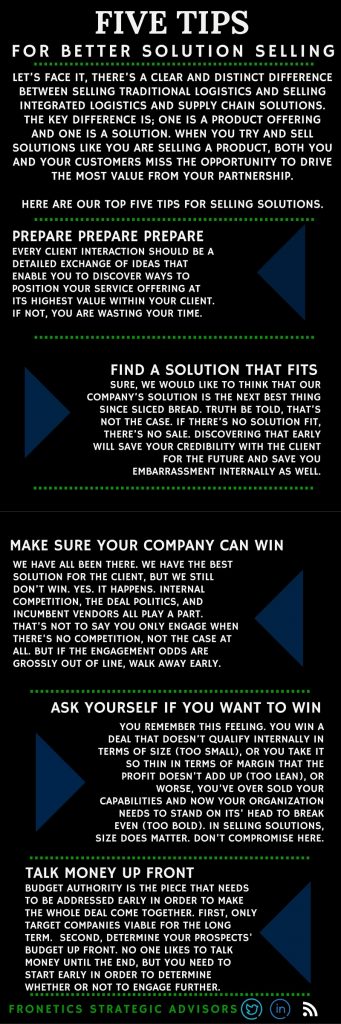
There are organizations that sell products and there are organizations that sell solutions. To be sure, both can be successful as long as products are being sold as products and solutions like solutions. The difference is that the product sale is really a commodity sale. Commodities come with an “each” price or a “per pound” pricing matrix, etc. It usually is a short or shortened sales cycle and negotiations revolve around the total price and your typical supplier performance metrics. The solution sale is much different. This sale is one that requires client discovery, isolation of unique client pain points (that only your solution can address effectively), and being able to drive distinct value for the client, and in turn, for your organization. This sales effort is highly specialized and requires selling time (sales cycle) that is much more detailed than a product sale. That being the case, you need to be sure that your close rates are high enough to justify the work load and sales cycle needed. You also need to be sure that the deals you close have a deal size that reflect the sales effort and cycle time (said another way, is the deal worth winning?)
If your sales team thrives on creating value for their customers far beyond ‘supplying’ their ‘product’ at the best price, check out our other solution selling tips below.
Fronetics Strategic Advisors is a leading management consulting firm. Our firm works with companies to identify and execute strategies for growth and value creation.
We advise and work with companies on their most critical issues and opportunities: strategy, marketing, organization, talent acquisition, performance management, and M&A support.
We have deep expertise and a proven track record in a broad range of industries including: supply chain, real estate, software, and logistics.

by Elizabeth Hines | Oct 8, 2015 | Blog, Strategy, Talent
Hiring someone who says he or she is not a team player sounds like a risky proposition, right? Few employers are, after all, searching for renegade employees or stubborn loners who refuse to interact with co-workers. But what if it actually turned out to be a good strategy? Researchers at the University of Tuebingen set out to examine the effects on applicant pools by stressing the need for teamwork in job ads. The conclusion of the study puts it like this: “Given the evidence of a possible downside, it is recommended that firms should never look for team players just because ‘everyone else is doing so.'”
The study analyzed survey data from 1,300 college students who had been asked to evaluate a number of job postings that outlined various requirements, including whether the applicant should be a team player or an independent task-oriented self-starter. Interestingly, what researchers found was that although the ads did indeed attract applicants who considered their teamwork skills to be a primary asset, they also discouraged people whose qualifications matched the job description with the exception of one criterion: social skills. As a result, the employer missed out on technically skilled or task-oriented candidates who took themselves out of the running before the race even began. The study went on:
“…considering that organizations always need employees with high task-related skills, but that they may not always need team players, they should carefully consider when the requirement for teamwork skills is listed in their job advertisements—because there is a downside to looking for team players.”
For organizations that truly need employees with an aptitude for collegial collaboration, the study shows ads that stress the importance of possessing teamwork skills do what they were intended to accomplish. But in other cases, where teamwork takes a backseat to specific talents or technical skills, the employer is likely to end up with a smaller pool of applicants than if that routine phrase had been left out of the job requirements.
People who don’t cite social acumen among their list of skills may not thrive at “water-cooler conversations” or rush to plan the next company outing, but they know how to get the job done and they do it well. If teamwork is irrelevant to their job description, isn’t that all we really need?
Fronetics Strategic Advisors is a leading management consulting firm. Our firm works with companies to identify and execute strategies for growth and value creation.
We advise and work with companies on their most critical issues and opportunities: strategy, marketing, organization, talent acquisition, performance management, and M&A support.
We have deep expertise and a proven track record in a broad range of industries including: supply chain, real estate, software, and logistics.

by Elizabeth Hines | Sep 15, 2015 | Blog, Data Security, Data/Analytics, Marketing, Social Media, Strategy
Personal connected devices – our laptops, cell phones, and tablets – are arguably the most complicit tools in the recent blurring of the parameters between personal and work life. And while most businesses have generally recognized the benefit of allowing employees to use their personal devices for work purposes, the bring-your-own-device (BYOD) revolution has certainly thrown a curve ball to those responsible for safeguarding company data. Although corporate finance groups are singing the praises of the trend due to its inherent reduction in costs, it’s not all rosy in the BYOD world. That’s why it’s crucial to format a corporate strategy policy that will protect your company from a potentially dangerous data-leak train wreck.
Here’s why: Employees are now widely accessing corporate data from their own computer, a tablet, even their mobile phone. With so many of us bringing more and more smart devices inside our office environments and hooking them to our corporate networks, the potential for data leakage grows exponentially. When anti-virus and digital security software company BitDefender set out to explore the connectedness of typical American workers last year, they found that over half stored work-related data on their personal devices. Shockingly, almost 40 percent of them had nothing in place to prevent unauthorized access to their device. Further, in a study conducted by the University of Glasgow, 63 percent of used smart devices purchased through second-hand stores and eBay-like marketplaces still had data on them. This data included personal information as well as sensitive business information.
The problem is there’s no chain of custody in the BYOD world. Think about it. When the corporations owned your cellphone and your PC or laptop, they controlled its issue to you, how you used it, what software you put on it, and when and how it was turned in and destroyed. A solid internal tracking of electronic assets coupled with a solid electronic asset disposal solution provider meant that, for the most part, the corporate digital assets were safe. In the BYOD world, the corporation does not own the IT equipment. Personal smart devices are being linked to corporate IT environments. This mating of personal and professional equipment and data is happening everywhere. Your corporate data is being commingled with secure and non-secure access points to the Web, cloud, etc. Not to mention the fact that those devices metaphorically walk in and out of your office every day, and you have no control.
Companies are scrambling to address this issue in a number of ways. Some have addressed the problem via software solutions at the enterprise level (think Blancco or BlackBerry enterprise), some at the device level (think solutions like Apple Find My Device, etc.), and some at the human resources and legal levels with policies and procedures that prohibit users’ use of corporate information. But the truth is, without a chain of custody model incorporated with these solutions, once the corporate data is accessed or downloaded, it’s already gone — you just don’t know it yet.
The reality is that it’s going to take some time for the corporate world to catch up with what some have called the “semi-private information revolution” like the cloud, Facebook, or social media. Secure file sharing, essential for an organization’s BYOD guidelines, is one of the best options available. Services are now available to help with cloud encryption and it’s changing the way we share and monitor files. Encrypting data is crucial and minimizes the risk of sharing sensitive data and having it tampered with. Rely on your electronic asset disposal provider to help your company develop a strategy and process that is aligned with your corporate information sharing guidelines. Right now, your corporate data is only as safe as the process that you create.
Fronetics Strategic Advisors is a leading management consulting firm. Our firm works with companies to identify and execute strategies for growth and value creation.
We advise and work with companies on their most critical issues and opportunities: strategy, marketing, organization, talent acquisition, performance management, and M&A support.

by Elizabeth Hines | Sep 7, 2015 | Blog, Strategy, Supply Chain
Multi-channel distribution is likely to fuel the demand for on-demand packaging as companies continue their search for more cost-effective solutions.
Only 7% of companies are making their boxes on demand. However, that figure is set to grow quickly. The explosive rise of e-commerce and all the uncertainties it entails in terms of order fulfillment will likely prompt a growing number of companies, especially those serving multiple sales channels, to seek the answers in on-demand packaging.
The potential savings of always getting the right-sized box at just the right time should speak to all those multi-channel distributors. In a Peerless Research study, distributors were asked to name the areas where fulfillment costs have gone up. The three most popular answers were transportation, labor, and packaging and materials.
A corporate manager at an e-commerce business said about trends in packaging automation, “We are able to consolidate multiple orders from one customer into as few boxes as possible. This saves on time and shipping costs.”
That study talks of the “ripple effect” felt throughout the supply chain as packaging optimization drives down the number of cases on a pallet, as well as storage space requirements and shipping costs, and ultimately has the power to increase a company’s sustainability rating.
In numbers, some of the advantages cited by on-demand packaging proponents include:
- A 28% reduction in the quantity of corrugate
- An 80-90% reduction in filling material
- Savings of 20-35% over conventional supply chains
- A 75% reduction in footprint required by two laborers to pack dunnage, seal, and label a box
Packsize, one of several companies behind the new automated technology, says it actually takes less time to make packaging on demand than going the conventional route of locating and moving packaging purchased from a vendor. Stockouts and obsolete inventory also become relics of the past when boxes can be made minutes before they are needed. In an industry chasing next-day or even same-day delivery, any gain in timely execution counts as a victory.
Though 80% of the 322 top materials handling, logistics, and supply chain managers surveyed by Peerless still purchase and store their corrugated boxes, the trend is pointing in favor of the new solutions. Industry familiarity with on-demand packaging is increasing while the desire for new packaging solutions continues to grow. “We currently have to order in advance custom size boxes for upcoming orders, and it would be better to make them on the fly, adapting to changes,” an engineering manager said. “We are considering some form of on-demand packaging to prevent the storage of cartons,” another said. “We can use the space better.”
It all sounds promising, but is it the way of the future?
Fronetics Strategic Advisors is a leading management consulting firm. Our firm works with companies to identify and execute strategies for growth and value creation.
Whether it is a wholesale food distributor seeking guidance on how to define and execute corporate strategy; a telematics firm needing high quality content on a consistent basis; a real estate firm looking for a marketing partner; or a supply chain firm in need of interim management, our clients rely on Fronetics to help them navigate through critical junctures, meet their toughest challenges, and take advantage of opportunities. We deliver high-impact results.
We advise and work with companies on their most critical issues and opportunities: strategy, marketing, organization, talent acquisition, performance management, and M&A support.
We have deep expertise and a proven track record in a broad range of industries including: supply chain, real estate, software, and logistics.