by Elizabeth Hines | Dec 10, 2014 | Blog, Leadership, Strategy, Talent
 Kate Lee, the senior director of research and strategy at Fronetics Strategic Advisors, has been named by Procurious as one of the 24 Most Influential People in Procurement.
The online business network for a new generation of procurement and supply chain professionals compiled the list to show who “you should be connecting with.”
Kate said she was “honored” by the recognition.
“The network and its members are not only industry leaders, but also leaders in innovation,” Kate said. “Procurious has more than 2,000 members from more than 70 countries and I’m thrilled to be part of such a niche social network.”
For the past 20 years Kate has worked with a range of people from senior executives at Fortune 500 companies to academics to refugees. At Fronetics Strategic Advisors, a management consulting firm focused on strategy and inbound marketing for the logistics and supply chain industries, Kate said she has been able to build a strong team which provides clients with unmatched service and value.
“I am proud of the team and our efforts in helping companies develop and implement inbound marketing and strategies that create results,” Kate said.
Kate is a newcomer on the Procurious list that also includes profiles such as ‘Local Producer’ AKA Brian Heinen, a driving force behind LinkedIn biggest groups for supply chain and sourcing professionals; Paul Snell, managing editor of Supply Management and Supply Business magazines; Hal Good, another LinkedIn power player in procurement with 13.5K followers on Twitter; and Tim Hughes, a top 35 UK blogger with 81.9K Twitter followers.
Procurious also cited the Fronetics Twitter account as a reason to welcome Kate into the mix.
The recognition of Kate read, in part: “The Fronetics’ Twitter account is both super-active and full of fascinating insights related to the profession.”
Kate again credited her team for the success:
“It comes down to the wonderful team at Fronetics,” she said. “We are committed to providing the industry with industry news as well as information on how to create and implement strategies that will create value.”
She continued:
“Additionally, we love engaging with individuals and companies within the industry via LinkedIn, Twitter, and our blog.”

by Elizabeth Hines | Dec 3, 2014 | Blog, Strategy, Talent
Where is your career going? If you feel like you are stuck in a career rut, here are five tips to pull yourself out:
1. Focus on the short-term, not your career path.
When it comes to a career path, one plus one doesn’t necessarily equal two anymore. The nature of business and the career landscape is evolving at lighting speed and making it nearly impossible to map out a five- or 10-year career path. So rather than trying to map out a long-term plan, optimize for one to two years.
Dara Khosrowshahi, CEO, Expedia, Inc., offers this sage advice: “Look for the right opportunities, stay flexible, have some idea of what direction you are headed in, but don’t lock into a long-term direction because chances are that the world will change up on you.”
2. Speak up.
Does anyone know you want to switch department or roles, or is it your secret? Are you the only who knows that you want to move up the ladder within your company? If so, you need to speak up and let people know what’s on your mind. Talk with your boss, talk with the manager in the role/department in which you are interested, and talk with HR. If you let people know your desires, your desires will be much more likely to be realized.
3. Prove yourself.
Don’t think — act. If you want to take on additional responsibilities, you need to show that you are capable. If you want to move into a new role, prove that you have the skills to do so. Actions speak loudly.
4. Network.
Networking opens doors. Networking begets opportunities that benefit and feed your career, professional development, and personal interests. And if you are interested in finding a new job, networking will help you do just that. Studies have shown that the majority of candidates find jobs via their networks.
5. Quit.
If you are truly unhappy — quit. When you make the mental decision that you are going to leave your job, most likely you’ll feel a weight has been lifted. With the weight gone you will be able to more easily determine your next steps and find a new position. Note I said mental decision. It is best to give your actual notice after you find a new position.
Getting your career going in a positive direction will benefit you and your organization. It’s never the wrong time to make some moves designed to get yourself out of a career rut.

by Elizabeth Hines | Nov 19, 2014 | Blog, Leadership, Marketing, Social Media, Strategy, Talent

Networking is often thought of as a (dreaded) job search action item. However, thinking about networking in this manner will leave you at a disadvantage. Networking is an action item necessary for your professional and personal growth.
Those who view networking as more than just a job search must, gain a competitive edge over those who turn to networking only when they are making a job/career change. Glen Llopis puts it this way:
“The more you procrastinate, the more you will find yourself disconnected from the opportunities that may potentially advance your career or allow you to meet the right people.”
How and why does networking matter? Here are five reasons why networking is essential and why connections matter:
- Research has shown that the larger the network, the larger the salary
- Networks beget jobs
- Networks bring opportunities that benefit and feed your career, professional development, and personal interests.
- Networks make people smarter
- Networks make people happy
Moreover, Kathryn Minshew, founder and CEO of The Muse and The Daily Muse, points out that:
“Networks are powerful, and when done right leave you surrounded by a core of individuals who are all rooting for your success and happy to help you.”
One of the greatest networking tools for professionals is LinkedIn. So before you begin, make sure you optimize your LinkedIn profile for success.

by Elizabeth Hines | Sep 30, 2014 | Blog, Strategy, Talent
Are your sales reps as sold on your leads as you are?
In theory, it seems straight forward: You write engaging blog posts; you spread your unique as well as curated content via appropriate social media channels; you include calls to action; you watch your prospects take the bait; and, finally, you hand off a neat list of qualified leads to sales.
Sales, in turn, swiftly goes to work and the sale is a fact.
The reality is, as most of us know, far more muddled. You may be in the habit of dumping any lead, qualified or not, on sales. Sales, on the other hand, may be busy doing anything but tending to your leads. Hours go by. Hours turn into days. When sales finally do follow up, the lead has moved on.
Here is the bad news: Time kills even the most eager leads.
The 2014 Lead Response Report by InsideSales.com shows an undeniable connection between the time it takes to make contact with a prospect and the likelihood of converting that prospect into a customer. Since most companies will send out an automatic e-mail confirmation to anyone who has filled out an online form, the study looked specifically at the phone response rate, which it argues is a much more effective sales tool.
Consider a few of the findings:
- Fifty percent of buyers choose the vendor that responds first.
- The median first call response time was 3 hours and 18 minutes.
- Only a fraction of companies reply within five minutes.
That last number is important because another InsideSales study on lead response management found the following:
“Making a successful contact with a lead are 100 times greater when a contact attempt occurs within 5 minutes, compared to 30 minutes after the lead was submitted. Similarly, the odds of the lead entering the sales process, or becoming qualified, are 21 times greater when contacted within 5 minutes versus 30 minutes after the lead was submitted.”
If you need further proof that response rate matters, an article in Forbes on inbound marketing sums it up perfectly: “If your goal is to ‘pull your customer toward you’ in order to sell them something, then time is definitely of the essence.”
With these statistics in mind, it is more important than ever to ensure marketing and sales are aligned. Too often poor lead-to-customer conversion can be blamed on a disconnection between the two departments.
Work in partnership to establish a common sales funnel. Spell out who is in charge of each step of the sales process. It doesn’t matter who makes that first call to your qualified lead, but it is important that you know someone will actually pick up the phone with a sense of urgency.
Bear in mind: All your leads need to grow cold is time.
by Elizabeth Hines | Sep 24, 2014 | Blog, Marketing, Social Media, Supply Chain, Talent
“Practice makes perfect.” This is what we have been told by our parents, our teachers, Malcolm Gladwell, and researchers. And, as pointed out by Fast Company, “There’s even a Macklemore song about it, so that makes it real.”
Here’s the problem – it’s not real. A 2014 study found that practice doesn’t make perfect. Instead, reaching a mastery level of whatever it is that you are trying to reach is dictated by your personality, intelligence, and a number of other factors.
Where does that leave us? For business it reaffirms the adage: “Do what you do best, and outsource the rest.”
During a Small Business Week panel discussion Gene Marke, Inc. columnist and owner of the Marks Group, discussed the importance of strategic partnerships and outsourcing:
“One of the smartest things I’ve been seeing companies do is that they do what they do best and outsource the rest. Companies are now thinking more about partners they can work with to provide the type of technologies, services, and solutions they cannot do or don’t have time to do.”
Dan Leberman, the vice president and general manager of PayPal’s North American online small and medium business unit, expressed similar sentiments:
“It’s all about knowing your company’s core competencies. As a small business, you need to decide what you’ll build and what you’ll give to a partner.”
The supply chain and logistics industries have been slower to adopt social media and inbound marketing than other industries. Reasons for this include: a lack of understanding of the benefits, lack of experience, and both time and budget constraints. In short, inbound marketing and associated activities including content creation and social media management are great examples of what companies within the supply chain and logistics industry should consider outsourcing.
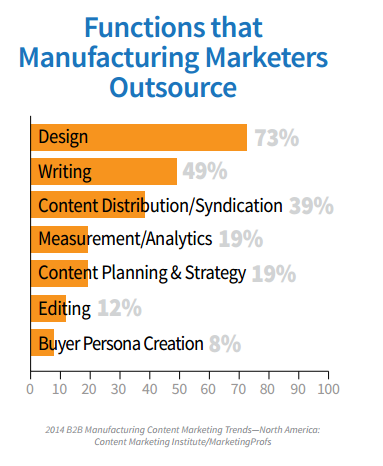
A 2014 study found that 86 percent of manufacturing marketers have adopted content marketing and that the majority (55 percent) of companies look to outsource partners for help.
As shown below, manufacturing marketers outsource a variety of content functions including writing, distribution, design, and editing.
Now that we know practice doesn’t make perfect – play to your company’s strengths and considering outsourcing the rest.

by Elizabeth Hines | Aug 28, 2014 | Blog, Leadership, Strategy, Talent
Most teams are able to fairly easily decipher what needs to be done. However, when it comes to the how, new or weak teams fall flat. Here is how you can optimize your team for success.
Define roles
Clearly define roles and make sure every team member understands not only their role, but the roles of others on the team. When roles are defined and understood the team can avoid overlap and can avoid the trap of “I thought someone else was doing that.” In short, by defining roles your team can be more efficient and more effective.
Establish a communication protocol
Take the time to establish a communication protocol. This protocol should not be a rulebook, but rather it should outline a set of decisions about how the team will message each other and stakeholders on the progress and needs of the team. If you leave this to chance you are, well — taking a chance. If you establish a communication protocol up front you will achieve better communication and it will be less likely the ball will be dropped.
Develop performance metrics
Develop performance metrics up front. If you don’t take the time to do this, how will you know if you are making progress? How will you know what to do if you are not making progress? How will you know when goals are achieved? How will you be able to reward team members? Take the time to develop performance metrics up front — and get everyone on the same page.
Provide your team with necessary tools
Provide your team with the tools that they need to succeed, or you will set them up for failure. For example, give them the go-ahead to make certain decisions without needing to go through 11 bureaucratic steps. Similarly, give the team access to the people and information that they need to get the job done.
By focusing on the best path forward, rather than the end goal, good teams can get even better.
A version of this post previously appeared on EBN.