by Elizabeth Hines | Jul 1, 2014 | Blog, Content Marketing, Manufacturing & Distribution, Marketing, Strategy, Supply Chain
Think like a manufacturer
Gartner’s Jake Sorofman wrote a great piece about building a content supply chain. His advice for understanding what it takes to use content as a tool to grow your business: think like a manufacturer.
Why? Sorofman connects the dots:
Manufacturing is actually an instructive example for what it takes to scale and sustain a content marketing program. Why? Because content marketing requires a replenishing pipeline of engaging content—a content supply chain—that helps feed the beast every day.
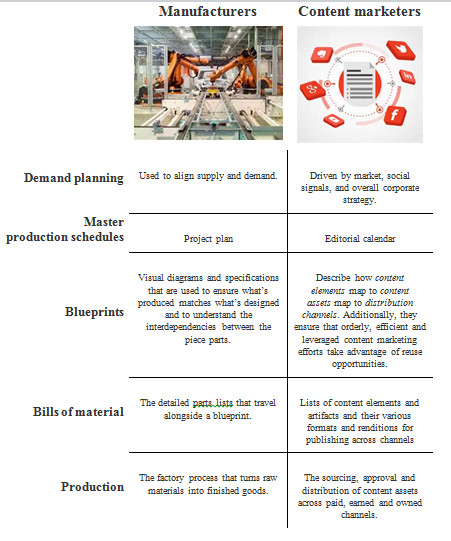
The following table (adapted Sorofman’s article) further illustrates the parallel between manufacturing and content marketing.
How can you successfully replenish your content supply chain and grow your business?
Strategy. As in manufacturing, strategy is essential when it comes to content. Without a strategy in place your content efforts will fall flat and will not help you grow your business. Want to learn more about creating a content strategy that will drive profitable customer action? Download our eBook: Grow your business with content: 12 steps to a content strategy.

by Jennifer Hart Yim | Jun 26, 2014 | Blog, Internet of Things, Logistics, Manufacturing & Distribution, Marketing, Social Media, Strategy, Supply Chain
This article is part of a series of articles written by MBA students and graduates from the University of New Hampshire Peter T. Paul College of Business and Economics.
Supply Chain Management will use the Internet of Things to improve factory workflow, increase material tracking, and optimize distribution to maximize revenues.
“Clap on “(clap, clap), “Clap off” (clap, clap), “the Clapper”!!
When introduced in 1986, “The Clapper” light switch was considered a significant breakthrough in home automation. Today, with advances in communication, sensors, and internet-connected devices, you can change the temperature of your home, your lights, appliances, and security system all from your smartphone — from anywhere in the world. This is just one simple example in the growing “Internet of Things” technology. The potential is enormous, not just in home automation but in industrial applications like manufacturing and distribution.
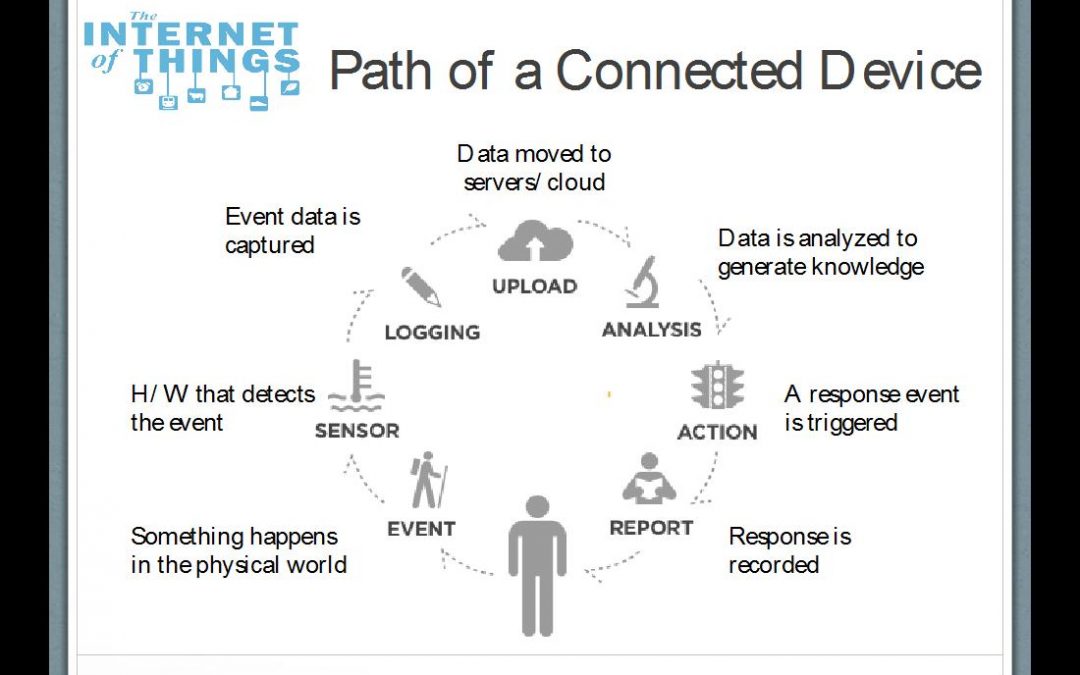
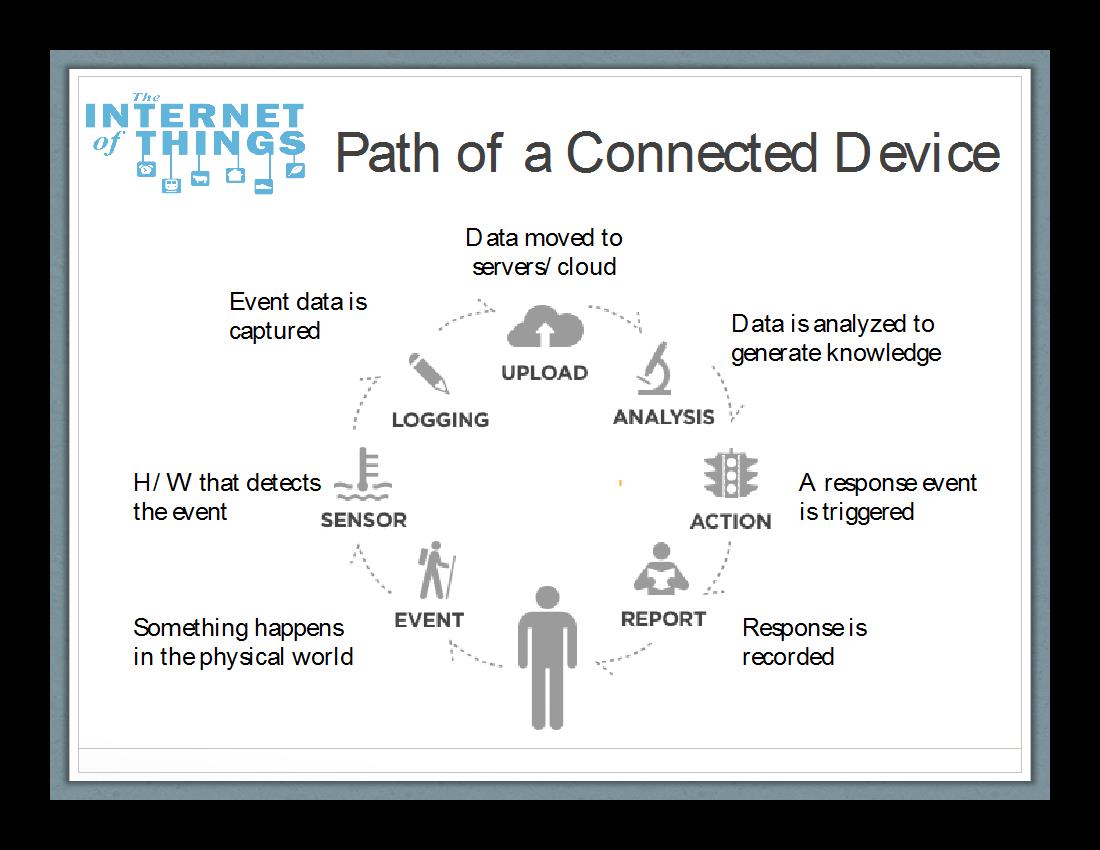
The Internet of Things (IoT) is broadly defined as the merging of the physical and digital worlds. It’s a scenario in which people and/or objects can be uniquely identified with the ability to share information over a network without any actual conscious intervention. The data is automatically transferred, analyzed, and used to trigger an event. Figure 1 below demonstrates how one of these devices functions and interacts with the Internet and other devices.
Figure 1.
The IoT and Supply Chain Management
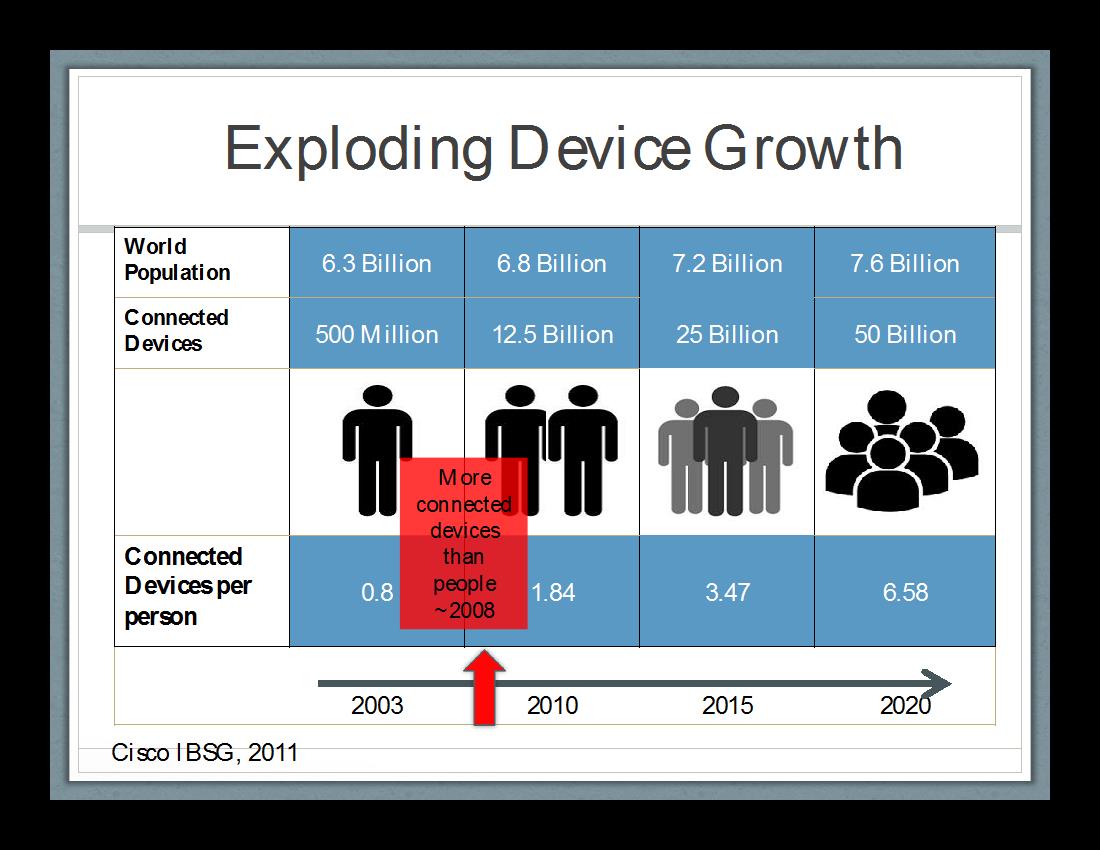
While many of us may be familiar with recent advancements in home automation, like the Nest thermostat, the real impacts of IoT will be in Supply Chain Management. Recent reports by Cisco, IDC and Gartner all claim that a significant increase in the number of devices making up the Internet of Things will have a profound impact on how future supply chains will operate. The 2011 Cisco report predicts there will be 50 billion connected devices globally by 2020, or about 6.5 devices for each person, up from only approximately 2.5 today (see figure 2). More active devices means more available data — to the point where they will be ubiquitous and transparent in our every day lives.
Figure 2.
Impacts to supply chain will be broad and far-reaching, utilizing Big Data to gather and analyze information across the entire process.
Some IoT devices have been in place for some time, such as commercial telematics now used in trucking fleets to improve logistics efficiency. Other commercial type applications — like fabrics that use sensors within clothing and industrial fabrics to monitor human health or manufacturing processes — are just being developed now.
Mark Morely of GSX, a leading provider of monitoring and management solutions, recently discussed three key impacts he believed IoT would have on the Supply Chain industry: Pervasive Visibility, Proactive Replenishment, and Predictive Maintenance. This is a great way to explain the immediate benefits, so I will summarize Mark’s description and expand with some real-world examples.
Three key impacts the IoT will have on the supply chain industry
1) Pervasive Visibility
Mark describes this as the ability to track and monitor a shipment in real time using a combination of sensors (RFID), connected devices, and communication channels (3G/4G, GPS, internet). It provides the ability to have real-time transit status, including location, temperature, and diagnostics — far more information than legacy infomatics provided.
One great example I found is from a company called Purefresh, who are at the cutting edge of Supply Chain IoT technology. They offer not only real-time shipment condition tracking, but also the ability to model and develop transit routes to optimize freshness in perishable cargo — taking into account environmental elements, such as ozone, atmospheres, and temperature. They indicate that an estimated “30% to 50% (or 1.2-2 billion tons) of all food produced on the planet is lost before reaching a human stomach.” IoT advancements will not only better optimize transit flow but also better serve humanity.
2) Proactive Replenishment
It’s the capability to automatically recognize the need to order and restock a product on a “machine-to-machine” basis, reducing the need for human interaction. The most common example is that vending machines will know when it’s out of or low on a Snickers bars and immediately trigger an alert to reorder them, instead of waiting for a service person to check on the vending machine and reorder products manually. The result is less human intervention, quicker replenishment, better sales forecasting and ultimately increased revenues. Oh, and many more happy office workers who really need a mid-afternoon sugar rush!
Opportunities for this technology go far beyond the candy vending machine though. Industries with time critical inventories like hospitals and pharmacies can better maintain supplies by supplementing human inventory control with real time use tracking. A much less critical but more broadly used application comes from Coke’s Freestyle fountain soda machine. It’s about the same size as the existing vending machines but it can dispense 126 kinds of flavors, offering an almost infinite amount of combinations. It uses Radio Frequency ID (RFID) cartridges that store the concentrated syrups in the machine. The RFID chips detect how much of each syrup it has and what combinations are being used. When it detects that it needs supplies, it transmits the information to both Coca-Cola and the storeowner including what has been sold, a record of when sales occurred, troubleshooting information, and service data. As a result, soda sales and customer satisfaction increases, all with less effort by the storeowner.
3) Predictive Maintenance
This application is closer to the true machine-to-machine communications the IoT was intended for. From large-scale manufacturing to diagnostics on the family minivan, predictive maintenance utilizes sensors and connected devices to monitor and react to issues. This self-diagnosis capability can detect a potential issue before there’s a failure, order a replacement part, and even schedule maintenance to avoid costly downtime.
Not only does predictive maintenance help keep factories running longer and the family minivan from unexpectedly breaking down, it can improve efficiency throughout the whole supply chain. If equipment manufacturers constantly receive service data from factory equipment, they can better trend problems and focus on those issues for future products. Parts depots can better forecast inventories and determine consistent safety stock levels. IoT, in this example, is a true B2B (business to business) — automating the communication between businesses on every link of the chain.
In relation to home automation, predictive maintenance will become integrated into our everyday lives. Appliances will become smarter, more efficient, and easier to monitor. Internet-connected sensors will be embedded into everything from refrigerators to washers/dryers and HVAC systems. So much so that companies like GE are investing heavily into these technologies, in both commercial and industrial applications. These connected appliances will perform self-diagnosis, determine the most cost-efficient time to operate, and even automatically order maintenance parts like furnace filters when needed. Imagine getting an alert on your smartphone that your forced hot air furnace needs a new air filter, and it has already been ordered through your Amazon account. It just saved you effort in remembering to check the filter and ordering it — leading to a cleaner, longer-lasting, and more efficient furnace.
So, why isn’t IoT here yet?
It’s close but there are still hurdles to overcome. In recent years, advances in sensor technologies, 4G communications, and cloud computing has made achieving Internet of Things capabilities even more possible. But for companies in the Supply Chain to leverage these opportunities, they will need to expand investment into cloud-based platforms that can support scalable devices and data-analysis services.
Critical to IoT’s success will be the necessary “middleware” software communication protocols to link all these devices. Companies like ProSyst and open-source SW projects like OPENIoT are pioneering these capabilities. But even with this progress, agreements on industry standards will be key to long-term platform success.
Having a common IoT protocol will be necessary to link the physical and digital worlds on a consistent and economical basis. Understanding the need for standards and common architectures, Intel has led the way by recently creating the not-for-profit Industrial Internet Consortium (IIC) with other vested companies like AT&T, Cisco, GE, and IBM. The connected Supply “Chain” will become exponentially longer once these common standards are in place.
The Internet of Things trend is quickly approaching and will impact the way we live and work through increased productivity and efficiency. Supply Chain Management will continue utilizing these advanced technologies to improve factory workflow, increase material tracking, and optimize distribution to maximize revenues.
In 1986, I recall how innovative I thought the Clapper was — I couldn’t have imagined how connected we would become only 28 years later. And the next 28 will be sure to amaze.
Steve Mondazzi is a Principal Master Planner in the Defense Contracting industry. After 20 years’ experience in project management and schedule development, he decided to further his education by recently earning a Masters in Technology Management at the University of New Hampshire. He’s a certified PMI Project Management Professional, an entrepreneur, and an avid lover of all things technology. He currently resides in Massachusetts with his wife, two teenagers, and an excessive collection of headphones. Steve can be contacted via his Twitter account @schedulepro or through LinkedIn.
Related posts:
by Elizabeth Hines | Jun 23, 2014 | Blog, Logistics, Marketing, Social Media, Strategy, Supply Chain
Many companies within the logistics and supply chain industries are stuck on the social media starting line. The reason – “they can’t get past the word ‘social’ and the perception it creates.” The reality is that social media is a tool that can be utilized to create value and grow your business.
This is the fourth in a series of articles that provides examples of companies within the logistics and supply chain industries who have moved beyond the social media starting line and have realized the business value of participating in social media.
Cerasis is a top freight logistics company and truckload freight broker. During the company’s first 15 years it focused on traditional sales and marketing strategies and relied heavily on referrals. This strategy worked. Cerasis acquired new customers, retained current customers, and realized positive growth. However, Cerasis was not viewed as an industry leader, and brand awareness was low.
In 2012 Cerasis decided to participate in social media and launch a content marketing strategy.
Cerasis began actively blogging, and began using Twitter, LinkedIn, Facebook, Pinterest, and Google+. The company quickly became seen as a leader within the industry, and brand awareness increased dramatically.
Within 15 months the company received 71 leads from search engines, 65 leads from social media, and 52 leads from webinars. Even more impressive, within 15 months the company gained 35 customers (one customer within the freight logistics industry can mean a lot of revenue).
The results show that Cerasis is no longer on the social media starting line – rather, Cerasis is now a leader, not only in the freight logistics industry, but also in using social media as a business tool.
by Jennifer Hart Yim | Jun 19, 2014 | Blog, Logistics, Manufacturing & Distribution, Strategy, Supply Chain

Entrants to the market need to understand the barriers to entry and problems with management and transparency within the pet food industry supply chain.
This article is part of a series of articles written by MBA students and graduates from the University of New Hampshire Peter T. Paul College of Business and Economics.
The pet food industry is a market that boasts $21.57 billion dollars in sales in the United States (2013). With 95.6 million cats and 83.3 million dogs owned in the United States, it is no wonder that there is such a large market for the food that the self-proclaimed “pet parents” feed them. However, it isn’t all good news for aspiring entrants, as they must first understand the supply chain that dictates this growing industry.
To manufacture, or not to manufacture
When a pet food company chooses to produce a product, they essentially have three options: 1) manufacture it themselves, or choose a co-packer who will either 2) use a private label or 3) manufacture the food to the specifications of the brand.
A contract packer (co-packer), otherwise known as a contract manufacturer, is a company that manufactures and packages foods for their clients. The manufacturer works under a contract with the hiring company to manufacture the pet food as though the hiring company was doing it themselves.
Co-packers can manufacture several different brands and for several companies at once. An example of a co-packer would be C.J. Foods, Inc. with manufacturing plants in Bern, Kansas, and The Pawnee City, Nebraska. According to C.J. Foods Inc., the company produces over 300 varieties of animal foods, including dog, cat, reptile, and exotic bird.
Companies typically outsource to another entity for production due to cost savings, rather than building their own plant. Additionally, they can focus on their own core competence, whether it is marketing, sales, etc. The manufacture’s core competency is production, and they have the experience and knowledge to produce the pet foods already. However, there can be many challenges associated with the management of pet food supply chains and co-packers in particular.
The challenges with co-packers
As the pet food market grows and becomes more complex, the sourcing of ingredients becomes more complicated.
Foreign suppliers source products from numerous small farms, and identities become lost and commingled. Unfortunately, brands are relying on these suppliers to meet food-safety criteria.
Additionally, these brands typically rely on audits of suppliers by private third-party companies that carry no guarantee. An example of this would be Kellogg and Peanut Corporation of America (PCA). Kellogg had PCA audited by AIB international, and PCA passed with a superior rating. However after the recall (explained in detail below), the FDA found leaks and rodent infestations within the plant.
Pet food industry product recalls
There have been two major recalls within the pet food industry in recent years.
One, the largest in history, was the ChemNutra recall in 2007. Two Chinese export firms sold wheat gluten bags tainted with melamine to Las Vegas-based ChemNutra, “the Chinese ingredient specialist importer.” ChemNutra then sold the tainted wheat gluten to pet food makers under false certificates of analysis. As a result, 5,300 pet foods were recalled, and thousands of cats and dogs were injured/killed. Owners of both the Chinese companies and ChemNutra pleaded guilty to various misdemeanors involving the mis-branding of food and conspiracy to commit wire fraud.
The second recall involves a 2009 salmonella outbreak in the Peanut Corporation of America’s plant in Blakely, Georgia. PCA knowingly shipped salmonella-tainted products across the country to many manufacturers, including those in the pet food industry. Along with the shipments, they sent certificates of analysis that indicated the product contained no salmonella, but they had yet to receive the test results (which were positive). This resulted in 3,200 pet food products being recalled, 8 deaths, and 500 illnesses. A 76-count indictment charged four former officials at PCA with numerous infractions relating to salmonella-tainted peanuts and peanut products.
These two examples are the horrific results from a lack of control over the supply chain within the manufacturing of pet foods. The consequences of these recalls, first and foremost, can cause the injury and death of both pets and people. Beyond that, there is implicit lost brand trust, consumer demand decrease, headaches for retailers/wholesalers, and severe cost increases for the company.
Solution: Improving supply chain management
Given the information above, it is essential that companies proactively work to avoid recalls through better management of the supply chain.
Co-packers become problematic when an ingredient or plant is infected because that trickles down to the many different brands and companies for whom they manufacture. That is not to say that pet food companies should never use a co-packer, especially because the cost-saving benefits can be so great. Pet food companies, however, should do their research prior to choosing a co-packer.
If you are using a private label, know where the co-packer is sourcing its ingredients. If you are not using a private label, you need to ensure you know the suppliers with whom the co-packer is working. The same rule applies if your pet food company has its own manufacturing plant, as well.
Secondly, pet food manufacturers can supplement third-party audits of co-packers’ plants with their own inspection and testing of ingredients and plant surfaces.
As a consumer purchasing these foods off the shelf, attempt to do your research, too. Although you may not be able to see exactly where products are coming from due to confidentiality of competitive sourcing, you can choose brands that have a commitment to transparency and educating the consumer on where their ingredients are sourced from. An example of this would be Natura Pet Products, which launched its “See Beyond The Bag” campaign. This part of their interactive website allows consumers to click on any product and view where in the world any specific ingredient in the product is being sourced from. Additionally, consumers can educate themselves on how Natura ensures a quality manufacturing process.
In conclusion, pet food manufacturing can be a difficult industry if a company is not well versed in the associated challenges. If a tight reign is held over the supply chain and quality manufacturing follows, the pet food industry is a growing market with a bright outlook for companies vying to do business within it.
Mikayla Cadoret recently completed her MBA at the University of New Hampshire – Paul College of Business and Economics. She is an experienced sales representative and is interested in pursuing a career in marketing or supply chain management. She can be reached at [email protected].
by Elizabeth Hines | Jun 17, 2014 | Blog, Marketing, Social Media, Strategy, Supply Chain
Many companies within the logistics and supply chain industries are stuck on the social media starting line. The reason – “they can’t get past the word ‘social’ and the perception it creates.” The reality is that social media is a tool that can be utilized to create value and grow your business.
This is the third in a series of articles that provides examples of companies within the logistics and supply chain industries who have moved beyond the social media starting line and have realized the business value of participating in social media.
Sourcemap: End-to-end supply chain visibility
In the wake of events such as hurricane Sandy, the Fukushima nuclear distaster, the Bangladesh factory collapse, and the horse meat scandal, businesses and consumers are increasingly demanding supply chain transparency.
Sourcemap is a social network which provides end-to-end visibility within a supply chain. Sourcemap offers supply chain mapping, crowdsourced RFIs, risks and alerts, and KPI dashboards. Launched by researchers at MITs Media Lab, Sourcemap was recently named one of Spend Matters Top 50 companies to watch.
Figure 1: What Sourcemap Offers

Sourcemap connects producers, manufacturers, and consumers for end-to-end visibility. Manufacturers can use Sourcemap to trace products down to raw materials, to manage risk, to and plan more resilient, efficient supply chains.
Consumers can use Sourcemap to learn where things come from and what they’re made of, including their social and environmental impact.
Stonyfield used Sourcemap to create an interactive sourcing map for its yogurt – to show consumers where the ingredients that go into their yogurt comes from.
Consumers simply click on an ingredient shown on the map (Figure 2) and then are shown information about the specific ingredient (Figure 3).
Figure 2

Figure 3

In the process of creating the map, Stonyfield engaged suppliers and fostered increased communication and stronger relationships. These relationships, this communication, and the ability for companies (and consumers) to know their supply chain from end-to-end is what Sourcemap wants to provide.
Sourcemap takes social media and makes it a vital supply chain tool.
by Jennifer Hart Yim | Jun 12, 2014 | Blog, Data/Analytics, Strategy, Supply Chain
This article is part of a series of articles written by MBA students and graduates from the University of New Hampshire Peter T. Paul College of Business and Economics.
Regularly tracking your relationship with your suppliers and their performance toward your expectations is critical to ensure the success of your business. One mechanism for tracking this is the supplier scorecard. A scorecard is in essence a report card for your supplier. Supplier scorecards when used effectively can help maintain a healthy supply chain and will benefit both parties. If not used effectively supplier scorecards can damage the supplier relationship and hurt both businesses.
Effective scorecards should use meaningful metrics. If it doesn’t align with business goals then it shouldn’t be measured. Easily measured variables of no importance will just cause clutter; they could also cause a supplier to focus their performance in areas that do not matter. If the metrics are not clearly defined and understood by the suppliers then it will be hard for them to adjust their performance in these areas. Another consideration is there may be things that are important to you which your suppliers have no way of measuring or attaining the performance you are asking for.
As with all business to business relationships communication is critical for maintaining and improving supplier performance. To ensure suppliers meet your needs you should communicate to them from the offset how their performance will be measured. You can even tie bonuses and penalties into their performance scores. You should be mindful that your relationship with your supplier should be collaborative; as you grow so should they. You should share the results of your scorecards with your suppliers on a regular basis and shouldn’t wait until a review to raise a concern. Another important aspect of communication is sharing your business objectives and performance data with your suppliers. This can help them to better shape their business to meet your needs as your business fluctuates.
It is important when evaluating suppliers to have a good process in place for tracking important metrics. When possible it is best to use accurate data that is understood by both you and your supplier. If you use fuzzy metrics which are subjective then improvements become difficult to measure and target. Also, tracking metrics throughout the scoring period will help to ensure the data is accurate and your scorecard reflects actual performance.
When dealing with different suppliers it is important to make sure the metrics you are evaluating are relevant to each supplier. As a result it is not recommended to use a one size fits all approach to supplier scorecards. Another thing to keep in mind is that you may be sourcing from the same supplier through multiple locations. It is important to track each of these on its own scorecard to help your supplier learn where they are doing things right and where they are falling short of your expectations.
Where I work we have several strategic supplier partnerships. The way we manage supplier relationships is through quarterly business reviews with each of our partners. In these meetings high level representation from both companies is present. We share with our partners our business results and forecasts in addition to any major company news. After sharing this information we review our scorecard process with the suppliers, show a score card comparison, take a detailed look at each rating, and then provide an overall summary.
Our scoring system looks at aspects of quality, delivery, cost, support, and inventory management. With respect to quality we look at hard numbers like failures out of the box and returns from our customers. We take into account both product quality and process quality. When it comes to delivery we measure on-time delivery, missed shipments, and lead times. Some of our customers have long term fixed cost agreements so this metric isn’t required, for others the cost fluctuates; we measure whether or not their costs are in line with our expectations. Support has several levels including technical support, order support, and special cases. Inventory management tracks how well they are able to maintain some inventory on hand for us.
Our scorecard metrics used to be scored on the basis of a five point scale from far below expectations to far above expectations. After running through several of these scorecards we determine that it was not likely to get exceeds expectations because the only time expectations could be exceeded is if our demand was well above our forecasts. Since this goal wasn’t something attainable by a supplier of their own action we adjusted our scorecard to have only three levels, from below expectations to meets expectations.
The scorecard comparison is unique to the supplier and it shows the ratings for each of the metrics for the current review period as well as four prior quarters. We display this in a color coded matrix so that it is easy to see where each metric is improving, staying the same, or regressing from period to period. For my employer these quarterly business reviews give us frequent touch points with our suppliers. This helps us to identify issues and areas for improvement to strengthen our supplier relationships and our business.
Throughout this article I have hit on several best practices with respect to supplier scorecards. I want to stress that this is just a tool. The fact that you have a scorecard system in place should not prevent you from acting immediately if issues present themselves. After all, this should be a collaborative exercise which will benefit both your company as well as your suppliers. In addition it is important to solicit internal feedback from interested parties. Supplier scorecards should be used to make decisions about whether or not to continue supplier relations or to pursue alternative suppliers.
Mike Cleary is a Software Quality Assurance Engineer at Empirix pursuing his Masters of Science in Management of Technology from the University of New Hampshire. He has over ten years of experience in testing IP and telephony solutions across a variety of platforms. In his current role he is responsible for not only ensuring Quality in the E-XMS solution but other administrative tasks such as lab configuration, VM server, and perforce administration.
