This article is part of a series of articles written by MBA students and graduates from the University of New Hampshire Peter T. Paul College of Business and Economics.
Corey Ducharme is Green Belt Certified in Six Sigma. He has a BA in Business and is currently in the MBA program at the University of New Hampshire. He has consulted at major corporations including Johnson & Johnson, Universal Studios, Sony Pictures, Oklahoma Oil & Gas, and Suncor as a management consultant at D&A Management. He can be reached via e-mail.
We all use Six Sigma problem solving whether we know it or not
How do humans tend to solve problems? Consciously or unconsciously humans use a four-step method that is defined as:
Table 1: Traditional Problem Solving Process
In the above example, the root cause is identified – exercise and eating less equals losing weight – and verified. The conventional wisdom is proven true and there is little need to consider a more robust or analytical method. Most humans solve their day-to-day issues in this manner whether consciously or unconsciously. My root-cause analysis in this case (I exercise and eat less) is verified by the fact that I lost ten pounds and sustainable until my goal is achieved. (Losing 20 pounds).
Six Sigma Problem Solving
What if the root-cause lies outside of conventional wisdom or is difficult to determine?
These needle-in-a-haystack problems – due to limited business resources – cause businesses to lose revenue and lead to process failures, poor quality, and poor customer service. These types of problems are at the heart of Six Sigma Problem Solving and are a way to find the needle-in-the-haystack.
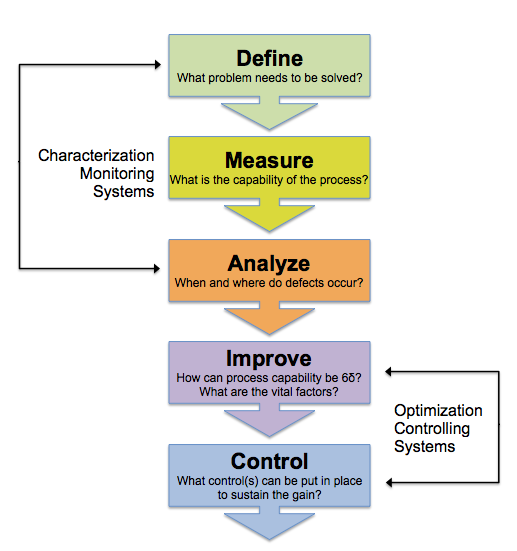
The Six Sigma methodology is based on the DMAIC process and using our weight loss example we begin to see the similarities between the two methods.
Define Phase: What is the problem and set the end goal.
Measure Phase: What is the current state?
Analyze Phase: 1. Develop cause-and-effect analysis of problem. What are the real causes and prove cause and effect links.
Improve Phase: Action
Control Phase: 1. Verify improvement and 2. Sustainability
What differs between the phases of conventional and Six Sigma problem solving begins in the Analyze Phase. Six Sigma methodology demands the proof of cause be determined before a clear course of action is taken. The proof of cause must be data-driven as root-cause analysis is at the core of Six Sigma problem solving. It is also the reason that the Analyze phase is divided into the development of cause-effects and proof of cause-effect links.
The second difference is in the fifth phase. In the Traditional problem-solving methodology, verification comes in the form of losing weight. I can prove it by weighing myself. In Six Sigma problem solving, a two-step process is needed. Verification is essential (Did I improve?) and if so, a plan to sustain our gains is created. This is not necessary in a Traditional methodology because our cause-effect is proven (exercise/eat less = weight loss); however, in the Six Sigma methodology our cause-effect must be tested and verified.
The Linguistics of Six Sigma: Y=f(X)
To speak in the language of Six Sigma, we need to change ‘problem’ with ‘Y’ and ‘cause’ with ‘X’. The Y is the output and the X(s) are any inputs that are involved in producing the output. In other words, the Y = 100% customer satisfaction and X(s) are the variables that affect the level of customer satisfaction. For more, click the following link: Y=f(X).
Using Six Sigma linguistics and the DMAIC process, we can combine the Traditional problem solving steps in Table 1 and we see that our four-step process has become a more robust seven-step process. We can now use DMAIC to ask ourselves the most essential question:
If our root-cause analysis is discovered and proven true, then can the problem be solved or reduced by controlling or removing the cause(s)?
Table 2: DMAIC Problem Solving
Real World Example: Boeing
Boeing’s Six Sigma team in Everett, WA discovered that root cause analysis is often like finding a needle-in-a-haystack, especially for the maker of the world’s largest commercial twin-engine airplane with millions of components. (To read the entire story, click the following link: Problem-solving approach helps team pinpoint solution). Boeing discovered that recirculating air fans were being rejected during production, costing Boeing money in waste, removal, testing, and cost of replacing the component.
Boeing assembled a cross-functional ‘detective squad’ that included employees from Engineering, Quality, Manufacturing, Supply Management, Procurement, and their supplier Hamilton Sundstrand who began the problem-solving techniques of the DMAIC process by examining data from the fans and beginning root-cause analysis.
This analysis determined that Foreign Object Debris (FOD) damaged the fans and the test tools. Job done, right? Not according to Kent Kuiper, Six Sigma expert at Boeing, the team had to dig deeper. “For example,” he said, “when we found that FOD was a problem and determined the source for it, removing the FOD and replacing the fan wasn’t going to get us where we needed to go. We had to figure out a way to keep the FOD from happening again.”
Further inspection led the team to discover failures in ductwork caps and plastic sheeting – two items ironically intended to prevent FOD damage and two electrical issues. One failure of improperly modified test equipment and the second issue related to crimping procedures in manufacturing process that improved connections in the fans. The results? Although the FOD in the fans was the main X, the results were clear. “After 18 fan failures in two years, we went four and a half months without a rejection,” said Max Limb, a supplier field service representative. “We haven’t completely eliminated the rejections, but we’re close.”
“Our team has become well-versed in the concept of Six Sigma,” said Valerie Feiberti, Supply Management and Procurement Director of the Lean Promotion Team. “We feel very strongly that it provides a way to correct production-related problems and proactively design-in quality.”
Summary
The DMAIC methodology is essentially a series of common sense questions to determine root-cause analysis, identification of X(s), elimination of problems, and maintaining of gains. The DMAIC process asks the following questions:
Define: What is the Y that is performing poorly?
Measure: What is Y’s current performance?
Analyze: What are the X(s)? Are they real?
Improve: How can X(s) be controlled/eliminated?
Control: How can X(s) be controlled to sustain gains in Y?
Six Sigma problem solving is the data-driven representation of the conscious or unconscious thinking we use to solve problems in our lives and can be used to solve may needle-in-a-haystack problems that vex businesses.
The University of New Hampshire Peter T. Paul College of Business and Economics is one university which offers MBA courses focused on supply chain management. Students in the school’s Supply Chain Management MBA course learn how to design, plan, and operate supply chains for competitive advantage; develop an understanding of how the key drivers of supply chain operations can be used to improve performance; and develop knowledge of logistics and supply chain methodologies and the managerial context in which they are used.
For the second year, Fronetics Strategic Advisors has had the opportunity to work with students in the school’s Supply Chain Management MBA course. Our work with the students focused on the the role and importance of content for companies within the supply chain industry.
This post begins a series which will include topical supply chain management articles written by MBA students. The students are inclusive of full-time graduate students and professionals who attend the MBA program part-time. The articles point to the diversity of this group of students as well as to the student’s breadth of knowledge on supply chain issues.
Thank you to the students and to Russell Miles, faculty lecturer in the Decision Sciences Department at the University of New Hampshire’s Paul College of Business and Economics. We enjoyed working with you and look forward to working together again next year.
Content marketing has become a priority for many companies in recent years. But connecting branded digital content with the right audience can be tricky. A new report from Fronetics Strategic Advisors examines the relationship between social media and content distribution. The report reveals which social media networks are the most popular for content distribution and which ones add the most value for brands. Take a look at some of the key findings of the report below and then dig into the full report.
Why do we apply the word “sexy” to things that are non-sexual, like, for example, the supply chain? Sexy is synonymous with the words exciting, appealing, fascinating, desirable, provocative. It’s a buzzword for something popular and attractive. When people think of the supply chain, do they think of the word “sexy”? Many might say no, but here’s an argument as to why it’s a perfect fit.
Are Apple products sexy? Are designer clothes sexy? Is the Audi A5 sexy? Are oysters sexy? Many people would answer yes. Substitute your favorite and most desired technology, clothes, cars, and food, and you will find that they are all products of the supply chain. Senior Vice President of Research at SCM World, Mark Davis, is leading the charge in pointing out the vibrancy, attractiveness, and desirability of the supply chain. A study conducted by SCM World shows how consumers view the supply chain. Here’s what they found:
Very few people react to the supply chain in a negative or strongly negative way.
People aged 16-25 view the supply chain as positive or strongly positive, which is more optimistic than any other age groups reported.
People aged 56 and older reported the highest level of unfamiliarity with the supply chain, while people aged 16-25 reported being most familiar with the supply chain.
People aged 16-25 were the least neutral compared to other ages in their reaction to the supply chain.
Given what we know about the Millennial generation, this makes sense, and it could be good news for the supply chain. Millennials are optimistic, achievement-oriented, social, collaborative, tech-savvy, and value-based. Their buying patterns are informing everything we do and it should be stressed that there are many of them. According to the New York Times, “there are more 23-year-olds — 4.7 million of them — than any other age, according to census data from June. The second most populous age group was 24, and the third was 22. There is no official age range for Millennials but the generation generally is defined as being born between the early 1980s and early 2000s. By 2020, they will account for one-third of the adult population.” We think of the Baby Boomer generation as the largest age group, but at 24% they are just surpassed by the Millennial generation at 26% of the population.
Often we equate what is sexy with youth. With the Millennial generation—our youth— poised to make up 50% of the workforce by 2020, the supply chain could harness their optimism and interest. According to Mark Davis, “we should all be highly optimistic about the future. Millennials are strongly positive about supply chain, which presents a unique opportunity for us to inspire them to choose it as a career. We have to keep them interested by sharing stories of how supply chain is innovating to solve the world’s three fundamental issues: health, hunger and environmental sustainability.”
Aside from being supported by Millennials, why else would we consider the supply chain “sexy”? Some of the most innovative work is being done in the supply chain, including enterprise resource planning, cloud-based computing, use of big data, and involvement in the Internet of Things. If the supply chain can continue to harness technology, make smart hires, and attract Millennials, the word “sexy” could apply for a long time.
Change management is the process of taking an individual or a group of people from a current state to a more desired state. Its recent prevalence, and often necessity, is heavily due to new technology and globalization. As humans we experience change constantly, on micro and macro levels. Today alone, around 350,000 babies will be born and 150,000 people will die. Gas prices might have dropped recently or your favorite flavor of potato chips might be discontinued. Stock prices rise and fall by the second. Nearly everything changes, yet the word change is often scary or stressful, especially when applied to the workplace.
Alan L. Milliken wrote in his article The Importance of Change Management in the Supply Chain that the key components of a successful business are process, technology, and people. He terms this the “Triad of Operational Excellence.” How is this “triad” involved in change management?
Process:
Sometimes process is the reason for implementing change. Are the processes in the supply chain preventing timely order fulfillment? Can the current process ensure proper, safe, and secure delivery? Are current processes compliant with regulations, nimble enough to weather unexpected change, efficient and modern enough to match innovative competitors? These are all good points to assess. When implementing change is it critical to understand a company’s current capabilities, what needs to be changed, and whether the current systems and finances can support change.
Technology:
Often change management can be spurred by a need for technological growth. If the end-to-end supply chain has antiquated practices, and one member of the chain is transitioning to modern technology, the rest of the players involved may feel the need to change despite being resistant to new technologies or feeling overwhelming by the cost and steps required to transition.
Some companies with decades or a century of business behind them, may be nervous about shifting to a social media driven, on-demand paradigm. There are many benefits to modernizing, and seeing the long-term view of how technology and media can assist business is critical. One company that has made changes to the way they present their business is the packaging supply company, Laddawn. Overhauling their website and providing customers with new purchasing capabilities has put them at the forefront amongst competitors. According to CEO, Ladd Lavallee, “It’s difficult for manufacturers to invest in service, or service technologies, because production can easily consume our time and money. But we need to make our customers’ lives easier if we want to keep winning their business in a shrinking world.”
People:
If leaders aren’t on board with a change management process their frustration or hesitation can seep into others’ mindsets. Studies have shown that emotional contagion occurs in society, and in business. People who cultivate a positive mind-set perform better in the face of challenge. When Bert’s Bee’s was rapidly growing on the global market, then-CEO, John Replogle, worked positive emotional contagion into his workplace, realizing, “Leaders, by virtue of their authority, exert a disproportionate impact on the mood of those they supervise.” He saw this change as an opportunity for people to grow as the company was growing.
In a sweeping meta-analysis of 225 academic studies, Sonja Lyubomirsky, Laura King, and Ed Diener found that happy employees have, on average, 31% higher productivity; their sales are 37% higher; their creativity is three times higher. According to executive coach and business consultant, Sara Regan, of Common Focus Consulting, thoughtful leadership during change is critical to success and employee satisfaction, “The biggest mistake I see leaders make is that they are too late in bringing others into the process. It usually creates more work in the end since it heightens anxiety and resistance then making the leader push harder instead of listen. The way in which leaders approach change impacts the end results but also the ongoing trust and engagement of the team.”
During his TED talk on the Internet of Things (IoT) technologist, Dr. John Barrett, described how every thing: appliances, furniture, vehicles, equipment, soil, food, animals and humans can become connected, identified, monitored, managed, and controlled. By 2032 he predicts that each person could come in contact with 3,000 to 5,000 connected things each day. IBM sees the Internet of Things as the planet’s new central nervous system.
The Internet of Things is already here and developing—monitoring our footsteps, heartbeats, lighting, home temperature and environment— and it will continue to grow at a rapid rate: “The growth in IoT will far exceed that of other connected devices. By 2020, the number of smartphones, tablets, and PCs in use will reach about 7.3 billion units,” said Peter Middleton, research director at Gartner. “In contrast, the IoT will have expanded at a much faster rate, resulting in a population of about 26 billion units at that time.”
The IoT and the Supply Chain
This will have a huge impact on the supply chain as we currently know it. In his talk, Dr. Barrett describes how a food processing company waiting for a delivery of shellfish will be able to not only “know where the food delivery is, but its entire storage and shipping history since the moment it came on board” the boat. Already, some vendors are able to remotely monitor their vending machines and access data about temperature, supply, and theft. In the future vending machines will be able to recognize a customer, recall their past preferences, and “even refuse to vend a certain product based on a shopper’s age, medical record, dietary requirements or purchase history.”
How else will we see IoT inform end-to-end transactions within the supply chain? Transparency in the supply chain is already growing with the swell of ERP and SCM, and with its growth it brings collaboration, clarity, and trust. With the increased use of Radio Frequency Identification (RFID) computer chips can talk to each other, and gather and deliver more detailed information than ever. Visibility in the chain will continue to expand and improve operations. The IoT will impact the supply chain in many ways including the following:
Stock management
Preventative maintenance
User insight
Manufacturing flow management
Product stability
Operational efficiency
Improved fleet management
An Example of Success
Many companies are already employing the IoT, and as a result they are seeing improvements while working out the kinks of this new technology. UPS has increased single carrier deliveries with the use of sensors. According to David Barnes, the company’s chief information officer, more than 200 measurements can be tracked on a delivery truck from “how fast the vehicle is traveling, how aggressively it’s accelerating or decelerating, the RPMs and the fuel consumption. We can hook into the engine bus environment. We also put in a GPS unit. There are sensors on the engine and on components like starter motors and seat belts.” The analysis of this data is a main focus for UPS and has resulted in improved safety management, fuel efficiency, environmental impact, and customer satisfaction. One carrier reported that his deliveries increased from 90 a day to 120 a day. UPS drivers have seen an increase in salary as the company’s revenue multiplies.
The $1 billion UPS invests in technology per year is producing results, but what are the downfalls of telematics and other advancements? The union representing UPS workers has already set forth some demands: drivers cannot be monitored without being informed and cannot be disciplined “based solely on data.” One driver noted that it “does feel like big brother.”
Issues of security, privacy, accuracy, capacity, and the growth of software substitution in the workplace are all matters that need to be examined as IoT explodes. As IoT matures, it is wise for companies, especially those in manufacturing and logistics, to pay close attention. As reported by Gartner, by 2020, “Economic value-add (which represents the aggregate benefits that businesses derive through the sale and usage of IoT technology) is forecast to be $1.9 trillion across sectors.” With the increased possibility, reach, and data of the IoT will come complex decisions and opportunities for businesses.
Fronetics’ Kate Lee has written extensively about the Internet of Things and the supply chain. Her article, How the Internet of Things will change your world, was published in the Quarter 1, 2015 edition of Supply Chain Quarterly.