by Elizabeth Hines | Oct 9, 2014 | Blog, Logistics, Marketing, Social Media, Strategy, Supply Chain
Report on social media use, motivations, preferences, benefits, and challenges.
Within the past five years companies within the logistics and supply chain industries have begun to see social media as a strategic tool and have begun to actively use and leverage social media.
A survey conducted by Fronetics looks, broadly, at the use of social media within the logistics and supply chain industries. The report discusses use, motivations, preferences, benefits, and challenges.
Key findings include:
- 68% of survey respondents report that their company has realized benefits by participating in social media.
- Increased engagement with customers, market intelligence, and business intelligence are primary benefits realized by companies.
- Companies are turning to social media to establish and advance their brand and image.
- The majority of companies are currently managing their social media strategy in-house.
- Twitter, LinkedIn and Facebook are the social networks most commonly used by companies.
- Twitter and LinkedIn are perceived to have the greatest business impact.
- Time constraints, budget constraints, and a lack of an identified strategy are the key challenges identified by respondents.
To learn more about social media and the logistics and supply chain industries, download the report.

by Elizabeth Hines | Sep 24, 2014 | Blog, Marketing, Social Media, Supply Chain, Talent
“Practice makes perfect.” This is what we have been told by our parents, our teachers, Malcolm Gladwell, and researchers. And, as pointed out by Fast Company, “There’s even a Macklemore song about it, so that makes it real.”
Here’s the problem – it’s not real. A 2014 study found that practice doesn’t make perfect. Instead, reaching a mastery level of whatever it is that you are trying to reach is dictated by your personality, intelligence, and a number of other factors.
Where does that leave us? For business it reaffirms the adage: “Do what you do best, and outsource the rest.”
During a Small Business Week panel discussion Gene Marke, Inc. columnist and owner of the Marks Group, discussed the importance of strategic partnerships and outsourcing:
“One of the smartest things I’ve been seeing companies do is that they do what they do best and outsource the rest. Companies are now thinking more about partners they can work with to provide the type of technologies, services, and solutions they cannot do or don’t have time to do.”
Dan Leberman, the vice president and general manager of PayPal’s North American online small and medium business unit, expressed similar sentiments:
“It’s all about knowing your company’s core competencies. As a small business, you need to decide what you’ll build and what you’ll give to a partner.”
The supply chain and logistics industries have been slower to adopt social media and inbound marketing than other industries. Reasons for this include: a lack of understanding of the benefits, lack of experience, and both time and budget constraints. In short, inbound marketing and associated activities including content creation and social media management are great examples of what companies within the supply chain and logistics industry should consider outsourcing.
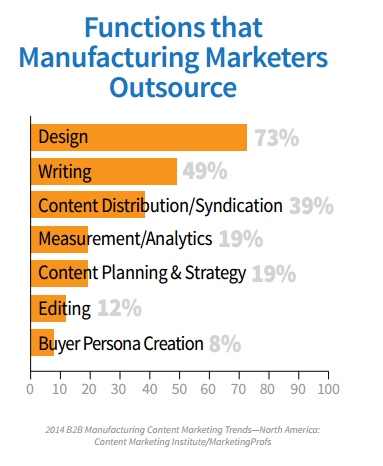
A 2014 study found that 86 percent of manufacturing marketers have adopted content marketing and that the majority (55 percent) of companies look to outsource partners for help.
As shown below, manufacturing marketers outsource a variety of content functions including writing, distribution, design, and editing.
Now that we know practice doesn’t make perfect – play to your company’s strengths and considering outsourcing the rest.

by Elizabeth Hines | Sep 23, 2014 | Blog, Marketing, Social Media, Strategy

The number of social media channels is astounding –and is growing daily. Which of these channel(s) should your business leverage? Here is what you should consider when determining which social media channels you should use for your B2B business.
Your ideal customer
Who is your ideal customer and on which social media sites are they active? Taking time to understand who your customer is and understanding where they spend their time is invaluable. If you want to reach potential and current customers you need to be where they are – you need to make it easy for them to find you and to engage with your business.
Competition
Identify which social media channels your competition is using. Do these align with the channels your ideal customers are using?
Don’t be follower. If your research has shown that your potential customers are using a social media channel that your competitors are not using, don’t assume your competition knows something you don’t. Play where your potential customers play.
Content
What type of content do you have, and what type of content do you feel will best attract and engage potential customers? Video, for example, is better suited for YouTube than Twitter.
Finally, it is essential that your business is an active participant on social media. Only take on what your business can handle and/or consider outsourcing.

by Elizabeth Hines | Sep 18, 2014 | Blog, Marketing, Social Media, Strategy
I start most of my days like you. I hit the snooze button on my alarm and lay semi-awake thinking about all the things I should be doing. Then, 20 minutes later (where did the time go?!), I autopilot my way to the kitchen for a cup of coffee. While I sip my caffeine, I scan the news to see what I’ve missed overnight. I recently discovered a new perspective on the inordinate amount of time I spend reading the news each morning.
Most news stories innately hold a sales lesson. In short, reading the news can increase sales.
Here are three news stories and an accompanying sales takeaway.
When the Brooklyn Museum of Art discovered that a third of items in their Egyptian sculpture collection were fake, they found a way to create value for their patrons by putting them on display. In sales, it’s essential to create and articulate value for your leads and prospects.
Daniel Pink, author of several bestselling books on the changing world of work, wrote in a post for the Harvard Business Review:
… the transactional aspects of sales are disappearing. When routine functions can be automated, and when customers and prospects often have as much data as the saleswoman herself, the skills that matter most are heuristic: Curating and interpreting information instead of merely dispensing it. Identifying new problems along with solving established ones. Selling insights rather than items.
What value are you providing to your potential customers? Is it unique enough to cut through the noise?
As Buzzfeed explains, “when you type a Facebook status, suggestions are made to auto-tag other users. When you start typing “grandma”, it often suggests tagging the seminal hip-hop artist Grandmaster Flash.” The result looks something like this:
Happy Birthday, Abby! Have a wonderful day sweetheart. – Love, Grandmaster Flash
Take a moment to think about why this is happening. It’s because some Facebook users are signing their names to a post – just like they would in a letter.
We sometimes need to make assumptions in sales about the tools and processes of our leads and prospects, but it’s important to ensure we share the same understanding of how they are being used. Taking action, like segmenting our buyers, allows us to predict the behaviors and characteristics of buyers with some degree of certainty. Understanding both the proficiencies and limitations of each buyer segments enables us to more meaningfully connect with leads and prospects.
It took thirteen years for this woman to find the owner of the photo. Thirteen years. Her dogged persistence resulted in an exceptionally gratifying ending – the woman not only found the photo’s owner, but also received confirmation that all six people in the photograph were alive.
Spend some time reviewing each of your successful closes and you’ll probably notice that many of them have one thing in common: persistence. Conversely, can any past missed opportunities be contributed to a lack of perseverance? Note how you navigated both successes and disappointing outcomes and whether or not you maintained momentum throughout the sales process. Identify what went right and how you influenced that. Understanding how and why you were successful increases the likelihood of repeating that success.
There’s a lot of news out there, but it’s worth taking the time to appreciate the implications of a few each day. Doing so can help you draw noteworthy conclusions about human behavior and inform your efforts to successfully engage with prospects. So, tomorrow morning give yourself a few extra minutes with that cup of coffee while you read the news.

by Elizabeth Hines | Sep 16, 2014 | Blog, Content Marketing, Marketing, Social Media, Strategy, Supply Chain
I work with companies from the supply chain and logistics industries to identify and execute strategies that will grow their business. Too often I see companies who have invested time and money into developing a B2B inbound marketing strategy and have fallen flat. Here are six reasons why inbound marketing strategies tend to fail:
The ideal customer is not being targeted
A successful inbound marketing strategy will attract and engage the “right people” – ideal customers. It is therefore essential that time is taken to understand who the ideal customer is, the needs of the customer, and the customer’s pain points. Your company’s website, social media presence, and email communications, should speak to your ideal customer.
Content is not published consistently
A common pitfall is establishing a blog, but only publishing content on a sporadic basis. To establish your company as an industry leader and gain leads, you need to publish content on a consistent basis. For example, your company needs to commit to publishing blog content every Tuesday.
Content is not quality content
All content is not equal. If you want your inbound marketing efforts to succeed, your content needs to be quality content. Your content should be well-researched, sourced, and edited. Grammatical errors and misspellings are inexcusable.
More isn’t always better
It is easy to sign up for a social media account. I’ve seen many companies who have decided to jump into social media feet first and have established many social media accounts, only to become overwhelmed. If you want your inbound marketing strategy to succeed, it is more important to be active on one social network than inactive on five.
Lack of strategy and commitment
A 2014 study of B2B marketers found that companies that have a strategy in place are more likely to consider their efforts effective than companies that do not have a stated strategy in place. Companies that do not have a strategy in place, and who do not have someone in charge of the strategy tend to fail.
A focus on sales
Content that informs and educates attracts and engages. Content that is “salesy” not only fails to attract and engage, it turns customers away.
Is your inbound marketing strategy falling flat? Assess your strategy – honestly. Has your company fallen prey to these common pitfalls?

by Elizabeth Hines | Aug 14, 2014 | Blog, Marketing, Social Media, Strategy, Supply Chain
We want to hear from you! 
We want to know what questions you have about:
- Demand generation
- Establishing and growing an online presence
- Social media
- Content
These categories are intentionally broad because we want to you to think about any (and all) questions and pain points you might have related to these topics.
Remember the adage – there is no stupid question.
Why do we want to hear from you?
We have an upcoming series of blog posts that are focused on answering questions that companies within the supply chain industry have regarding demand generation, an online presence, social media, and content. We want to give you the opportunity to ask your questions and state your challenges so that your questions and challenges can be addressed.
How can you be heard?
Fill out the form below or content with us via Twitter or LinkedIn.