by Elizabeth Hines | Jan 12, 2015 | Blog, Logistics, Social Media
Originally published January 2015. Updated November 2026.
Your next shipper is already checking you out on LinkedIn. Before a VP of supply chain sends an RFP or takes a sales call, they look up your company and the people behind it. If your page hasn’t posted since the last trade show, that silence becomes your first impression.
LinkedIn is the most effective platform for logistics and transportation companies to reach shippers and supply chain decision-makers. The companies that win on it do five things well: they keep an optimized company page, get executives and employees posting, share useful industry content, run targeted ads, and engage with prospects consistently. Here’s how to do each one.
Why LinkedIn matters most for logistics and transportation
LinkedIn has more than 1 billion members, and the people who buy logistics services spend their professional time there: VPs of supply chain, transportation managers, procurement leads, and operations directors. Logistics sales cycles are long and built on trust, so buyers want to know who they’re working with before they ever request a quote. LinkedIn is where they check.
For logistics and transportation companies, LinkedIn does three jobs at once:
- Demand generation: keeps your company visible to shippers months before they go out to bid
- Sales support: gives your sales team credibility and a reason to start conversations
- Recruiting: helps you attract dispatchers, operations staff, sales talent, and drivers in a tight labor market
What a LinkedIn strategy for a logistics company includes
| Component |
What it does |
What good looks like |
| Company page |
Your brand’s home base on LinkedIn |
Clear description of services, lanes, and industries served; posts 3 to 5 times per week |
| Executive and employee profiles |
Builds trust and extends reach |
Leaders post original insights; sales reps share and comment |
| Content |
Earns attention and positions you as an expert |
Market updates, customer stories, operational insights, video |
| LinkedIn ads |
Reaches decision-makers you aren’t connected to |
Targeted by job title, industry, and company list |
| Engagement and social selling |
Turns visibility into conversations |
Consistent comments, connection requests, and follow-up |
| Recruiting |
Fills open roles faster |
Culture content, employee spotlights, job posts |
LinkedIn content ideas for 3PLs, carriers, and transportation companies
The logistics companies that grow on LinkedIn share what they know. Content that consistently performs:
- Freight market updates. Short takes on capacity, rates, tariffs, and port conditions, and what they mean for shippers.
- Customer results. How you cut transit times, recovered a disrupted shipment, or lowered landed cost. Use numbers when the customer approves.
- Behind the scenes. Warehouse operations, new equipment, safety milestones, and the people who make it happen.
- Explainers. Answer the questions shippers ask your sales team, like how to choose between LTL and FTL or what a 3PL should report on each month.
- Leadership perspective. Opinions from your executives on industry change, technology, and customer service.
- Document carousels. Checklists and step-by-step guides formatted as swipeable PDFs.
- Short, informal video. A 60-second clip from an operations manager often beats a polished brand video.
How to get more reach on LinkedIn
LinkedIn’s algorithm rewards content that keeps people on the platform and sparks conversation. The tactics we see working across our logistics and supply chain clients:
- Lead with people, not the logo. Posts from employees and executives get far more reach than company page posts. Have your team post original content and let the company page reshare it.
- Put links in the first comment. External links in the post body tend to reduce impressions.
- Use few hashtags. One to three relevant hashtags at most. Long hashtag strings hurt reach.
- End with an easy question. Low-friction prompts like “What’s your biggest capacity challenge this quarter?” invite comments.
- Reply quickly. Engagement in the first hour after posting signals relevance.
- Post consistently. A steady weekly cadence beats bursts of activity followed by silence.
LinkedIn ads for logistics and transportation companies
Organic content builds trust with your network. Ads reach the decision-makers who aren’t in it yet. LinkedIn’s targeting is especially useful in logistics because you can reach buyers by:
- Job title and function: supply chain, logistics, procurement, operations
- Industry: manufacturing, retail, food and beverage, healthcare, automotive
- Company size and location: match your service footprint and ideal shipper profile
- Account lists: upload target companies for account-based marketing
Effective formats include Lead Gen Forms (which prefill contact details), document ads for gated guides, thought leader ads that promote your executives’ posts, and retargeting for people who visited your website. LinkedIn ads cost more per click than other platforms. The trade-off is precision, and one closed shipper contract usually pays for the campaign many times over. Learn more about paid media for supply chain and logistics companies.
Where LinkedIn fits in your broader social media mix
LinkedIn should anchor a B2B logistics social strategy because that’s where buyers are. Other platforms play supporting roles, especially for driver recruiting and company culture. For a full look at Facebook, Instagram, YouTube, and how to choose the right mix, see our guide to social media for transportation and logistics companies.
LinkedIn metrics logistics companies should track
Follower counts and likes alone don’t tell you whether LinkedIn is working. Track:
- Engagement rate on company and employee posts
- Follower growth among your target job titles and industries
- Website traffic and conversions from LinkedIn
- Leads, meetings, and pipeline influenced by LinkedIn
- Cost per lead and cost per opportunity from LinkedIn ads
- Applicants sourced through LinkedIn for open roles
Common LinkedIn mistakes in logistics marketing
- Posting only job openings and holiday greetings
- Treating the company page as the whole strategy and leaving employee profiles idle
- Sharing generic industry news without your own point of view
- Running ads without a clear offer or landing page
- Measuring success by likes instead of pipeline
What the best logistics LinkedIn pages have in common
When Fronetics first surveyed logistics and supply chain professionals about their favorite LinkedIn pages in 2014, the winners shared one trait: they published useful content consistently. That still holds. The strongest logistics brands on LinkedIn today, including large 3PLs like C.H. Robinson, mix market insight, customer stories, and people-first content, and their employees amplify it.
When to bring in a LinkedIn marketing partner
If your team doesn’t have time to post consistently, your ads aren’t producing qualified leads, or you can’t tie LinkedIn to revenue, a specialist can help. Fronetics provides LinkedIn marketing services for logistics and supply chain companies, including strategy, content creation, executive ghostwriting, ad management, and reporting. We’ve worked with 3PLs, carriers, warehousing providers, and logistics technology companies since 2011. See our work as a logistics marketing agency and transportation marketing agency.
Request a free social media audit
Frequently asked questions
Is LinkedIn good for logistics companies?
Yes. LinkedIn is the most effective social platform for logistics companies because shippers, supply chain leaders, and procurement teams use it to research and vet vendors.
How often should a logistics company post on LinkedIn?
Aim for 3 to 5 company page posts per week, plus regular posts from executives and sales staff. Consistency matters more than volume.
What should logistics companies post on LinkedIn?
Freight market insights, customer results, behind-the-scenes operations, explainers that answer shipper questions, and executive perspective. Posts from real people on your team outperform polished brand posts.
Do LinkedIn ads work for 3PLs and freight companies?
They can. LinkedIn ads let you target shippers by job title, industry, and company, which makes them well suited to high-value logistics contracts. Pair them with a strong offer and a dedicated landing page.
Should logistics companies hire a LinkedIn agency?
An agency with logistics experience makes sense when you need consistent content, executive ghostwriting, or ad management and don’t have the internal bandwidth to do it well.
by Elizabeth Hines | Jan 7, 2015 | Blog, Leadership, Marketing, Social Media, Strategy, Supply Chain
The majority of companies within the logistics and supply chain industries are realizing benefits by participating in social media. The social network that provides the greatest business impact: Twitter. A survey found that 95% of respondents believe Twitter to be either “somewhat impactful” or “very impactful” on their business.
What are the must-follow Twitter accounts for the logistics and supply chain industries?
In December 2014 Fronetics conducted a survey to learn which industry Twitter account is your favorite. The results are in.
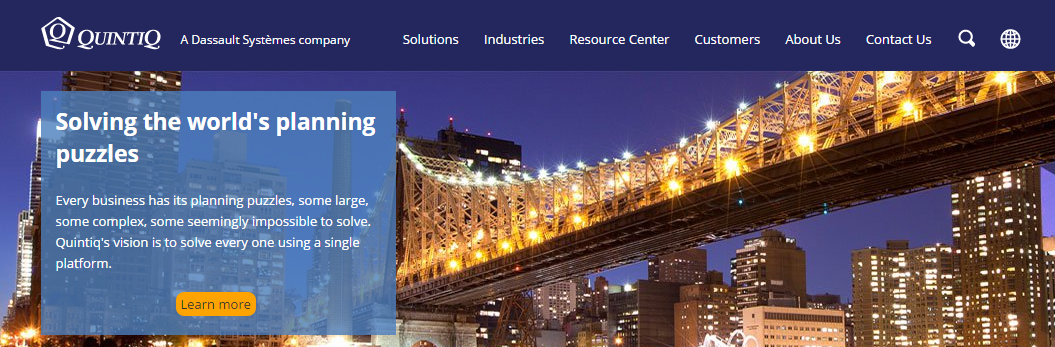
The number one must-follow Twitter account for the logistics and supply chain industries is: Quintiq
Quintiq’s vision is to transform the world’s supply chains. The company’s Twitter account speaks to this vision by sharing and providing industry knowledge and news. Additionally, Quintiq uses to Twitter to engage with others within the industry.
Other must-follow Twitter accounts include:
by Elizabeth Hines | Jan 5, 2015 | Blog, Content Marketing, Internet of Things, Logistics, Marketing, Social Media, Strategy, Supply Chain, Talent
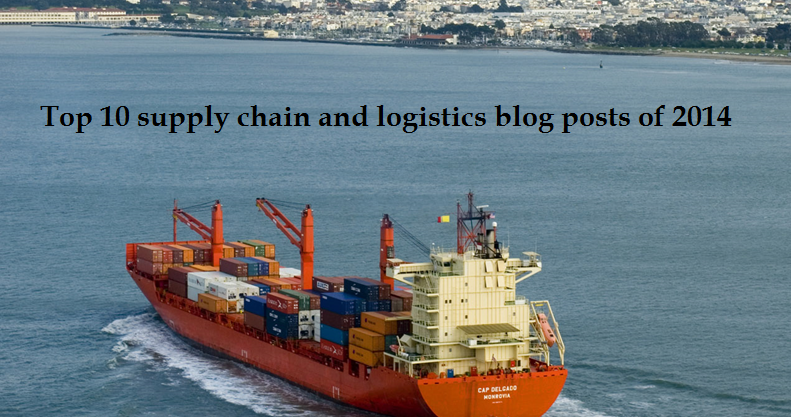
Here are the top supply chain and logistics blog posts of 2014
2014 is over and a new year has begun. We look back at the content we created and shared in 2014.
Looking at content focused on the supply chain and logistics industries, there are three topics which garnered the most interest:
- The use of social media and content marketing;
- Supply chain talent;
- Technology.
Here are the top ten supply chain and logistics blog posts of 2014 based on pageviews. #1 receiving the most pageviews.
The Internet of Things trend is quickly approaching and will impact the way we live and work through increased productivity and efficiency. Supply Chain Management will continue utilizing these advanced technologies to improve factory workflow, increase material tracking, and optimize distribution to maximize revenues. Read the full blog post.
Within the past five years companies within the logistics and supply chain industries have begun to see social media as a strategic tool and have begun to actively use and leverage social media. A survey conducted by Fronetics looks, broadly, at the use of social media within the logistics and supply chain industries. The report discusses use, motivations, preferences, benefits, and challenges. Read the full blog post.
Santa’s supply chain was the first to run “in the cloud.” Read the full blog post and check out the infographic.
Looking at the manufacturing, supply chain, logistics, transportation, distribution and freight industries there are a few companies that have emerged as leaders – companies that exemplify the business value of creating and executing digital, social media, and content marketing strategies. Cerasis, a freight logistics company, is one of these companies. Read the full blog post.
The supply chain industry has a talent crisis. The question is: how can we solve this crisis? To answer this question I turned to Rodney Apple, founder of the SCM Talent Group. Apple has worked as a supply chain recruiter for the majority of his 19+ year career within the staffing industry and he has filled more than 1,000 positions within the industry ranging from executive-level in Fortune 500 headquarters settings to leadership and staff-level roles across large networks of manufacturing and distribution facilities within North America. Apple’s role affords him the ability to witness the talent crisis from the perspective of the industry, the company, and the job seeker. Read the full blog post.
The purpose of this series of blog posts is to give others in our industry and especially those in the manufacturing industry, a guide to create an effective digital, social media, and content marketing strategy which will produce results for your company. If you have followed the Cerasis blog since its launch in March 2013, you have noticed that we work really hard at executing our strategy. The reason we work so hard is because we are passionate about educating the marketplace on information that matters to them. In that way, we want to be the de facto expert in the manufacturing and logistics industries. If we can help those who are our customers and potential customers (manufacturers and distributors) with best practices around logistics and freight, as well as manufacturing industry news, we are continuing our mission of driving long term value (even if we give the information away for free). The result (we hope and have seen) is that people view us as the expert and will want to engage us in a long term relationship as their logistics services provider. We hope this is helpful and you learn something from it! Read the full blog post.
3PL provider Coyote Logistics is one of the fastest growing companies in North America. The company’s incredible growth (five-year growth: 3,585 percent) and tenacious spirit has not gone unnoticed. Forbes included Coyote in its list of Most Promising American Companies; Supply & Demand Chain Executive listed Jeff Silver, Coyote CEO, as one of their “Pros to Know;” and the company was listed as one of the best places to work by the Chicago Tribune. There are undoubtedly many factors that have contributed to the success of the company. Coyote’s approach to social media is likely one of the company’s keys to success. Read the full blog post.
Here’s the thing – the supply chain industry is perceived by those outside the industry as having no “wow” factor whatsoever. If the supply chain industry is going to attract new and qualified talent, it needs a face lift. It is time for the supply chain industry to re-brand itself. Read the full blog post.
Without a comprehensive social media strategy, your message may be getting lost in the chatter. There are a number of tools that will help you monitor your online influence and, effectively, make the necessary adjustments to ensure your efforts are paying off. Here are 10 free tools to help you measure your social media ROI. The basic features of each of these tools are free. Read the full blog post.
Regularly tracking your relationship with your suppliers and their performance toward your expectations is critical to ensure the success of your business. One mechanism for tracking this is the supplier scorecard. A scorecard is in essence a report card for your supplier. Supplier scorecards when used effectively can help maintain a healthy supply chain and will benefit both parties. If not used effectively supplier scorecards can damage the supplier relationship and hurt both businesses. Read the full blog post.
by Elizabeth Hines | Dec 30, 2014 | Blog, Logistics, Manufacturing & Distribution, Marketing, Social Media, Strategy, Supply Chain
 I wrote a guest blog for freight logistics company Cerasis in October which discussed how companies within the manufacturing, supply chain, logistics, and industrial industries can increase their B2B visibility on LinkedIn.
The catalyst for writing the blog were results from a recent survey focused on the supply chain and logistics industry. 58% of respondents rated LinkedIn as “very impactful,” and 37% rated LinkedIn as “somewhat impactful.” At the same time, respondents reported challenges associated with strategy (33%) and a lack of understanding about the application of social media (24%).
Leveraging LinkedIn
There are over 3 million LinkedIn company pages. Being present on LinkedIn is critical, but is not enough. To maximize your LinkedIn presence you need to take steps to increase your B2B visibility. Here’s how:
-
Create a compelling company page
Your company page is an extension of your company. Make sure that the page is compelling, informative, and presents your company as a leader within the industry.
-
Be active
In addition to keeping your company page up-to-date, you need to be active on LinkedIn on a daily basis. LinkedIn groups are great. Actively participating in LinkedIn groups will allow your company to: 1) gain business and market intelligence; 2) introduce you to new, interesting, and relevant topics; 3) help you increase brand awareness; and 4) position your company as an industry leader.
-
Distribute content
If you want your content to be seen you need to get it out there; you need to distribute your content. Distribute your content and curated content via your company page and (when relevant) within the LinkedIn groups to which you belong.
-
Employee engagement
Your employees are your brand ambassadors. Empower your employees to be active within LinkedIn groups as representatives of your company. Encourage employees to share your content and industry content with their connections. Additionally, encourage employees to share open positions with their LinkedIn connections, and to identify great talent within their network.
-
Prospect for leads
LinkedIn is an effective prospecting tool. Use LinkedIn to prospect for leads and to build your sales pipeline.
-
Optimize your profile
Every employee is a reflection of the company. Encourage employees to optimize their personal LinkedIn profiles.
-
Don’t be annoying
You will fail if you take a “me, me, me attitude.” Constantly self-promoting is bad for business.
If your company is not using LinkedIn you are missing out on opportunities and revenue.

by Elizabeth Hines | Dec 24, 2014 | Blog, Marketing, Social Media, Talent
LinkedIn is the largest social network for professionals. There are more than 332 million users – and this number is growing rapidly. An average of 2 users joins LinkedIn every second.
There is the perception that LinkedIn is only for job seekers, and that a red flag will be raised if those who are employed update their profile. Neither is accurate.
Here are 6 reasons you need to be on LinkedIn even though you have a job:
Your personal brand matters
People are looking at your LinkedIn profile to learn more about you. And it isn’t just recruiters or potential employers looking on LinkedIn. Clients, colleagues, and even your current employer look to your LinkedIn for information on who you are, what you have done, and what you do.
Because your personal brand matters, take the time to optimize your LinkedIn profile.
Network, network, network
Networking is often thought of as a (dreaded) job search action item. However, thinking about networking in this manner will leave you at a disadvantage. Networking is an action item necessary for your professional and personal growth.
LinkedIn is an incredible network building tool. Leverage it and “Network your face off.”
Industry groups
Being involved in relevant LinkedIn groups will help you grow your network. It will also help you stay up-to-date on what is happening within your industry, and give you the opportunity to get involved in the conversation.
News
Company and individuals are posting content, and having conversations on LinkedIn every day. These conversations and the content posted are chock full of relevant news.
Be a brand ambassador
Is your company hiring? Share the posting with your connections. Also, take the time to look through your connections; is there anyone who might be a good fit for the position? If so, reach out to them. Bonus: your company may compensate you for referring a candidate if they are hired.
Opportunities
You may not be looking for a new position, but what if the perfect position fell into your lap? If you are active on LinkedIn and have optimized your profile, you may find that people begin reaching out to you and present you with opportunities.
Have a job? Be active on LinkedIn. Not being active is more likely to raise a red flag.
by Elizabeth Hines | Dec 18, 2014 | Blog, Marketing, Social Media, Strategy
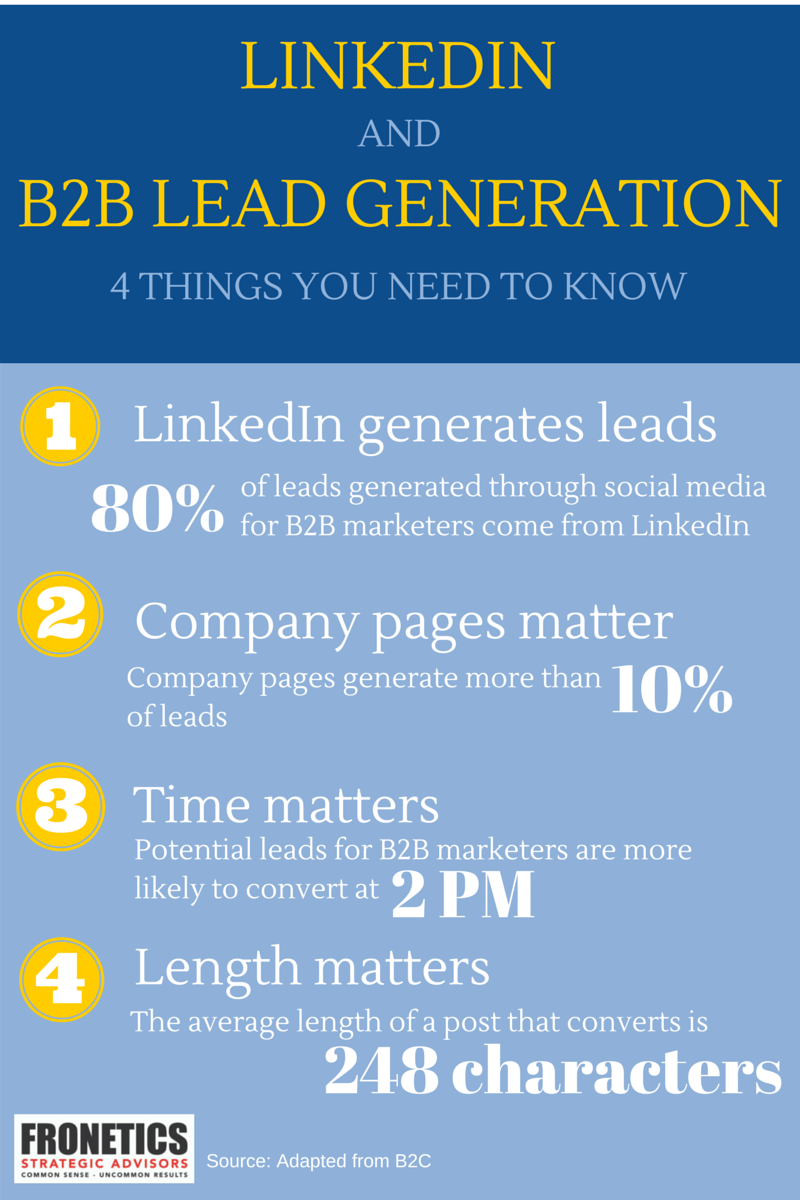
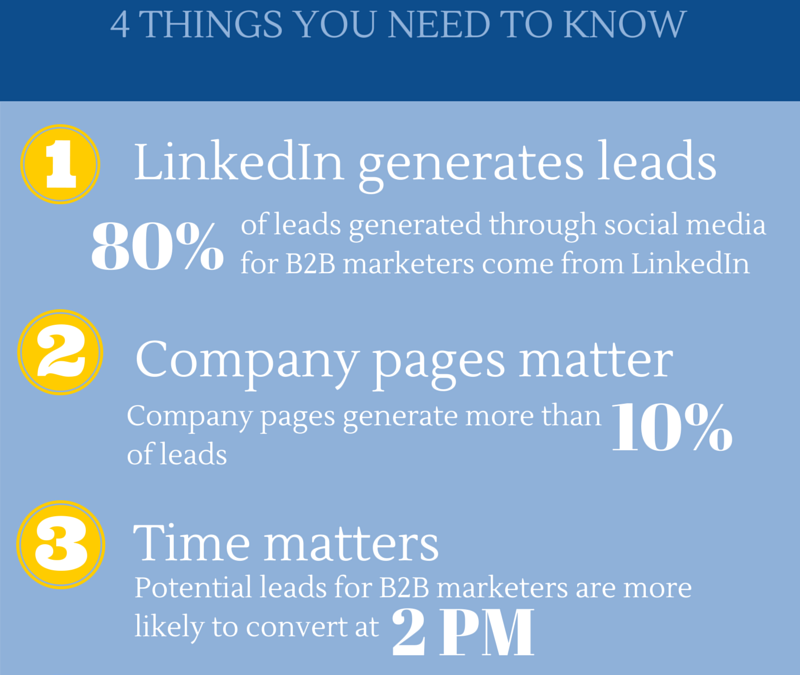
Oktopost, a social media marketing platform, analyzed over 100,000 posts on four different social networks (LinkedIn, Twitter, Facebook, and Google+) and found that LinkedIn is the most effective social network for B2B.
Oktopost found that more than 80% of B2B leads were generated through LinkedIn. Lead generation through other social networks paled in comparison:
- Twitter: 12.73%
- Facebook: 6.73%
- Google+: 0.21%
We’ve put together an infographic that outlines four things you need to know about LinkedIn and lead generation.