
by Elizabeth Hines | Apr 6, 2016 | Blog, Content Marketing, Marketing, Social Media, Strategy

Fronetics helps clients increase brand awareness, foster meaningful customer engagement, and grow business.
Fronetics is a B2B marketing agency for supply chain and logistics companies. We are unique in that we use a data-driven approach to align marketing programs with business objectives and to deliver results.
“Fronetics” is derived from the ancient Greek word fronesis, meaning wisdom or intelligence, and is translated as “practical wisdom.”
Our team of strategists, marketing professionals, writers, designers, and social media experts leverages industry experience to elevate our clients’ brand position within the industry. We work with you — getting to know your business, your target customers, your industry, and your competition — to create a digital and content strategy individualized for your specific situation and needs. We put metrics on all marketing activities and monitor them regularly. And then we identify challenges, trends, and opportunities and take action so that your content marketing program constantly evolves and delivers results.
Fronetics offers comprehensive digital and content marketing services, including: content creation, content curation, content distribution, social media management, email marketing, lead nurturing strategies, and pay-per-click. Learn more about what we can do for your business below.
Content Creation
There is a lot of content out there. If you want your content to stand out and drive profitable customer action, you need quality content. At Fronetics, we create quality content that drives results. Unlike other firms, we don’t outsource content creation. By keeping all content creation in-house we are able to ensure a quality product.
Our team creates the following types of content:
- Blog posts
- Articles
- eBooks
- Case studies
- White papers
- Newsletters
- Press releases
- Infographics
- Social media
- Custom content
Social Media
Social media is an incredible tool; however, for it to be effective it must be driven by strategy, be consistent, and must have someone managing the execution.
At Fronetics, our social media strategists distribute content, curate content, engage your target audience, and monitor your social networks. We develop a social media strategy that aligns with your company’s goals.
We analyze your competition, classify your target audience and cultural attributes, identify the influencers in your industry, recommend platforms, detail best-engagement practices, create social media schedules, and identify specific tactics that deliver results.
Through the proper execution of social media, your brand is given a voice and personality, and becomes more accessible to your target audience.
Strategy Workshops
To effectively attract target customers, generate leads, and establish your company and your brand within your industry, you need a digital and content marketing strategy; a piecemeal approach does not work.
At Fronetics we offer both half-day and full-day workshops to help your business create and execute digital and content marketing strategies that drive success and elevate your brand position within your industry. Our workshops are intensive and hands-on. By the end of the workshop you will have an actionable and sustainable strategy that is aligned with your company’s business objectives.
Following the workshop you will receive a full year of support from our expert staff.
Schedule a free marketing assessment
Related posts:

by Elizabeth Hines | Mar 31, 2016 | Blog, Content Marketing, Marketing, Social Media, Supply Chain
Employ a content and social marketing strategy to nurture leads you meet during MODEX.
Hundreds of potential customers will be heading to Atlanta next week for MODEX, and you’re gearing up to gain lots of new business. That is, you and over 800 other exhibitors are hoping to gain lots of new business. So how do you plan to stand out among the competition?
Using content and social marketing to nurture leads surrounding the event will help maximize the benefits of attendance. You can bring more attention to your presence, which will help you find more new potential customers, and then you can increase your chances of converting them if you use these tools properly.
Here are some tips for before, during, and after MODEX for using content and social media to gain new business.
Before the show
1) Define your goals.
A trade show represents an opportunity to spread brand awareness, find new leads, and, of course, make sales. Decide what is most important to your business, and strategize around those goals. For example, if one of your goals is to increase your social following, make sure every handout, landing page, and face-to-face interaction includes a request to like you on Facebook (or elsewhere).
2) Promote your attendance.
With the trade show hashtag (#MODEX2016), use Facebook, Twitter, and LinkedIn to let your followers know that you will be attending and when and where they can find you. Engage with other attendees who are using the event hashtag. Offer teasers — such as photos of the freebies you’re bringing — to entice visitors, and provide any longer-form information (e.g., an excerpt from a presentation you’ll be giving) in a blog post, distributing it through your social channels.
3) Set up a landing page/landing pages.
Create an event-specific landing page that includes a call to action (CTA), like reserving a time to speak with you at the conference or downloading a coupon to redeem a free sample. Make sure to ask for some information (such as a name, company, or contact information) in exchange. Monitor traffic and keep a running list of leads who visit and provide their information.
4) Research the attendees.
Perform prospect research using the list of attendees, paying special attention to those who have provided their information on your landing page or connected with you on social media about the event. Check out their social pages to see what they’re saying about the event, and like or follow them. Connect with high-value prospects on LinkedIn and try to arrange a time to meet up during the show.
5) Prepare to nurture.
Draft content that you can distribute during and after the show. Examples include lead-nurturing email templates, slides from presentations you are giving, and other offers you plan to provide visitors. Create another landing page, which includes a special offer or specific information you’ll be providing during the show, to drive attendees to during and after the event.
During the show
6) Keep chatting.
Reach out to the people you meet during the show on their social media handles. A nice-to-meet-you tweet and/or an invitation to connect on LinkedIn shows that you remember and appreciate the potential customer. Send the lead-nurturing emails you prepared in advance.
7) Monitor social media.
Continue using the show’s hashtag to monitor the conversations that are happening online, and see if anyone is talking about your company. Like or reply to anyone who does to show you’re listening.
8) Generate content.
Trade shows are a great place to generate content. Post photos of your booth and attendees from your company, and create videos of product demonstrations, presentations, or customer testimonials. Share your thoughts on the issues being discussed, and keep track of those themes, as well as any recurring questions that attendees ask, for future content.
After the show
9) Plan out your editorial calendar.
Develop posts for your company’s blog over the coming months around the questions and issues that were raised during the show.
10) Keep up the conversations.
Continue to engage the people you met on Facebook, Twitter, and LinkedIn. Follow and like their pages, and invite them to connect.
11) Offer your leads something of value.
Make event presentation or speaking materials part of your lead nurturing activities by sharing them with prospects using Slideshare or email. Remind leads with whom you shared your special-offer landing page to visit. Make sure to segment your contacts based on their interests and send them only relevant offers.
How do you nurture leads around trade shows? Will you be attending MODEX this year?
Related posts:
by Elizabeth Hines | Mar 28, 2016 | Blog, Marketing, Social Media
 A recent collection of social media facts and stats offers an interesting look at B2B company and buyer behavior.
Last month, Webbiquity published a list of 49 social media facts and stats about user behavior on Facebook, Twitter, LinkedIn, Pinterest, Instagram, and Google+. These figures, collected from various studies, offer insight into how people and businesses are using social networking in recent times.
B2B companies may find several of the stats particularly interesting, and it may influence the way they think about social media marketing. I have pulled out some of the most applicable and offered some thoughts below.
Social media facts and stats from Webbiquity
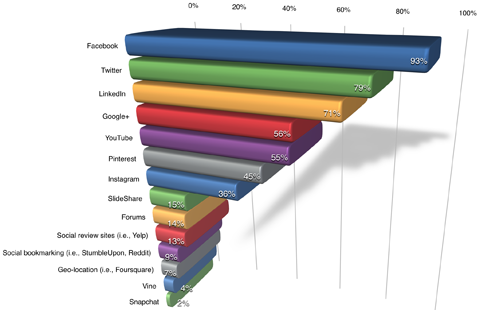
88% of B2B companies use Facebook for marketing (and 96% of all B2C companies )
If you are not using Facebook in your marketing efforts, you are in a quickly growing minority. With 968 million active daily users, the largest social networking site offers a huge opportunity — actually, the most expansive opportunity available — for your business to attract, court, and convert potential customers. Here are some of our top tips for using Facebook to market your business.
93% of small business owners and marketers use Facebook.
Small businesses don’t have the time or budget to compete with large brands when it comes to marketing — but social media can level the playing field. Social media, and Facebook especially, is an ideal marketing platform for small businesses because it can be relatively inexpensive but have a high impact on growth. Your company can cultivate your brand, engage with customers, and form business relationships. Learn how two small companies saw enormous growth thanks to social media.
21% of consumers say they unfollow brands that post repetitive or boring content. 19% say they would unfollow a brand on Facebook if the brand posted too often — more than six times a day.
We know that creating good, original content is key to a successful inbound marketing strategy. But knowing how often to post to the various social channels can be one of the more intimidating obstacles to overcome. How do you know what’s too much and what’s too little? Learn how often you should post on social media.
74% B2B decision makers use LinkedIn to help make purchasing decisions.
Don’t let anyone convince you that social media channels are for personal use only: customers are online, and if you aren’t, you’re at a disadvantage. And since nearly three-quarters use LinkedIn for purchasing decisions, it’s critical that your business is strategic about your presence on the network. Check out this guide for creating the perfect LinkedIn company page to get started.
88% of B2B marketers in North America use Twitter for content distribution.
Twitter is one of the more effective channels for gaining business, and the numbers prove it. A Market Probe International survey found that 72% of those who follow a business on Twitter are more likely to make a purchase from that business, and that 82% of followers are more likely to recommend a product or service to friends and family. Additionally, 85% of respondents reported feeling a closer connection to a small business if they follow them on Twitter. Learn more about Twitter for business.
Pinterest has 47 million active monthly users worldwide, 80% of whom are women.
While Pinterest use is rapidly growing among B2C marketers, the B2B world still hasn’t quite figured it out yet. I pulled out the two above stats to show the enormous potential this channel has, particularly for businesses whose customer base is primarily women. Fronetics’ social prospecting workbook has some ideas on how to get started using Pinterest.
32% of U.S. companies with 100+ employees used Instagram for marketing activities in 2015. eMarketer predicts that number will jump to 70.7% by 2017.
The importance of Instagram for B2B companies will continue to grow. Here’s why: 90% of Instagram users are under age 35. A recent Google study showed an increasing number of Millennials on the B2B purchasing path — up to 46% of potential buyers were of this generation in 2014. Their preferences and behaviors are having a noticeable impact on B2B buyer behavior as a whole. So if your business wants to capitalize on the nearly 300 million active monthly users, Instagram should be on your radar.
64% of North American B2B marketers use Google+ to distribute content, but just 17% use it for new product launches (vs. 81% who use LinkedIn).
Americans may use Google+ less frequently than some of the other networks, but don’t count it out entirely. More people check the site than people realize, including die-hard fans of Google products and the many businesses who use the Google suite professionally.
Related links:

by Jennifer Hart Yim | Mar 17, 2016 | Blog, Leadership, Marketing, Social Media, Strategy, Supply Chain

Source: Library of Congress
This is a guest post written by Tania Seary, founder of Procurious. Procurious, the world’s first online social network for supply chain and procurement professionals, has acquired more than 12,000 members in less than two years.
I’m trying to use a baseball analogy here, but appreciate that my headline does have other connotations!
Another analogy might be to say that we’re “getting the flywheel spinning” here at Procurious – the world’s first online network for supply chain and procurement professionals.
Now, for those of you who aren’t familiar with the flywheel analogy, it is a metaphor created by author Jim Collins in his famous business manifesto, “From Good to Great,” to explain one of the key drivers for creating long-term success in business.
A flywheel is a heavy disk on an axle used to smooth a machine’s operation to generate momentum and maintain a constant rotational speed.
It takes much effort and persistence to get the metaphorical flywheel to move, but consistent energy in one direction over time helps build momentum and ultimately leads to a breakthrough. In the case of Procurious, as with Collins’ companies, there has been no specific event, decision, action, or lucky moment that single-handedly helped us to successfully break through the “beta” stage, to where we are today.
Over the last two years, we have remained committed to building something truly special for the procurement profession. Step by step we have stayed focused on our goal of building a very credible and content-rich community for our members.
Now with more than 12,000 members in 135 countries, Procurious has cemented its position as the secret weapon for professionals wanting to be part of the movement toward creating the new face of procurement.
Getting back to our headline analogy with baseball, I wanted to share some of the key decisions we have made along our journey to date to build Procurious.
Agreeing on the MVP
Just to confirm, we are talking about Minimum Viable Product here, not the Most Valuable Player. In the early days of designing this business, everything was up for grabs. Among a long list, we considered building a procurement news aggregator, a pure-play training repository called Procurious TV, and a procurement lifestyle magazine.
What we ended up with was a community platform that included a community feed, member profiles, discussions, eLearning, a worldwide calendar of procurement events, twice-daily blog, and private groups.
The end result was a powerful combination of career advancement, skill development, and professional networking opportunities to help propel today’s procurement professionals forward.
To have open or closed membership?
Once we had agreed on the core features and functionality of Procurious, we had a lot of heated debates over whether we should have an open or closed network. That is, should it be closed exclusively to highly pre-qualified procurement professionals, or open for the whole world to join?
Luckily my team convinced me to keep our network open… and it’s been an important part of our success story to date.
Of course, the major advantage to our members is that on Procurious, they gain access to a wide range of thought leaders and industry experts which then exposes them to diverse opinions on the hot topics in procurement.
Finding our fans
Every club, or community, needs a strong support base. We have been very fortunate to have a number of “early adopters” from around the globe support the building of the Procurious community. And, of course, we now have our “poster child” — Siddarth Sharma — who was surprised to learn he was our 10,000th member. Siddarth is representative of so many of the exciting procurement professionals around the globe — an MBA working for KPMG managing a small team of indirects buyers in India.
Securing our sponsors
Like a baseball club, we needed some big-brand sponsors to keep our operations humming. We have been fortunate to create partnerships with the profession’s leading institutes, associations, analysts, and technology companies. The Hackett Group has supported Procurious from the start, and The Institute for Supply Management (ISM) has joined the team this year. These relationships enrich Procurious in many ways and, most importantly, provide our members with access to world-leading research and resources.
Fielding a winning team
Lisa Malone, Euan Granger, and Jack Slade have been a powerhouse behind building this community, covering all the bases, and getting runs on the board.
Handling the curveballs
The biggest threat to our success is the introduction of a fierce competitor. But we are fortunate that we now have a loyal community that has been built on a substantial foundation of trust and commitment. This will be difficult to shake.
Our next biggest hurdle to success is to overcome the procurement profession’s hesitancy to create social media networks.
Despite the well-publicized benefits, we still meet procurement professionals that tell us “they don’t believe in networking” and don’t accept LinkedIn invitations from people they don’t know. We need to convince the profession of the multiple benefits of using social media, and then provide them with the skills to leverage the opportunity.
One base at a time
Our plan is to continue building Procurious based on our members’ needs, one base at a time.
We will be hosting our Big Ideas conference in London on Thursday, 21 April, for which you can register as a digital delegate on www.bigideassummit.com.
We are also currently beta-testing our new app, which can be downloaded from the Apple App store.
We are asking as many procurement professionals as possible to sign up to the network at www.procurious.com to join this new era and — as we like to say — get involved and get ahead!
Tania is the Founding Chairman of three companies specializing in the development of the procurement profession – The Faculty, The Source and Procurious.
The Faculty is recognized as one of Australia’s leading advisors on procurement development. Established twelve years ago, The Faculty works with leading organizations to transform and elevate the role of procurement, build high performance procurement teams and create professional knowledge networks.
Under Tania’s leadership, The Faculty has instigated a number of “firsts” for the procurement profession in Australia, including the development of a Procurement Executive Program through Melbourne Business School, the establishment of a Procurement Roundtable which includes many of Australia’s leading organizations, creation of an annual Chief Procurement Officer (CPO) Forum and attracting leading global procurement thought leaders to teach in Australia. She also initiated the Corporate Board for Social Procurement, which has created a foundation for leading corporations to dedicate appropriate areas of spend toward social enterprises.
Four years ago, Tania founded The Source, a specialist recruitment firm for the procurement profession. In 2013 she moved to London and founded Procurious, the world’s first online community for procurement professionals to connect, share and learn.
Tania’s fascination and commitment to procurement development started around fifteen years ago in the United States. After finishing her MBA at Pennsylvania State University, Tania became one of Alcoa’s first global commodity managers.
Prior to moving to the USA, Tania’s career was focused on marketing roles within Alcoa and Rowland in Australia, and the Walt Disney Company in the UK. Tania has an MBA and a Bachelor of Business.

by Elizabeth Hines | Mar 8, 2016 | Blog, Marketing, Social Media, Strategy
Social prospecting helps you identify potential customers outside your established audience using social platforms.
Social media should be an integral part of your marketing strategy — we know it helps build brand reputation, gather market intelligence, discover customer problems, and influence purchasing decisions. But your lead generation efforts should also include the use of social platforms. It’s a practice called social prospecting that can be highly effective in identifying new prospects.
You’ll use your existing social handles to identify and pursue potential customers that may be interested in your business but that don’t yet know about it. HubSpot describes social prospecting: “It’s about scouring the social web, identifying potential prospects, and engaging them through content to get them to your site and move them through your funnel.”
Why does it work?
Think about the size of your established audience. Now think about the total number of active users on social media: As of the fourth quarter of 2015, Facebook had 1.59 billion active monthly users, Twitter averaged at 305 million, LinkedIn had 414 million, Google+ had 111 million, and Pinterest had more than 100 million. Those enormous numbers equal enormous potential for your business.
That’s because social media isn’t just for recreational purposes anymore. More than half (53%) of B2B buyers report using social media to research purchases, in fact. Social prospecting allows you to be proactive in finding all of the considerable number of social-media-using prospects who are looking for you, too.
How do you get started?
If you already have a social media presence, that’s step one. It gets a little more complicated from there.
Fronetics has developed a free social prospecting workbook to learn how to use social listening to generate new leads for your business. We’ve identified the quickest way to find potential customers on Twitter, Facebook, LinkedIn, Pinterest, and Google+. Every worksheet includes:
- Short preparatory work to make the actual prospecting easy
- Visual instructions on how and where to find prospects
- Pro tips that will help you get the best results
- Prescriptions (Marketing Rx) for success
- Take-home exercises for follow-up prospecting

Happy prospecting!
Related articles:

by Elizabeth Hines | Mar 7, 2016 | Blog, Content Marketing, Marketing, Social Media
Your content stinks. Here’s why.
Twenty-seven million pieces of content are shared every day — and most of it is crap. To attract readers to your content, you must stand out, and I mean really stand out, among the masses. That’s no easy feat.
You may be spending an enormous amount of time and money as part of a content marketing effort, but, if no one is reading what you’re producing, you’re definitely not achieving your ROI. Consider the following points, and ask yourself if any could be negatively impacting your readership.
Here are the top 10 reasons no one is reading your content.
10. You don’t have a strategy.
Only 11% of companies without a documented content marketing strategy find their efforts to be successful, compared to 60% of companies with a strategy in place. And that number rises to 86% when the company designates someone to lead the strategy. Having a clear vision for your content and a plan for executing that vision is crucial to earning an audience.
9. Your content isn’t search-engine optimized.
Seventy-seven percent of today’s buyers use Google to research information about products. Search engine optimization (SEO) means writing copy for your digital assets so they will be prioritized by Google in web queries related to your business or products. Three of four people will click on the top five search results. So the further you move from those top five results, the less likely someone is to find, much less read, your content. If your content isn’t SEO-friendly, readers may not even have the chance to see what you’re writing because it is so far down in their search results.
8. You are using the wrong channels.
If a tree falls in the woods and nobody is around to hear it, did the tree fall after all? Stop publishing in the empty woods. Who is the target audience for your content, and where are they active? Evaluate your audience (or lack thereof) in each of the channels where you publish, and see if something is amiss. This will vary greatly by business. You can access personalized information on your followers’ social media habits through analytic programs like Google Analytics and sites like Tweriod.
Also to consider: on lightning-fast platforms like Twitter, a miscalculation of timing could be to blame. (See The Best Time to Post on Social Media.)
7. You’re not publishing often enough.
Inconsistent content is one of the primary reasons readers become disengaged with a particular publisher. Even publishing one more blog post a week can significantly boost your readership. Try a little experiment for a few months by playing with the number of times per week you publish — say, three times per week one month, four times the next, and five the next. You’ll find the sweet spot where you get the most engagement but can also handle the production schedule.
The next reasons have to do with the substance of the content itself.
6. You’re publishing a sales pitch instead of content.
Imagine you’re looking to buy a car. Researching different options online, Site A, run by Dealership A, offers expert opinions about various makes and models, while Site B talks about how Dealership B offers top-notch customer service and a no-nonsense negotiation policy. You’d probably never come across Site B in the first place because the content is irrelevant (and trite… and annoying), whereas Site A has exactly what you’re looking for.
Content marketing is your opportunity to provide valuable, expert information to people who are seeking it out. Associating your brand with that sort of expertise attracts customers — not to mention, helps them find you via organic search in the first place. No one wants to read your sales pitch over and over again, and they won’t.
5. You are not telling the truth.
I am talking about two different definitions of truth here.
For one, are you being honest? Today’s consumers can smell b.s. from a mile away, largely because the Internet forgets nothing and forgives nothing. The prevalence of user-review sites and platforms like social media means customers will always have an outlet to share their experiences, both good and bad. If your business does not provide what you promise, people will be upset and take to these forums to complain about it. Trust and transparency are two key assets in earning (and keeping) readership.
Secondly, are you being true to who you are as a business? A recent Harvard Business Review article defines successful marketers as mission-focused, not consumer-focused. Don’t produce content based on what you think your customers want to hear. The beauty of content marketing is that when you put your business mission out into the universe through content, people who are seeking that information find you. In other words, build it, and they will come.
4. You’re not offering anything of value.
DigitalTonto says, “The first step towards engagement is creating value beyond the basic transaction of payment for a product or service.” This is the essence of content marketing: a related offer of value in the form of expertise, entertainment, etc. For example, L’Oreal Paris provides free makeup tutorials on its YouTube channel, Destination Beauty, and, Apple offers free classes, product demonstrations, and tech support from the Genius Bar for product users.
The question to ask is, what is your value to your customers? Can you offer expert advice on a particular topic through a blog? Is there something about your products or your people that would make for entertaining or informative videos? Do you have access to top-of-their-field specialists that could lead a webinar series? Find whatever it is that is unique to your company, and leverage that in your content marketing to attract readers.
Because there is so much content out there, today’s consumers can afford to be partial to publishers who provide information in a way that is pleasing to them. They also have shorter attention spans than goldfish. That means things like format, length, accessibility, and voice can majorly impact whether people read your content or not. Also, be mindful that different platforms should offer different experiences based on reader expectations (e.g., Instagram isn’t the place for lots of text).
2. You’re not heeding performance analytics.
The one certain constant in marketing is that things will always change. What works for you one year will certainly be irrelevant the next. Content marketing won’t allow you to rest on your laurels, either. You should stay on top of your analytics to monitor what kind of content is successful in the present moment, and you should tweak how you’re doing things as people, technology, and events change. Keep testing new ideas to see how they are received, and get rid of old standbys that no longer pull their weight.
1. Your content is bad.
While this seems obvious, it’s worth repeating. If the quality of your content is bad, no one will read it, regardless of what value it offers. The same goes for if you find yourself saying, “it works,” or “it’s fine!” If there are 27 million options, who would choose “fine?”
Do an honest evaluation of your content, or have a neutral outside party do so for you. Is it original, substantial, and well-written? Make sure that your content is edited, and that it is free from grammatical errors, spelling mistakes, and awkward phrasing. And remember that you get what you pay for. Professional writers can be expensive, but there’s a reason for that — theirs is a specialized craft, and very few people can do it well. If you want people to read your content, you should make sure that it’s worth reading.
Related articles: