by Elizabeth Hines | Jun 15, 2017 | Blog, Content Marketing, Logistics, Marketing, Social Media, Supply Chain
A global marketing survey finds that many businesses are focusing on these initiatives and challenges.
As more supply chain and logistics companies understand the benefits of content marketing, more are turning to this type of marketing strategy to build brand awareness and grow business. One of the functions of this blog is to update you on various marketing trends to help you keep pace with the rapidly evolving digital marketing landscape.
The State of Inbound has been tracking global marketing and sales trends for the last eight years, with a particular focus on inbound marketing. (Content marketing is a form of inbound marketing.) The 2017 survey included more than 6,300 professionals at from 141 countries — so it’s very comprehensive.
There’s a lot to look through in the full report, but I’ve pulled out a few of the most important takeaways that speak to trends we’re finding most relevant to our supply chain clients.
5 takeaways from the State of Inbound 2017
1) Inbound marketing results in higher ROI.
The vast majority of respondents (46%) agree that inbound marketing helps them achieve higher ROI, as opposed to 12% who say outbound marketing achieves a higher return. (For the record, 23% can’t or don’t calculate ROI, and 18% don’t know.)
If you’re not convinced about the benefits of an inbound strategy like content marketing, here are 5 reasons supply chain and logistics businesses need to use content marketing.
2) There is a growing chasm between leadership and employees’ perception of success.
Executives who set the strategy and vision for their companies perceive things differently than the employees executing that vision. For example, while 69% of C-suite executives believe their organization’s marketing strategy is effective, only 55% of individual contributors do.
Are executives seeing benefits of marketing they’re not sharing with the team? Or, do they have misconceptions about how things are working? Either way, there seems to be room for improvement regarding transparency and communication from the top down and bottom up.
3) Gaining customers is a top challenge.
When asked about their top marketing challenges, 63% of respondents agree generating traffic and leads was their biggest concern. (Proving ROI of marketing activities was second with 40%.)
We hear this all the time. Our first response is usually, if you want more leads, focus on brand awareness. Secondly, it’s important to make sure your content strategy closely aligns with your business goals and that you’re creating content that suits your target audience at various stages of the buyer’s journey.
4) Video marketing is the next big investment.
When asked about expansion to new content distribution channels in the next 12 months, respondents most often said they plan to add YouTube (48%) and Facebook video (46%). This reflects the growing popularity of video as a content medium — and YES, it can work for the supply chain and logistics industries.
We’ve written extensively about this topic. Here are a few posts that may interest you if you’re curious how video might fit in your content strategy.
5) Companies need to focus on sales and marketing alignment.
Only 22% of respondents say their sales and marketing relationship is tightly aligned. That’s a big problem.
Sales and marketing teams that are aligned perform better. In this survey, for example, sales teams closely aligned with their marketing counterparts ranked the quality of marketing-sourced leads much higher than those that were rarely aligned or misaligned. That shows that when marketing and sales work together, everyone gets more of what they’re looking for — namely, leads!
Looking at these 5 trends, how does your company line up? Do these challenges resonate, or are you focused on other initiatives and problems?
Related posts:

by Elizabeth Hines | Jun 8, 2017 | Blog, Content Marketing, Marketing, Social Media
Word of mouth happens organically, but these three tips will help your business get the most out of this kind of recommendation.
For as long as I can remember, I’ve been relying on friends and family for recommendations on everything from cars to coffee makers. The oldest — and perhaps the most effective — form of marketing is word of mouth (WOM). Today it’s easier than ever to research opinions on products and services through social media and review sites.
Buyers are no different. They value the opinions of peers and colleagues. In fact, B2B buyers rank it among their top three resources for information. And, in general, 82% of Americans seek recommendations when making a purchase of any kind.
It makes sense: User reviews offer an unbiased, credible experience regarding a company’s products or services. So potential customers do not have to rely exclusively on information the organization provides. What’s more, reviewers often share more than just opinions; they frequently include related tips or good-to-knows, which offer extra value for the reader.
You know buyers are out there talking about your company, so make their chatter work for you. Here are three tips to turn word-of-mouth marketing into leads.
3 ways to make word of mouth work for you
1. Identify target influencers
More and more consumers are turning to third-party reviews over brand messaging. In fact, data from MuseFind shows that 92% of consumers trust an influencer more than an advertisement or traditional celebrity endorsement.
Influencers have established credibility with their followers and the ability to sway opinions. By identifying key influencers in your sector or industry, you can begin to foster a partnership and help drive the messaging about your brand and products. Influencer marketing drives brand awareness and builds relationships with your target audience.
2. Talk about the exceptional
Social media has allowed word-of-mouth referrals to go one step further. With digital reviews, companies have a new responsibility to respond to customer comments, both good and bad. This creates an opportunity to demonstrate exceptional customer service.
Be available, be responsive, and be attentive to customers who leave comments on social media and third-party review sites. This will create a loyalty that translates into customers that care deeply about your product and are much more likely to share with their peers and coworkers. It also allows users checking your social media or third-party review sites to witness your exceptional customer service firsthand.
3. Make reviews easy
The easiest way to get people talking about your company is to give them the opportunity to do so. Seek out customer reviews on specific products or processes and share them far and wide.
One unique way of capturing this information is using a platform like Yotpo. By directly sending customers an email with a built-in review form, this company is able to collect quality feedback in the form of customer reviews or user-uploaded images. These credible experiences can be shared as a marketing tool on your website, social media platforms, and elsewhere.
B2B marketers need to be thinking about the power of word-of-mouth recommendations. There is no shortage of thoughts and opinions being shared online, so use these opportunities to your advantage.
Have some good ideas on how to utilize word-of-mouth recommendations and customer reviews? We’d love to hear them!
Related posts:

by Elizabeth Hines | Jun 7, 2017 | Blog, Content Marketing, Data/Analytics, Marketing, Social Media
Building brand awareness is one of the key benefits of content marketing, but it’s notoriously difficult to measure. Until now.
Content marketing is a long-term solution through which a business establishes a relationship with and earns the trust of target customers. It’s called building brand awareness. Drawing the public’s attention to — and heightening their knowledge of — your business ultimately generates leads that turn into sales, after all, which is the end marketing objective.
Let’s be honest: This doesn’t happen overnight. And it’s often difficult to quantify (as opposed to a vanity metric, such as website visits). But that’s not a reason to throw in the towel. There are ways to measure the work that you’re putting into your content marketing program. And, more specifically, there are ways to measure brand awareness.
4 metrics that indicate you’re building brand awareness
1) Social media reach
The reach of your social content has a direct impact on your brand awareness. The larger the reach, the larger the potential audience.
Twitter originally had an internal tool that tracked how many times a tweet had been shared, but stopped supporting this data back in 2015. So where do you go to track your social media reach?
Sharedcount is a free online tool that allows you to track the number of times a piece of content has been shared on social media, including Facebook, LinkedIn and Google. Sharedcount is an easy way to get basic information about your social reach, so you can spend less time tracking tweets and more time producing your content.
2) Brand mentions
There’s a great deal of value to be gained from monitoring discussions about your brand online. Tracking brand mentions can lead to honest feedback and objective insight from potential leads.
There are several options you can use to track brand mentions. We prefer the ease of Google Alerts, which allows you to easily set up a custom alert, or Hootsuite, where you can track brand mentions, as well as specific keywords and phrases, across all of your social media feeds.
3) Blog shares
By adding a share bar to your blog posts, you make it easy for readers to share your blog content on social networks, spreading awareness about your content and your brand through the amplifying effect of social media.
These share bars are easy to set up and even easier to monitor. By measuring your average number of shares per blog, you can track what content your users are drawn to and what pieces fall flat.
4) Search volume
One of the main sources of traffic for most websites is through simple searches. If people are searching for your company or products, that’s a pretty solid indication that they are aware of your brand.
Using online tools, such as Google Adwords or Moz, you can track the searches for your products, blogs, social media platforms, and any other variation that you find useful. These tools are free, easy to use, and perfect for determining if your company is popping up when customers are searching.
Content marketing takes time, but there are hints along the way that your efforts are working. Using these tools to measure brand awareness offers clues that customers are finding your company in their search efforts. If the needle is not moving in a positive direction, always adjust your strategy to until you find what works for your business.
Related posts:

by Elizabeth Hines | May 31, 2017 | Blog, Content Marketing, Data/Analytics, Marketing, Social Media
Analyzing the right metrics is crucial to determining whether you are achieving content marketing ROI.
We all want to see the fruits of our labors. Whether launching a product or a new social media campaign, we look for instantaneous numbers that will affirm we made the right choices. But here’s the problem: Not all metrics are created equal. Content marketing ROI is harder to confirm than checking a few quick numbers.
A spike in homepage hits may be the result of your marketing efforts, or it may be because of ghost spam. (Or, both.) Regardless, more visits do not necessarily correlate to increased revenue — just more visits. Even so, 83% of B2B enterprise companies (over 1,000 employees) use web traffic as their main metric for measuring content marketing ROI.
The number of email subscribers is another common success metric. But, again, having 100,000 email subscribers means nothing if only 0.001% are opening them. You actually could be losing money in terms of resources allocated if the emails aren’t helping drive sales. That’s why it is crucial to focus on your company’s return on investment (ROI). You could waste hours reviewing a hundred different analytics that tell you nothing about how revenue was affected by a particular effort.
Know where to allocate resources
Lean-startup pioneer Eric Reis said, “The only metrics that entrepreneurs should invest energy in collecting are those that help them make decisions.” In other words, measure the things that will tell you if an effort was profitable so you know where to put your time and money.
ROI can help you determine whether it was worth spending your resources in a particular way. This is extremely useful on platforms like blogs and social media, where things are constantly changing. Using ROI as a litmus test, you can keep experimenting and making sure you’re using these tools effectively.
According to our Social Media Use Report, 81% of respondents wanted a tracking and measuring tool to prove their ROI. Your resources are limited, so it’s crucial to evaluate your efforts with meaningful numbers that illustrate their affect on your bottom line.
So what are they best metrics to use? Here are three of our favorite tools.
3 tools for measuring content marketing ROI
1) Built-in Social Media Analytics Tools
Most social media platforms have their very own built-in tools that give you detailed information about engagement with your content. Even better, most of these tools are free. Twitter Analytics, Facebook Insight, and YouTube Analytics are just a few examples of tools you can use to measure exposure and engagement with your followers. This priceless information will help you gain a better understanding of your followers and the content they are drawn to.
2) Hootsuite
Hootsuite promotes smarter, data-driven social media marketing decisions backed by real-time analytics that allow you to spot trends as they develop and drill down for insights on how your social content is performing. It takes all your top social media platforms (Twitter, Facebook, YouTube, LinkedIn) and combines them into one application for full-scope results.
3) HubSpot
Measuring ROI through HubSpot is both accurate and convenient. HubSpot sends you weekly updates on your campaign performance and allows you to pull any reports of your own. Standard analysis includes: visits, leads, percentage changes, submissions, bounce rate, downloads, and much, much more. HubSpot Marketing Analytics can identify blog articles, landing pages, emails, and social media posts that perform well in terms of specific keywords.
Calculating ROI might take some time — both in the few extra minutes to do the math and the amount of time that needs to pass before all the data is available — but that number will be invaluable to you.
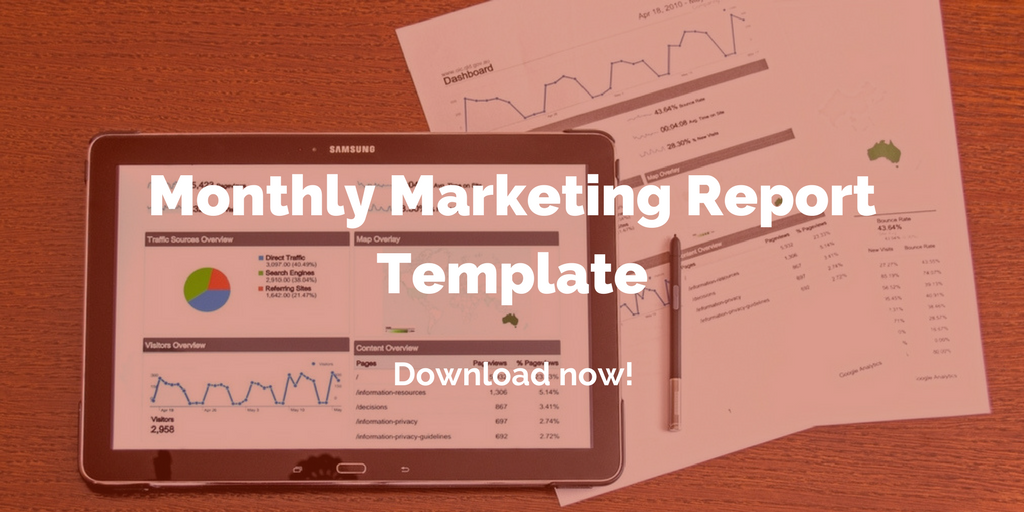
Let us help you get started. We’ve created a monthly marketing reporting template just for you. This template tracks your marketing metrics and generates graphs you can use in reporting and presentations. Click the button below to get the template (an Excel document) now.

Related posts:

by Elizabeth Hines | May 25, 2017 | Blog, Content Marketing, Marketing, Social Media
In this month’s social media news, Facebook cracks down on misleading content, while Snapchat and Pinterest appeal to advertisers.
If you sense that the competition between social media networks for users and advertisers is heating up, you’re not alone. This month, Facebook continues its quest to cut down on the sharing of false information and misleading content while launching better lead-tracking tools for ads. Twitter moves to protect user privacy by updating its terms and conditions. And exciting new technology launches at Google, Pinterest, and Snapchat.
Here’s the latest social media news for the supply chain.
Facebook reduces links to low-quality web pages and misleading ads
After months refining its News Feed algorithm and ads, Facebook announced another update to weed out false information and spam in a blog post: “We reviewed hundreds of thousands of web pages linked from Facebook to identify those that contain little substantive content and have a large number of disruptive, shocking or malicious ads. We then used artificial intelligence to understand whether new web pages shared on Facebook have similar characteristics. So if we determine a post might link to these types of low-quality web pages, it may show up lower in people’s feeds and may not be eligible to be an ad. This way people can see fewer misleading posts and more informative posts.”
As changes roll out gradually in the coming months, publishers with high-quality landing page experiences might notice an increase in traffic, while those with negative experiences will see a decline. Businesses looking to improve their web experiences can read the full Facebook Business post and visit the Help Center for tips.
See also:
Twitter updates opt-out process
Twitter is helping users weed out irrelevant personalized ads and protect their privacy. The Twitter website tag will now “rely on the Digital Advertising Alliance’s consumer choice tool and other ways to opt-out described here.” Site owners must update the privacy policy to notify their users of this new opt-out process.
Google unveils Google Lens
Google’s latest product, Google Lens, will leverage computer vision and AI technology to enable smartphone cameras to not only see, but to understand what it’s seeing to help users. For example, if you take a photo of the login information on the sticker on your router, the lens will identify the action by offering to connect you to the Wi-Fi, using the photo of the network name and password.
Snapchat reaches 166 million daily active users, rolls out limitless snaps, adds ad lenses and geofilters
In its first quarterly earnings report since going public in March, Snap Inc. announced that its daily active user (DAUs) base grew to 166 million in Q1 2017. Additionally, the Snapchat app released four new creative tools:
- Infinity timer setting: This option eliminates the 10-second time limit and allows your videos to play as long as you like. The snap then erases when closed.
- Looping: Users can choose to have their photos or videos loop indefinitely until viewers close the snap.
- Magic eraser: Users can select and remove objects from snaps.
- Emoji drawings: Users can now draw with emojis using the pen tool.
Ad partners also have three new creative tools at their disposal:
- World Lenses are an extension on Snapchat’s Sponsored Lens, which already let advertisers turn users’ selfies into ads. Sponsored World Lenses allow advertisers to create content for the rest of the photo beyond the face, like floating 2-D or 3-D objects.
- Audience Lenses let advertisers buy a guaranteed number of Lens impressions for a specific audience. This includes those that are targeted by demographics like age and gender, as well as those identified as falling in one of Snapchat’s Lifestyle categories.
- Smart Geofilters automatically add location information or other real-time information to a nationwide or chain Geofilter. This ad type allows users to activate branded overlays that appear when they swipe left or right on the camera.
Pinterest applies visual search technology to ads
Pinterest announced that it’s now leveraging the technology behind its newly released visual discovery tools — Shop the Look, Instant Ideas and Lens beta — to make Promoted Pins even more effective. Machine learning allows the platform to identify what is most relevant to a user based on the images s/he pins. For example, if the user pins images of blue, formal, A-line dresses, Pinterest will begin to show similar images in that user’s feed. The same technology will now be applied to ad content. “We help people find your ads in the very same way, connecting people to products they like the looks of, but don’t quite have the vocabulary to describe. As a result, your ads feel more relevant, and they can reach audiences you may not have considered before.”
Not sure how to use Pinterest’s advertising tools? Check out these 4 free webinars for businesses.
Facebook enables targeting to users who have saved posts, adds offline conversion solution for lead ads
Facebook page admins can now see the number of saves for each page post, then “create custom audiences of people who have saved [their] posts and retarget them with different content.”
Additionally, Facebook is now allowing businesses to connect their CRM, point of sale, or even their call-center systems to their Facebook ad campaigns to help advertisers monitor which of their lead ads drive those business results. This is huge for advertisers who have been trying to attribute conversions from lead ads based on offline activity.
Ellen, Ludacris, Katy Perry and more to star on YouTube’s exclusive new shows
YouTube announced plans to launch seven new “star-studded” shows, exclusively premiering on the video platform “beginning later this year.” Stars include Kevin Hart, Rhett and Link, Ellen DeGeneres, Katy Perry, the Slow Mo Guys, Demi Lovato, and Ludacris. The shows will be fully ad-supported and thus free to watch.
Facebook releases “Latest Conversations” feature
Facebook’s new Latest Conversations feature shows timely topics that many members across the network are discussing in its search results. It appears in its own section of the search results and includes a running count of how many people are talking about the topic at the moment. This feature is currently only available on the mobile app.
Related posts:

by Elizabeth Hines | May 23, 2017 | Blog, Marketing, Social Media
If you’re a large company not using social media for all that it’s worth, you’re missing out on customers and business.
We know that the majority of businesses participate in social media — in fact, a dominant 88% of B2B marketers report using these platforms as part of their marketing programs. Large corporations, small businesses, and those in between are promoting their brands and engaging with customers online. Even companies within the logistics and supply chain industries are reaping the benefits of social media marketing.
The truth is, if your company is not participating in social media, you are at a disadvantage. Your customers, your employees, and your competitors are taking advantage of these technologies to conduct business in new, more efficient ways.
Content Marketing Institute’s new report on B2B enterprise companies (companies with over 1,000 employees) shows that large corporations are also jumping on the social media bandwagon. Here are some stats:
- 87% of B2B enterprise companies use LinkedIn
- 81% use Twitter
- 77% use YouTube
- 74% use Facebook
But when asked about the importance each of these channels to their organization’s content marketing success, 87% felt that email is still the most effective tool for distributing content.
What does that say to you? These enterprises are using social media for content distribution, but their heads aren’t in the social media game.
So, why should their social media efforts be turned up?
Let the numbers speak for themselves:
Businesses are using social media, so if your B2B enterprise company isn’t, you’re already behind the eight ball. Social media is a great way to distribute information to a vast audience in a quick, cost-effective manner.
Social media also allows you to get to know your audience in a more personal way. After a few weeks and months of committing to your content marketing strategy on social media platforms, you’ll know what your target audience likes and what they’re interested in. The more time and effort put into your social media campaign, the more refined and effective it will become.
And we can’t ignore that your competitors are already out there, happily exploring the online market share.
Social media platforms have already proven their worth and most companies, big and small, have embraced their value. If your enterprise company hasn’t, it’s time to get your foot in the game.
Related posts: