by Elizabeth Hines | Feb 20, 2018 | Blog, Content Marketing, Current Events, Logistics, Marketing, Social Media, Supply Chain
One of 2018’s fastest growing marketing trends is influencer marketing. Companies will increase their influencer marketing budget to keep up with the competition.
You’ve probably heard the buzzword by now: Influencer marketing seems to be on the tip of every marketer’s tongue these days. Linqia’s latest report, The State of Influencer Marketing 2018, shows that B2C companies are already taking full advantage of this marketing trend. Their report shows that 86% of B2C marketers used influencer marketing in 2017, and 92% of marketers that tried it found it to be effective.
B2B marketers, on the other hand, have been slower to adopt this new marketing trend. Influence 2.0 – The Future of Influencer Marketing Research Report 2017 showed that only 11% of B2B marketers have an ongoing influencer program.
To understand why influencer marketing is becoming so popular and why B2B companies need to jump on the trend, let’s start with the basics.
What is influencer marketing?
Influencer marketing is a form of marketing in which focus is placed on influential people, rather than the target market as a whole. Marketers identify individuals that have influence over potential buyers and create marketing campaigns and activities around these influencers.
For example, Microsoft teamed up with National Geographic last year to launch an influencer marketing campaign, called “Make What’s Next.” The technology giant leveraged some of the most famous adventure photographer influencers on Nat Geo’s Instagram for the campaign. The objective was to bring awareness to young women with interest in science, technology, engineering and math (STEM). By utilizing Nat Geo’s most heavily followed female photographers, Microsoft was able to access a built-in following.
Why influencer marketing works.
Influencer marketing is extremely effective because of three key components:
- Social reach: Influencers can reach millions of followers (and consumers) through their social media channels, websites, and blogs.
- Original content: Influencers work with marketers to produce original content for your brand.
- Consumer trust: Through their existing, strong relationships with their audiences, influencers have a built-in level of trust and can influence consumer opinions.
Content marketers are working overtime to update their content marketing strategies to include influencer marketing campaigns. Consumers no longer want to hear from brands about their products; they want someone they trust to recommend products and services. This is where influencer marketing comes in to play.
Marketers across industries found influencer marketing to be so effective in 2017, that 52% of are planning programs that leverage multiple types of influencers (celebrities, top-tier bloggers, micro-influencers) in 2018.
Where do you begin?
Instagram should be your starting point. According to new research, influencer marketing on Instagram will have generated over $1 billion by the end of 2017, with significant annual growth going forward. With more than 700 million users, Instagram’s platform allows influencers to easily share photos and videos with their followers. Product promotion has never been easier.
Boxed Water turned to Instagram influencer marketing to market its philanthropic campaign, The ReTree Project. The company paired with social influencers, like actors Aidan Alexander and Jaime King, and YouTube star Megan De Angelis, to spread the word about their new campaign. These popular Instagram users asked consumers to post a photo with the hashtag #ReTree and, in turn, Boxed Water would plant two trees for every photo posted. Just one month after launching the campaign, Boxed Water generated more than 2,600 posts with the hashtag.
With 39% of marketers planning to increase influencer marketing budget this year, B2B companies are quickly seeing the leverage that influencers can have over their target audiences. By pairing your products or services with the right influencer, marketers can easily tap into thousands of potential consumers, increasing website traffic and leads.
Have you tried influencer marketing? How was your experience?
Related posts:

by Elizabeth Hines | Feb 8, 2018 | Blog, Content Marketing, Logistics, Marketing, Social Media, Strategy, Supply Chain
These social media statistics are important to keep in mind when planning out your content marketing strategy.
A strong social media presence is key to successful marketing in 2018. Social media is simply unavoidable these days.
So, you jumped on board and you’re posting and tweeting. You’re creating content. You’re learning about search engine optimization and how to improve your rankings. But you’re still not reaching the audiences you were hoping to attract. What’s going wrong?
When you are posting on social media could be as important as what you’re posting.
Timing is everything, and that statement especially holds true when it comes to posting content to social media. If you are sending out your message and nobody is there to see it, you are that proverbial tree falling in the forest; you did not make a sound. Your post had little to no impact.
So, even if you are putting in the time and effort to craft informative blog posts, tweets with just the right message, or Facebook posts that inspire more than just page likes, you still are not getting the most exposure you can out of social media.
We have done our homework when it comes to the best times to post on social media. And the truth is there is no “one size fits all” answer to when you should post. There are general guidelines that differ for each site. But in general, it’s important to keep your target audience in mind when deciding where and when to post.
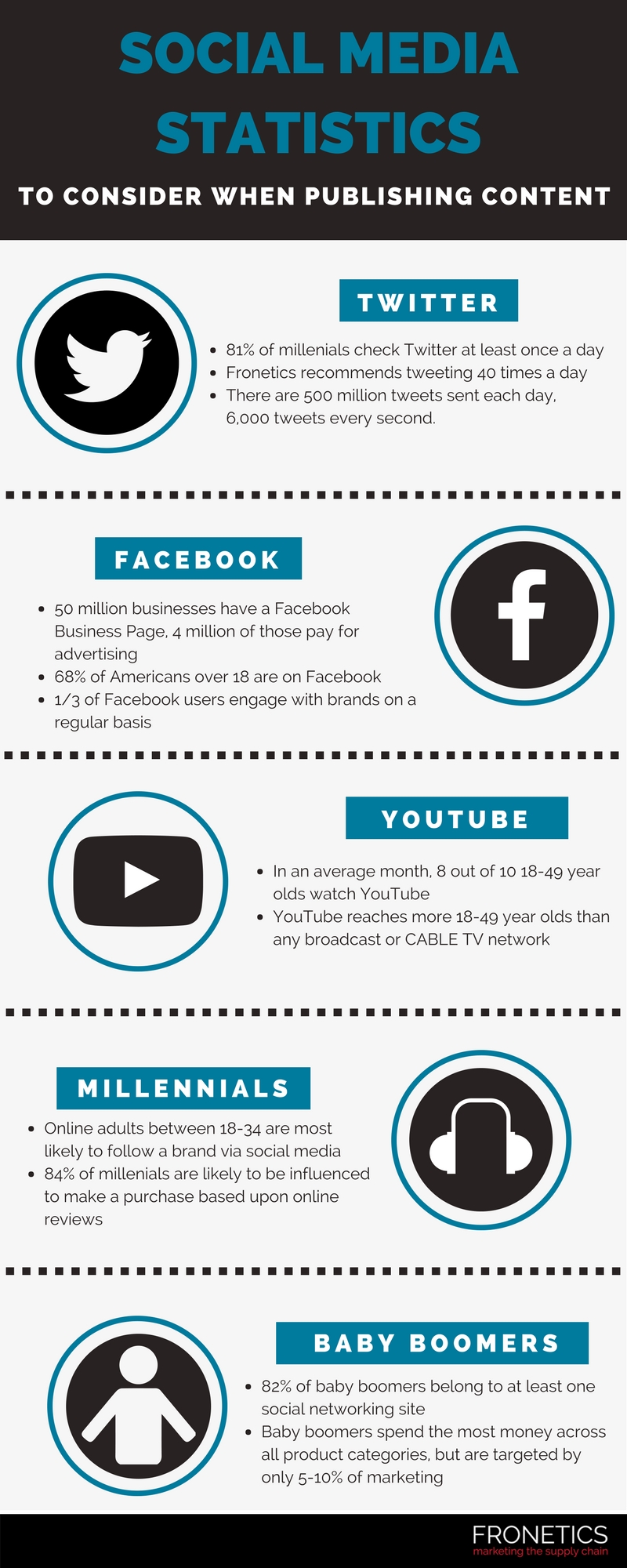
Here are some social media statistics that you need to consider when deciding when to post your content.
Social media statistics your business needs to consider when publishing content
(Made with Canva)
Related posts:
SaveSave
SaveSave

by Elizabeth Hines | Jan 31, 2018 | Blog, Content Marketing, Current Events, Marketing, Social Media
Also in social media news January 2018: SnapChat is considering 3-second unskippable ads; Twitter will now display a video count on all video tweets; and Facebook is rolling out custom audiences for users that linger on ads.
The new year has brought lots of new changes, especially to the Facebook community. I’m sure by now you have heard about the updates to Facebook’s News Feed that are having major impacts on business page’s organic reach. But the changes don’t stop there. Twitter, Snapchat and Instagram are trying to follow Facebook’s lead and enhance their user experience. Through updates that include video counts, enhanced data collection, and recommended posts, social media is working overtime to make sure it’s active users are staying active.
Here’s your social media news for January 2018.
Facebook’s News Feed tweak penalizes pages soliciting likes and shares.
Facebook continues to make changes to News Feed — including limiting the amount of content users will see from Pages. See our full update here. Facebook also is tightening the reigns on Pages and individuals that use engagement bait to attract new followers. The site will now penalize posts that ask people to like, share, comment on, or otherwise engage with the post to boost engagement. Posts “that systematically and repeatedly use engagement bait to artificially gain reach in News Feed … will now be shown less,” the company announced in early January.
Twitter rolls out account activity API for powering customer service and chatbots
Twitter introduced a new API that will offer developers access to real-time activities, like tweets, mentions and replies, to help update their customer service tools and chatbots. The latest version of Twitter’s data collecting software is designed for those who need data for a large number of accounts, multiple URLs, or managed support.
Instagram allows users to send live video in direct messages
Instagram announced that users can now send live videos through direct messaging. By tapping on the Direct icon, users can send live video to a friend or group to encourage them to view the content. “Today’s change makes it easy to invite people to watch your live videos and send exciting live videos you’re viewing to your friends in real time,” says the announcement.
SnapChat contemplating 3-second unskippable ads
AdAge reports that Snap Inc. is giving “serious consideration” to adding 3 seconds of commercial breaks before offering a skip option on ads on SnapChat. This new ad format was created to attract more ad dollars from brands. “Advertisers are not spending as much as they have previously with SnapChat,” says the top advertiser from a brand that works closely with the messaging service. “They have to do something that draws more interest from advertisers, and they are getting more aggressive to address the market’s needs.” If implemented, the postponed skip option would be similar to YouTube’s ad experience.
Facebook testing custom audiences for users lingering on ads
Matt Navarra, director of social media for @TheNextWeb, reported a new option for targeting a list of people who have “spent more time than usual viewing your display ads on Facebook and Instagram.” The new custom audience option, called Dwell, is an expanded version of Dwell Time, which targeted people who spent any time viewing an ad. In theory, this new custom-audience option will give advertisers the ability to re-target users who viewed your ads but didn’t take any action.
Twitter displays video count on all video tweets
Twitter is adding a video count to all organic and video ads. In compliance with the Media Rating Council’s video viewability standard, Twitter will count a view once the video has been played for at least 2 seconds and with at least 50% of the video in view. This new update is a minor change to support the company’s mission to make the platform more attractive to users. “View counts are a subtle way to encourage people to share more video to the service if they feel their content is being widely seen,” writes Garrett Sloane for Adage.
Instagram rolls out recommended pages
Instagram has officially started recommending posts to users based on posts that have been liked by other accounts the user follows. The new feature is being compared to Facebook’s Explore Feed, where users can view content from a wider network, not just people and pages they follow directly. But don’t worry, the update isn’t meant to replace a user’s preferred content. The section will appear after a user has viewed all the posts in their feed, an Instagram spokesperson explains, while confirming the feature’s public launch to TechCrunch.
Related posts:

by Elizabeth Hines | Jan 24, 2018 | Blog, Content Marketing, Current Events, Logistics, Marketing, Social Media, Strategy, Supply Chain
Companies in the supply chain and logistics industries should take note of these top social media trends in 2018.
While we don’t know what 2018 has in store for companies in the supply chain and logistics industries, we do know change is coming. That is true not only in terms of the economy and your business, but also for the marketing tools you use. Of course, ever-evolving social media platforms are an important part of that.
We already know that Facebook News Feed will be making some big changes this year. What other platforms or types of media will be hot? What will your industry peers and competitors be trying in 2018? As we dive into the new year, it’s important to be aware of the social media trends that will dominate the next 12 months so you can incorporate them where you are able.
As always, good content will be as important as ever. With over one million new-data-producing social media users each day, high-quality content is the only way to stand out from the masses. But we also think you should pay attention to a few social media trends that we have highlighted in the following video. We’re certainly planning to adjust our strategy and those of our clients to consider these things.
As you start to strategize for 2018, and beyond, be sure to consider these social media trends in your content marketing plans.
Top social media trends for 2018
Make sure to follow our blog for our monthly social media news posts to stay updated on the latest platform updates. And feel free to reach out to us with questions or if you would like to see a certain social media trend covered on our blog.
Related posts:

by Elizabeth Hines | Jan 17, 2018 | Blog, Content Marketing, Current Events, Marketing, Social Media
Users will see less content from businesses, brands, and media, so you need to adjust your strategy to appear on your followers’ Facebook News Feed.
Mark Zuckerberg once again rocked the world on January 11 — at least for businesses — when he announced that Facebook News Feed was evolving to include less public content, meaning content from Pages of businesses, brands, and media. The algorithm will now prioritize posts from friends and family (over public posts) and those that “spark conversations and meaningful interactions between people.”
Cue businesses around the world freaking out. They’re about to see their organic reach, video watch time, and referral traffic take a nose dive.
The fact is, this is really not a huge surprise. Facebook has been taking steps in this direction for a while, including the testing of Explore Feed last year. Even though you may have anticipated that some changes to Facebook for businesses were coming, you may be tempted to suddenly stop maintaining your Facebook Page. Is it worth posting content to Facebook if it is not going to reach your followers after these new changes?
Our stance at Fronetics is that Facebook is still worthwhile for businesses. But Zuck’s recent announcement does merit your close attention to — and perhaps a revisiting of — your Facebook strategy. We’ve compiled a list of things you need to know/do in light of the new changes to Facebook News Feed. Here they are.
4 steps to adjust your strategy for Facebook News Feed changes
1) Focus on news-worthy content that drives engagement.
Zuckerberg says, “I’m changing the goal I give our product teams from focusing on helping you find relevant content to helping you have more meaningful social interactions.” That means that engagement will now mean more than ever before for content visibility.
In other words, posting your blog content to Facebook is no longer going to cut it. If your posts don’t garner comments or reactions, it’s time to go back to the drawing board. You’ll need to start thinking of Facebook as a place to post and discuss active news items, hot-button issues, and highly shareable content (content that is educational or entertaining, for example).
Scheduling multiple posts ahead of time, though convenient, will probably land your content further into the depths of oblivion. You’re going to have to pay attention, actively seek to generate conversation between users with your posts, and fight to win space on your followers’ feeds.
2) Tell your community to access the See First feature.
Users who still want to see posts from certain Pages they follow can choose “See First” in News Feed Preferences. So, quite simply, we suggest asking your followers to choose to see your content.
While some proactive followers may do this on their own, we want to encourage you to explicitly remind your community to do this. Remember that people are most likely to do what you want them to when you make it easy, exact, and clear. So send them an email with directions. Or put it in your newsletter or a blog post. Just tell them to do it.
One thing you don’t want to do: goad people into commenting on your posts as a means to increase your content visibility. Facebook has explicitly stated that it will demote “engagement bait,” or posts that ask for comments or reactions. So you’ll actually hurt your content by doing this.
3) Get your executives on social media.
I’ve written before about getting your executives on social media as themselves — they act as brand ambassadors for your business. Facebook’s latest announcement underscores the importance of this directive.
Your company’s executives are the most visible people in your business. For many of your industry peers and customers, they are the face of your brand. Get them active on Facebook to add meaningful thoughts to your company’s posted content, to engage in discussions, and to share newsworthy content of their own.
It’s important to note that I don’t mean that they should do this in a superficial way. They should actively seek to add value to your Facebook content and that which is relevant to happenings within your industry. By being engaging on Facebook, your executives emerge as thought leaders, which boosts your brand’s visibility and reputation.
4) Consider your Ad budget.
In the past, we have recommended adding some social media advertising to a traditional content marketing strategy as a way for clients to add gasoline to a fire, so to speak. It speeds things up. But those companies who are just starting out or who rely heavily on referral traffic might want to consider reallocating budget to sponsored ads.
Final thoughts on the new Facebook News Feed
This is a shift, yes. A challenge, for sure. But not one that’s insurmountable — or even contrary to the basic principles of good, data-driven content marketing.
Remember, Facebook is not eliminating Page content from News Feed altogether — just limiting it. The most relevant, engaging Page content will win that space. So seek to understand your target audience and produce high-quality, original content that engages those people, and you’ll come out on top of the new Facebook News Feed.
Related posts:
SaveSave
SaveSave

by Elizabeth Hines | Jan 9, 2018 | Blog, Current Events, Logistics, Marketing, Social Media, Supply Chain
Facebook is making lots of changes that will affect businesses’ organic reach. Here’s what you need to know and how it may impact your company.
In our most recent social media news post, we mentioned that Facebook was experimenting with an Explore Feed feature. You may or may not have heard about how this might affect businesses’ ability to achieve organic reach on Facebook.
The social media network claims it is trying to create the best user experience possible. But it might come at a high cost to businesses trying to reach new audiences. Could this be the end of organic reach for businesses on Facebook? Let’s take a look.
What is Facebook’s Explore Feed?
Explore Feed is a new tab on your Facebook homepage that will include recommended content that it thinks you might find interesting. This will include posts, articles, photos and videos from users and other Pages you don’t currently follow.
This separate news feed will only appear when you click on the Explore tab, leaving users’ homepage news feed to content from friends and Pages you already follow.
“We’ve heard from people that they want an easy way to explore relevant content from Pages they haven’t connected with yet,” says Facebook in a statement. “Businesses should be optimistic about the potential for users interested in content like theirs to find their pages through the new Explore Feed.”
What does this mean for your business?
In October, Facebook launched Explore Feed as an experiment in six countries — Sri Lanka, Bolivia, Slovakia, Serbia, Guatemala, and Cambodia. The results showed a massive decline in businesses’ organic reach. Most countries reported a drop of two-thirds within the first 48 hours after Explore launched.
A user’s feed will now only show their friends’ posts and paid posts and advertisements. This is a huge disadvantage for small businesses with limited budgets that have traditionally relied on the organic reach of their Facebook posts to help attract new audiences.
As Mashable says: “That means Facebook’s main feed is no longer a free playing field for publishers. Instead, it’s a battlefield of ‘pay to play’, where publishers have to pony up the dough to get back into the News Feed.”
What now?
Facebook insists these changes are in direct response to requests from users for an easier way to discover new Pages they aren’t already following. But it means a lot of changes for businesses running a Facebook business page. Companies need to ensure their content is high quality, unique and highly relevant. And more and more companies will have to start dipping into their budgets to boost posts and buy ads.
Important to note
Facebook is also tightening the reigns on Pages and individuals that use engagement bait to attract new followers. What is engagement bait?
“Engagement bait is a tactic to create Facebook posts that goad people into interacting through likes, shares, comments, and other actions in order to artificially boost engagement and get greater reach on News Feed,” says Facebook’s Newsfeed Guidelines. The social network’s new algorithm will demote any posts by individuals or Pages that promote their content through engagement bait.
Fronetics’ takeaway
Despite all of these new changes and their accompanying challenges, we’re not ready to write off Facebook for businesses just yet. The key will be for companies to continue to provide the best content possible through the social media platform to organically engage followers.
What do you think of Facebook’s new Explore Feed?
Related posts: