With Facebook’s latest Cambridge Analytica scandal, you may be reevaluating if it makes sense to dedicate time and resources to your company’s Page. Can users trust Facebook?
Facebook has been in the spotlight quite a bit lately. And we’re not sure the saying “all publicity is good publicity” is holding true for the ‘Book.
From a user perspective, Facebook has faced widespread criticism in recent months for its role in spreading sensationalist, often inaccurate news stories. And from a corporate standpoint, a number of changes to News Feed deprioritize content from business Pages, making organic reach less attainable.
Next, a scandal.
Then the Cambridge Analytica scandal broke. The New York Times reported that UK-based data firm Cambridge Analytica had obtained personal information without user’s knowledge, or more importantly, their consent. Since the report was published, Zuckerberg has profusely apologized for Facebook’s involvement in the data breach scandal, even placing a full-page apology ad in three American newspapers.
The fallout.
More and more big-name companies are removing their Facebook Pages — including Sonos, SpaceX and Tesla — as a result of the data breach. The hashtag #deletefacebook has been trending as more and more users remove their personal Facebook pages.
And then there’s Facebook’s stock. It fell more than 13 percent in the five days of trading following the initial reports. And at the end of March, the stock fell more than 20% off its 52-week high.
What does this mean for your business?
Kettie Laky, director of social media at Fronetics, has been closely following all the latest developments, as well as monitoring our clients’ Facebook analytics data. In this video, she’ll let you know whether you can trust Facebook and what you need to do next.
Here are four simple steps to measure your company’s content marketing ROI and the success of your content marketing strategy.
Measuring your content marketing ROI gives you valuable insight into what’s working (and what’s not) with your content marketing strategy. It’s important to measure if your efforts are profitable so you know where to put your time and money.
Content marketing ROI is harder to quantify than just tracking how many likes your social media pages have. But tracking certain metrics is important for understanding how your content marketing activities are performing. Keeping a close eye on your ROI allows you to make cost-effective marketing choices and to avoid costly mistakes.
In the article, How to Measure Content Marketing ROI: A Simple 4 Step Process, eCommerce content marketing and SEO consultant Bill Widmer breaks down the simple four-step process that will quickly — and effectively — measure your content marketing ROI.
Every company has specific key performance indicators (KPIs) that help shape their marketing strategy. These KPIs will be the foundation for measuring your content marketing ROI.
Infographic: How to measure your content marketing ROI in four easy steps
We all want to see the fruits of our labors. Whether launching a new social media campaign or creating new videos for your blog, we look for instantaneous numbers that will affirm we made the right choices. Calculating ROI might take some time – both in the few extra minutes to do the math and the amount of time that needs to pass before all the data is available — but that number will be invaluable to you.
Are you using subtitles as part of your YouTube marketing strategy? You should be, as well as these other tips.
I’ve written a lot about YouTube and how the supply chain should be leveraging it as a marketing tool. Of course, I don’t recommend just creating videos at random and throwing them up on your channel. Like any content or platform, you should approach YouTube strategically.
Here are some tips for optimizing your YouTube marketing strategy.
5 tips to improve your YouTube marketing strategy
1) Do the groundwork.
It may seem like a bigger-than-necessary investment of time at the front end, but doing your research is often “one of the most undervalued aspects of content marketing,” according to Forbes contributor AJ Agrawal.
This means getting a grasp of the existing landscape before you publish your content. Look at others in your market, and what works or doesn’t work for them.
2) Create “content buckets.”
“YouTube marketing really comes down to picking a few key areas where you feel you can deliver true thought leadership, entertainment, or some kind of value, and then mass-producing content that falls within those larger buckets,” says Agrawal.
“Buckets” refer to the broader categories your content falls into. For example, if you’re looking to create awareness about the role you play in a larger supply chain structure, one bucket might be education. Once you start organizing your thinking this way, generating quality content that falls within your larger strategy gets much easier.
3) Create a standard for your content, and stick to it.
Agrawal points out that one of the most important keys to building a loyal audience is consistency. This can be a challenge when it comes to posting quality video content, since it requires an investment of time and resources.
But it’s crucial that you “set the tone from the beginning and let your audience know what to expect,” including what kind of content you’ll be posting, and how often your audience can expect to hear from you. Once you’ve done that, stick with the promises you’ve made.
4) Use subtitles.
People are increasingly watching videos on their mobile devices in public, without the sound on. Taking this small step means that, rather than bypassing your content because they can’t hear what’s being said, people are paying attention to your videos no matter where they are.
5) Collaborate.
Content marketing at its very core benefits tremendously from collaboration. “One of the most effective ways to get your content disseminated, shared, and ultimately seen is by collaborating with other people who have audiences as well,” says Agrawal.
Collaborations are beneficial for everyone involved, particularly when you chose your partners strategically. If they share a similar audience, it boosts exposure for both parties, as well as boosting credibility within your industry.
So you are ready to commit to a more active social media presence (or you’re going to be ghost-posting for your executive). Where do you begin?
We’ve come up with 4 tips for supply chain leaders to making the most of their presence on social media.
4 tips for supply chain leaders on social media
1) Find the right platform (or platforms) for you.
The first thing to consider is your target audience. If you’re looking to reach a young demographic, for example, Snapchat is probably the way to go, as 45% of its users are under the age of 24. Likewise, if your brand would be well-served by live video (hint: it probably will!), Facebook Live and Instagram Stories offer great possibilities.
Next, think about your personal voice, and what type of content you are likely to be posting. Thought leadership can often best be established on LinkedIn. But that doesn’t mean that Facebook, Twitter, and YouTube aren’t also good avenues to present your voice to the world. Pick the platforms that you feel speak most to your audience and best serve your brand.
2) Use your creative side.
Supply chain and logistics leadership requires a tremendous amount of creativity and innovation. Let these qualities shine through in your social media presence! You have the tools to spark more engagement, increase follower count, and make your posts go viral.
This means using your unique voice to be a storyteller, engage your audience, and create a face for your brand. If you need some inspiration, check out these 7 Twitter accounts.
3) Create space for conversation.
Too many would-be social media mavens fall into the trap of posting the kind of content that doesn’t invite interaction. Instead, be a conversation-starter.
First, take a look at your audience and what kind of interactions they have online. You can scan the pages of other leaders in your niche as a reference point.
You can generate interaction and engagement by showing gratitude, listening to your audience, handling queries, posting thought-provoking content, and posing questions in your posts.
4) Avoid controversy.
This might seem obvious, but there’s a fine line to walk between posting or re-posting thought-provoking content and becoming an inadvertently controversial figure.
Keep in mind that, in the public platforms that are social media, all your moves will be under constant scrutiny from your fans, followers, and people in their networks. This means that while cultivating a personal voice, it’s important to maintain a level of professionalism. And stay away from posting anything that can make you a lightning rod for controversy!
Where do you go to follow supply chain leaders on social media?
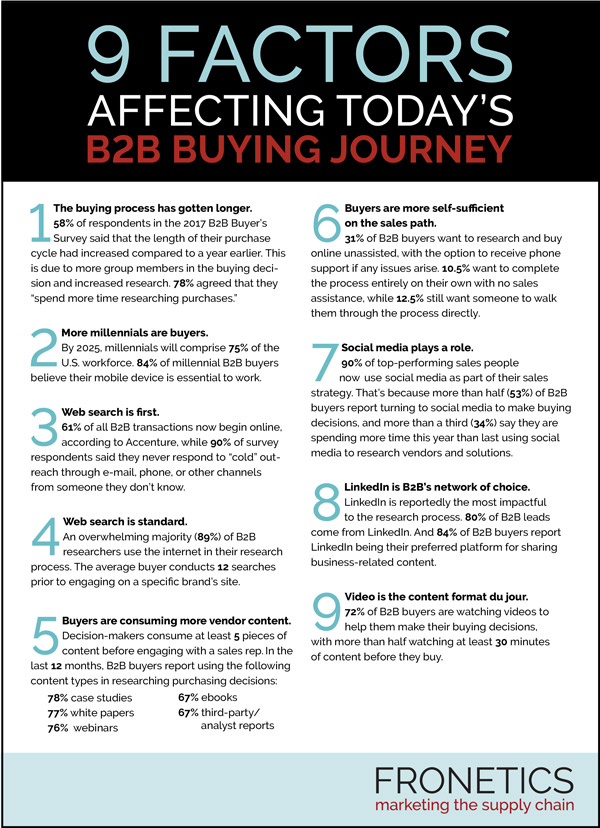
Today’s B2B buyer’s journey involves more internet research and more social media use.
The B2B buyer’s journey has undergone a dramatic transformation, driven by digital innovation and changing buyer preferences. Research from Gartner shows that B2B buyers now spend only 17% of their total purchase journey time meeting directly with potential suppliers. Instead, they dedicate 27% of their time researching independently online.
Key Trends Shaping the B2B Buyer’s Journey
Digital-First Research Phase
According to TrustRadius’ 2023 B2B Buying Disconnect report, 87% of buyers want to self-serve part or all of their buying journey. This shift toward digital self-service has fundamentally changed how B2B companies must approach their marketing and sales strategies.
The Rise of Multi-Channel Engagement
Recent data from McKinsey (2023) reveals that B2B buyers regularly use ten or more channels throughout their purchase journey, compared to just five channels in 2016. This multichannel approach includes:
Online research and comparison tools
Social media platforms
Peer review sites
Virtual product demonstrations
Video content
Interactive webinars
The Impact of Peer Influence and Social Proof
LinkedIn’s State of B2B Marketing report highlights that 84% of B2B buyers are more likely to purchase from vendors recommended by their professional network. This emphasis on peer validation has made social proof and customer testimonials more crucial than ever.
Adapting Your Strategy to the Modern Buyer’s Journey
Content Personalization and Industry Expertise
Recent research by Salesforce indicates that 76% of B2B buyers expect vendors to understand their business needs and industry challenges specifically. This demands:
Industry-specific content creation
Personalized solution recommendations
Targeted thought leadership content
Custom ROI calculations
The Role of Digital Content in Decision Making
Content continues to play a pivotal role, but its format and delivery have evolved. According to HubSpot’s 2023 State of Marketing Report, the most effective content types now include:
Video content (preferred by 91% of B2B buyers)
Interactive tools and calculators
Case studies and success stories
Industry research and original data
Expert webinars and virtual events
Strategic Implications for B2B Companies
Understanding the modern B2B buyer’s journey is crucial for optimizing marketing and sales efforts. Companies must:
Invest in robust digital presence across multiple channels
Create high-quality, industry-specific content
Leverage social proof and customer testimonials
Provide self-service information and tools
Maintain consistent omnichannel engagement
The B2B buying process hasn’t necessarily shortened, but it has become more complex and digitally oriented. Success requires adapting to these changes while maintaining focus on delivering value throughout the buyer’s journey.
Infographic: the B2B buyer’s journey
The B2B buyer’s journey continues to evolve with technological advancement and changing buyer preferences. Companies that understand and adapt to these changes – by providing comprehensive digital resources, personalizing content, and enabling self-service options – will be better positioned to attract and convert modern B2B buyers.
Supply chain marketers can use marketing automation to drive efficiency and be more successful in earning and converting leads.
Marketing automation is the process of using software to complete repetitive marketing tasks designed to nurture sales leads, personalize marketing messages and content, and — in the process — save marketers’ time and effort. Supply chain marketers are using marketing automation to streamline processes and increase qualified leads.
Marketers can scale their processes so they can reach more people, with less effort.
Buyers are increasingly demanding a more personalized experience along the buyer’s journey, which means marketers are working overtime to produce more targeted content. That’s where marketing automation comes in. By using automated messaging, marketers are able to nurture prospects with highly personalized, useful content that helps convert prospects into customers and customers into loyal customers.
Jumping into marketing automation can be overwhelming. Utilizing the right software and knowing where to implement automation into your marketing processes will help nurture leads and get you back to more pressing tasks.
Here are five ways to get started using marketing automation for the supply chain.
Video: marketing automation for supply chain marketers
Don’t worry about being redundant.
We are all too familiar with the batch-and-blast approach many companies use in their email marketing efforts. And, oftentimes, those emails end up in someone’s spam folder.
We also have so many clients that worry they will become redundant by implementing marketing automation. But that’s not true.
Instead, marketing automation can help you provide a more personalized experience for your leads (no batch-and-blast). This will increase the chances that they’ll buy. But it won’t take up more of your time. In fact, it will give you more time to focus on tasks that can’t be automated, like content creation.