Also in social media news, September 2018: Twitter launches audio-only live streaming, and Facebook Creator Studio is going global.
The kids are back to school, football is back on tv, and the leaves are starting to change colors. This can only mean one thing: fall is officially upon us. What does this mean for our most popular social media platforms? Similar to battling dropping temperatures, it’s time to heat things up to keep users engaged and active.
Especially for Facebook. In a new survey by the Pew Research Center, users revealed how their engagement with the social media platform has changed in the wake of privacy and security concerns. Most notably, 44% of Facebook users ages 18 to 29 reported deleting the Facebook app from their phone in the past year. Despite the fall chill, Zuckerberg and his crew need to continue heating up their security updates and find new ways to gain user trust and ensure user privacy.
Here’s what else has been happening in September with the hottest social media platforms and how the latest updates help businesses gain exposure and target new audiences.
Here’s your social media news for September 2018.
Facebook Expands Ad Pixels to Group
Facebook will now allow pixels to be added to a brand’s Facebook Group. This expanded feature will enable marketers to track user growth, activity, and engagement with their websites. Facebook is hoping the new update will boost attention for Groups as an advertising avenue. “Facebook Groups are the new email for brands. They get push notifications. The engagement rate of Groups is extremely high. It makes sense they’re going to put a pixel in there, just like you would with email, because now through groups you can track conversions,” says Nik Sharma, Director at Hint Inc.
Snap Inc. Announces New Webinars for Ad Tools
Snap Inc. announced two upcoming webinars that provide more insight into how Snapchat can boost marketing campaigns for advertisers. These webinars are “for advertisers who want to learn more about the Snap Pixel. From how it differs from other pixels, the optimizations and attribution it enables, to implementation and troubleshooting, we’ll cover everything you need to know to power your eCommerce campaigns.” Though Snap’s niche is young adults, the app is working overtime to provide more advertising options, including performance tracking and user engagement.
Twitter Rolls Out Audio-Only Live-Streams on Twitter and Periscope
Twitter launched a new audio-only option on its app and Periscope. The popular feature, available on Facebook since 2015, has been heavily requested by users for years. “Broadcasting with audio only in Periscope is something the community has been asking for, and have been doing already by covering the camera lens. Sometimes people are not comfortable being on camera, but they still want to broadcast and interact with others via Periscope’s powerful chatroom feature.” writes Periscope engineer, Richard Plom. The new feature allows users to hear content without being locked to a screen. This will help businesses tap into the podcasting trend (streaming without video), creating new ways for users to tap into a brand’s content.
Facebook’s Creator Studio Launches Globally
Facebook officially launched Creator Studio globally, “providing one central place for Pages to manage their entire content library and business.” Publishers and account managers can now manage content, interactions, insights, video publishing, and much more in one central location.
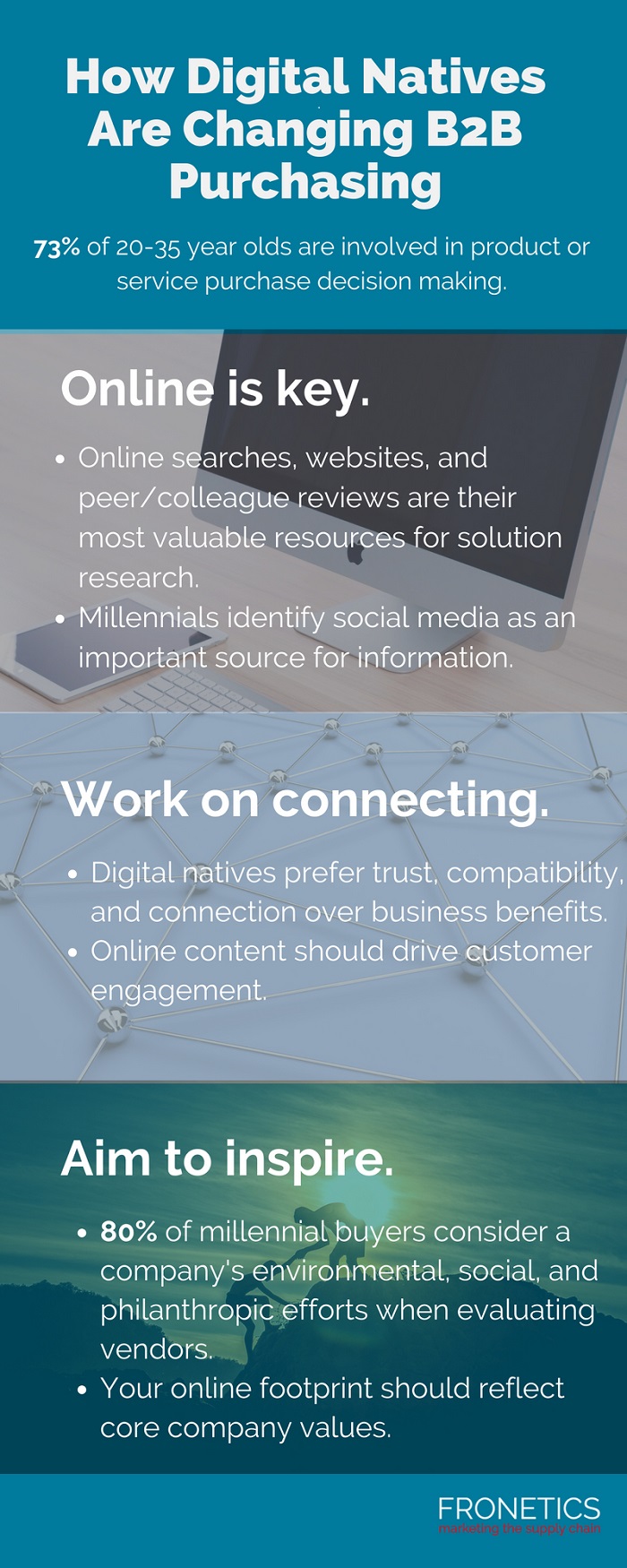
In fact, according to a study of millennial buyers by Merit, some 73% of 20 to 35 year olds are involved in product or service purchase decision-making at their companies. Not only that, about half of all B2B product researchers are digital natives — and the number is rising by the year, according to a Google/Millward Brown digital survey of buyers.
It goes without saying that the B2B purchasing landscape is going through a radical shift. Here are 6 ways that digital natives have changed B2B purchasing — and how companies have to respond.
6 ways digital natives are changing B2B purchasing
1. Product searches begin with a generic web search.
This means that companies now have to focus on SEO and producing informative content. First impressions are everything in B2B markets, and when it comes to digital natives, your first impression is conveyed through every piece of content you produce and distribute online.
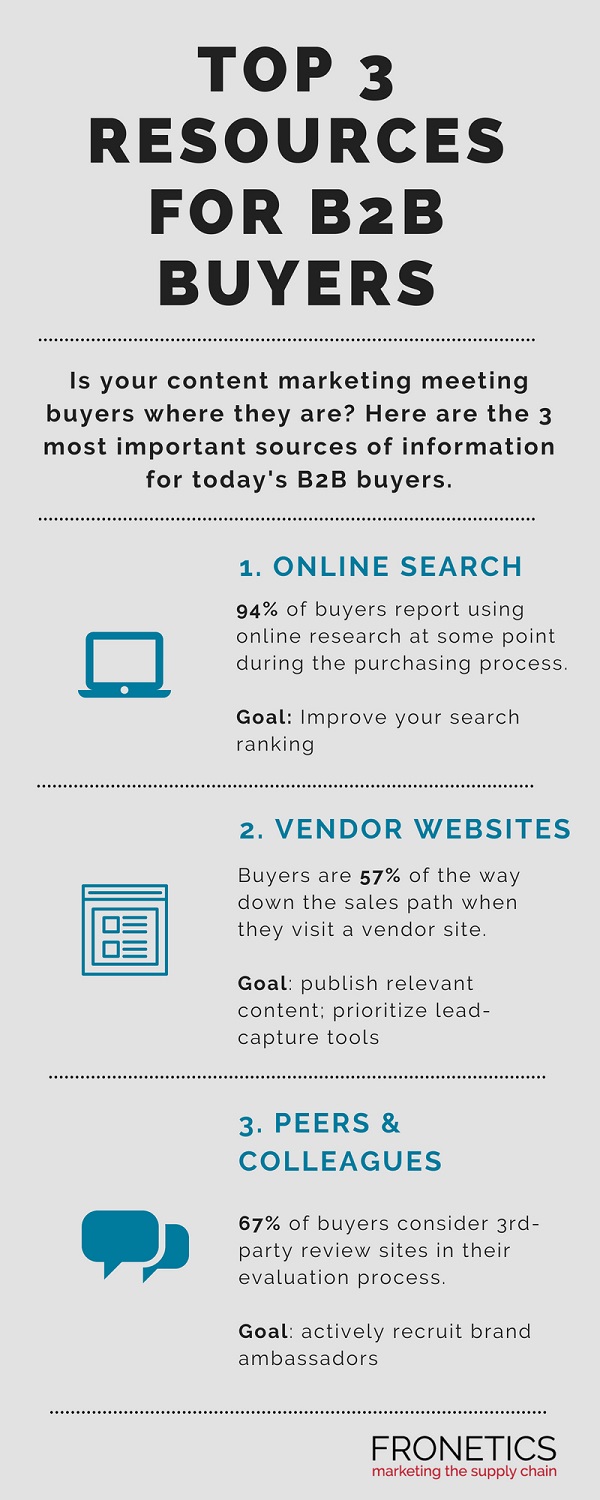
3. Online search, vendors’ websites, and peer/colleague reviews are their most important sources of information.
It’s time to place focus on SEO, website development, social media, influencer marketing, and B2B review sites. Again, your reputation depends on your online content. Are you establishing your brand as a trusted source of information?
4. They prefer short bursts of information, often in visual formats.
Not only that, they find phone calls tedious and disruptive. Companies need to be strategic about the type and format of any content they distribute. Emails and websites should be mobile-friendly, and visual formats like infographics are a highly effective way to present dense information.
5. Social media is a preferred source.
These digital natives are relying on social media for information on brands, products, and services. How does your social media presence stack up?
6. They know what they want by the time a salesperson enters the process.
This new generation of buyers already has a clear idea of the value they expect from a vendor by the time they’re ready to move down the sales funnel. So vendors need to deliver on the promises made by their content.
How is your company accommodating the research and purchasing habits of digital natives?
Online searches, vendor websites, and peer recommendations are the top 3 resources for B2B buyers.
As a marketer, it’s not enough to just know about the B2B buyer’s process. Your success rides on your ability to understand how your buyers are getting their information — and, more specifically, where they’re getting the information they need to make a purchasing decision.
So where are they getting most of their information? I can tell you, it’s no longer from sales reps.
In our digital era, buyers are heading straight to the internet to gain valuable insight before making purchases. Thanks in large part to social media, mobile technologies, and the world wide web, buyers are becoming increasingly self-sufficient. In fact, 70% of the buyer’s journey is complete before a buyer even reaches out to sales. This means they have already spent a fair amount of time educating themselves with the enormous amount of information available to them on the internet.
Is your content marketing meeting buyers where they are? Here are the three most important sources of information for B2B buyers.
Listen, your prospects are forming their opinions about your business and your products based on what they find on the web, and early on.
This new reality may seem daunting, given how much of the purchase decision-making process occurs before you have the opportunity to engage with a potential client. But in reality, this changing climate offers serious opportunities for businesses to demonstrate their expertise, without turning buyers off with overt sales pitches.
To make the most of the potential purchaser’s experience with your business, content is key.
A robust content marketing program builds brand awareness, establishes trust and rapport with prospects, and generates traffic to your website. Thoughtfully generated and curated content catches the attention of buyers and keeps them interested in your business through the time of purchase.
With a well-thought-out, data-driven content marketing strategy, you’ll be ready to meet digital natives where they are.
Ask yourself these five questions before you dive headfirst into an influencer marketing campaign to set you on the right path.
We’ve been writing a lot lately about influencer marketing and how it can work for the supply chain. These campaigns can be extremely effective — but getting the most bang for your buck requires a strategic approach from the outset.
Before you start an influencer marketing campaign, ask yourself these 5 questions.
5 questions to ask before starting an influencer marketing campaign
1. Why do I want to use influencers?
According to Natasha Lekwa, influencer marketing and social media editor at Snapchat, it’s important to “make sure you have a clear idea why you want to use influencers.” Answers might include boosting brand awareness, gaining followers, or increasing sales, to name a few. But each of these answers will lead you to a different strategy.
Being fully and deliberately aware of why you’re embarking on a campaign will help you set key performance indicators, determine your audience, and “envision what success will look like at the end of the campaign.” You’ll also be able to choose strategically the best platform to use, based on your content and target demographic.
2. Who are my influencers?
It may seem obvious, but you’d be surprised how often businesses dive into an influencer marketing campaign without having fully identified key influencers in their sector.
Lekwa suggest using hashtags to search Instagram for appropriate influencers and advises not just focusing on the obvious influencers in your industry. In fact, exploring influencers in other related industries can help expand your reach.
3. Who are my micro-influencers?
So you’ve identified your major influencers. Now you can start thinking about your “micro-influencers,” those with 10K to 100K followers. “Micro-influencers can give you a much higher ROI than big stars, and audience engagement tends to get higher as social niches get narrower,” Lekwa says. And since engagement is the name of the game when it comes to any kind of social media marketing, micro-influencers can be enormously valuable.
4. What are your terms?
Since influencers tend to be content creators at heart, they often have plenty of great ideas. But it’s important that your goals are transparent and aligned.
“It’s important to be on the same page,” says Lekwa. “Having a clear contract that spells out what each side will execute will help manage expectations for both your team and for the influencer.” In fact, Lekwa points out that influencers generally appreciate having guidelines and “the big conceptual themes of a campaign handed to them.”
5. What is my own value?
Approaching influencers can be intimidating. As Forbes writer Andrey Slivka points out, “As you might expect from people who get deluged with free stuff, influencers can be hard to impress.” This means you need to be clear and specific when you approach them about what you have to offer.
“Especially with micro-influencers, who are building their brands, what you offer doesn’t always have to be monetary,” Lekwa says. Often, brands can offer influencers exposure, the prestige of having their own brand associated with a larger business, or the resources to improve their content production.
Influencer marketing can be daunting at first, but it’s a powerful tool of the supply chain. If you lay the right foundation, an influencer marketing campaign has the potential to expand your brand’s reach exponentially.
Daunted by the idea of proving social media ROI? These 3 steps will give you the structured framework you need to show the results of your efforts.
We all know social media is effective — but do we really know it?
Social Media Examiner’s 2018 Social Media Marketing Industry Report found that only 44% of marketers agree that they know how to measure social media ROI. That means two-thirds of you don’t know whether or not, or how much, your marketing efforts are paying off when it comes to the use of social media.
Managing your business’ social media is no small task. It can be a time-consuming and laborious process, so you want to make sure you’re doing it right. That means having a systematic framework in place to prove social media ROI. These three steps will get you started.
3 steps to prove social media ROI
1) Set goals
It may seem obvious, but too many businesses approach social media marketing with vague goals or none at all. Deciding that you want to “grow your business” through social media is great — but it does little to set you up for success.
As you think about goals, keep the SMART principle in mind: Your objectives should be specific, measurable, achievable, realistic, and timed. So for example, instead of shooting to “generate more leads,” set a goal to “generate 10% more leads over 30 days.”
2) Track and measure
Once you’ve set your goals and identified your key metrics, it’s time to implement a system that will track and measure your metrics. At the very least, you should be tracking your metrics on a monthly basis.
We’ve created this monthly marketing reporting template just for supply chain and logistics businesses. It can help you measure social media ROI, as well as track your content marketing efforts, all in one place.
3) React
This is your endgame. While proving your ROI is a great outcome of tracking and measuring your metrics, the real object of your efforts should be reacting to what you discover. Look at your metrics in the context of your goals and objectives. Which efforts are moving you forward? What’s not working?
Trying to prove social media ROI is far from impossible when it’s supported by a solid framework. With a data-driven approach, you can prove ROI and use concrete tools to take steps to improve it.
Digital natives are changing the landscape for B2B purchasing. Here’s what you need to know about the new B2B buyer.
Long gone are the days of men and women sitting around a conference table listening to a sales pitch over a free lunch. Today’s B2B buyers are younger, more technologically savvy, and more independent — they’re a generation of digital natives. And they’re making waves across the B2B buying landscape and changing how marketers must work to reach new customers.
Who are digital natives?
The term digital native describes a person that grows up in the digital age, rather than acquiring familiarity with digital systems as an adult. So, unlike the previous generation, digital natives grew up understanding how to work a computer and a mobile phone instead of picking up these skills (slowly) in our 20s, 30s, or even later.
Having grown up in a time of rapid technological advancement, digital natives are very comfortable online. These skills have carried over to their professional careers, as millennials descend upon the workforce. Organic searches have become the starting point for researching products and services, instead of looking for specific brands.
Ch-ch-changes
This new reality means marketers trying to reach new customers must make big changes in the way they target and engage today’s buyers. Marketers have had to shift their focus from outbound marketing to inbound tactics, like content marketing, to engage and connect with their target audiences.
Here’s what you need to know about digital natives and how their tech-savvy ways have changed the B2B purchasing process.
Infographic: How digital natives are changing B2B purchasing
With so much content available on the internet, first impressions are everything. Your website needs to be informative and visually pleasing. Your social media posts need to be engaging. Your blog posts need to be enlightening. Make sure your online presence accurately depicts who you are as a brand and what you stand for. Digital natives will be more likely to find and connect with you.
Have digital natives had an impact on your business? Tell us about it.