As content marketing continues to increase in popularity, here are six trends to consider when planning your 2019 strategy.
A recent article by Forbes on content marketing notes: “As recently as a few years ago, marketers handled content mostly as a side project. It was more of a bonus than an essential role — something you did when you had time because it took a backseat to more traditional marketing projects and responsibilities. That’s changed.”
Boy, has that changed. The content marketing industry is expected to be worth more than $400 billion by 2021.
The 2018 report from the Content Marketing Institute shows just how prevalent content marketing is, and how essential it has become to creating brand awareness, educating your audience, and building credibility and trust with your customers.
Supply chain & logistics marketers: Trends to watch
So, where is content marketing headed in 2019? Content marketing budgets are still on the rise, and supply chain and logistics companies are increasingly seeing the value in moving to an inbound marketing strategy driven by original content.
These are the six notable trends to consider when planning your 2019 content marketing strategy.
1. Video
Video is currently the most popular form of content being consumed online today, and video marketing will continue to have substantial value in 2019.
Smart supply chain marketers should start the new year by developing a visual storytelling strategy that offers consistent delivery of valuable content.
What’s your best bet? Be helpful and teach your audience something worthwhile to them.
2. Chatbots
The rise of chatbots – automated computer programs that simulate human conversation in messaging apps – is expected to continue in 2019. Business Insider recently reported that the number of people on messaging apps surpassed the number of users on social networks!
Voice search is becoming an increasingly prevalent means of attaining information. Statistics vary, but it’s expected that anywhere between 30-50% of all searches will be voice searches by 2020. A recent report by NPR and Edison Research found that the rise of smart speakers is substantially changing consumer routines and purchasing behavior.
A good content marketing strategy for 2019 should consider how your customers might use voice search in your industry, and what you can do to maximize your content’s ability to respond.
4. Long-form content
I love this one, because it harkens back to humble beginnings of content marketing and the desire to put informative, quality content in front of a targeted interested audience.
Long form content – white papers, case studies, and lengthier blog posts e.g. – will have a resurgence of renewed appreciation in 2019. Why? Because many industries, including supply chain and logistics industries, are saturated with tons of mediocre short form content. People are increasingly looking to weed through it all for substantial quality posts from trusted sources. In addition, search engines will favor longer posts in results rankings.
Cheers to 2019 being the year of quality over quantity!
Definitely consider how you can help make brand ambassadors out of your employees in 2019.
6. Market Influencers
The final trend to watch in 2019 is influencer marketing, a form of marketing which focuses on influential people rather than the market as a whole.
Basically, marketers identify individuals who might have influence over potential buyers and create marketing campaigns and activities around these influencers. In many ways, this works similarly to a brand ambassador, where a single person influences their network of friends; in this case, however, the market influencer has a large network and a lot of “friends” who listen.
Influencer marketing will be a huge trend in marketing for 2019, and it would be worth considering who might be an influencer in your industry in the coming year and what your company might do reach them.
So, there you have it. As we head into 2019, these are the trends to watch and plan for in content marketing space.
Social media is a valuable tool for businesses, but only if they use it to their best advantage and avoid these three common mistakes.
81% of small and medium businesses use a social platform. And we all understand why. By 2019, it is estimated that there will be around 2.77 billion social media users around the globe. That’s a lot of potential customers.
So, there’s no question as to why companies are jumping on the social media bandwagon. And there’s no disputing social media is an effective way to increase brand awareness and generate leads. But it can be fairly useless if your company isn’t doing it right.
Top three social media mistakes companies make
Mistake #1: Using objectives instead of strategy
Social media platforms are continually making changes and updates to improve the user experience. In order to weather these changes and keep your audience engaged, it’s imperative to have a clear strategy that includes types of content, frequency, and pillar topics.. Posts should reflect your brand, so make sure posts follow style guidelines and reflect your specific tone.
A strategy will also help prove ROI. Social Media Examiner’s 2018 Social Media Marketing Industry Report found that only 44% of marketers agree that they know how to measure social media ROI. That means two-thirds of marketers don’t know whether or how much their marketing efforts are paying off when it comes to the use of social media. A strategy that incorporates defined goals, tracking and measuring will help prove data-driven ROI and improve your social media presence.
Mistake #2: Using the most popular social media platforms
Not all social media platforms are created equal. In fact, all social media channels have a differentiating quality that makes them appealing to specific audiences. Start by identifying where your target audience is spending their time. For example, 81% of millennials view their Twitter account on a daily basis. If your company is looking to capture millennials as leads, your social media efforts should certainly include Twitter.
Once you’ve determined where you should be posting, concentrate on creating content that caters to those specific platforms. Lots of companies post the same content across all of the apps they use. We understand how easy that is for marketers, especially with automation tools. But the foundation of social engagement is authenticity, something that is hard to achieve when posts are the same across all channels. Work to create content — including video and images — that caters to specific platforms to build brand awareness and loyalty.
Mistake #3: Promoting instead of connecting
Social media is all about engagement. Users don’t want to engage with brands that are pushing their products and services. Users want informative, interesting, and yes, even fun content. Companies need to focus on creating content that leaves their users wanting more.
Companies that are succeeding on social media are finding innovative and creative ways to relate to users. When you engage and get users involved in your story, you create long-lasting customer relationships. Storytelling creates an emotional bond with your company and drives brand loyalty.
Greg Hadden, executive creative director of Motive Made Studios, sums up the power of connecting with users: “What often gets lost is the fact that good storytelling is potent stuff. It has the power to make people want to believe and to belong, which is the goal of all storytellers. We’re all selling something, be it an idea, an exploration of the human condition, or say, a vacuum cleaner. It’s no mistake perhaps that good stories often create products.”
Final thoughts
Social media platforms are a powerful resource that can help your business grow. But they have to be used correctly. Creating a documented strategy will help shape your brand’s social media presence and give you milestones to test and tweak your progress. Need help creating a social media strategy? Let us help.
Also in social media news, November 2018: Instagram tests options to promote stories on business pages, Pinterest unveils updates to self-serve ad tools, and Facebook tests advanced analytics for Instagram.
November was the month of social media updates and the development of new tools aimed at helping brands. Though Facebook has vowed to boost content for individuals – think posts from friends and family – they are also making significant strides in helping businesses gain reach and increase engagement after a slow start to the calendar year.
For example, Instagram tested options to help promote Stories on Business pages. What does this mean for your company? Soon brands will have the ability to get Stories in front of new audiences, increasing followers and engagement. Building lasting relationships with prospects on social media means presenting your brand in a visually engaging way while linking them to useful and relevant information.
Here’s your social media news for November 2018.
Facebook announces third-quarter earnings report
Facebook just revealed it has 1.49 billion daily active users in its quarterly earnings report. When you combine Facebook, Messenger, Instagram, and Whatsapp, monthly active users total 2.6 billion. Though these numbers are the highest of any social media platform, Facebook significantly dropped active users in Europe last quarter.
Mark Zuckerberg, Facebook CEO, noted a growing shift in social media engagement including an increased focus on private messaging and stories. Another shift? Video. “We’re seeing video grow dramatically across the ecosystem, and while Watch is now growing very quickly, we’re well behind YouTube and still working to make this a unique people-centric experience.” writes Zuckerberg. Facebook will also continue to improve safety and security measures to address increased threats.
YouTube premieres now available to all users
YouTube premieres is a feature that lets you and your viewers watch and experience a new video together, much like a movie or TV show premiere. Premiering your video allows you to schedule a video upload and to create buzz around the video with a shareable watch page. Premieres originally debuted to specific creators but is now available to all users. Businesses can invite fans to use Live Chat as it counts down to the premiere of a new video that users can watch together while answering questions and responding to comments.
LinkedIn offers new integration tool with Google Campaign Manager
LinkedIn announced a measurement integration tool with Google Campaign Manager, a part of Google Marketing Platform. This new tool allows businesses to see LinkedIn ad performance alongside other paid advertising, and get attribution for LinkedIn ads across all impressions and interactions. “Earlier this year, we launched this integration for a few ad formats, but today – we are launching it for Sponsored Content,” writes LinkedIn.
Instagram tests Promote: a new way to share Stories on business pages
Instagram is giving businesses a new way to share Stories without much effort. Promote, a new ad type, allows admins to “auto-target users similar to their followers, specific locations, or use all of Instagram’s targeting parameters to inject their stories into the queue of more users.” The ads will also link back to a business’s Instagram profile or webpage. Instagram confirmed to TechCrunch that Promote for Stories is similar to Facebook’s Boost option that lets businesses pay to show their posts to more users instantly.
Facebook tests advanced analytics for Instagram
Facebook introduced Instagram Analytics, a new part of Facebook Analytics. With Instagram Insights, businesses can already see how audiences interact with posts and Stories, but what happens next and what does that mean for your business? Now with Instagram Analytics, businesses can track “lifetime value and retention rates for people who do or don’t interact with their content and create audience segments to see if people who commented on a particular post generate more value for them.” They can also analyze how audiences overlap with website visitors and Facebook followers.
Pinterest updates self-serve ad tools
Pinterest is working to make it easier for brands to reach the right audiences with their ads. In October, Pinterest unveiled updates to its Self-Serve Ads Manager to streamline the campaign creation process and give companies tools to track their progress on the app. “Over the past year, we’ve used your feedback to redesign our ad tools so businesses on Pinterest can define and size audiences, create ads and pull reports with ease.” The new features are currently available in English-speaking markets with a Pinterest business profile.
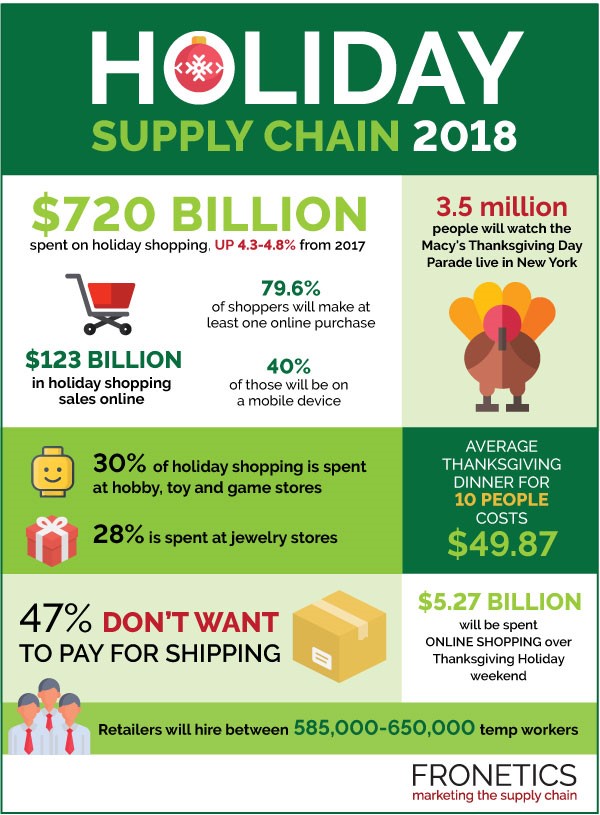
With the 2018 holidays approaching fast, customers are pulling out their wallets and getting ready to increase holiday spending by at least 4.3%.
The National Retail Federation (NRF) is estimating that holiday sales will be up 4.3-4.8% over 2017, for a total of $717.45 billion to $720.89 billion. “Thanks to a healthy economy and strong consumer confidence, we believe that this holiday season will continue to reflect the growth we’ve seen over the past year,” says NRF President and CEO Matthew Shay.
Shopping insights
Consumers are planning to spend an average total of $1,007 for decorations, candy, and gifts ($853 on average), as well as other purchases for themselves and their families ($154 on average). This is an increase from 2017, continuing the trend of growth over the past 5 years.
Not only are they spending more, but consumers are starting early this year—as many as 40% will have started their holiday shopping by November 1, and 18% got started in September or earlier.With Black Friday and Cyber Monday behind us, consumers have been using deals and promotions to start getting items on their holiday lists. 164.6 million shopped or considered shopping during the Thanksgiving holiday weekend.
Increasingly, shoppers are turning online, many on mobile devices. 71% are planning to use a smartphone or tablet to research or make a purchase. In fact, 55% of consumers are planning to shop online. Of those, 94% plan to take advantage of free shipping, 50% plan to buy online and pick up in store, and 16% plan to splurge on expedited shipping.
Priorities
Holiday shoppers rank sales and price discounts (71%), quality (60%), selection of merchandise (60%), and free shipping (47%) as the top factors in deciding where to shop this year.
“Consumers will be scouring through retailers’ ads to make sure they are getting the best deal possible,” Prosper Insights Executive Vice President of Strategy Phil Rist said. “Although sales will remain an important factor, shoppers want good quality and want to be able to find what they’re looking for.”
Here’s how content can help support sales during the seven stages of the sales cycle, including personalization and building last relationships.
The sales process is often an uphill journey with lots of unexpected bumps along the way. Sales teams are all too familiar with these obstacles, but they don’t have to face these challenges alone.
Arm your sales rep with content to educate prospects during specific points in the purchasing process, and it will build his or her reputation as a knowledge source. That can be the difference in getting a foot in the door, advancing through the final stages of a purchasers’ decision, or closing a deal.
Strong communication between sales and marketing can help achieve big-picture goals when it comes to creating content. These teams can work together to create a better understanding of the buyer’s journey, make updates on buyers insights, and brainstorm solutions to bottlenecks in the sales funnel.
You need to take a close look at your sales process and be strategic about the times when content would be helpful — as well as the types of content that will successfully assist sales reps in educating and informing prospects. Here’s how content can support sales in each of the 7 stages in the sales cycle:
Video: 7 Stages in the Sales Cycle Content Can Help
Takeaway
Don’t forget how important it is for sales teams to be armed with informative, relevant content to support the sales cycle. It’s not enough to just produce content, sales teams need to be ready to provide this content to potential customers at every point of contact.
Want help identifying what content your supply chain and logistics company can provide to your sales team? Let us help.
With a growing shift toward social messaging platforms, your business needs to find a way to incorporate these apps into your content marketing strategy.
Feel like giving yourself a pat on the back for finally getting a handle on how to effectively use social media networks like Facebook, Instagram, Google+ and Twitter in supply chain marketing? Well, you might not want to celebrate just yet.
In the constantly changing world of online connection, social messaging apps are the new social media. The top four social messaging platforms have overtaken the top four social media networks in terms of monthly active users.
The increasing popularity of social messaging platforms means your business needs to consider how to incorporate social messaging apps into your marketing strategy if you want to continue to best meet your costumers.
Here’s what supply chain businesses need to know about social messaging apps — and why to use them in supply chain management.
What’s a social messaging platform?
Social messaging platforms are exactly as they sound. They are applications that allow people to easily and quickly connect with friends, family, and businesses for personal and professional conversations. They are basically email’s hip, smart, stylish grandchild. Sending text, photos, multimedia files, and even making voice calls are all available options.
Let’s take a closer look at the top four social messaging apps to gain a better sense of what they can do.
WhatsApp. The enormously popular WhatsApp, owned by Facebook, is the most used social messaging app in the world with more than 1.5 billion users. Easy to understand and designed for smartphones and tablets, users can send text messages, photos, voice recordings and videos and even make voice calls over the internet. And guess what? It’s all free. In addition, WhatsApp lets users set a status for their contacts to see without having to message everyone, use the map function to communicate location info with someone, and share files from a phone or computer.
Facebook Messenger. Facebook has its own messaging app too, and it’s just behind WhatsApp at 1.3 billion users. This social messaging app builds on Facebook’s user network but the message functionality was separated from the main social networking app a few years ago. Users can send messages and exchange photos, videos, stickers, and audio files, and they can react to other users’ messages too. You can also make free voice and video calls through the app.
WeChat. With nearly 700 million users, WeChat dominates in China and is making a serious push for global reach. WeChat provides users with free mobile instant messaging, video and voice calls, group chat, and multimedia messaging with images, video, audio, stickers, and more.
Viber. Viber is another free messaging app that works between phones, tablets, and computers. It currently has 400 million users. Users can send texts, stickers and emoticons, photos, voice and video messages. Viber also has a feature called Communities, which are public chat channels where the user can like and reply to messages in group conversations. It also has a built-in QR code scanner and, like WhatsApp, the ability to share your GPS location in conversations.
Why move to social messaging platforms?
If you’re questioning why to move toward one (or more!) of these four social messaging apps, here’s the short answer: because your customers are.
The longer answer is that supply chain businesses can use these platforms to deliver content, engage with customers one-on-one, and offer superior personalized customer service, all of which result in high-quality relationships and leads. And with the successful rise of chatbots in supply chain marketing, this kind of interaction is more feasible than it may initially sound.
If you need more reasons, don’t just take my word for it. Consider these 10 graphs that show why your business should gravitate toward increasing your social messaging presence.
Social messaging apps for the supply chain
So, which social messaging app is best for the supply chain? There’s no one-size-fits-all answer here. These are the top 4 platforms where your customers and potential customers are spending time, so this is where you should meet them.
But we all know that “doing it all” isn’t always feasible. So, in order to get the most from your time (and budget!), make sure to take the time to choose the best social messaging app for your marketing needs.
Ask these important questions:
Who is my target audience?
How will the app add value to my target audiences?
How do I want to deliver my content?
Do I want to use more than one app?
How frequently will I be marketing on the app?
These questions can help you find the social messaging apps that will work best for your marketing campaign and start connecting with customers in a more personalized way.
With the shift toward messaging apps, your business needs to find a way to do the same. But however you plan to incorporate a social messaging app, here’s a final word of caution: you aren’t a friend, and you aren’t family. Be engaging, be helpful, be available. Just don’t be intrusive. The 2018 Sprout Social Index shows that people are still using social media primarily for connecting with friends and family. As businesses consider how to use messaging apps to deliver content and engage with leads, it is very thin line between getting into your costumers’ hearts or getting under their skin.