Selling certainly isn’t like it used to be. Take the requisite childhood lemonade stand, for example. Every summer thousands of entrepreneurial youths take to their neighborhood streets with pitchers of homemade lemonade to offer passers-by a cool drink for a small fee. For decades now these business startups and their transactions have generally been straight-forward. Recently, though, the owners and operators of these businesses, almost all children, have faced increasing complexity in their business environment. Local authorities have been cracking down on lemonade stands without proper city permits or food handling licenses. Potential customers have grown more mindful of product ingredients. These new idiosyncrasies have everyone wondering, “When did selling become so complex?”
Successful companies have adapted to these new selling pressures by placing emphasis on a strategic selling process. MHI Global suggests that these strategic selling processes “significantly improves the odds of [a business] winning complex sales opportunities by defining a process for pursuing sales opportunities and establishing common criteria for allocating resources.” Those companies are then able to determine when to walk away from resource-intensive deals with a low probability of success, giving salespeople the time and energy to focus on the opportunities most likely to become profitable, long-term customers.
There’s little doubt that the role of strategic selling is one of the toughest in any organization. It’s also one of the most expensive line items for most companies – so getting it right is important. There are a lot of great strategic sales teams out there, to be sure. But there’s an equal amount of selling teams that could use some advice.
Here are five ways to optimize your strategic sales teams and, in turn, increase their revenue-producing effectiveness.
Devise a Process
Strategic selling is a process. Like any process, discipline and milestones mark the way. Only through uniform use, iteration, and formal improvement will your organization, the sales team, and the salesperson become more effective. I don’t care what the process looks like…yet. Get a process that everyone can track inside your organization and stick to it. No loose cannons or end around players….they devalue the process.
Refine Your Process
Once you have an established process, take the time to refine it. The most successful strategic selling processes include some iteration of the following items:
Identifying the key decision makers and their motives/agendas
An action plan
Sales plan testing and improvement
An organization implementation process
Create a Compelling Event
If your sales process relies solely on responding to RFPs, you are not strategically selling….you are responding to opportunities that every qualified organization will see and compete for. Create a compelling event inside your target customer. The easiest sale is the one that your competitors never knew about in the first place. Creating a sense of urgency and need inside a customer is hard work and takes time, but that’s what makes it valuable to your client and your organization. Knowing your customers’ needs and how your solution fits makes you more valuable than a traditional “RFP responder”. Be there first, be relevant, and be action oriented and your customers will rely on your solutions more often.
Make the Most of Your Resources
Time is money and both are scarce resources. Make the most of these precious resources and never fall in love with an opportunity unless it meets the following criteria. If it fits, engage fully and engage to win. No half efforts. Ask yourself these questions:
Is there a true opportunity that has been clearly identified and agreed to within your customer’s organization? Said another way, is there a “compelling event” as mentioned above that everyone involved is aligned around?
Can you compete to win? Does your solution or unique business differentiator align to produce customer benefit? Can it be aligned?
Can you win? Are there any commercial obstacles that would stand in the way to your winning? These can be politically driven, relationship driven, or even solution driven.
Is the opportunity worth winning? Does it have the desired ROI for the investment of selling resources? Does it contain enough profit to engage your organization? Is it too risky a fit (a force fit to your solution) or does the risk and reward balance? Can your customer pay for the service? Have they allocated funds?
Avoid ‘Work for Free’ Promotions
Stay away from “free trials” or “free pilot” engagements. In fact, run from them. If your customer is headed down that path, revisit number four above. It could be that they do not completely understand your solution and how it fits, or simply that they have no funds to undertake the engagement. In either case, time is money and it’s time to move on.
Make no mistake, the strategies listed above are not easy to instill in a sales organization. But by doing so, true opportunities will increase, they will have greater value, and your chances of success will soar. No hard work goes unrewarded.
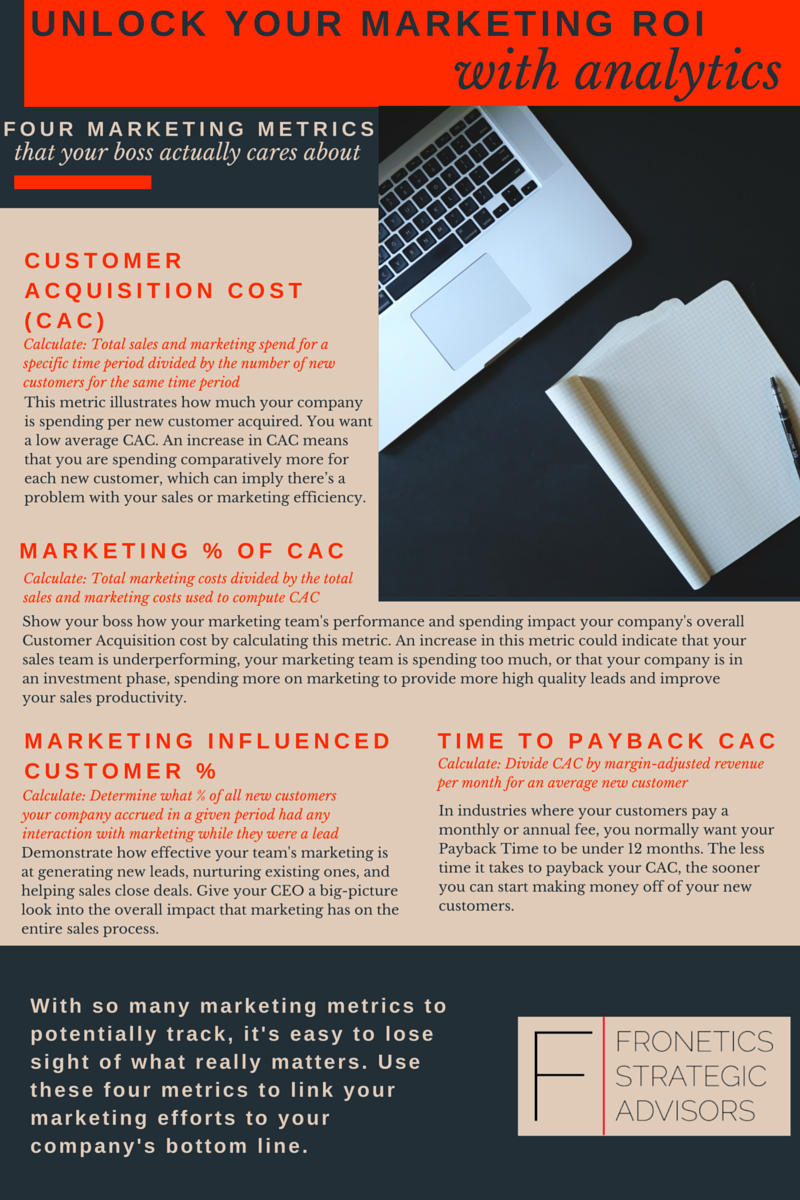
In the age of big data, everything in marketing is measureable – and that’s not necessarily a good thing. As Dimitri Maex of Ogilvy Consulting puts it, “marketers are drowning in numbers because they are focused on what they can measure rather on what they should measure.” Unfocused efforts to evaluate the success of your marketing activities can lead to a host of problems. Central to these problems, though, is the failure to measure and report activities in a way that clearly demonstrates the link between marketing and your company’s bottom line. Check out our infographic that details four marketing metrics guaranteed to resonate with your CEO (and our guide to the 6 marketing metics your boss really cares about).
When it comes to marketing we work with our clients to create and execute strategies that drive success and elevate their brand position within the industry. Unlike other firms, we align marketing programs with business objectives and, through a data driven approach, are able to deliver results with a targeted ROI. Our team is comprised of strategists, marketing professionals, writers, designers, and experts in social media. Together we leverage our experience to increase brand awareness, position our clients as thought leaders, drive meaningful engagement with prospects and customers, and help businesses grow.
Content marketing has become a key marketing strategy for many businesses. Statistics show that content marketing generates three times more leads than traditional marketing methods – and those leads cost an average of 62% less. At Fronetics, we’ve built our content marketing services around one goal – helping our clients grow. We’re harnessing the power of content to help our clients connect and engage with leads and prospects in meaningful ways. And our clients are enjoying faster growth and higher profits because of it.
How do we use content to support our clients in their business growth?
We create quality content that helps our clients connect with leads and customers in a number of ways. First, we appeal to and engage potential customers by creating relevant content that’s aligned with the needs of our client’s target audience. Then, we nurture those leads into customers by proving the value of our clients’ products and services. Even after they become customers, we work to create positive customer experiences that make it easy for them to recommend our clients to others.
Services offerings
Here’s a quick breakdown of some the service offerings included in our comprehensive approach to content marketing:
Content strategy
Research has shown that B2B and B2C companies with a documented content strategy in place are more effective than those without one.
At Fronetics, we work with our clients to create a content strategy individualized for their specific situation and needs. We learn about our client’s business, target customers, industry, and competition. We also conduct an audit of current content and digital assets. All of this information is used to create an effective content strategy.
Content creation
There is a lot of content out there. If you want your content to stand out and drive profitable customer action you need quality content. At Fronetics, we create quality content that is keyword-optimized. Also, unlike other firms, we don’t outsource content creation. By keeping all content creation in-house we are able to ensure a quality product.
Lead generation
Once we’ve helped our clients draw visitors to their website, we work to identify potential customers and manage their leads. We create and couple high-value content like white papers and eBooks, with strategic calls-to-action that direct visitors to landing pages expertly designed to convert website visitors into leads.
Lead nurturing and customer acquisition
We work closely with our clients to develop a lead nurturing strategy to convert leads into paying customers using email and marketing automation. By segmenting leads and sending them targeted content designed to catalyze engagement, we help our clients build relationships – and importantly, trust.
Social media
Social media is an incredible tool; however, for it to be effective it must be driven by strategy, be consistent, and must have someone managing the execution. At Fronetics, our social media strategists distribute content, curate content, engage your target audience, and monitor your social networks. We develop a social media strategy that aligns with your company’s goals. We analyze your competition, classify your target audience & cultural attributes, identify the influencers in your industry, recommend platforms, detail best engagement practices, create social media schedules, and identify specific tactics that deliver results. Through the proper execution of social media, your brand is given a voice and personality, and becomes more accessible to your target audience.
Analytics and reporting
At Fronetics we take a comprehensive data driven approach to marketing. Metrics measure success, drive strategy, and demonstrate ROI. We provide our clients with monthly marketing reports.
In short, our content marketing strategies drive success for our clients. The Fronetics team is comprised of strategists, marketing professionals, writers, designers, and experts in social media. Together we leverage our experience to increase brand awareness, position our clients as thought leaders, and drive meaningful engagement with prospects and customers – all with the goal of helping our clients grow.
Earlier this year, when Fronetics set out to explore the role of content within the logistics and supply chain industries, a full 86% of the companies we surveyed reported using content as a marketing tool – their primary goals being to build brand awareness and generate leads. Remarkably, more than three quarters of these companies told us that content was an effective tool for their business. However, a top challenge identified by respondents was the execution of a structured and effective content strategy.
In response, we’ve developed a content marketing guide specifically for companies within the logistics and supply chain industries. This guide has been designed to not only get your content strategy off the ground, but also to supercharge your route to success. In it you’ll find step-by-step instructions, templates, lists, and samples that’ll walk you through building your own content strategy – from proven best practices to advanced techniques. Download your free content marketing guide to get started today.
When it comes to marketing we work with our clients to create and execute strategies that drive success and elevate their brand position within the industry. Unlike other firms, we align marketing programs with business objectives and, through a data driven approach, are able to deliver results with a targeted ROI. Our team is comprised of strategists, marketing professionals, writers, designers, and experts in social media. Together we leverage our experience to increase brand awareness, position our clients as thought leaders, drive meaningful engagement with prospects and customers, and help businesses grow.
Fronetics is a B2B marketing agency for supply chain and logistics companies.
Do reverse logistics companies need to focus on content marketing? Yes.
Should they use LinkedIn? Yes. Twitter? Yes. YouTube? Yes. Yes. Yes. Should they blog? Yes!
Several reverse logistics companies are already using content marketing in an effort to connect with peers and potential B2B consumers. IT Asset Disposal (ITAD) company, TradePort, has an informative blog and utilizes LinkedIn, Facebook, and Twitter. The large 3rd-party logistics (3PL) company, Unyson, utilizes the top B2B social media outlets with just under 2,000 followers on Twitter and just over 3,000 followers on LinkedIn. On the homepage of their website you can view a running tally of how much money they have saved their customers. At the time of the writing of this blog it’s at $2,055,763,398.
What the studies show:
The Content Marketing Institute reports that 8 out of 10 people identify themselves as blog readers, and 23% of all time spent online is spent on social media sites. With the rise of the blog, companies have gotten smart about how to reach their current and potential consumers. According to Forbes, many brands are moving their advertising budgets from television to online videos.
In the B2B world things are changing, too, with many executives wanting to gain information through other mediums. The Content Marketing Institute also reports that a majority (80%) of business decision-makers prefer to get information from articles rather than through advertisements.
We know that inbound marketing is effective in garnering consumers’ attention. It’s aligned with a generation of people who want to be educated about the products they’re buying and who are willing to search for those products online. Even with all of this known, it’s important to ask: what is the ROI when it comes to content marketing?
Return on Investment
In order to calculate ROI, the cost of content marketing needs to be assessed:
salaries (if going in-house)
marketing agency or contractor services
additional overhead
distribution costs
design and publication software
After those costs have been calculated, the next step is to subtract that number from the revenue generated. The Guardian has put forth its simple content marketing ROI calculator:
(Revenue Generated – Cost of Content Marketing) / Cost of Content Marketing = ROI
According to the newspaper, “A simple calculation could say that you drove 1000 visits through a piece of content, and Google Ads would have cost £1 per click, e.g. £1000 to equal the same. If the content only cost £500, you have a saving!”
But with most seemingly simple things, there’s complexity underneath. Dig deeper and ask more questions:
Is the money you’re spending on inbound marketing deterring other, less obvious, costs?
Would it have cost you more through outbound marketing methods to achieve that same level of visibility than through inbound marketing solutions?
Is inbound marketing bringing in customers or closing a deal more quickly than alternative methods (time is money, after all)?
Is inbound marketing cutting down the need for staffing in other areas, such as support staff to manage inquiries or support calls?
Some incalculable values from inbound marketing, like consumer preferences, content intelligence, customer relationship strategies, and branding can be hard to tie to a number, but over time you will see that your ROI will become more clear to you as you generate leads, turn leads into customers, and see the result in the form of money gained (American dollars or British pounds!).
There are several ways to measure ROI. Reverse logistics will continue to grow in importance as regulations increase and the environment continues to come to the forefront as an ethical and practical issue. Content is king, so consider it, measure it, and go for it.
When it comes to marketing we work with our clients to create and execute strategies that drive success and elevate their brand position within the industry. Unlike other firms, we align marketing programs with business objectives and, through a data driven approach, are able to deliver results with a targeted ROI. Our team is comprised of strategists, marketing professionals, writers, designers, and experts in social media. Together we leverage our experience to increase brand awareness, position our clients as thought leaders, drive meaningful engagement with prospects and customers, and help businesses grow.
In an interview with the Kitchn, Food Network’s Barefoot Contessa Ina Garten shared her top three secrets to hosting a successful dinner party – plan ahead, use your best stuff, and have fun building and sustaining relationships with those around you. Her focus may be food, but her advice is applicable to marketing and sales professionals. Undeniably, lead nurturing is remarkably similar to hosting a dinner party.
Using the dinner party strategy, let’s take a look at how your business can actively build relationships with prospects and advance the movement of leads through its sales funnel.
Clean house
As the host of an upcoming dinner party, it’s unlikely you’d host people in your home without first getting it in tiptop shape. The same should be true for your website, your company’s online home. As part of your preparation for a lead nurturing campaign, review your website and make any necessary modifications so that it presents the best digital representation of your business. Beyond increasing conversions, having an attractive, modern website that’s free of broken links and out of date contact information serves to establish your company’s website as a trusted resource for information.
Decide what to offer guests
Preparing a dinner party menu for a number of people requires some forethought and planning. For instance, what type of food would your guests enjoy? Do any guests have food allergies or aversions for which you need to plan? Just as you would build the menu for your dinner party, the decision about what content you’ll offer will be guided by the preferences and content needs of your leads. Create content that is relevant to your leads and make sure to identify appropriate channels of distribution in order to extract maximum value from your content.
Determine when and how you’ll serve menu items
Traditional dinner parties start with appetizers and move from one course to the next until after the dessert wine is poured. Similarly, the lead nurturing process is intended to push content to leads in a linear fashion, with the ultimate goal being that they’ll emerge as customers. Once your content “menu” is set, you’ll want to decide how you’ll serve them up to your leads. To do that, align content with where your leads happen to be in the buyer’s journey. Leads will enter and exit your lead nurturing campaign at different points, and that’s okay, just be certain that your content is relevant to leads in their specific stage. Regardless, each nurturing touch should be focused and specific and include a call to action to promote advancement in the buyer’s journey.
Create and sustain dialogue
Beyond sharing a meal, it’s likely that you’ll also take part in spirited conversation with your dinner party guests. While it’s certainly acceptable to offer up topics of discussion, your guests will not enjoy you dominating the conversation. Meaningfully adding to the conversation builds relationships not just by showing expertise, but by showing genuine interest. In other words, don’t view the lead nurturing process as a way to blast your prospects with promotional information or marketing materials; treat it as a dialogue. The best lead nurturing campaigns are designed to learn as much about your leads as you would have them learn about your company.
Say thank you
As host, at the end of the night when guests grab their coats and head toward the door, it’s polite to thank them for attending your dinner party. Extend that same courtesy to your customers and leads. Whether it’s by showing gratitude to current customers for their continued support or showing appreciation to leads for their download, saying thank you goes a long way in building connections and professional relationships.
What’s required to run a successful lead nurturing campaign is building trust and establishing relationships with prospects and leads as you develop them into customers. Most of the effort involved in hosting a dinner party happens before guests arrive, so hosts are free to enjoy interaction and conversation with guests during the party. Lead nurturing can be approached much in the same way you’d plan and execute a dinner party. Developing a thoughtful lead nurturing campaign will almost always ensure meaningful – and memorable – communication.