Today’s B2B buyer’s journey involves more internet research and more social media use.
The B2B buyer’s journey has undergone a dramatic transformation, driven by digital innovation and changing buyer preferences. Research from Gartner shows that B2B buyers now spend only 17% of their total purchase journey time meeting directly with potential suppliers. Instead, they dedicate 27% of their time researching independently online.
Key Trends Shaping the B2B Buyer’s Journey
Digital-First Research Phase
According to TrustRadius’ 2023 B2B Buying Disconnect report, 87% of buyers want to self-serve part or all of their buying journey. This shift toward digital self-service has fundamentally changed how B2B companies must approach their marketing and sales strategies.
The Rise of Multi-Channel Engagement
Recent data from McKinsey (2023) reveals that B2B buyers regularly use ten or more channels throughout their purchase journey, compared to just five channels in 2016. This multichannel approach includes:
Online research and comparison tools
Social media platforms
Peer review sites
Virtual product demonstrations
Video content
Interactive webinars
The Impact of Peer Influence and Social Proof
LinkedIn’s State of B2B Marketing report highlights that 84% of B2B buyers are more likely to purchase from vendors recommended by their professional network. This emphasis on peer validation has made social proof and customer testimonials more crucial than ever.
Adapting Your Strategy to the Modern Buyer’s Journey
Content Personalization and Industry Expertise
Recent research by Salesforce indicates that 76% of B2B buyers expect vendors to understand their business needs and industry challenges specifically. This demands:
Industry-specific content creation
Personalized solution recommendations
Targeted thought leadership content
Custom ROI calculations
The Role of Digital Content in Decision Making
Content continues to play a pivotal role, but its format and delivery have evolved. According to HubSpot’s 2023 State of Marketing Report, the most effective content types now include:
Video content (preferred by 91% of B2B buyers)
Interactive tools and calculators
Case studies and success stories
Industry research and original data
Expert webinars and virtual events
Strategic Implications for B2B Companies
Understanding the modern B2B buyer’s journey is crucial for optimizing marketing and sales efforts. Companies must:
Invest in robust digital presence across multiple channels
Create high-quality, industry-specific content
Leverage social proof and customer testimonials
Provide self-service information and tools
Maintain consistent omnichannel engagement
The B2B buying process hasn’t necessarily shortened, but it has become more complex and digitally oriented. Success requires adapting to these changes while maintaining focus on delivering value throughout the buyer’s journey.
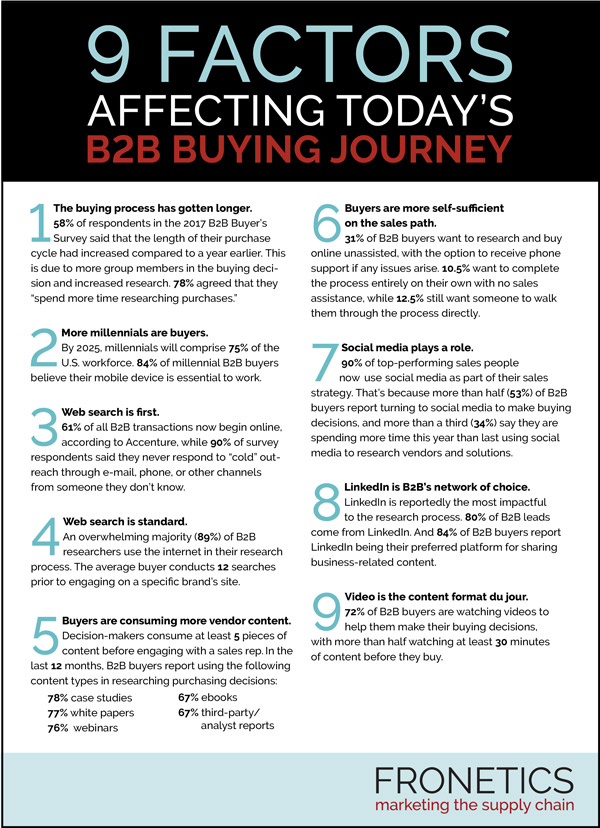
Infographic: the B2B buyer’s journey
The B2B buyer’s journey continues to evolve with technological advancement and changing buyer preferences. Companies that understand and adapt to these changes – by providing comprehensive digital resources, personalizing content, and enabling self-service options – will be better positioned to attract and convert modern B2B buyers.
Check out these marketing automation tools for email workflows, social media scheduling, and customer relationship management.
Lately it seems like everyone is talking about marketing automation. As B2B buyers increasingly demand personalized experiences through the buyer’s journey, marketers’ jobs are getting tougher, as they need to provide custom lead-nurturing content to all prospects in their databases.
And that’s where automating marketing tasks can help.
The term “marketing automation” refers to a variety of tools used to automate the process of personalizing leads’ interactions with your business. The sheer variety of these tools can sometimes be overwhelming — so we’ve pulled a few of our favorites in the categories of email workflows, social media scheduling tools, and customer relationship management.
6 marketing automation tools for supply chain and logistics marketers
This tool lets you send targeted messages to your customers, crafting them based on how they interact with your business, and making personalized messages simple. You can also keep track of conversions and create customer profiles. Our favorite part? It integrates with your mobile app or website, letting you see data in real time and trigger actions by adding in predefined rules.
2. Constant Contact
This powerful tool has some features that are unique — and can take your marketing capabilities beyond the basics. Beyond setting up and managing an automated database, Constant Contact offers Facebook fan promotion, coupons and deals, and event management.
This is an extremely effective tool for retargeting customers through re-engagement on Facebook, Twitter, and elsewhere on the web. It offers cross-device and cross-platform retargeting capabilities, as well as flexible segmentation, letting you provide customized experiences that dramatically improve your marketing efficiency. It also offers customized budgeting and full control over ad spend.
Pardot is an all-inclusive marketing automation suite, but it’s particularly strong for amping up your engagement with CRM integration. It’s a great tool for helping your sales team shorten the sales cycle. And, in addition to CRM integration, it offers email marketing, lead nurturing, lead scoring, and ROI reporting.
5. Marketo
This cloud-based marketing software lets you drive revenue with lead management and mobile marketing. It not only helps build customer relationships, but it helps you sustain them as well. Best of all, you can try it out for free until you’re sure it’s right for your business.
Bonus all-in-one tool: HubSpot
HubSpot is an inbound-marketing tool that lets you generate leads, close deals, and manage your sales pipeline from start to finish. It integrates beautifully with a content marketing strategy, with the goal of turning outbound leads into inbound ones. It includes revenue reporting, custom-event reporting, custom-event automation triggers, predictive-lead scoring, contacts and company reporting, and event-based segmentation.
What marketing automation tools does your business use?
Supply chain marketers can use marketing automation to drive efficiency and be more successful in earning and converting leads.
Marketing automation is the process of using software to complete repetitive marketing tasks designed to nurture sales leads, personalize marketing messages and content, and — in the process — save marketers’ time and effort. Supply chain marketers are using marketing automation to streamline processes and increase qualified leads.
Marketers can scale their processes so they can reach more people, with less effort.
Buyers are increasingly demanding a more personalized experience along the buyer’s journey, which means marketers are working overtime to produce more targeted content. That’s where marketing automation comes in. By using automated messaging, marketers are able to nurture prospects with highly personalized, useful content that helps convert prospects into customers and customers into loyal customers.
Jumping into marketing automation can be overwhelming. Utilizing the right software and knowing where to implement automation into your marketing processes will help nurture leads and get you back to more pressing tasks.
Here are five ways to get started using marketing automation for the supply chain.
Video: marketing automation for supply chain marketers
Don’t worry about being redundant.
We are all too familiar with the batch-and-blast approach many companies use in their email marketing efforts. And, oftentimes, those emails end up in someone’s spam folder.
We also have so many clients that worry they will become redundant by implementing marketing automation. But that’s not true.
Instead, marketing automation can help you provide a more personalized experience for your leads (no batch-and-blast). This will increase the chances that they’ll buy. But it won’t take up more of your time. In fact, it will give you more time to focus on tasks that can’t be automated, like content creation.
Adidas and FIFA have found great success in using social media in supply chain management.
Sometimes, a success story can be a powerful motivator. FIFA and Adidas have been extremely successful in using social media in supply chain management. Here’s how it works for these organizations and why your business should consider it.
FIFA and Adidas
These two brands are a match made in heaven. In fact, their relationship spans the 48 years since 1970, when Adidas began supplying the official match ball for all FIFA World Cup matches. And clearly it’s been working for both brands, as they have recently extended their partnership until 2030.
With a global supply chain consisting of more than 1,000 independent factories around the world, Adidas is harnessing the power of social media as it relates to the supply chain.
How they used social media in supply chain management
In 2014, the brand launched the #allin campaign on Twitter, letting users follow the progress of the official 2014 World Cup soccer ball (nicknamed the Brazuca). The ball even had its own Twitter handle. Videos showed the Brazuca outfitted with cameras and sent on a journey around the world.
As you can imagine, this creative marketing was social media gold. Adidas was able to leverage its partnership with the FIFA World Cup and engage its audience in a meaningful and lasting way.
According to Waterloo blogger Jaime Salinas, “Adidas is using social media to improve their organization’s supply chain management globally by creating transparency, increased visibility, communications and quality control that leads to reduced operational and labor costs.”
For example, the Adidas SMS Worker Hotline allows direct communication with factory workers, bridging the gap that can exist between management and workers. The system allows the workers to have anonymity, ensures transparency in tracking complaints. It also allows correction efforts to happen in real time.
The takeaway
So what can your business learn from this duo’s successes with social media in supply chain management?
“Social media can improve [an] organization’s supplying chain management,” writes Salinas. “It can create more visibility, improve communication, increase control, and reduce operational and labor costs.” This creates a more efficient and steady supply chain, which in turn increases customer satisfaction.
Salinas concludes, “The ripple effect of using social media to improve supply chain management can expand outwardly across virtually internal and external organizations, which is great for business.”
Integrating marketing automation into your CRM strategy can improve efficiency, streamline workflows, and make communications more consistent.
Over the past few weeks, we’ve been talking about different types of marketing automation, why you should be considering them, and what they can do for your business. Today, we’re talking about customer relationship management (CRM) — an area where you may not have realized that automation could help. Integrating marketing automation into your CRM strategy can improve efficiency, streamline workflows, and make communications more consistent.
So how does integration of CRM and automation look?
Pardot blogger Jenna Hanington explains it like this: “Automation … is the marketing counterpart to your CRM, focused on lead generation and personalized, one-to-one communications powered by the data collected through prospect and visitor tracking.”
Your CRM is a database, and marketing automation is “the tool that allows you to execute on the information stored in that database,” writes Hanington. Integrating the systems has the potential to cut costs and make big gains in terms of productivity. According to Salesforce blogger Matt Wesson, “Marketing automation and [CRM] are complementary tools that only reach their full potential when paired together.”
Combining CRM with marketing automation has the potential to give you more organizational bandwidth, more precision in your messaging and lead nurturing, and more measurable value in your campaigns. Here are a few examples of how CRM and marketing automation can work in tandem.
3 ways your CRM and marketing automation can work together
1) Track behavior
Combining automation with your CRM allows you to go beyond basic demographic data. You can see things like what pages your prospects are visiting, what types of content they’re interested in, and where they are in the buying cycle.
2) Tie revenue to campaigns
Marketing professionals often run into the problem of not being able to specifically tie their efforts to ROI. Creating a campaign in your marketing automation system maps it back to your CRM, so you can correlate closed deals directly with the campaigns that created them. This means you can attribute revenue directly to campaigns and more accurately measure your ROI.
3) Send targeted messages
You can use the behavioral information collected by your marketing automation tool to create and send targeted messages that are customized to your prospects’ interests and stages in the buying cycle. This means your prospects will find your messages more relevant and engaging.
In summary, integrating marketing automation with your customer relationship management database can save you time, make sales and marketing more effective, and better track ROI. This one is a no-brainer.
In many cases, automation in manufacturing creates leaner, more efficient operations. Efficiency facilitates new opportunities and business growth, which in turn allow for job creation.
The rise of artificial intelligence (AI) and its applications in manufacturing have driven a palpable fear that mass job loss is on the horizon. We have to wonder: is the threat as real and as imminent as many think? Like many things, the answer is more nuanced than a simple yes or no.
A McKinsey Global Institute report predicts that automation could cause the loss of between 39 and 73 million jobs by 2030 in the U.S. alone. Clearly, the AI genie will not be put back into its bottle. However, this doesn’t mean that all jobs across all sectors will be affected evenly.
Generally, low-skill jobs are more susceptible to replacement by AI. This is especially true in industries like retail, which has worked to automate many aspects along the purchase journey, including processes designed to get packages into consumers’ hands faster.
Not the end of the world
Oddly enough, 73 million lost jobs doesn’t spell all doom and gloom. Yes, people will lose jobs — that is inevitable. Automation, however, will create many more.
Think about it: In many cases, automation creates leaner, more efficient operations. Efficiency facilitates new market opportunities and business growth, which in turn allow for expansion and job creation. And these new jobs aren’t the low-skill positions of their pre-automation predecessors. They’re operating new technology, supervising automated processes, and other higher-paying opportunities.
Amazon: Case in point
Consider the retail industry’s brick-and-mortar boom and bust and the rise of e-commerce. As stores shuttered, companies had to downsize the number of individuals they employed. Then, as e-commerce boomed, e-retailing companies were able to bring on more employees — often at higher salaries than in traditional retail.
Amazon’s expansion to the “once-thriving factory town” of Fall River, Mass., offers a prime example. The city, which boasted nearly 20,000 manufacturing jobs in 1991, saw that number dip below 4,000 by 2015 — in large part due to automation. The 2016 arrival of an Amazon fulfillment center was the single largest job-creation event in recent memory.
Employment at the Fall River center has crept above 2,000 in just over a year. And it’s apparent that number will keep rising and that humans won’t be phased out anytime soon. In fact, rather than replace human workers, Amazon’s technology helps each become more efficient. That stimulates Amazon’s growth and the need for more fulfillment centers and more talent to fill those jobs.
While the majority of the Fall River center’s jobs are not skilled and pay reflects that, other benefits such as overtime, tuition aid, and company shares make annual compensation comparable to or better than what local textile mills once paid. Fulfillment center jobs certainly pay above traditional retail and offer employees the opportunity to work withartificial intelligence — rather than in competition with it.
A double-edged sword
AI in the warehouse may stimulate job growth. But those most likely to lose their jobs to automation — low-skill workers — may not possess the transferable skills to be successful in the new wave of jobs created by technology. For example, would a former factory worker who put together boxes for fulfillment be hirable for a position operating custom box-cutting machinery?
Amazon, again, exemplifies a solution. The company offers its workers significant training and education to breach any skill gaps. Those who have never had experience in a warehouse or operating technology will need companies to invest in their training to ensure those who have lost their jobs to automation will have a place in the new economy.
History repeating
This isn’t the first time we’ve encountered such an issue. Before ATMs were the ubiquitous cash-dispensing machines, many thought them the great disruptor of the banking industry. The bank teller’s role was sure to become obsolete.
What actually happened is that ATMs led to more efficiently run banks. While some jobs were lost, banks were actually able to open up more branch locations, which led to the creation of more jobs.
Will automation in the warehouse cause the same scenario to happen? Will organizations become more efficient, allowing them to grow and hire more workers at better, higher paying jobs? In many cases, it looks like it already has.