In fact, more people are using email than ever before (close to 3.8 billion worldwide). Fronetics works with supply chain and logistics businesses every day, so we have a first-hand understanding of how email marketing can be successful in these industries.
That being said, it’s true that email is changing. Marketers need to be on top of these latest changes to keep pace and stay relevant. Here are 5 email marketing trends supply chain and logistics marketers should be ready for in 2018.
5 email marketing trends
1) Interactive emails
According to a recent survey by Litmus, more than 27% of marketers believe interactive emails make a big impact in email marketing. Making your emails engaging to read will reduce bounce rates and capture your target audience’s attention span for longer. A few ideas to make your content interactive: image galleries, sliders, buttons, quizzes, search bars, surveys, and, of course, an “Add to Cart” button.
2) List segmentation
If you’re not segmenting your email lists, you’re shortchanging your email marketing campaigns. MailChimp found that businesses who use list segmentation generate more than 14% more email opens and get 100.95% more clicks from email campaigns.
Effective email list segmentation is about collecting adequate data to create and target optimal email content based on audience preferences. A simple way to collect this type of data: email opt-in forms that collect more information than simply name and email.
3) Artificial intelligence
Artificial intelligence and machine-learning technologies will shape the future of email marketing. For example, Adobe has invested in AI-powered marketing, including features with the ability to suggest the best subject line for an email based on what it has learned about users. Machine learning can make email marketing easier, suggesting ways to segment email lists, send more personalized emails to key individuals, and generate product recommendations.
4) Plain-text emails
This one may seem counter-intuitive. While high-quality email design filled with images used to be a trend, marketers are increasingly finding that plain-text emails are more effective. This is largely because plain-text renders the same across all devices, and it has the added benefit of seeming more personal.
5) The rise of mobile-first
It’s not news that most emails are now opened on mobile devices. This means that it makes sense to start designing emails mobile-first. In addition, email subscription forms will start becoming more mobile-friendly, and content, such as articles and blog posts, should end with an email sign-up form to increase conversions.
What email marketing trends are you paying attention to?
Focus on what you do best — and save time and money — by parceling off these 6 marketing tasks to outsource.
If you’re anything like me, you’re busy — not-enough-hours-in-the-day busy. We find that supply chain and logistics marketers are some of the most overworked professionals in the industry. One person (or a very small team) is often responsible for all marketing and sales efforts for an organization. So I want to let you in on a little secret: Outsourcing is your solution to being too busy.
Outsourcing marketing tasks allows you to focus on insourcing your core competencies. In other words, you can start focusing on what you do best and delegate specified tasks to external experts.
The content marketing landscape is constantly changing. There are more and more marketing tasks to cover: social media, videos, blogs, emails, etc. How can you truly focus your attention on any one area when you have so many balls in the air?
Don’t work harder. Work smarter.
Outsourcing marketing gives you the opportunity to remove some of the time-consuming and laborious tasks from your desk, so you can get back to the core of your marketing efforts.
That doesn’t mean you have to outsource all your marketing tasks, or even half of them. Choosing several areas beyond your staff’s expertise, or tasks that are particularly tedious, can help you improve your marketing efforts and take stress off an overworked internal team.
Here are six areas you should consider outsourcing.
Video: 6 marketing tasks to outsource
Final thoughts
Finding the right partner is key when you choose to outsource marketing tasks. You have to trust the people to whom you are delegating tasks, so that you know the work is getting done the way you want while you focus your attention on other tasks.
The right partner will work with you to develop a strategy that closely aligns with your business goals. Your partner can even execute the strategy for you and provide regular updates on how it’s working. This kind of results-driven approach will ensure you’re stretching your marketing dollars to the fullest extent and getting the kind of results that will grow your bottom line.
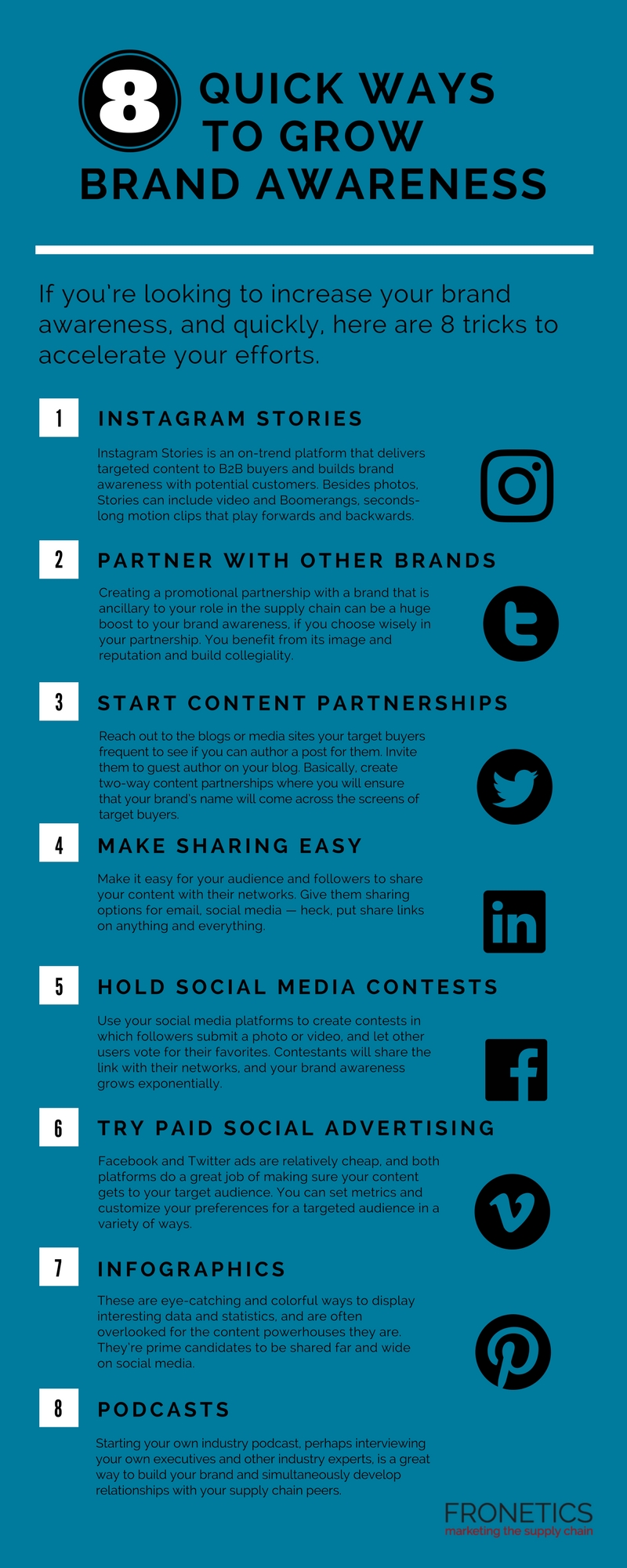
If you’re looking to grow brand awareness fast, here are 8 tricks to boost your efforts.
Have you ever noticed how some brands seem to have crept into popularity overnight? You’ve never heard of them, and then, all of sudden, they’re everywhere.
Their brand awareness has sky rocketed, and they’re achieving every company’s ultimate goal: Customers know about them. So what’s their secret?
Here at Fronetics, we don’t believe they have a secret. We believe that they took advantage of content marketing and its many benefits — growing brand awareness included. They were able to scale their growth in a short amount of time, a true success story for the digital era. Companies like Uber and Yelp have used these tips to implement small changes that yielded large results.
Remember, in order to grow brand awareness, you need to be proactive. It’s time to steer away from some of the traditional marketing methods, which don’t take into account how modern B2B buyers research vendors. Start putting your content marketing strategy to the test.
If you’re looking to increase your brand awareness fast, there’s no better place to start than with content marketing. Check out these 8 tips for using content marketing to grow your brand awareness fast.
A new study shows that businesses that reply to customer reviews receive better ratings overall than those that do not respond.
I’ve written before about the rising popularity of B2B user review sites and how supply chain and logistics businesses can use them to increase organic traffic and lead-to-sale conversion rates. B2B buyers are increasingly considering user reviews when making purchasing decisions. That’s great for business — when the reviews are good.
But what if you get bad reviews?
A brand new study published in the Harvard Business Review (HBR) shows that businesses that reply to customer reviews get better ratings overall. This means that bad reviews don’t necessarily spell disaster — but they do mean that you should incorporate a response plan into your overall marketing strategy.
Replying to reviews is an important part of online reputation management — which is especially crucial in the B2B space, where companies live and die by their reputation. So how does responding to reviews improve your online reputation?
A study in why to reply to customer reviews
To examine this question, Professors Davide Proserpio and Giorgos Zervas looked at tens of thousands of hotel reviews and responses from TripAdvisor. What they found was that “when hotels start responding, they receive 12% more reviews and their ratings increase, on average, by 0.12 stars.”
While 0.12 may not seem like a lot, in the scale of TripAdvisor’s 5 star system, where ratings are rounded to the nearest half star, it has a significant impact on customers’ perceptions.
Proserpio and Zervas found that “approximately one-third of the hotels we studied increased their rounded ratings by half a star or more within six months of their first management response.”
Improved ratings are related to management response
So why is it that the hotels started to get more and better reviews when management started responding?
The researchers examined every facet of the data to rule out other factors that would undermine causality, and found that in fact “improved ratings can be directly linked to management responses,” rather than improvements made to facilities or services.
To explain it, the researchers make the analogy of eating at your favorite restaurant and your meal arrives late. You complain to your dinner companions, but when the manager checks in seconds later and asks how everything is, “for a moment, you consider complaining, but instead choose to avoid confrontation and focus on enjoying the rest of your meal.”
Essentially, by humanizing your presence on review sites, you discourage potentially awkward online interactions.
The researchers conclude, “While negative reviews are unavoidable, our work shows that managers can actively participate in shaping their firms’ online reputations. By monitoring and responding to reviews, a manager can make sure that when negative reviews come in — as they inevitably will — they can respond constructively and maybe even raise their firm’s rating along the way.”
Do you always reply to customer reviews on user review sites?
Use these three steps to calculate content marketing ROI to show the value of your investment.
As supply chain and logistics businesses are finally recognizing the merits of content marketing, many are looking into it. But it doesn’t take much research to realize what an enormous investment it is. And how difficult it can be to calculate content marketing ROI.
Many companies we talk to need help convincing management that it’s a worthwhile investment. To that we say, use data!
But what data should you use? How do you quantify certain benefits, like growth in brand awareness? And do you really have to keep track of all the hours you spend writing blog posts, managing social media, etc.?
Here arethree basic steps for how to calculate content marketing ROI.
3 steps to calculate content marketing ROI
1) Set up your ROI measurement.
It’s important that you measure content marketing ROI at the initiative level. This means calculating the ROI of your blog, your webinar series, your Facebook marketing, etc. individually.
After calculating the ROI of each initiative, you can aggregate that data to determine your overall content marketing ROI for your business.
2) Know as much detail as possible.
“To measure ROI, you have to know, in as much detail as possible, the R (return) and the I (investment) of your content initiative,” says Jay Baer, president of Convince & Convert. Baer walks his readers through the example of figuring out ROI for a podcast, including calculating total investment in the project (including preparation and execution), and calculating total return.
Content marketing is about creativity. By the same token, think creatively about every measurable avenue of return in each of your initiatives.
3) Calculate your ROI.
The formula for ROI is universal: return minus investment, divided by investment, expressed as a percentage.
And there’s some good news for supply chain and logistics content marketing: “Content marketing ROI calculations are indeed easier for B2B companies because they almost always have visibility at the transaction layer,” writes Baer.
Once you’ve calculated ROI for each of your major initiatives, it’s time to think strategically about optimizing your content marketing resources, in terms of allocation and timing. Having hard data helps you answer questions about which initiatives are most fruitful, what language engages your audience best, when your efforts are most likely to pay off.
Ultimately, this data-driven approach lets you continually adapt to the needs of your audience, ensuring an ongoing, robust ROI.
Also in social media news April 2018: Instagram shuts down API platform, LinkedIn’s updates aimed at helping B2B marketers, and Facebook expands split ad testing.
Facebook has been busy creating updates focused on user security in the wake of the Cambridge/Analytica scandal. Since the data breach, Facebook CEO Mark Zuckerberg has committed to protecting user’s information and outlined several initiatives in the works to “prevent abuse, protect personal data and privacy, improve security, and take down fake accounts.”
One of the key takeaways from the scandal has been the lack of regulations overseeing business practices, as it applies to user data. It is safe to say that new regulations are looming in the not-so-distant future.
Google engineer Yonatan Zunger wrote in the Boston Globe, “Computer science is undergoing a ‘reckoning’ and an ‘ethics crisis’ not unlike what has happened in chemistry with dynamite, in physics with nuclear bombs, and in human biology with eugenics.” These regulations could have major impacts for advertisers, who have been capitalizing on data collected by social media platforms. Regulations that limit the tracking and retaining of user data will especially affect target advertising that relies on capturing data from target audience users.
Fronetics is staying on top of these changes and will continue to provide social media recommendations and updates on regulations.
Here’s your social media news for April 2018.
Facebook Changes Include More Transparency Around Ads and Pages
Facebook is working to make important changes that are aimed at increasing transparency and authenticity. “By increasing transparency around ads and Pages on Facebook, we can increase accountability for advertisers — improving our service for everyone,” says Rob Goldman, VP, Ads, and Alex Himel, VP, Local & Pages, in a statement on Facebook’s website.
Last October the social media giant rolled out restrictions on electoral ads on Facebook and Instagram. This April, Facebook is expanding those restrictions to all “issue ads” — for example, political topics — so only authorized advertisers that have been approved by Facebook can run issue ads. These changes are aimed at preventing any additional user data and privacy issues.
Facebook is also enforcing a verification process for all admins managing pages with large numbers of followers. “Those who manage large Pages that do not clear the process will no longer be able to post. This will make it much harder for people to administer a Page using a fake account, which is strictly against our policies.”
YouTube Introduces TrueView Ads
YouTube’s new ad format, TrueView for Reach, is its latest update aimed at boosting engagement for advertisers. The format allows advertisers the ability to build ads from 6 to 30 seconds long, with the skip option available after 5 seconds. “Our six-second bumper ads were designed to drive more reach among the audiences you care about, especially as they become increasingly on-the-go. They showcase not only the fun of storytelling in six seconds, but also the benefits of adapting to consumer behavior,” posts Ali Miller, Product Manager, Video Ads, and Khushbu Rathi, Product Manager, Video Ad for YouTube.
Facebook Improves and Expands Ad Split Testing Capabilities
Last October Facebook gave advertisers the ability to create split tests in Ads Manager’s Guided Creation workflow. The new update this month allows users to create tests in Quick Creation flow, making it even easier to manage ads in bulk and test ads against one another. Quick Creation will also feature a dashboard that shows “standard KPIs for the ads in your split test, such as CPM, CPC, CTR and more, to inform your marketing strategy.”
Instagram Cuts Off Older API Platform
In light of Facebook’s data security issues, Instagram announced it is shutting down the API platform, effective immediately. They have also greatly reduced the amount of data developers can access per hour, dropping from 5,000 calls per hour to only 200. Tech Crunch reports Facebook’s bold action to reform its APIs shows it’s willing to prioritize users above developers — at least once pushed by public backlash and internal strife.
LinkedIn Rolls Out Native Video for Sponsored Content and Company Pages
LinkedIn introduced autoplaying native video ads that will appear in the news feed section as stand-alone posts, as well as the ability to include native video on a company page for businesses and publishers. These changes were developed to help B2B marketers grab the attention of their audiences and increase engagement. “While video is a proven and popular tactic to engage decision-makers, the challenge has been finding a quality environment in which to reach them.” The update will be available to all businesses in the next few weeks.
Twitter Expands its Official Partners Program
Back in 2015, Twitter introduced its Official Partner Program, a select set of companies aimed at helping brands increase their ROI on advertising, brand awareness, and scaling customer care. The program has been so successful, Twitter announced it’s expanding the program to include six new partners: Curalate, Jebbit, VidMob, Vidsy, Animoto, and Social Native. “Each provider offers a unique solution that expands the advertisers’ toolset and delivers high-quality creative for brands on Twitter.”