Knowing the right video distribution channels can go a long way toward driving traffic and getting your content to your target audience.
Highlights:
An effective video distribution strategy is key to success.
Choose video distribution channels that match your marketing goals.
Paid ads can give video an extra boost.
Video transcript:
I’m Christy Lemire, the Director of Video Marketing here at Fronetics. Today we’re going to be talking about the four best distribution platforms for video.
Here are the four best platforms for distributing your marketing videos.
1. Your network
Don’t underestimate the power of your own existing network. Send your videos, via email, to your primary contacts and everyone in your current database.
2. Social media
Platforms like Facebook, Instagram, Twitter, Snapchat, and of course YouTube are great to reach your target audience. Of course within the category of social media, you want to consider what platforms suit your content best. YouTube is a great place to start, but there are also many industry specific online forums and social groups that can benefit you as well.
3. Blogs
Promote your video on your own blog to reach your followers and boost your SEO. It’s also a good idea to distribute your video on other industry specific blogs to overlap your target audience.
4. Paid ads
While the first three channels of distribution we discussed are organic, sometimes it is well worth it to use paid ads to give your content a significant boost, such as Google Adwords and AdSense.
Bottom line is using the right distribution channels helps you get the most out of your video marketing efforts. For more information about video marketing, visit Fronetics.com.
Social media is an ideal way for supply chain and logistics companies to reach their audience. But too many businesses are still making these basic social media mistakes.
Highlights
Social media only works as a marketing tool if you have a documented strategy.
Don’t try to use every popular platform. Find where your target audience spends their time and focus on that platform.
Don’t promote your brand. Engage with customers to build long-lasting relationships.
Video transcript:
I’m Kettie Laky. I’m the director of social media at Fronetics, and today we’re going to be talking about the basic mistakes that companies still make with social media.
As of 2019, there are approximately 2.8 billion social media users around the globe. So there’s no denying social media is a powerful tool for businesses to create brand awareness and generate leads. But it’s not going to be effective if it’s not done correctly.
There are three mistakes that businesses tend to make on social media still.
The first one is using objectives instead of strategy to drive their social media. Social media platforms are making updates and changes all the time to improve the customer experience. To weather those changes and to keep your customers engaged, it’s important that you have a strategy behind what you’re doing. The strategy should include content, the frequency of posts, and pillar content. A strategy’s also going to help you prove ROI.
The second mistake that companies tend to make is using all the most popular social media platforms. Social media platforms have differentiating qualities that appeal to different audiences. So get to know where your audiences are spending their time. For instance, if you’re marketing to millennials, you’re going to want to be on Twitter.
The third mistake companies tend to make on social media is by promoting rather than engaging. The companies that are having success with social media are finding innovative and creative ways to relate to their customers. So get your customers engaged, get them involved in your story, and you’re going to create long-lasting relationships with them.
If you need help with your social media strategy, give us a call or visit us at Fronetics.com.
Blogging should be a central part of your content marketing strategy. Here are our top tips for creating and sustaining a successful supply chain blog in 2019.
Highlights:
Blogging needs to be a central part of your content marketing strategy.
Focus on quality over quantity.
Make all posts mobile-friendly.
It’s the start of a new year and the perfect time to start setting goals and strategizing how to achieve them. Hopefully, blogging is a big part of your strategy for 2019 — after all, supply chain companies should make blogging a central part of their content marketing strategy for all kinds of reasons.
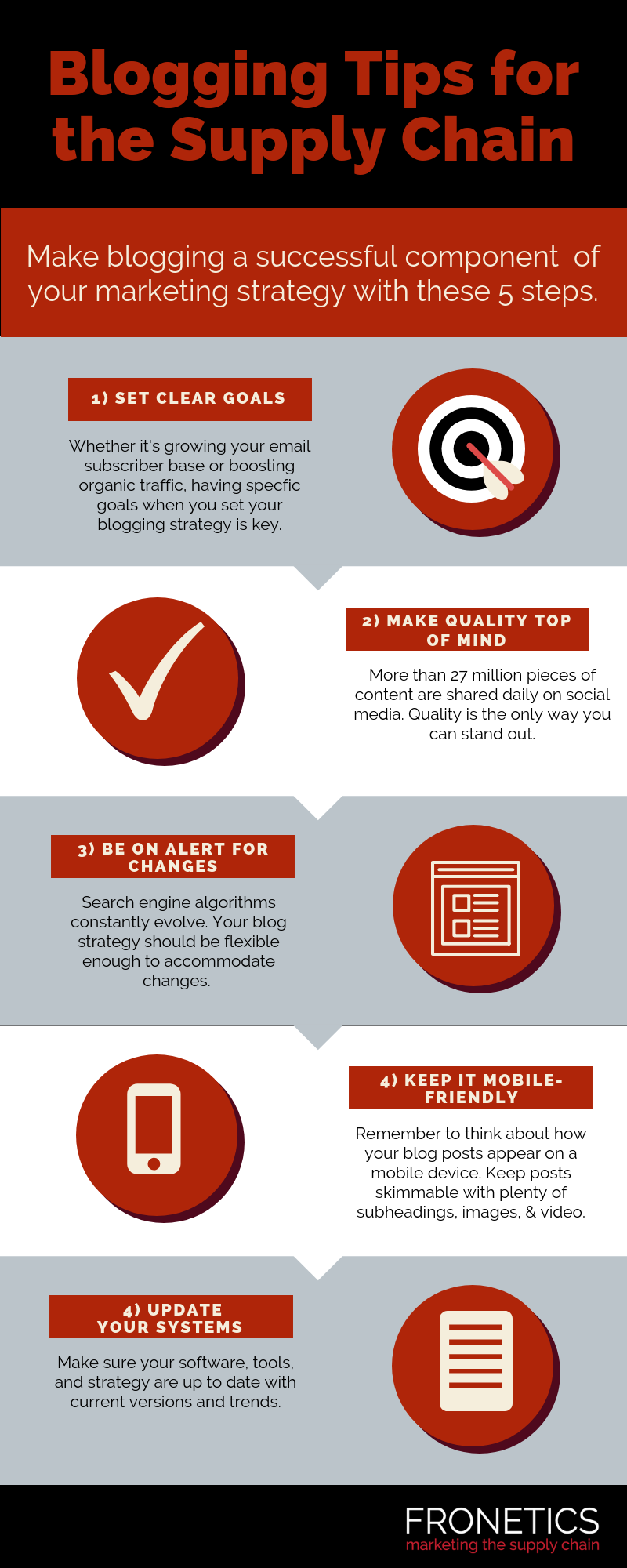
Making your supply chain blog stand out from the pack isn’t always easy. That’s why we created the infographic below. Read on for our top 5 supply chain blogging tips for 2019.
We know, this one sounds obvious. But you’d be surprised how often marketers overlook this seemingly simple step or settle for general, vague goals. It’s true that blogging can have all kinds of positive impacts for the supply chain, but that doesn’t mean that you should just be blogging without a clear, documented set of goals specific to your business.
Whether it’s growing your email subscriber base, boosting organic traffic, or generating more qualified leads, having specific goals in mind when you set your blogging strategy is key. For one thing, it lets you target your efforts and generate content that is focused on achieving a specific result or set of results. Furthermore, having objectives allows you to be far more effective in evaluating your results, including measuring blogging ROI, and tweak your strategy accordingly.
What are your top three goals for your supply chain blog in 2019? Let us know in the comments!
For supply chain companies in particular, it’s crucial that every piece of your content be well-researched, clearly written, focused, and trustworthy. We know that producing consistently high-quality content isn’t easy, but, trust us: if you invest the time and energy to make your content stand out, you will see the results. To get you started or keep you focused, check out our guide to creating good content for logistics and supply chain marketers.
3. Be on the alert for changes
Particularly when it comes to search engine optimization (SEO), changes happen fast these days. In August of 2017, Google updated its algorithm, continuing a set of changes we’ve been watching for a while now. Voice searches are becoming increasingly prevalent, and researchers estimate that by 2020, 50% of all searches will be voice queries.
As these changes continue to happen, it’s crucial that your strategy is lithe and flexible, ready to adapt to a quickly shifting climate. This means keeping abreast of conversations going on in the industry, following blogs you trust and respect, as well as tracking your own results, and being alert to changing trends.
4. Keep it mobile-friendly
You don’t need researchers to tell you: people are increasingly receiving and reading content on their phones. Whether it’s social media, emails, or blogs, mobile usage continues to skyrocket as devices become more and more ubiquitous and user-friendly.
What does this mean for supply chain blogs? Of course, your website needs to have a visually attractive and accessible mobile version, but it’s also helpful to think about your blog posts in terms of how they appear on a phone. Keep your posts skimmable, with plenty of subheadings to orient the reader, and absolutely include video whenever possible.
5. Make sure your systems are up to date
We keep coming back to the reality of the rate of change these days. It can be exhausting and overwhelming for marketers to keep pace. Take the opportunity of the new year to make sure all your blogging-related tools are updated and running the current software.
As you’re keeping your tools fresh, it’s also a good time to make sure your procedures are running smoothly and are at a pace with the current marketing climate. This means evaluating responsibilities and results within your team, ensuring that your editorial calendar is serving you well, and taking a look at your data collection and reporting methods.
Bonus: What not to do in 2019
These might seem obvious, but again, you’d be surprised how may marketers fall victim to these blogging “don’ts.” We figured it bore repeating.
Don’t: attempt to post content that doesn’t reflect your business’ “comfort zone.” Stick to what you know, and do it well.
Don’t: copy and paste text or images from other blogs. Using other content for ideas is great. Copying it verbatim is verboten.
Don’t: post at irregular intervals. Creating a content schedule and sticking it is key to establishing a loyal following and boosting your credibility.
What goals do you have for your supply chain blog this year?
It’s time for consumers to stand up to tech giants and force them to procure raw materials, used in an ethical and sustainable manner, for smart devices.
Highlights:
Smart devices have created a dependency on batteries.
Blockchain is being considered to track cobalt from its source in the production of lithium ion batteries.
The number one way to decrease reliance on batteries is to reduce overall consumption of energy from batteries.
Battery technology is hot these days, no pun intended. Consumers are demanding high performance and safety from batteries as energy storage devices. Smart device manufacturers are responding by producing batteries that are smaller, safer, and store more energy; this performance comes at a cost. Increasingly rare and advanced materials are required to produce a safer and more high-performance battery for your smart device.
Cobalt is one of the key raw materials required to support the green revolution. Too bad over half of the world’s cobalt supply comes from the war-torn Democratic Republic of the Congo, where they are known to use child and slave labor in the mining of cobalt.
No one cares, however. Device manufacturers are delivering a price point and value that the consumers are willing to pay for. Supply chain reform could briefly interrupt this harmony, and peoples’ relationships with their smart devices could be jeopardized. The sad truth is that device manufacturers have pulled the wool over our eyes for too long and we have now become dependent on these batteries.
There is a solution, however.
Consumers have to stand up to tech giants such as Apple and Samsung and force them to procure raw materials used in an ethical and sustainable manner. This is happening in the “Responsible Cobalt Initiative” where blockchain is being considered to track cobalt from its source in the production of lithium ion batteries.
The blockchain method relies on adequate and honest oversight at the very site where the cobalt is being mined from the Earth in locations such as the DRC. How will honest oversight be implemented in what is known to be one of the most war-torn and corrupt regions of the world? Why wouldn’t Congolese mine owners simply lie about labor practices? In this case, the supply chain reform also requires political and cultural reform. I can’t help but think about that time when the U.S. tried to cause political and cultural reform in Iraq…
The bigger and more disturbing picture is that society is on track for over-reliance on lithium-ion batteries as energy storage devices. The number of smart devices is skyrocketing. And if electric vehicles achieve widespread adoption someday, the amount of lithium-ion batteries and cobalt required to fuel that growth will be staggering.
This is just one reason why the energy future of our planet is so uncertain. Surely the population will continue to grow. Smart device numbers will keep rising exponentially. The planet is going to need more energy and more energy storage. Hopefully, an increasing amount of energy will come from renewable and carbon-neutral sources. In order to maximize the potential of renewable energy installations, we need vast amounts of energy storage. Putting all our eggs in the lithium-ion battery basket is a very bad idea by-in-large due to the shortcomings of the cobalt supply chain.
It is important to note that the number one, most surefire way to decrease our reliance on batteries is to reduce overall consumption of energy from batteries. Simply put, if everyone were to spend half as much time on their cell phones, we would need half as many cell phone batteries. The phone would have to be charged half as often, and the battery would last twice as long, thus requiring half as many batteries over time. Maybe we would even start talking to each other once again.
In addition to reducing consumption, humankind must pursue radical technological advances in the field of energy storage. Power-to-gas and room-temperature-superconductors are two cutting-edge technologies that have the potential to revolutionize the way we store energy. Distributed generation, smart grids, and passive heating and cooling are some more conventional ways to reduce the energy storage burden placed on large-scale renewable generating facilities.
To make a long story short, the force of corporate greed and government corruption has overpowered the force of the consumers’ desires up until now. I am sure that the vast majority of smart device users, if asked, would be opposed to the use of child and slave labor in the mining of raw materials for their smart devices. I, for example, would be willing to pay more for a device that guarantees fair and ethical trade up and down the entire supply chain. We must never forget that we the consumers have the ultimate power. If we want Apple or Samsung to change their ways, we can easily do that. Get out and vote. Make your voice heard. Stand up to corporate greed and government corruption. Take a break from your cell phone and talk to the person next to you. I promise the world will be a better place.
This article was written by Peter Chivers, an MBA student at the Peter T. Paul College of Business and Economics at the University of New Hampshire. Pete is an engineer and MBA student with a passion for innovation and the outdoors. He spends his free time with his family hiking mountains, gardening, and building ice fishing contraptions.
With the start of the new year, it’s time to take a breath and get ready for what’s next. Here are five trends in supply chain marketing to expect in 2019.
Highlights:
People trust people, not ads.
Knowing how your customers communicate is key.
Personal connection is the key to success.
There are a lot of sales and marketing speakers already shouting out the trends for 2019. It’s a fast-paced world, and it can be tough to tune out the noise and maintain your identity in the constantly shifting marketing landscape.
The best way to navigate all the changes and trends is to plan ahead and be aware of what’s in the pipeline. Here are five supply chain marketing trends to be on the lookout for in 2019.
With ad blockers on the rise and this continued cultural shift towards inbound marketing, supply chain marketers need to tailor their efforts towards creating reliable, relevant content that will be of value to their customers.
2) Creativity is the wave of the future
We’ve written before about the increasing need for creative thinking in the supply chain. It’s no different when it comes to marketing the supply chain. The age of conformity is over (if it ever really existed in the first place). With so many players on the field, the ones who will really stand out in the coming years are those who think outside the box.
While we can’t tell you how to be creative, remember that content marketing, at its core, is about telling stories. Take a step back and think about your brand, its story, and what it means to your audience — then get ready to brainstorm!
3) Successful businesses will focus on breaking down internal divisions.
Increasingly, supply chain companies need synergy between sales and marketing to be successful. In a recent article in Forbes, Calendar co-founder and President John Hall writes, “companies that put up barriers between departments will fail in the long run.” We agree. Hall goes on to point out that “great content can fuel other parts of the company, resulting in better talent, lower costs, and improved relationships with investors.”
4) Knowing how your customers communicate is key.
It’s easy to forget how quickly communication has changed over the past several decades. While life before cell phones is a dim memory, it’s important to remember that the ways in which we communicate with each other as individuals and as businesses continue to evolve.
For content marketing efforts to be successful, supply chain companies need to be keenly aware of how their target buyers are interacting, and they need to be ready to meet their buyers where they are. Keep a finger on the pulse through social media, and continue to evaluate and refine how well your content is reaching and resonating with your target audience.
5) People haven’t really changed that much.
Ok, so we’ve been telling you about all of the seismic cultural shifts brought about by technology, and all of the ways that marketing has changed over the past decade, and now this? Well, at the end of the day, people are still people, and they value helpfulness, authenticity, and relationships.
Luckily, that’s what good content marketing is all about. As technology and automation continue to progress, it’s crucial to remember the point of it all: personal connections and communication of trustworthy, valuable information.
Email subject lines can make or break an email marketing campaign. Read on for our dos and don’ts for creating an effective subject line.
Email marketing is an unquestionably effective content marketing tactic for B2B businesses. But too often, marketers lose out on potential benefits by focusing too much on internal details while overlooking the importance of the subject line.
It may seem silly, but think about it: When you see an email pop up in your inbox, how do you decide whether or not to open it? If you’re like 47% of all email recipients, you decide to open it based on the subject line alone. And furthermore, if you’re like a whopping 69% of email recipients, you report it as spam purely based on the subject line.
Here are some email subject line dos and don’ts.
7 email subject line dos and don’ts
1. Do: be specific; Don’t: be vague
It’s tempting to think that the mystery of a vague subject line will pique the interest of the recipient. But think again. An overly vague teaser is simply annoying and uninteresting. Make sure that the subject line gives an accurate preview of what recipients will find when they open the email.
2. Don’t: send incessant reminders
While it’s great to stay in the forefront of your prospects’ minds, sending too many reminders about the same subject or offer is just plain annoying. Not only that, if your audience doesn’t mark you as spam, their email system might automatically do so anyway.
3. Do: send regular messages at strategic times
It’s true that constant reminders are not your friend — but that doesn’t mean you shouldn’t be sending out regular messages to the various segments of your email list. Just make sure your subject lines show variation based on the content, or else your recipients will think they’re receiving the same message over and over again.
4. Don’t: Use all capital letters
If you’re sending someone a message in all capitals, it’s the equivalent of yelling at them. Too many marketers think that the caps-lock is a sure way to capture a reader’s attention. In fact, it’s much more likely that they will send you straight to the trash.
5. Do: Personalize
Personalizing marketing emails increases open rates, click-throughs, and revenue. But it’s not as simple as just addressing recipients by name. We’ve written in detail about how to personalize marketing emails, but suffice it to say that personalized subject lines mean that users are 22% more likely to open your emails. The more information you track in your email database, the easier it will be to target your emails to your readers, making them feel that they are being personally addressed.
6. Don’t: Be sloppy
You’d be surprised how often people make these 5 email subject line mistakes. For example, misspellings, poor grammar, and excessive use of punctuation can make your open rates plummet. Check out our list — and don’t fall into the trap!
7. Do: Use Psychology
If you’re not up on the latest internet jargon, we’ve got one for you: FOMO, the “fear of missing out,” can be a powerful motivator of user behavior. While vague subject lines won’t work, using phrases like “last day to enter…” or “don’t miss out…” make your readers more likely to open your emails, simply because of FOMO.
A bad email subject line is a sure way to cripple otherwise well-thought-out email marketing tactics. But a good subject line can boost engagement, increase open and click-through rates, and spell more conversions.