With the ubiquity of mobile phones and the ease of SMS messaging, text-based marketing holds plenty of potential for supply chain marketers.
Highlights:
Many of marketers’ hesitations about text-based marketing are based on misconceptions.
Research shows that text outperforms email in open and click-through rates.
Currently, there’s a competition vacuum as business have been slow to adopt this channel.
Text-based marketing presents something of a quandary for supply chain businesses. Many marketers are understandably reluctant to make use of this communication channel, fearing the possibility that it will be perceived as intrusive and cause leads to turn away.
But, in fact, many of the fears about text-based marketing are actually misperceptions. As Ardath Albee, CEO of Marketing Interactions, Inc. puts it, “When done strategically, respectfully, and in a contextually relevant way, the profitable benefits of SMS marketing easily supersede the most common pitfalls of this unique channel.”
Here are some common misconceptions about text-based marketing.
4 popular misconceptions about text-based marketing
1) SMS marketing means sending out unsolicited text messages.
Most of us have gotten them: the text from a random number — perhaps advertising health insurance, warning of a compromised bank account, or congratulating you on winning a gift card. This kind of spam is what many marketers think of when they hear “text-based marketing.” No legitimate business wants to be associated with this sort of tactic.
You may be surprised to learn that legitimate text-based marketing doesn’t work this way at all. According to Justin Mastrangelo, founder of JA.TXT text message marketing software platform, “Not only is sending unauthorized text messages terribly ineffective, it’s illegal and could lead to lawsuits and penalties.” Instead, your contacts will need to opt in to receive text messages, so they will be expecting them.
2) I need my own shortcode.
Many small and mid-sized businesses shy away from text-based marketing based on the hassle and expense of obtaining their own shortcode. While it’s true that for large brands, obtaining their own shortcodes can be worthwhile, most moderately sized businesses don’t actually need a shortcode of their own.
Most SMS marketing providers furnish their clients with their shared shortcodes, meaning that your business would likely not need to spend the time or money to obtain and set up a shortcode.
3) Text-based marketing doesn’t engage leads.
When many of us think of text-based marketing, we imagine it to be a one-way street, with businesses seeking to grow a massive list of numbers and blasting them with texts. Because we all have experience with SMS spam, we naturally assume that texts from businesses will be ignored.
But the reality is that since prospects need to opt in to receive texts from your business, they are quite likely to engage with them, as texts are immediate and easy to react to. Businesses “often overlook the two-way capabilities of SMS,” says Mastrangelo. “Many organizations have captured email addresses, ZIP codes, survey responses, product numbers, and more through text message.”
4) My audience doesn’t want texts from my business.
Because text-based marketing inherently feels more intimate and immediate than other forms of digital marketing, marketers are often leery of taking the leap, believing that prospects will just be annoyed to receive texts.
But, as it turns out, text-based marketing is not unlike other forms of digital marketing: your audience absolutely wants to receive it, on one condition – you need to be providing value.
7 reasons to consider text-based marketing
Now that we’ve cleared up some of the most widespread misperceptions about text-based marketing, here are six reasons why we think you should consider it.
1) Your audience prefers it.
You’ll probably be surprised to learn that recent research shows that 85% of mobile device users prefer a text from businesses over phone calls or emails.
2) Texting is what people do most on their phones.
While email and social media marketing generally capture most of the buzz, users actually spend more time texting than doing anything else on their mobile devices.
3) Get ahead of the competition.
Since B2B businesses have generally been hesitant to integrate text-based marketing, there’s currently a competition vacuum.
4) It works throughout the buyer’s journey.
As with email marketing, text-based marketing can be effective at every stage of the buyer’s journey, and the highly personal nature of the medium fosters better relationships and customer experience.
5) SMS marketing is interactive.
Text-based marketing is actually an excellent way to promote engagement, since users opt in to initiate it, and responding to and interacting with texts is extremely easy.
6) It’s an ideal precursor to chatbots.
We’ve written a lot about chatbots, and how they can be a great tool for the supply chain. Text-based marketing is the perfect testing ground to see how your content will fare with chatbot marketing.
7) Text-based marketing outperforms email.
You read that right. By two of the most important metrics, open and click-through rates, text-based marketing actually outperforms email. While email has an average open rate of 22% and a click-through rate of 6%, texts have a whopping 97% open rate and a 36% click-through rate.
The bottom line: give text-based marketing a try
Digital marketing is a many-headed hydra, with new channels opening up all the time, like text-based marketing. This channel holds tremendous untapped potential for businesses, thanks to the immediacy of the medium, the ubiquity of mobile devices, and the high engagement rate. Savvy marketers will jump on text-based marketing now and get ahead of the competition.
Here are our most-viewed supply chain and logistics blog posts from this year as of July 1, 2019.
Throughout the year, we regularly write blog posts to help our readers stay on top of the latest news and trends happening in the supply chain and logistics industries, particularly in regards to digital marketing. We hope these posts provide insight, tips, and insider information on how to stay ahead of your competitors with the consistent publication of quality content.
We’ve covered some great stuff this year, from new trends in automation to the best places to distribute your videos. Here’s a look at our most popular posts so far this year.
Top supply chain and logistics blog posts from 2019 (so far)
1. Top 3 Logistics and Supply Chain Blogs of 2019
You voted, and the results are in! Cerasis is your number one blog of the year, with Women in Trucking and Hollingsworth coming in second and third. Read more
2. Digital Marketing for the Supply Chain and Logistics Industries
Today’s B2B buyers are researching, evaluating, and coming to conclusions about companies without a single contact with a team member or salesperson. This kind of B2B buying landscape requires cutting-edge marketing strategies to showcase nut-and-bolt industries that have survived without them for many years. Read more
3. Send in the Drones: How PINC & Amazon Have Optimized Inventory Management
It’s been five years since Charlie Rose interviewed Amazon CEO Jeff Bezos on 60 Minutes about new innovations that Amazon was working on. Bezos revealed that Amazon was on the brink of a supply chain revolution involving octocoptor drones transporting parcels: Amazon Prime Air. Read more
4. 4 Examples of AI for the Supply Chain
Artificial intelligence is not simply affecting supply chain management; it is revolutionizing it. With the power to drastically increase efficiency in all areas of the supply chain, McKinsey estimates that firms could gain $1.3 trillion to $2 trillion a year from using AI in supply chain and manufacturing. Read more
5. Infographic: 10 Companies that Are Getting Instagram for B2B Marketing Right
Instagram now boasts over 1 billion monthly active users, making it one of the most popular social media platforms out there. It’s a tremendous opportunity for businesses. In fact, recent research has shown that 66% of brands now use Instagram. But many B2B marketers are still struggling to find their footing on this highly visual platform. Read more
6. B2B Digital Marketing Trends, Budgets, and Benchmarks: Highlights for 2019
The Content Marketing Institute has published its ninth annual survey, giving insight into the most significant digital marketing trends and priorities for 2019. We’ll get into some key takeaways in detail, but perhaps the most striking finding was one that we’ve been talking about for years. Read more
7. Video: 4 Best Channels for Video Distribution
Knowing the right video distribution channels can go a long way toward driving traffic and getting your content to your target audience. Bottom line is using the right distribution channels helps you get the most out of your video marketing efforts. Here are the 4 best channels for distributing your videos. Read more
8. Video: 6 Digital Marketing Trends for the Supply Chain 2019
Digital marketing has become essential for creating brand awareness, educating audiences and building trust and credibility with your customers. Supply chain and logistics companies increasingly see the value in digital marketing. They’re increasing their budgets, and it’s important to understand what the trends are for the upcoming year. Read more
9. How Rogue Ales is Leveraging IoT to Revolutionize the Beer Brewing Industry
Rogue Ales believes that its “Ground to Glass, Grow your Own Revolution” is a key tenet to its success. The company leverages the Internet of Things (IoT) to ensure that the supply chain is able to deliver the highest-quality ingredients to its breweries just in time. Read more
10. 6 Content Marketing Trends for the Supply Chain in 2019
Content marketing is no longer optional. It’s essential in creating brand awareness, educating audiences, and building credibility. Here’s a look at the biggest digital marketing trends for 2019. Read more
LinkedIn a great place for businesses to make relevant LinkedIn users aware of their brand. However, there are common mistakes that companies make on LinkedIn.
LinkedIn is a powerful social network to connect with industry professionals, especially for B2B(business to business). People use LinkedIn to connect with coworkers and industry peers, get business advice, and even find new jobs. It’s a great place for businesses to make relevant LinkedIn users aware of their brand. However, just like Facebook and Twitter, there are common mistakes that companies make on LinkedIn.
Here are 9 LinkedIn for business strategies to avoid, as well as how to remedy them.
1. You Don’t Answer Questions.
The “Answers” section of LinkedIn, where people go to ask their business-related questions, is a place where businesses establish themselves as industry experts and even find new customers. These questions are categorized by industry; anything from finance & accounting to marketing & sales. Avoiding answering questions because you’re too shy or don’t want to invest the time is such a missed opportunity. Take a few minutes each day to look at the new questions in your industry, and see if there is a question you can provide a helpful answer to.
2. You’re Overly Self-Promotional when Answering Questions.
If you were in a bind and reached out to a community of peers for help, would you want the only response to be “Give me your money”? Of course not. You’d hope for honest and valuable guidance. The “Answers” section of LinkedIn is a fantastic place to find potential customers who have publicly revealed that they have a problem your service/product would solve. Instead of proclaiming that they should hire or buy from you to reach a solution, offer useful advice and let them know to contact you directly if they have more questions. This way, you’ll be building a relationship that will gain their trust, and then they’ll be more likely to turn into a customer.
3. You Don’t Join or Participate in Groups.
If you haven’t joined any relevant groups on LinkedIn, you’re missing out on a few things. First, being in a group lets you share links with that group, so you can share links to your own blog or site (in a very non-spammy fashion, of course). Second, you can find out the latest industry news, because other professionals post helpful links to groups constantly. Also, they’re a great place to find industry peers to connect with, whether to find new customers or even find fellow industry bloggers who could potentially link to you.
4. Your Profile is Blank/Incomplete.
Since you’ll be answering Questions and joining Groups with your personal account, you should make sure your own profile is complete so that you can gain people’s trust and establish authority. If people can’t learn anything about you in your profile, they won’t want to connect with you. Describe your role at your current and previous companies, and provide links to your website and any relevant profiles (i.e. Twitter).
5. Your Company Page is Blank.
Your company page has the potential to gain LinkedIn followers who will see your blog posts, company profile updates, and job openings appear in their LinkedIn newsfeed. But if your company description isn’t filled in, it might prevent people from following you, or even from finding you in the first place. Make sure you optimize your company page by including relevant keywords and links to your website.
6. You Don’t Promote Your LinkedIn Page on Your Website.
Keeping your company’s LinkedIn profile page a secret from your website visitors isn’t a good idea since these are the people most likely to actually follow you. Add a LinkedIn icon to your website to increase awareness of your presence on LinkedIn. Make it easy for your visitors to find out how to connect with you on social media.
7. You Ignore Connection Invitations.
Once you provide value in Answers and Groups, people will start inviting you to connect with them on LinkedIn. Don’t just ignore these invitations. Unlike Facebook, don’t feel like you need to personally know everyone that you connect with. LinkedIn automatically sorts your connections based on how you know them; whether through a current or previous job, or through a group, so don’t be concerned about having a network that’s too big to keep track of.
8. You Don’t Post Status Updates
It might seem like overkill to post updates on Facebook, Twitter, and LinkedIn. But it’s not. LinkedIn is a more professional social networking site than Facebook and Twitter, so it’s likely that you’ll have different followers here who will benefit from seeing your updates. It’s ok to re-purpose content across all of the social channels, as long as you’re not duplicating the content.
What would be your #9? Let me know in the comments below!
This article was written by Diana Urban, marketing manager at BookBub and the former Head of Conversion Marketing in HubSpot. Diana is a results-driven marketer and content strategist who’s passionate about inbound marketing at startups.
U.S. Consumers will shell out $6.78 billion on food for cookouts and picnics for the Fourth of July 2019.
Highlights:
Holiday food spending is projected to be down slightly from recent years.
More Americans than ever (48.9 million) are planning to travel this Fourth of July.
Men are expected to spend about $10 more on average than women.
As Americans get ready to celebrate the nation’s 243rd Independence Day, the National Retail Federation is making its annual list of projections for spending. Holidays have a big impact on the supply chain, and the Fourth of July is no exception.
Who’s spending what?
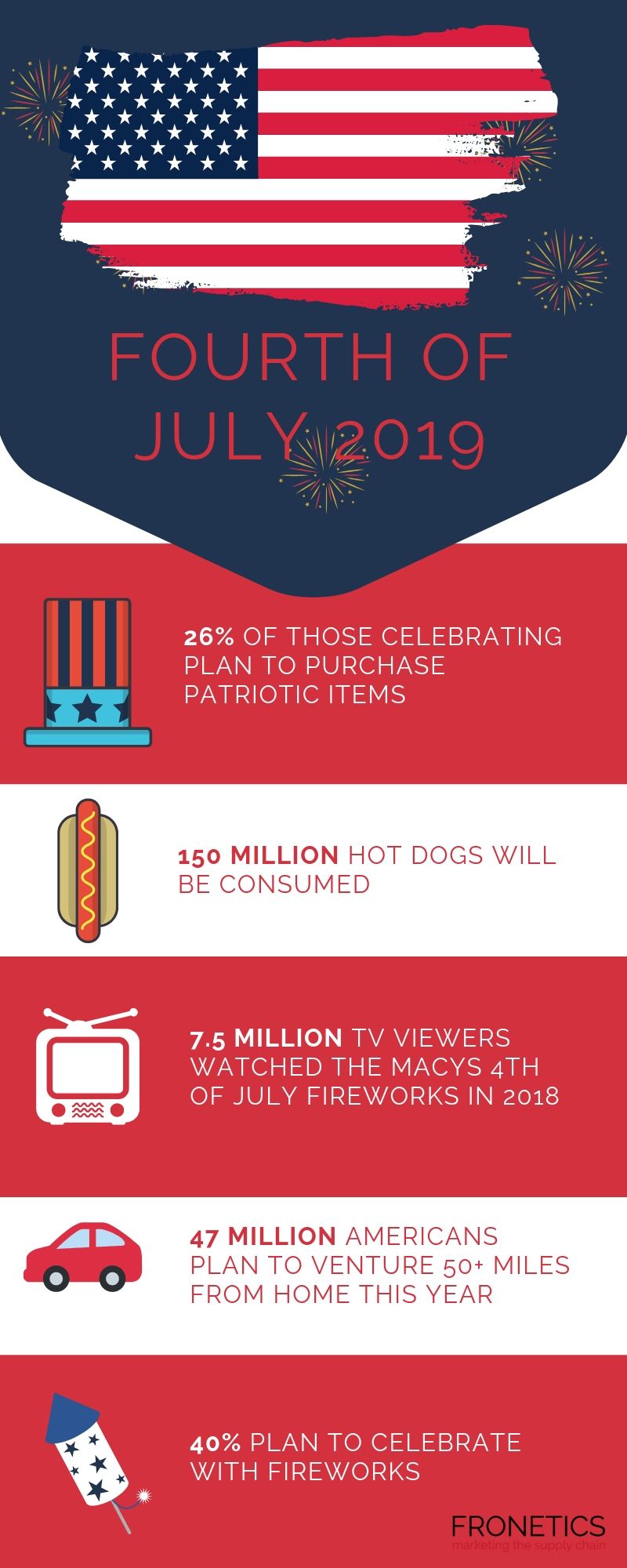
This year, 86% of Americans are planning to celebrate the Fourth of July. That number is down very slightly from recent years, with 87% celebrating in 2018 and 88% in 2017. Consequently, the average expected spending is down by just a few dollars this year, coming in at $73.33 per person, as compared with $75.35 last year.
Interestingly, while men and women are planning to celebrate in just about equal numbers (86% and 85% respectively), women plan to be significantly more frugal than men when it comes to purchasing food. Men are expected to spend $78.68 on average, while women plan to spend $68.20 each.
What’s everyone doing for the Fourth of July?
Cookouts, BBQs, and picnics are in most people’s plans (61%), with 40% planning to attend fireworks or other community celebrations, and 11% are attending parades. 26% of Americans are expected to purchase patriotic merchandise for Independence Day this year.
Even though overall spending is expected to be slightly down this year, AAA estimates that a record-breaking 48.9 million Americans are planning to travel this Fourth of July. This is a 4.1% rise over last year, with 1.9 million more people planning to get on the road this year. AAA credits the record numbers to lower gas prices, strong economic fundamentals, low unemployment, and rising disposable incomes.
Hot dog stats
Americans eat hot dogs better than just about anyone, and this Fourth of July, we’re expected to chomp down on roughly 150 million. It’s worth remembering that a year ago, Joey Chestnut set the record for the number of hot dogs eaten in 10 minutes, working his way through an impressive 74. Hot dogs are best washed down with a patriotic toast, and Americans are expected to spend upwards of $1.6 billion on beer and wine.
However you plan to spend the Fourth of July, Fronetics wishes you and your family a fun-filled and safe weekend.
Participating in social media is increasingly important for businesses in the supply chain. Here are the 3 steps to proving social media ROI.
Highlights:
It may seem obvious, but too many businesses approach social media marketing with vague goals or none at all.
Once you’ve set your goals and identified your key metrics, it’s time to implement a system that will track and measure your metrics.
Once you’ve calculated ROI for your social media platforms, it’s time to think strategically about optimizing your content marketing resources in terms of allocation and timing.
Video transcript:
I’m Elizabeth Hines, Creative Director at Fronetics, and today we’re talking about three steps to prove social media ROI.
Participating in social media is increasingly important for businesses in the supply chain. But many clients tell us they have a hard time getting approval for the expense because it’s notoriously difficult to measure the return on investment.
Well it’s true that many of the benefits of social media — like greater brand awareness and improved communication with customers — are difficult to quantify, there are some ways to prove the ROI of your participation in social media.
Here are the 3 steps to proving social media ROI:
1. Set goals
I’m not talking “grow your business” or other vague benchmarks like that. I mean “increase web traffic from social by 10% over the next 90 days.” Really specific benchmarks and goals are important in measuring success.
2. Track and measure
Make sure you have means to accurately measure how you’re doing against your goals. All the social platforms have excellent analytics tools to help with this. We also use tools like Google Analytics and HubSpot.
3. React
Look at your metrics in the context of your goals. Once you figure out what’s helping you meet those objectives and where you’re falling short, you can tweak your efforts to be more successful and to make sure that you’re actually achieving your ROI.
For more information on social media and all things digital marketing, visit our website at Fronetics.com
As the internet is increasingly dominated by visual content, social media analytics are failing to keep up.
Highlights:
Most social media analytics tools are purely text-based.
Even tools that analyze images are costly and offer limited insights.
We predict that machine learning capabilities will improve and the gap between analytics capability and brands’ needs will close.
Here’s an interesting conundrum: social media, and the web at large, is becoming increasingly visual, and social media marketing relies on increasingly sophisticated analytics. However, most of the analytics tools out there are woefully unable to make sense of the visual content that is dominating social media. The alarming truth is that social media analytics are failing to capture invaluable data on visual content.
How social media analytics are failing to keep up
Big data and artificial intelligence expert Kalev Leetaru describes the shortfalls of social media analytics by detailing what they can — and can’t — do. While the capabilities of visual analytics have grown in the past several years, as Leetaru points out, most analytics tools that claim to analyze visual images are in fact based on textual or structural aspects of the image, not the visual content itself.
“The overwhelming majority of production social media analytics research relies primarily on hashtags and associated caption text, rather than the actual contents of the images themselves,” writes Leetaru. Instead, “from simplistic bag of words counting algorithms through advanced deep learning approaches, it is text that forms the lens through which we see social media.”
It’s important to note that this text-based approach is true not only for social media analytics, but for search engine algorithms. At Fronetics, we are constantly advising our clients to make use of visual content, from images to infographics to video, in their digital marketing efforts. But we always advise that marketers optimize their images for search engines, both by tagging all visual assets and publishing transcripts to go along with video or infographics.
In essence, we’re advising our clients to take advantage of the increasingly visual nature of the internet, while also hedging against the ways in which algorithms and social media analytics are failing to assess visual content. As Leetaru points out, even in the rare cases when an analytics tool offers image analysis, it “typically offers only a few basic lenses through which to analyze that content, such as logos and a small number of topics.”
Of course, analyzing visual content is no easy task, and it’s also not cheap. “Images don’t capture reality, they construct it,” observes Leetaru. Not only are there all kinds of variables, like framing or lighting, that come into play, but there is a tremendous amount of non-visual context that determines how an image will be received. And the fact is that “current deep learning approaches are largely unable to incorporate such external world knowledge into their assessments.”
The problem with analytical failure
It’s important for marketers to recognize that, at the current moment, there is a gap between the capabilities of analytics tools and the analytics needs for modern digital marketing. As we as a society “increasingly express ourselves exclusively through visual forms,” brands desperately need insights about this visual expression.
Leetaru sums up the problem with sobering simplicity: “As social media becomes more visual, it becomes less accessible to our data-mining algorithms. In turn, as social media is less and less data minable, we are less and less able to understand it.”
Perhaps even more alarmingly, he cautions that “given that visual expression skews towards the younger and influencer demographics of greatest interest to many brands, this transition is especially damaging to their ability to extract useful insights from social media.”
Essentially, what Leetaru is recognizing is that we’re at a perilous moment for digital marketing. Just when the possibilities for content creation and dissemination seem endless, social media analytics are failing to offer up the insights needed to shape these processes in an increasingly visual climate.
“In the end, as social platforms rush towards a visual-first world, the vast landscape of social analytics is getting less and less representative of what we’re really talking about,” concludes Leetaru.
What does the future hold for analyzing visual data?
While you may be thinking that the future looks pretty bleak in light of how social media analytics are failing us, there’s a silver lining. If there’s one constant when it comes to social media marketing, it’s that when there’s a demand, sooner or later, supply will catch up.
It’s true that the current visual analytics capabilities of most platforms are far behind what’s needed. But at Fronetics, we predict that deep machine-learning capacities will start to catch up, and increasingly sophisticated analytical capabilities will become available to a wider segment of the market.
Currently, social media analytics can recognize text, faces, and brand logos within images. While these capabilities are, at present, too costly for most companies to take advantage of, we’re keeping our eye on some emerging technologies. For example, analytics provider Scraawl has recently released a tool called Scraawl PixL, which will allow users to run object and face detection, as well as Optimal Character Recognition, which extracts text from images.
Expect to see more tools like PixL on the market, offering increasing sophistication. While social media analytics are failing to keep up with the onslaught of visual data at the moment, we predict that they won’t be behind for long.