Supply chain leaders must be ready to implement big data in order to continuously improve.
This guest post comes to us from Adam Robinson, director of marketing for Cerasis, a top freight logistics company and truckload freight broker.
Supply chain leaders are enthralled with the idea of using big data, but they tend to fail to understand how to disseminate big data in their organization properly. True, they may know how to roll out big data in a single warehouse, or they may have heard their competitors used branded systems for implementing this new technology. However, the fundamental problem remains.
Supply chain leaders must be ready to implement big data and leverage it to improve their companies without any delay or inhibition. This may sound impossible and frightening, but they must only understand how big data always goes back to these two, simple principles of measurement: review and action.
Ask traditional questions, and let big data provide answers.
The most common complaint of newer companies using big data analytics capabilities tends to revolve around traditional questions of business strategy. Consider the following elements explains John Richardson of Inbound Logistics, that impact business strategy.
Increasing order efficiency.
Demand forecasts.
The quantity of each product.
Inventory location and management.
Raw material suppliers and logistics.
Transportation modes used in procurement and shipping.
Distribution of goods prior to purchase.
Demand fluctuations.
Each of these elements more traditionally handles by outsourcing analysis of processes to supply chain consultant. This is actually where the concept of third-party logistics providers involved. However, rapid growth and diversification of products are making shippers, manufacturers, and suppliers rethink their business strategy. In other words, consumers can get practically anything they want at a moment’s notice, and more consumers are expressing a willingness to wait for a product a few days if free shipping is a possibility. So, this need to adapt operations reflects the common concerns of traditional customers and supply chain entities. However, there is a distinction.
Previously, these entities only needed to focus on their local demographic for ensuring continued stability. But the rise of the internet has given consumers and everyone else the ability to access any product from any seller and any place on the globe. This is a traditional business strategy, and it is essential that the modern supply chain is willing to use big data all operations to create a more positive result than consumers, stakeholders or government organization ever needed before.
Performance measurement and management.
As explained in a previous blog post, continuous improvement in an organization can be achieved through the use of performance measurement tools via big data. Mostly, this reflects the skills and actual working capacity of employees. Since employees represent one of the largest expenses an organization may face.
Having the best staff members available can mean the difference between success or failure in a company. Furthermore, big data can help employees understand what they do and do not need to do in order to improve their performance scores. This will also help to prevent oversight from managers and keep all employees on track to complete their responsibilities as assigned.
Performance measurement does not have to be limited to the performance of employees either. It can be expanded to identify poorly performing machines, or it can be used to isolate inefficiencies in collaboration with suppliers or vendors. Ultimately, performance measurement is a metaphor for tracking any metric in the course of the supply chain, but it’s key to being effective is found in transferring the insights gleaned from big data into actionable results.
For example the operational efficiency of a given loading is directly related to how quickly pickers are able to fulfill orders and move them onto the dock. Obviously trucks can only be loaded so fast; what is the number of pickers appropriate for the current workload, or which route through the factory is adding an extra 20 minutes to each worker’s duties?
These questions illustrate that the most insignificant details can be driving forces of inefficiency in the supply chain. But they represent opportunities for continuous improvement. Changes in the design or layout of the warehouse or alterations to the truck schedule may require changing the duties of a certain worker at a moment’s notice. Essentially, the worker must be able to access continuous data measurements on all factors affecting his or her responsibilities.
Supply chain leaders need to focus on continuous improvement.
Continuous improvement is a complex notion. It is based on hundreds, if not hundreds of thousands, of individual metrics from various collection points and analyzed in real time. All of this reflects a very large volume of data. It can be digested and broken down into usable bits, much like the biological processes of the stomach making it essential to surviving the coming season.
This comparison is much more than a metaphor; it is the real issue being faced by supply chain entities and their leaders. Supply chain leaders must use big data to gather insight and create quantifiable measures of performance and functionality across their enterprises on a recurring, frequent and immediate basis.
Consumer expectations of expedited, free shipping come at a cost to e-commerce businesses — but is it worth it?
The race to deliver orders at an ever-increasing pace — free of charge — is raising the stakes for shippers and retailers. Everything from the size of packaging to the selection of the right carrier has to be examined to prevent e-commerce ventures from becoming financially unviable.
While Amazon, the uncontested super power of e-commerce, has been known to rack up big losses to gain market share, smaller players are battling to meet consumer expectations of two-day, next-day, or even same-day delivery. The Amazon effect also means consumers are less willing to pay anything at all for shipping.
As free shipping is becoming a prerequisite for building customer loyalty, retailers know that charging even a minimal amount to deliver the product can break the deal. If the cost of shipping is perceived to be excessive, 63% of consumers surveyed by Jupiter Media Metrix will cancel the purchase.
In addition, consumers have grown accustomed to adding on smaller items to qualify for free shipping. But those items — one-ounce face creams, eye shadow, ear plugs — frequently arrive at their destination at significant cost. Jupiter found, for example, 45% of companies lose money on shipping.
Shippers also pay the price as small items do not necessarily come packaged in small boxes, consuming valuable space at a time when U.S. trucking tonnage is at record highs. FedEx and UPS both made headlines early last year when they, despite low fuel prices, raised shipping rates, partly as a result of dimensional weight pricing.
Now standard industry practice, dimensional weight pricing is estimated to have increased parcel shipping costs by as much as 20%, an additional expense ultimately passed on to consumers as well as small business owners. And with e-commerce forecast to grow from $392 billion this year to $491 billion in 2018, according to eMarketer Projections, demand will remain high at the same time as the shortage of drivers appears to have no real solution.
Pressure is likely to mount further as Amazon seems to be preparing to launch its own global package-delivery service that could rival those of competitors such as UPS and FedEx. With space on pallets a hot commodity, Amazon kicked off the year by adding thousands of trailers to its fleet, which is transported by third-party carriers. The online giant also hopes to build its own U.S. cargo operations to guard itself against delivery delays that affected some shoppers this past holiday season.
So what is the small business owner with a burgeoning e-commerce business to do?
Since it may be nearly impossible to rival the speed of Amazon Prime, focusing on keeping shipping costs to a minimum should pay off, advise several experts interviewed by Entrepreneur.
Steve Strauss, author and founder of www.smallbiz.com, a small-business consulting site, recommends businesses offer at least one express service and one standard service. “In this competitive environment where there’s very little customer loyalty, things like shipping matters. Look at it this way: If you don’t have a store location, you’re saving on rent and employees. Eat the shipping. It’s a small cost to you, and customers will respond,” he said.
What do you think is the key to staying competitive in the e-commerce space?
Companies within the logistics and supply chain industries are increasing customer engagement, market and business intelligence, leads, and more by participating in social media.
Results from a previous Fronetics survey tell us that 100% of responding companies in the logistics and supply chain industries consider social media a strategic tool. So how are they using these platforms, and what benefits are they getting from participating?
Below, find some highlights from that survey.
By the way, if you’re interested in how companies in these industries are using social media, take our latest survey so that we can provide you with the latest results and trends. It takes about 3 minutes, and we’ll send you the new report once it’s completed.
Social media networks popular with the supply chain
According to the survey, the most popular networks are as follows.
YouTube (50%) and Google+ (45%) are networks which are also commonly used within the supply chain and logistics industries.
Reasons for using social media
Companies reported participating in social media for the following reasons.
Increasing the visibility of their company (95%)
Brand image (90%)
Establishing the company as a thought leader (86%)
Attracting new leads and customers (82%)
Top benefits realized from social media participation
Companies reported the following benefits.
Customer engagement: 80% of respondents reported that they agree or strongly agree that by participating in social media, their company has realized an increase in customer engagement.
Market intelligence: 80% of respondents also reported that they agree or strongly agree that their company has realized an increase in market intelligence.
Business intelligence: 73% responded that they agree or strongly agree that their company has realized increased business intelligence through participation in social media.
Other top benefits included increased leads and increased demand for products and services.
You can download the full report below for more information on how your industry peers are using social media. And don’t forget to participate in our new survey so that we can send you the latest information.
Fronetics invites you to participate in a survey on how companies in the logistics and supply chain industries use content marketing.
If there’s one thing we can say about the ever-changing B2B marketing climate, it’s just that: it’s ever-changing. Keeping pace with shifting industry trends, innovations, and challenges can be daunting. But knowledge is power when it comes to creating a vital and robust marketing strategy.
In 2014, Fronetics decided it was time to gather hard data on how logistics and supply chain companies were using modern marketing tools like content. We conducted an industry-wide survey, gathering a valuable snapshot of the marketing landscape.
Now it’s time for another look at the data. So Fronetics invites you to participate in our 2016 surveys on content use in the logistics and supply chain industries. The survey takes about 3 minutes to complete, and no personal or company data will be reported. Additionally, you can indicate your preference to receive the completed report.
Key findings from the 2014 content use report point to companies using content primarily to build brand awareness and generate leads, with blog posts being the most popular content format. While all respondents reported using content marketing for a relatively short time, the majority had already seen a positive impact on their business.
Fronetics is curious to know, two years later, about the ongoing impact of content marketing. In addition, we’d like to find out if the industry is using content in new ways. Has content use expanded? Are blogs still the most popular format? What challenges are B2B companies facing when it comes to content creation and distribution?
The answers to these and more questions can provide vital insights as you shape your company’s marketing strategy for the future. Especially when it comes to modern marketing techniques, knowledge is power.
Take the content survey by clicking on the button below. Be sure to indicate your preference to receive the results. We look forward to your responses!
The shortage of drivers paired with the continued growth of the trucking industry paves the way for driverless trucks.
This guest post comes to us from Rachel Everly, a writer for Cerasis, a top freight logistics company and truckload freight broker.
The trucking industry has been serving America for many decades, and even today it is the main method by which freight is transferred all over the country. Anyone who says the trucking industry is facing a decline or a reduced demand is way off the numbers. More large trucks are coming on U.S. roads, traveling more miles, and transporting more good than ever before.
We have seen more than 3% increases in the number of trucks, which translates to almost 11 million trucks. Also, trucks are still transporting 73% of almost all cargo weight moved in one year. With all these impressive numbers, surprisingly there is a shortage of drivers. That spells both trouble and opportunity for this industry.
Where is there a shortage of drivers?
The U.S trucking industry is facing a severe driver shortage. One estimate shows that around 48,000 drivers are required to move about 70% of freight.
To improve safety, in December 2015, the U.S. Department of Transportation’s Federal Motor Carrier Safety Administration (FMCSA) announced that driver hours will be recorded via Electronic Logging Devices by 2017. This becomes mandatory by December 18, 2017. This was introduced because the existing systems of time-logging are purposely made very complicated, thus not allowing one to check how many hours is a driver on the road.
This is being introduced to ensure that driver safety is not compromised, keeping fatigued drivers off the road. According to calculations, this will save 26 lives a year and prevent 562 injuries every year. Not just this, the ELD will save companies the hassle of paperwork, eventually leading the trucking industry to save somewhere around $1 billion due to reduced paperwork and time-savings.
However, this means reduced hours per driver, thus increasing the need for more drivers. Small trucking companies will be hit the hardest, but overall the industry will be in a better position thanks to this rule. It is estimated that this new rule would cost the industry $1.8 billion, but cost savings from reduced accidents and paperwork amount in excess of $3 billion.
The way to driverless trucks
Humans are amazing creatures, but we are prone to human errors. Human errors account for the majority of the road accidents. Plus with the new rule in, companies will need more drivers, adding to costs. Uber has been actively working on getting driverless trucks on the roads, with a project already started in Singapore, and now has turned its eyes on the trucking industry.
Uber has recently acquired the start-up Otto. Otto has made great inroads into driverless trucks. Otto currently has 6 working self-driving trucks, with plans to expand to 15. This year Otto is continuously running tests; trucks are hauling random items from the company’s garage to test how the vehicles respond to hauling weight.
The company is confident that soon they will be moving all kinds of goods for shippers. They have already started forging relationships with big names in the trucking industry. The self-driving trucks have shown that they can easily operate on highways, maneuvering off the open interstate is still a work in progress.
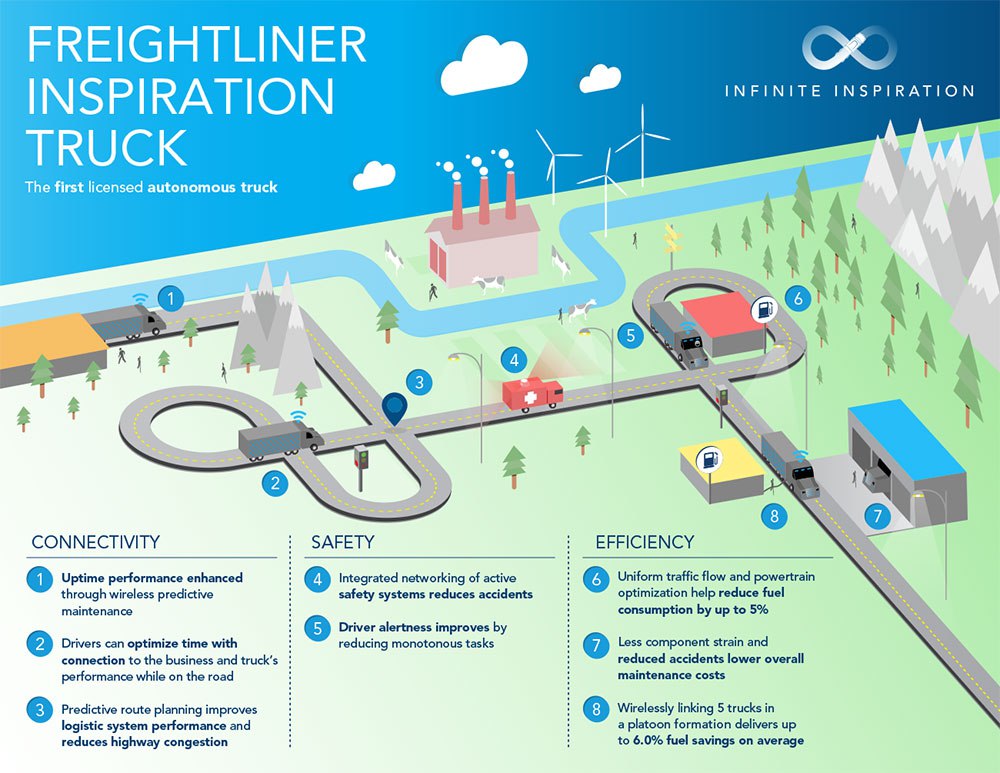
The following infographic outlines some of the benefits of driverless trucks:
Fronetics is conducting a survey to determine the benefits and challenges of social media for companies in these industries.
Two years ago, Fronetics surveyed a number of individuals working in the logistics and supply chain industries, including those employed by manufacturing, warehousing, and transportation companies. The survey’s goal was to find out how these companies were using social media, and if they were realizing any benefits or encountering any challenges by participating.
Interestingly, 100% of respondents reported having used social media for 5 years or less. Despite this relatively short implementation period, the majority (68%) said that their companies had already realized benefits from participation — primarily increased engagement with customers, increased market intelligence, and increased business intelligence.
As things go in the technology space these days, social media looks quite different than it did two years ago. What’s more, companies in these industries have, presumably, been using these tools for longer. Have a better understanding of social platforms and more opportunities for businesses impacted the benefit to users?
Fronentics is conducting a new survey to find out. We invite individuals working in the warehousing, manufacturing, and transportation industries — or those in other supply chain and logistics fields — to participate.
The survey takes about 3 minutes to complete. Responses will be reported in aggregate, and no identifiable information (individual or company) will be shared.
We look forward to hearing about your experience with social media!