by Elizabeth Hines | Feb 1, 2017 | Blog, Content Marketing, Marketing
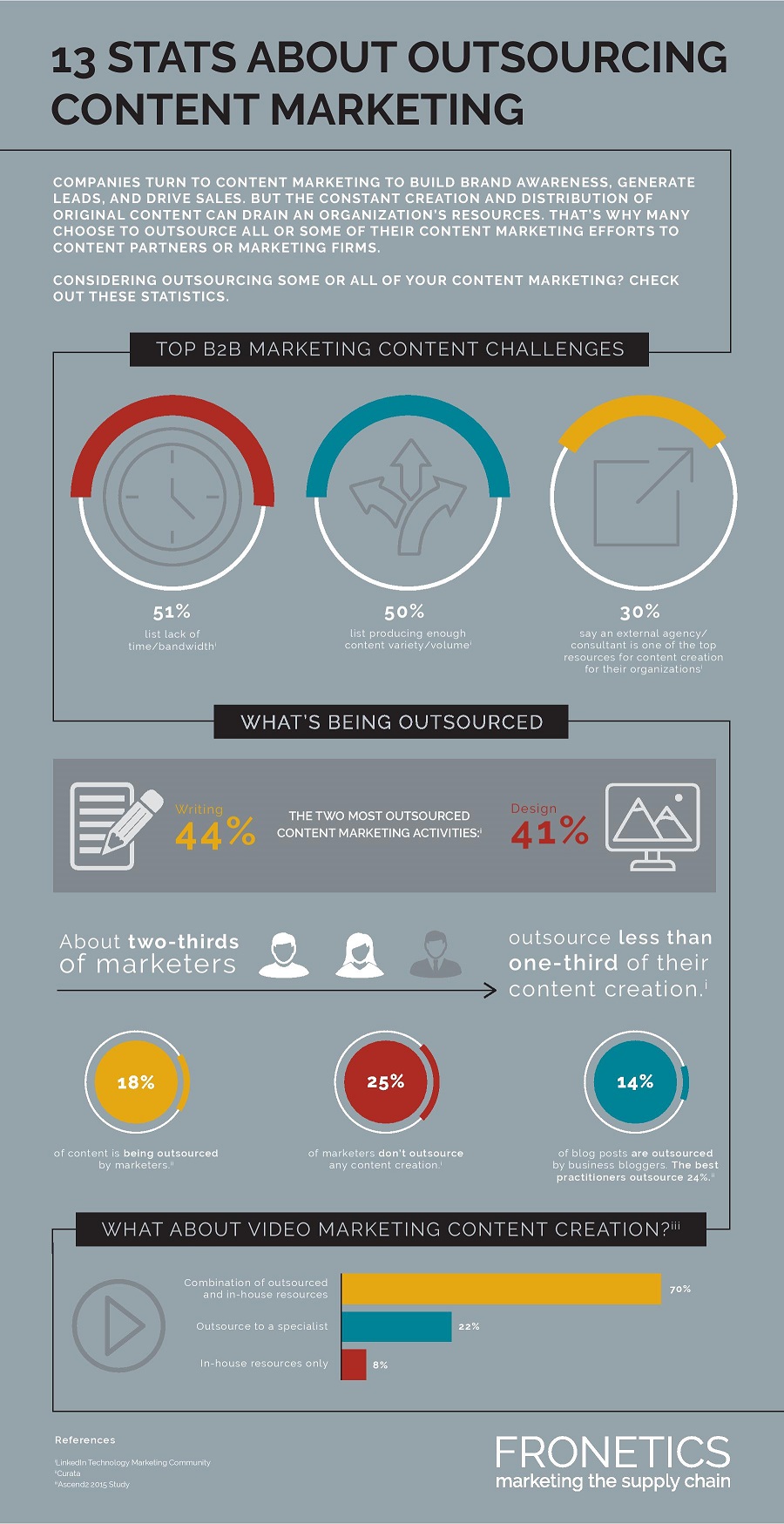
Thinking of outsourcing content marketing? This infographic illustrates how other B2B marketers are handling content creation.
Plan. Create. Distribute. Repeat.
Does the constant creation of content feel like a drain on your resources? Do you feel like the content you’re publishing isn’t on par with the standards of your business? Do you dread the days that you need to write a blog post or prepare a customer resource?
If any of these questions hit home, chances are you’ve thought about outsourcing.
Outsourcing content marketing can be a beautiful thing: You put the content creation, design, and even distribution in the hands of an expert, leaving you free to focus on your job. But, isn’t that cheating? (It’s not.) Are other companies doing it, too? (You bet.) Ultimately, is it a good business decision? (The top business blogs outsource about 24% of their content creation.)
We’ve created the following infographic to illustrate how other B2B marketers are handling outsourcing content marketing. Here are 13 statistics you need to know before you consider outsourcing.
(Made with Canva)
Related posts:

by Jennifer Hart Yim | Jan 31, 2017 | Blog, Content Marketing, Marketing, Social Media, Strategy
Rival IQ’s Danica Benson discusses the importance of social benchmarking and offers three steps for getting started.
This guest post comes to us from Danica Benson, marketing communications manager at Rival IQ.
Imagine you’re on a little league baseball team. You’re up to bat. You swing and hit, sending the ball far over the second baseman’s head. You take off to first, see the outfielders running to the fences, fly past second base and onto third. The center fielder overthrows the ball as you sprint toward home, kicking dirt into sky behind you. Everyone is screaming, clapping and shouting! A home run! You feel on top of the world!
No matter which league you play in, be it little league or the MLB, a home run is successful. But, what if the pitcher walked you? In little league nobody claps, screams, or cheers. The next batter comes up, and you feel bummed out. But, not necessarily in the MLB. A walk is a strategic move. You’re on base. It’s only one base hit away from scoring position. A walk has the potential to be a game-changer and is considered a success. How is this so?
The benchmark determining success is different in the MLB than in little league. It’s the same performance in both cases, but a different interpretation of success. The same idea applies when measuring your social media activity — what is considered a successful engagement rate, number of followers, or content in one industry isn’t the same as the next.
Benchmarks require context
Benchmarks are key when interpreting data. Organizations of all kinds — large corporations, small privately owned business, nonprofits, and even sports teams — need to measure their performance to see if they’re efforts are leading to success.
Key performance indicators (KPIs) like Net Promoter Score (NPS) at a company, number of clicks on a social post, or a player’s batting average tells someone a lot about what is happening as a result of their activities. But it tells them nothing in terms of whether their efforts are successful, failing, or where to focus to close up those gaps. Why? Because benchmarks are relative.
3 steps to successful social benchmarking
Establishing benchmarks relative to your top competitors, like audience size and engagement rate, are meaningful because you are comparing to others like you who are fighting for the attention of the same audience. Without context, your metrics are what we call a “so what?” metric. We have 1,500 followers on Facebook… so what? Do we need more? Is that a good amount? These numbers only mean something if you have a benchmark for comparison.
At Rival IQ, measuring digital marketing performance begins with setting competitive benchmarks. To develop an effective social media strategy, you need contextual data. Analytics are great, but not if you don’t have context to compare your data. There are a couple of ways to do this: by comparing your organization’s metrics to itself, or by keeping tabs on your competitors. Using these methods, you can compare apples to apples and see growth in your organization, as well as how well you’re doing compared to your competitors.
Step #1: Know YOUR organization’s internal benchmarks
First and foremost, get to know your numbers. Identify your metrics and compare them to how you did last month (MoM) or last year (YoY). You always want to outperform yourself, so these benchmarks give you a base to start from and allow you to see if your activities are resulting in growth. Benchmarks can help you understand where your performance has been in the past, and help you create realistic expectations for the future.
But, what do you do if you don’t have any historical data to work with because you’re just starting up your analytics? I recommend looking at industry benchmarks, which you can find on websites such as Kissmetrics and MailChimp.
Step #2: Know your competitive benchmarks
Measuring your performance against your competitors gives you business intelligence you can use to make better decisions — especially if you’re struggling to earn social media attention. It’s too easy to think that we can just type, “What’s a good engagement rate for Instagram?” in a Google search to find a benchmark that means anything. What you will find are general figures calculated using everyone who uses the platform, which is great if your target audience is everyone who uses Instagram (not likely).
Go deeper than your industry by building your social benchmarks from scratch. Hand-select your direct competitors and look at metrics, such as:
- Which social channels do they use?
- How does the content differ between channels?
- When and how often are they posting on social media?
- What type of content are they sharing? Are they posting updates, photos, videos, live video, .gifs?
- What do their engagement rates look like?
- How many followers do they have?
Setting your social marketing strategy using your own landscape of competitors will give you a realistic, attainable goal. Accurate, relevant benchmarks are the first step in paving the way toward gaining a competitive advantage.
Step #3: Track, test & tweak
Now that you’ve reviewed your organization’s performance and can measure if it’s trending upward (or not), and you have established your benchmarks relative to your competitors, you track, test and tweak.
Track performance
By tracking your performance over time, you will be able to see if your audience is getting bored with your usual posts and may need to change your tactics. By monitoring your competitors, you can learn what content works well and take advantage of opportunities they may be missing.
Never stop testing
Social media is a great place to test things out, like new ads, campaigns, copy, contests, surveys, images, etc. Secondly, they give you feedback, fast! Find out what your audience likes on social first, then learn from your wins and failures. Take what you learn about your audience on social media and apply it to other marketing activities.
Tweak for optimization
This goes hand-in-hand with testing. Once you’ve tested a few things and have identified what’s working, tweak it and test it again to optimize it. Find the sweet spot. Social media is always changing, so there will always be more work to do.
Just as with all good strategies, you have to continually measure success and adjust based on real-world results. Competitive analytics is a great way to set social media benchmarks by basing them on companies you aspire to beat. If you aren’t beating the competition, it might be time to go back to the drawing board.
Originally from the Portland Metro Area, Danica Benson migrated north to work as a marketer in the startup arena. As the marketing communications manager at Rival IQ, she’s bringing her passion to the tech world. Outside of the office, Danica spends her free time on outdoor adventures and exploring the great city of Seattle.
Related posts:


by Elizabeth Hines | Jan 31, 2017 | Blog, Content Marketing, Marketing, Social Media, Strategy
Sales teams can use social media to cultivate relationships with potential buyers, a process called social selling.
With the dawn of the social media age and the exponential increase in choices and information available to buyers, we’ve seen a massive shift in the way B2B sales occur. According to the Harvard Business Review, a striking 84% of B2B sales start not with a salesperson, but with a referral.
As outbound sales become decreasingly effective, peer recommendations are influencing more than 90% of all B2B buying decisions. So how do we make the shift from outbound sales to this new reality? One of the more popular answers is social media.
It’s likely that your organization has some sort of social media marketing strategy in place. But making full use of these platforms requires a more nuanced, well-rounded strategy than blanket social media marketing. It’s time to introduce the idea of “social selling.”
Social media as a sales tool
In a basic sense, social selling is the strategy of adding social media to the sales professional’s toolbox. This means using social platforms to research, prospect, and network by sharing curated educational content and answering questions. The key is building relationships until prospects are ready to buy.
So what’s the difference between social media marketing and social selling, and why is it important? While both are necessary to an integrated marketing and sales strategy, the former is about engaging many — with the goal of increasing brand awareness or promoting a specific product — by producing content that users will ideally share with their networks.
Meanwhile, social selling means producing focused content, and providing personal communication between the salesperson and the buyer. Again, the key is building and cultivating a relationship using social media platforms.
How to start social selling
The benefits of social selling are numerous and significant. For example, according to a LinkedIn survey, B2B buyers are five times more likely to engage with a sales rep who provides new insights about their business or industry. Social media is a powerful engagement tool, giving sales people a platform for sharing these insights.
Here are some steps your sales team can take to implement social selling.
1) Put it in your calendar.
Allot a small portion of your day for social media. It doesn’t take a big time investment to reap the benefits of regular interaction with your prospects.
2) Integrate sales and marketing.
Encourage collaboration between sales and social marketing departments, to make the most of both efforts. HBR suggests that “marketing can train salespeople in social media systems, processes, and best practices.” In addition, sales and marketing should be regularly sharing information to make sure their goals are aligned, and efforts are dovetailing. According to a study by Data Room and Marketo, “sales and marketing alignment can improve sales efforts at closing deals by 67% and help marketing generate 209% more value from their efforts.”
3) Prioritize relationship-building.
Focus your business’ ongoing efforts to building and cultivating quality relationships with prospects. This means building in time every day for personal communication. Make your prospects’ needs your priority.
The bottom line here is building and maintaining relationships. Social media — and social selling — are powerful tools for doing just that.
Related posts:

by Elizabeth Hines | Jan 30, 2017 | Blog, Content Marketing, Logistics, Marketing, Supply Chain, Transportation & Trucking
Our readers voted Morai Logistics, Women in Trucking, and the Oracle Supply Chain Management Blog as the top 3 logistics and supply chain blogs of 2017.
Every year we ask our readers to vote for the best industry blogs. The results are always interesting — there’s really a lot of great supply chain and logistics content out there, plus it’s great to see where our readers are finding value.
This year was no different. The best logistics and supply chain blogs, as named by our readers, are all new to our best blogs list. They probably couldn’t be more different, either. But all three offer consistent, high-quality content, which is key to running a successful blog.
Here are the top 3 logistics and supply chain blogs of 2017.
1) Morai Logistics
Morai Logistics Inc. is a Toronto-based third-party logistics provider representing Mode Transportation. Morai’s blog covers the most pressing issues facing the logistics industry, as well as trends to watch out for, professional tips, and career advice. The almost-weekly posts have a lot to offer, in terms of information and thought leadership, and they often include valuable (and, might we add, beautiful) visual elements like infographics.
P.S. Check out our interview with Morai Logistics’ President Kelli Saunders.
2) Women in Trucking
The Women In Trucking Association is a non-profit organization focused on encouraging the employment of women in the trucking industry, promoting their accomplishments, and minimizing obstacles. Just one vote shy of the top spot, the Women in Trucking blog — or, should we say blogs — bring to light many issues of concern to both women and men working in the trucking industry. President/CEO Ellen Voie’s blog offers thought-provoking, insight on topics from the driver shortage to recruiting women drivers. The driver’s blog — with content mostly from longtime driver and writer Sandy Long — tackles pressing day-to-day issues facing drivers, such as parking in dangerous locations, family problems stemming from job-related realities, and assimilating to trucking culture.
3) Oracle Supply Chain Management
The Oracle Supply Chain Management blog looks at how Oracle helps organizations transform their supply chains into more holistic and integrated value chains that cover the three key operational pillars: Demand, Supply, and Product. Weekly content from a number of contributors cover topics including supply chain management, events, product lifecycle management, logistics, technology, and more.
Honorable mention
These blogs received quite a few votes as well.
What blogs do you read on a regular basis? Which have the most valuable content?
Related posts:

by Jennifer Hart Yim | Jan 26, 2017 | Blog, Strategy, Talent
The “Right to Disconnect” is combating round-the-clock email culture, but can better work/life balance help boost employees’ productivity?
This guest post comes to us from Argentus Supply Chain Recruiting, a boutique recruitment firm specializing in Supply Chain Management and Procurement.
Here’s a new frontier in work-life balance: For the past several years, work-life balance has been one of the biggest topics in employer and HR circles. Companies are recognizing the productivity benefits of flex time, childcare assistance, on-site stress workshops, and other initiatives designed to make employees happier. They’re also using work-life balance to help attract and retain the best candidates. Read any (good) modern job description, and you’ll see lots of language from companies recognizing the importance of having a life outside of work.
But anyone who’s worked at a few different companies knows that every company has a different track record in terms of actually implementing work-life balance initiatives, and not just paying lip-service to them.
The Right to Disconnect
So here’s an interesting solution from abroad: As of January 1, a new law in France affords workers the “Right to Disconnect” from their emails after hours. In France, a country long-associated with the development of rights, companies with more than 50 employees must now negotiate a new protocol with employees to make sure that their work obligations — like email — don’t carry over to after-work hours.
Europe has long been characterized in North America as laissez-faire when it comes to working hours, mandating more weeks of vacation than Canada (where 3 weeks is the standard) and the U.S. (which typically affords a stingy 2 weeks of vacation). There’s always been a stronger cultural attachment to leisure hours in Europe, where 35-hour workweeks are common, so it isn’t surprising that such a law comes from France.
It’s also not surprising that the idea of completely banning after-work emails has been ridiculed in North America, where many employees work long hours, take lunch at their desks, and answer emails around the clock to prove their value. But outlets like Time magazine have reported on how round-the-clock email culture has taken over France as well, which is part of what’s led to these guidelines.
Work/life balance = productivity?
The idea behind a “right to disconnect” is to restore some of the ever-blurrier boundary between work and life brought about by smartphones with email access. But the idea isn’t just to give workers a break — it’s that if you make sure people can turn off their phones when they leave the office, they’ll likely be more effective in the morning. In other words, a stronger boundary between work and life improves not only life, but work as well.
One interesting piece of Time’s reporting is that checking emails after hours isn’t always company mandated. It’s something that we all often know first-hand: In many cases, checking emails after hours is something we often bring upon ourselves — either out of a desire to get ahead, to be seen as busy and highly responsive, or, let’s admit it, out of boredom. But email begets email, and when everyone’s replying on an email chain after hours, suddenly you come into the office and you’re swamped. Time reports on how companies themselves are tackling the issue of after-work emails. Some companies are building time restrictions into their email clients. Others are formally discouraging using “reply all” to limit the number of unnecessary emails. Others are outright telling their employees not to email after hours.
So does the tendency to email around the clock begin with us, or our employers?
It’s a tough question. For our part, our policy as recruiters is that we should be responding to emails after work hours only for highly time-sensitive issues. We recognize the importance of downtime, even if it’s hard to mandate.
But what do you think? It’s unlikely that a law like this would catch on in the U.S., but is our after-hours emailing obsession making workplaces more productive, or is an always-on mentality leading to burnout and distraction?
Related posts:

by Elizabeth Hines | Jan 25, 2017 | Blog, Content Marketing, Marketing, Strategy
To stay relevant following Google’s mobile-first approach, marketers need to examine their company’s mobile user experience.
Marketers, take notice: Google’s announcement that it is experimenting with a “mobile-first” search index is a reminder to examine your website content and configuration. The message from the search engine giant is clear: Now is the time to enhance your company’s mobile online experience.
A mobile-first society
The future is pointing toward increasing mobile device use. In 2015, mobile traffic accounted for more than half of internet traffic, and that percentage is growing. Google reported that more searches take place on mobile devices than on desktops. In response to this trend, Google’s new algorithms will rank mobile-friendly web pagers higher in search results than desktop pages.
These days, it’s pretty much a given that your clients and customers own a mobile device and use it quite often in their professional lives. Your site needs to meet the expectations of the viewer, which is to access content easily via mobile. If you fall short of this, you’ll lose credibility and, ultimately, income.
What do B2B marketers need to do?
Google currently uses two indexes to rank search results, 1. desktop pages and 2. mobile pages. If Google makes good on its promise to have a mobile-only index, websites optimized for mobile use will get higher billing at the top of search results, leading to more clicks, more brand recognition, and, ultimately, more sales.
Marketers need to prepare now to ensure a prominent place in Google’s search results. Here are three tips on how to do that.
- Develop a strong working relationship with your webmaster — they are in the experts on the technical side and can keep you abreast of updates and trends in website optimization.
- Conduct an audit of your websites to check for SEO. Use a website such as https://responsivedesignchecker.com/ to give you real-time feedback.
- Become familiar with these three methods of web development:
- Responsive web design – allows website pages to adapt to whatever size screen the viewer is using.
- Dynamic serving – the server responds with different HTML (and CSS) on the same URL depending on the user agent requesting the page
- Mobile-only URL – each desktop URL has an equivalent different URL serving mobile-optimized content
Check here to see how your site is configured.
Google’s tips
Google offers tips to webmasters to make their sites mobile-first. If your site is already optimized for mobile with RWD or is a dynamic-serving site, you shouldn’t need to make any adjustments. But if not, work with your webmaster on the following:
- Serve structured markup for desktop and mobile versions
- Make sure your site is accessible to Googlebot
- Verify both desktop and mobile sites in Google’s Search Console
Should your business website be optimized for mobile searching? The short answer is undoubtedly yes.
Related posts: