by Jennifer Hart Yim | Feb 27, 2017 | Blog, Supply Chain, Talent
Argentus Supply Chain Recruiting answers the question about what supply chain companies are looking for in new hires in terms of education.
This guest post comes to us from Argentus Supply Chain Recruiting, a boutique recruitment firm specializing in Supply Chain Management and Procurement.
This is the first installment of a new Argentus feature where we answer career questions. We’re starting this feature to help put our years of recruitment experience to good use, whether your questions are specific to our recruiting specialty of Procurement and Supply Chain or more general. You can find more questions and answers on our blog.
Drum-roll please for our first question:
Hello,
What value do you see in getting a Master’s Degree in Business/Supply Chain vs. some of the designations out there? (APICS, SCMA, etc.)?
Thanks, Vince C.
Thanks for the question, Vince. First of all, we aren’t experts in the curricula of both of these types of programs. Every university program is different, just as every professional designation is different. So we can’t speak to the specifics of various programs. However, we can speak to what companies are looking for in hiring, and how graduating from these programs builds your personal brand. We talk to lots of people in the field.
The short of it is that both an MBA and a Supply Chain designation such as APICS or SCMA can be a boon to your career, but your mileage may vary. It’s fairly common that a client looking to hire has designations as a requirement. It’s less common that they’ll ask for a particular designation (i.e. SCMA), although it’s certainly happened before. Companies are often looking to see that candidates are invested in their continued career development and education. A designation is a good way to establish that, and to pick up some valuable skills in the process.
It’s worth mentioning at this point that a designation is also often valuable for newcomers to North America who might have overseas Supply Chain Management experience, but haven’t yet secured that all-important first U.S./Canadian role in the field. A designation can be a great way to learn about local Supply Chain practices and increase your initial marketability while searching for that first role. While this option isn’t financially feasible for all newcomers, we’ve heard of candidates using it successfully in the past. A designation can provide networking opportunities, make you more marketable, and boost your income.
So is a designation the right move for your career?
One thing to keep in mind is that roles we get that “require” designations are typically at the sole contributor level — meaning below the “manager” level. Sole contributor roles can pay anywhere from 50k to 130k, so it’s not necessarily a roadblock, but it’s less common that leadership roles require designations. And while many designations offer strategic components to their curricula, we’ve had feedback from certain executives that a lot of the education offered is more transactional in nature — and that can be a limitation. For example, learning how to fill out a purchase order might make you a more immediately employable Procurement clerk at the junior end, but when looking for future leaders, executives want to hire people who have a holistic understanding of business strategy. Why are you filling out that purchase order? What’s the impact on the business? Should we be purchasing from someone else? Can we streamline our purchasing process? Should we be purchasing this at all?
The key to progressing into leadership is an understanding of strategy — so if that’s your goal, assess designations based on their strategic content.
Which brings us to MBAs — the coveted Master’s of Business Administration. It’s becoming more common for hiring managers to require Bachelor’s degrees, but it’s rare that they require an MBA. It’s also pretty new to have Supply Chain as an MBA specialization in the first place, and some people have used them to good effect to boost their careers.
The perception is that an MBA is going to be strategic. That they’re polished. That they have enhanced presentation ability. All of these are leadership qualities, and that’s why MBAs are seen as future leaders, even if the degree isn’t an absolute requirement to advance into business leadership — especially within Supply Chain.
However, there’s also the perception that an MBA isn’t going to be hands-on. From our perspective, an MBA isn’t going to work as a replacement for solid work experience. There’s a reason why people often work for 5-10 years in the field before pursuing an MBA: it’s going to augment your leadership potential, but it’s not going to give you leadership potential if you don’t have a variety of experience beforehand.
MBA programs encourage their students to think ambitiously, but it’s important not to let an MBA “go to your head.” We sometimes hear from recent MBA grads who expect to earn 150k+ on the merits of their degree rather than their experience, and they often find themselves in a 70k job a few years after graduating. If you’re prepared for this possibility, an MBA can be valuable, and it can help make you more marketable as a business leader.
So if you’re looking to slot into a Sole Contributor role, a designation might get you there faster. But if you’re looking to eventually climb into a Director, VP or CPO or CSCO role, an MBA might help you more. But don’t expect immediate dividends.
Again, we hope our advice is helpful! And every case is different, so take it with a grain of salt.
Oh, and send us more questions by visiting our blog and filling out a brief form. It can be Procurement and Supply Chain-specific, or it can be about any career topic.
Related posts:

by Elizabeth Hines | Feb 23, 2017 | Blog, Marketing, Social Media, Supply Chain
Here’s what supply chain and logistics marketers need to know about recent social media news as of February 2017.
Staying on top of what’s happening in the ever-changing social media world is crucial, but can be a challenge. To keep you informed of some key developments, here’s our February 2017 edition of social media news for the supply chain.
Facebook shares Q4 and full-year 2016 earnings and community updates
Facebook announced that it now has nearly 1.9 billion users, including 1.2 billion people active every day. More than 65 million small businesses use Facebook as a marketing tool. Zuckerberg emphasized to investors that the company is committed to “putting video first across [its] family of apps and making it easier for people to capture and share video in new ways.”
LinkedIn adds option to disable comments on long-form articles
The site now allows publishers to manage comments on individual long-form articles “at any time.” LinkedIn plans to add the option to turn off comments on all posts “soon.” Publishers can now also report, flag, or hide abusive or offensive comments. Read more
Facebook algorithm updates geared to show more authentic and timely stories
Updates rolled out this month are intended to prioritize “more authentic and timely” content in the new feed. Posts and topics that are already getting “a lot of engagement” or “might be temporarily important to you” are getting a boost. Read more
Facebook extends lead ads to Instagram
Marketers can now run lead ads across both Facebook and Instagram placements. The company recommends that advertisers verify that the creative complies with Instagram’s design requirements for lead ads.
YouTube expands mobile live streaming and launches Super Chat
For creators with more than 10,000 subscribers, mobile live streaming is here, and other creators will have it “soon,” according to the company. YouTube also released Super Chat, “a new live stream monetization tool that lets any fan watching a live stream stand out from the crowd and get a creator’s attention by purchasing chat messages that are highlighted in bright colors and stay pinned to the top of the chat window for up to five hours.” Read more
Related posts:

by Elizabeth Hines | Feb 22, 2017 | Blog, Content Marketing, Marketing, Strategy
Follow these 4 steps to learn how to build a successful DIY content marketing strategy that will help grow your business.
Are you trying to create a content marketing strategy, but don’t know where to begin? Even the language around content marketing can seem foreign to newcomers. That’s why Fronetics created its guide, How to Grow Your Business with Content (download below) — to make creating a content marketing strategy possible for the DIYer in your company.
Setting your content marketing strategy is a crucial first step in trying to reach your target audience. Before you begin writing blogs and posting tweets, you need to set goals. A content marketing strategy outlines the methods by which you will target, reach, and engage your audience. Here are four steps, outlined in the guide, to creating a successful foundation to your content marketing strategy.
Steps to building a content marketing strategy
1. Identify your target audience and buyer persona(s)
Knowing who your ideal customer is allows you to create content that is informative, educational, and entertaining to that specific person. Trying to write compelling content for an unidentified audience is like taking a shot in the dark. The more detailed you can be with your buyer persona(s), the more specific and effective your content can become.
2. Define goals and objectives
Your content goals should be a direct reflection of your business goals. What do you want your content marketing efforts to accomplish for your company? The top marketing goals for content marketers in 2016 included converting contacts/leads to customers, growing website traffic, and increasing revenue derived from existing customers. Make sure you include short-term and long-term goals and that you frequently refer back to these goals to make sure your strategy is on track.
3. Developing and distributing content
Once you have identified your audience and defined your content goals, you can begin to educate yourself about the distribution platforms that will work best for your business. Let’s face it: Social media is not a one-size-fits-all solution. It’s imperative you know not only what to post but where to post it.
There are lots of great resources to help you optimize your content marketing presence. You can individualize your outreach so your blog posts are reaching one target audience, while your tweets are capturing another.
4. Put your knowledge to work
Once you have worked through the initial steps of planning a successful content marketing strategy, the real fun begins. It’s time to start pushing valuable, effective content out to consumers. If you’ve spent the time and effort up front to really thing through your strategy, you’ll reap the rewards in good time. Just remember that your strategy should be fluid, and you should be able to adjust your plans as you move forward and find what is working and what isn’t.
Pulling together a content marketing strategy for your B2B business can seem overwhelming. But having the right tools to support you can make all the difference. Download Fronetics’ easy-to-follow, step-by-step guide How to Grow Your Business with Content below to take the leap to a successful DIY content marketing strategy today.

Related posts:

by Elizabeth Hines | Feb 21, 2017 | Blog, Consumer Electronics, Manufacturing & Distribution, Strategy, Supply Chain
Will sustainability trends from the consumer packaging industry have an impact on electronics manufacturing this year?
As we wrap up the first big consumer holiday of 2017, it’s interesting to think about how innovation in packaging never stops. While many of the newest ideas are hitting consumer applications first, perhaps they will point to new directions for electronics manufacturing as well.
Packaging trends suggest a wide range of startups, researchers, and big companies are committed to finding solutions that match the buzzwords du jour — sustainable, bio-degradable, natural, and eco-friendly.
Here are some sustainability trends in packaging that I think will gain momentum in 2017.
2017 packaging trends to watch
1) Multiple uses
Great packaging protects not only your product, but also your brand. But what if the packaging is part of the product itself?
That is the case with innovations such as the expandable bowl by Swedish design studio Tomorrow Machine. Using 100% bio-based and biodegradable materials, the company created a cellulose wrapper that hugs freeze-dried food and morphs into a bowl when hot water is poured into the spout. The bowl ― a sustainable packaging award winner ― is now in good company, and I expect more will follow.
2) Unconventional materials
Egg shells, fermented sugars, barley, and wheat ribbons — those were the materials used to create, in turn:
- Bio-compostable films: Nano-particles from waste eggshells helped researchers at Tuskegee University in Alabama make a plastic film that is completely sustainable and 700% more flexible than other bio-plastic blends. Film made of the new material could be used in retail packaging, grocery bags and food containers.
- A prototype PHBottle: The European PHBottle project aims to initially create a bottle, cap, and sleeve, although use in other applications (non-food packaging and non-packaging uses) will be tested. The bio-plastic material used to make the bottle comes from the transformation of organic matter found in juice processing by-products.
- Edible six-pack rings for beer: Imagine washing down the six-pack ring with your favorite beer. Although that moment is not quite here yet, the future is looking up for a piece of plastic that is notorious for ensnaring wildlife. The first bio-degradable edible six-pack ring for beer is the result of a partnership between Saltwater Brewery; We Believers, an advertising agency; and Entelequia, Inc., a small startup in Mexico. Made from barley and wheat ribbons spent grain from the brewing process, the rings are safe for wildlife to eat and sturdy enough to support the cans.
3) Reusable packaging
The throw-away culture is not for everyone. In fact, Mintel’s Global Packaging Trends 2017 shows 63% of U.S. consumers actively seek out packages they can re-use. More than half of consumers also say they would prefer to buy foods with minimal or even no packaging. With such great demand for waste reduction, innovation is bound to pick up even more momentum.
What do you think 2017 will bring in terms of sustainable packaging for the electronics industry? Let us know about promising innovations you’ve seen.
This post originally appeared on EBN Online.
Related posts:

by Elizabeth Hines | Feb 20, 2017 | Blog, Content Marketing, Marketing, Supply Chain
A recent survey of over 400 business blogs shows what the best bloggers have in common and what supply chain marketers can do to improve their blogs.
Maintaining a blog for your business can be somewhat of a guessing game. How often should you publish? Should you do all the writing in-house? Will anyone read our posts?
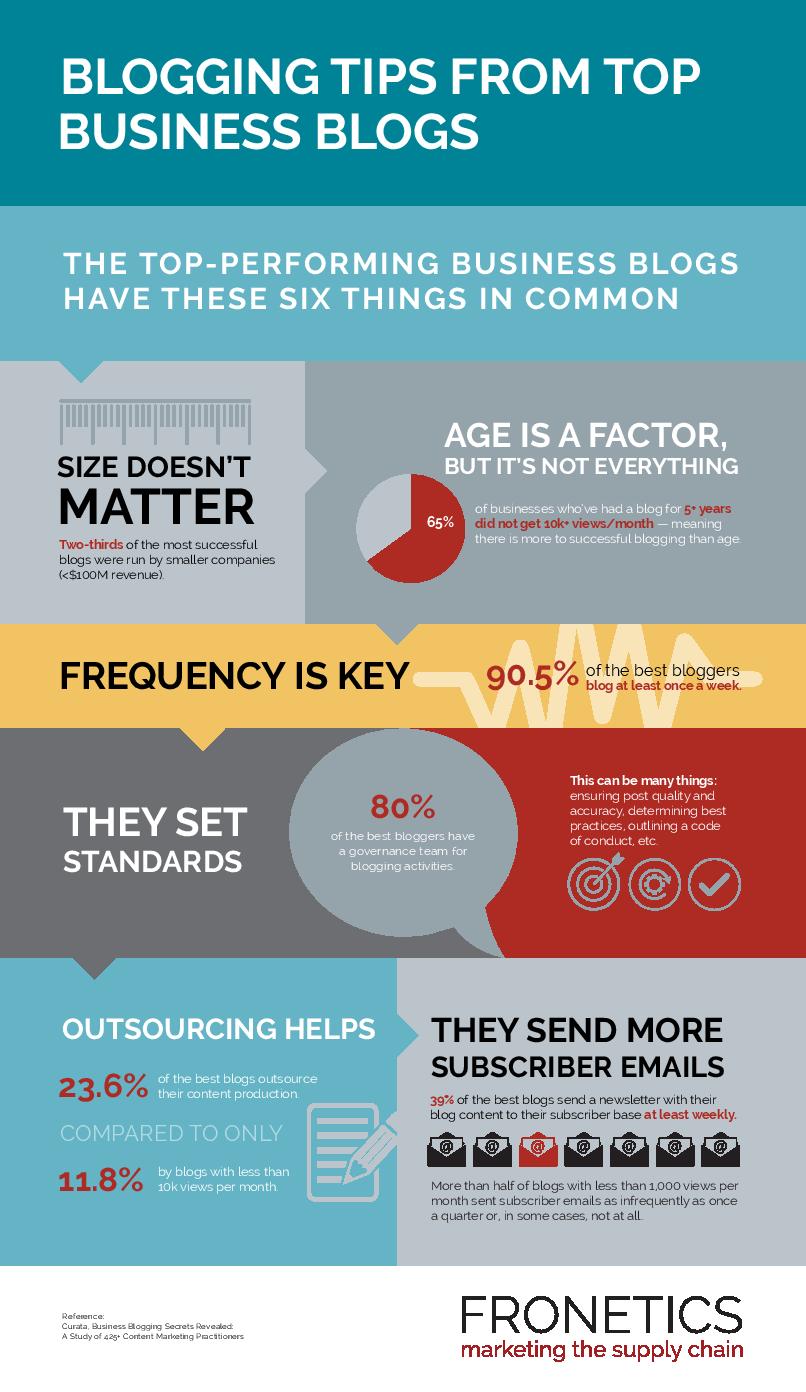
A recent survey of 428 marketers conducted by Curata sought to identify any patterns or trends among those with the most successful business blogs. Specifically, the authors grouped together those whose blogs had more than 10,000 views per month and compared them to those with less than 10,000 views per month.
The most successful blogs (those with over 10,000 views per month) have several things in common. The following infographic shows some highlights from the survey.
(Made with Canva)
Read the full report from Curata’s survey here to get more insight into the best business blogs. For more information and tips on blogging for your supply chain business, check out our related posts below.
Related posts:

by Elizabeth Hines | Feb 15, 2017 | Blog, Content Marketing, Marketing, Strategy
Ask yourself these six questions to see if you could be attracting more leads by writing better content.
All too often, marketers fall into the trap of sacrificing quality for quantity in their content writing efforts. It’s an easy mistake to make — the pressure to produce a constant stream of content can naturally lead to a drop in quality. But if you’re not writing high-quality, substantive content, you’re wasting time and energy.
If you’re wondering whether your content might not measure up, ask yourself these six questions.
Do you need better content?
1) Is my content search-engine optimized?
Since over three-quarters of today’s buyers use Google to research products, a key to making sure your content is showing up in search results is search engine optimization (SEO). This means writing copy that will be prioritized by Google in web queries related to your business or products. For ideas on SEO optimization, check out these 3 Quick SEO Tips to Improve Your Blog Right Now.
2) Am I using the right channels to reach my target audience?
In order to answer this question, you first need to have a clearly defined idea of your target audience. Once you know who you’re trying to reach, evaluate where they’re active. Analytic programs like Google Analytics and sites like Tweriod can provide valuable insights on your followers’ social media habits.
3) Am I publishing content, or a sales pitch?
Remember that content marketing is about offering valuable, expert information to your audience — it’s not an overt sales pitch. Present your readers with this kind of expertise, rather than a repeated sales pitch, and you attract loyal customers, and associate your brand with quality and value. Anything you post should be geared to meet specific needs of your customer, rather than to bludgeon them with information about your products or services.
4) Am I providing a good quality user experience?
Pay attention to format, length, accessibility, and voice. Is your business’ website visually appealing and easy to navigate? People will read your content only if it’s visually accessible and engaging.
5) Have I paid attention to performance analytics?
Be aware that what worked last year may not work this year — pay attention to performance analytics to monitor what kind of content is successful and what is no longer generating and converting leads.
6) Is my content good?
This might seem like the most obvious question of all, but it’s important to ask it every time you post. Of course, determining what constitutes good and bad content is the key here. Are you producing writing that is original, substantial, and well written? A good tool to get you started is Fronetics’ On Writing Good Content: A Guide for the Logistics and Supply Chain Industries.
Remember, your content is a reflection of your company. When potential buyers come across your blog posts or other content online, that’s how they get to know you. If it’s poorly written with mistakes and blurry images, well — you look pretty sloppy.
Quality, substantive content shows that you are an authority in your field. It will let potential buyers know that you know what you’re talking about, that you run a polished business, and that they can trust you. So while quantity is important when it comes to content, quality should never be compromised.
Related posts: