Find the right marketing outsource partner for your business by asking specifically about strategy development, industry experience, and more.
More and more supply chain companies are choosing to outsource their marketing, giving them the flexibility to focus on their core business, while leaving marketing to trusted experts. But before you jump into a partnership, it’s important to remember that not all marketing firms are created equal.
To help you decide if a marketing firm is right for your business, here are 10 questions you should be asking potential marketing partners — and what to listen for in the answers.
10 questions to ask marketing outsource partners
1) How do you develop a strategy?
The word you should be listening for is: individualized. Your marketing partner should build a strategy specifically tailored to your business, based on data, analytics, and your company’s goals.
2) What would my account team look like?
When you outsource your marketing, look for a team of experts that work together to improve the various aspects of your marketing strategy. For example, the person running your social media presence should have specific social media expertise.
3) Do you know my industry?
It’s vitally important that your marketing partner has a deep understanding of your company, your industry, and your customers. Don’t be satisfied with a surface knowledge, or with a marketing firm that doesn’t have personnel that specializes in your industry.
4) How do you measure success?
Your marketing partner needs to have a plan in place to provide you regular and frequent reports showing designated metrics that match the goals of your strategy. For instance, if one of your business’ goals is to increase brand awareness, web traffic and social impressions are two metrics you should be getting reports on every month.
5) What other services do you offer (even if I don’t need them yet)?
Many of Fronetics’ clients start off wanting only one of our services (like social media management), but quickly realize a multi-channel digital strategy would better help them reach their goals. You want to know that, if you need to expand your scope of work to include more services (such as social advertising or video creation), your partner can handle those.
6) Do you offer training?
We’ve all heard the old adage about teaching a man to fish. While it can be hugely beneficial for your business to trust your marketing strategy to the experts, part of a well-rounded strategy includes educating key members of your staff, such as sales personnel, on how the rest of your business’ operations can dovetail with your marketing strategy. A partner who offers workshops or other types of training is a plus.
7) What is your philosophy for content creation?
Listen for a partner who listens to you. If you’re going to outsource content creation, your partner needs to be ready to learn every aspect of your business, its goals, and its philosophies — and to create content that reflects those things.
8) Do you have videography capability?
Even if you don’t think your business needs video content right now, chances are, this new wave content platform will be something you need at some point. You want to find a partner who can easily help you make strides in this area — whether the partner handles video production in house or will manage a third-party vendor for you.
9) What are your goals for my business?
You want a partner who shares your company’s vision. But it’s a bonus if you can find a partner who offers you goals you hadn’t even considered but that make sense for your business.
10) What’s the first thing you’re going to do when I hand over my business’ marketing strategy to your firm?
While it might be exciting to hear an answer like “revamp your entire web presence,” the savvier business listens for something a little different. A partner who assures that they will first seek to analyze, research, and understand every aspect of your unique business will ultimately be more likely to guide you to your goals. Once they know the ins and outs, then it’s time for the revamping!
Use Quora to answer potential customers’ questions, and they’ll perceive you as a valuable source of knowledge and an industry thought leader.
Despite gaining popularity over the last several years, Quora’s potential as a marketing tool for supply chain and logistics companies remains largely untapped.
In case you haven’t jumped on the bandwagon yet, Quora touts itself as “a place to share knowledge and better understand the world.” It’s a simple premise, but one that’s been highly effective since its founding in 2009: “It’s a platform to ask questions and connect with people who contribute unique insights and quality answers.” Essentially, the site is a community-generated question-and-answer forum.
How does Quora work?
Anyone can ask or answer questions on Quora. A key feature of the site is voting feature: community members vote on which answers are most helpful, boosting those responders’ visibility and credibility. A few other things the site allows you to do:
Target your question to specific users;
Publish content (much like LinkedIn’s publishing platform);
Search for questions or topics relevant to your business, and follow these keywords to get notifications of new questions.
You might already be starting to see the exciting potential in this social media platform. But let’s talk about three specific ways you can use Quora to build your brand, generate leads, and engage with your potential buyers.
3 ways supply chain and logistics marketers can use Quora
1) Research
Using Quora is about gaining and spreading knowledge. Your peers and competitors might be talking about their new projects with an audience that’s actively offering feedback on what it wants or doesn’t want. Before even jumping in with your own content, just staying attuned to the conversation can be a valuable resource as your business builds its marketing strategy.
2) Building and maintaining connections
Relationship-building is a key benefit of using Quora. While sites like LinkedIn and Twitter are valuable for quicker engagement, Quora offers a forum for substantive conversations, a crucial building block for lasting buyer engagement.
The site also offers a great opportunity to reach beyond your normal sphere. Emma MacAnnally of Torchlight suggests: “Don’t be afraid to ask questions and engage in conversations with others you respect and admire.” She points out that doing this will broaden your audience, offer new insights, and give you recognition with thought leaders in your field. “Networking can happen anywhere,” she says.
3) Reputation building
Quora offers you the ability to run a quick search of your business’ name, and tune in to what’s being said about your brand. Also, by answering others’ questions with substantive, reliable content, you can become a resource for potential buyers, as well as others in the industry.
Your business is more than its product. You can offer your audience valuable knowledge. Quora gives you a direct way to answer the questions that your potential buyers are asking, building your reputation as a resource for knowledge and as an industry thought leader.
As B2B buyers expect customized sales experiences, sellers can use these 3 tips to offer personalization at scale.
One of today’s biggest challenges facing B2B sellers is the increasing expectation of personalization as part of the buying experience. The seller’s task of offering personal experiences for all leads is a daunting one, particularly with limited time and marketing budgets.
As companies become increasingly focused on risk-mitigation in the buying process, they are far more inclined to trust vendors who can demonstrate that they understand and can address their specific needs and risk factors. According to Demand Gen Report’s 7th Annual B2B Buyer’s Survey, 89% of respondents stated that winning vendors “provided content that made it easier to show ROI and/or build a business case for the purchase.”
While the task of personalization may be daunting, it’s not impossible. And it’s certainly worth the effort. Here are three strategies your business can use to personalize sales pitches and make your marketing dollars work more efficiently.
3 ways to offer personalization at scale
1) Target smarter
We all know that social media platforms offer a wealth of demographic information. One of the most valuable insights it offers is intent signals: things like job changes, social posts, and hiring patterns, all of which can help your sales team identify the right time and strategy for reaching out to a potential buyer. You can use social media features built into the platforms themselves, like advanced filters and lead bots, to identify qualified leads.
Beyond identifying leads, smart targeting involves well-written and targeted online ads. According to Demand Gen’s report, “Online ads are shaping early behaviors and opinions of B2B buyers. 63% of respondents said they noticed ads from the solution provider they chose during the research phase.”
2) Demonstrate your understanding
Justin Shriber, vice president of marketing for LinkedIn sales and marketing solutions, reports that “80% of buyers don’t believe that the salespeople they deal with understand their business.” Most of this perception, Shriber says, is driven by the way salespeople converse with potential buyers. Using generic openers, and talking more than listening, reinforces this negative perception.
Set yourself apart by making sure that your opener lets the potential buyer know that you are paying attention to his/her particular needs and challenges. Make use of the information you’ve gleaned from social media to open the conversation by addressing a need or question the prospect has recently voiced.
3) Engage more closely
An important aspect of the personalization B2B buyers and consumers alike have come to expect is ongoing engagement. “When sales professionals are unable to provide ongoing value,” says Shriber, “the buyer feels no obligation to maintain a dialogue.” Continuing the conversation throughout the buying cycle is key to keeping the potential buyer invested. In addition, the most effective sellers use technology like email tracking and PointDrive to gauge whether the information they’re sharing is hitting the target. These technologies provide sales professionals with a feedback loop that they, in turn, can use to tailor future interactions.
How will self-driving, autonomous stores impact the retail industry and the supply chain?
This guest post comes to us from Argentus Supply Chain Recruiting, a boutique recruitment firm specializing in Supply Chain Management and Procurement.
Here’s another dispatch from the far-flung realms of emerging technology that will transform the Supply Chain – how products are brought to market, and how customers acquire those products.
We’ve written before about the upheaval Amazon has wrought on the Retail industry – whether it’s the company’s move into brick and mortar retail, its acquisition of Whole Foods Market seeking to improve its Last Mile Delivery, or its proposed use of drones to deliver products. We’ve also written about some emerging technologies – like augmented reality – that are blending the world of eCommerce shopping and a more traditional brick and mortar experience.
Suffice it to say, the retail industry is going through some major convulsions. With dozens of major U.S. retailers shutting down, and tons of new startups entering the eCommerce market, the landscape looks different than it did even five years ago. Companies are looking to the bleeding edge of technology to revolutionize the last leg of the Supply Chain, imagining the best ways to deliver products to consumers in 2020, 2030, and beyond.
Now, an idea that’s been explored in theory is seeing testing in Shanghai, a city known for its leadership in the mobile payments space, as well as its Blade Runner-style futurism.
Self-driving, autonomous stores
Analysts have touted autonomous drones and self-driving trucks as disruptive technologies to Logistics and Retail. Now, a great recent article in Fast Company profiles a startup called Moby which is testing a model of autonomousstores that drive around, seeking customers based on traffic data. Customers can “order” a store to drive to them, similar to how we order Ubers today. They then enter the store using an app and pay for goods with mobile payments. When the store is out of products, it drives back to the warehouse, or connects with another store that has excess supplies of, say, milk, to restock. Like a food truck, but one that also sells toothpaste, and replacement phone chargers, and apparel – using only robots.
Check out the video:
Pretty cool, no?
Produced in partnership between Swedish-based startup Wheelys and China’s Hefei University, the Moby Stores are electric, solar powered, and allow customers to order products for their next visit based on voice activation. Wheelys’ background is in making mobile coffee carts for entrepreneurs, and it’s extending that manufacturing experience towards these new prototypes, hoping (perhaps optimistically) to eventually build the stores for $30,000. It’s planning to start commercial production of the stores by 2018.
It’s a wild idea, to be sure – with significant manufacturing and regulatory hurdles still to clear – but pie-in-the-sky technologies have transformed retail before.
There are a few cool implications for this model from a Supply Chain angle, beyond the obvious convenience of having a store that comes to consumers:
It potentially changes the approach to last mile logistics, possibly eliminating the human component in delivery – similar to drones, but with product selection.
These stores combine the convenience of eCommerce with the tactile experience that’s still brick and mortar’s strength in areas like apparel.
They will allow retailers to compete in the brick and mortar space without paying for rent / real estate, which is a huge barrier to entry and carrying cost making brick and mortar uncompetitive. Of course there are maintenance costs to consider, as well.
By allowing customers to “order” a mobile store to a nearby location similar to how one would order an Uber, this model can allow a very fast form of same-day delivery, something that’s been a “holy grail” for companies like Amazon.
We know that startups don’t always translate into industry-redefining enterprises, but even if Moby itself isn’t the future of Retail, it’s very possible that wandering stores will be a big part of the autonomous era.
When it comes to social media news in August 2017, the words of Kanye West, “stronger, better, faster, stronger,” have never been truer.
August has seen a continued push to get more information to more people in real time. Pinterest is introducing mobile ads. YouTube is adding sharing and chat features to the app. Google is developing new software to rival Snapchat. And, of course, the social media giant Facebook is always working on new improvements to dominate its competitors.
Facebook Tests Custom Audiences Based on Interactions with Event Pages
Google Developing Rival to Snapchat Discover Feature
Back in 2016, Snapchat introduced ‘Discover,’ which allowed users to view news in the form of Snapchat Stories. At the time, this new technology allowed social media to combine news and television in short videos. Now Google wants a piece of the action. Google is working to allow publishers the ability to create media-oriented content. “The new publisher technology, called ‘Stamp,’ represents an escalation in the competition between tech platforms for publisher partnerships and access to media content, which they need to drive user engagement,” writes Erik Sass for Media Post.
Pinterest Rolls Out Mobile Video Ads to All Advertisers
Initially introduced a year ago to a limited amount of Pinterest advertisers, now all advertisers will have the ability to create mobile video ads. Using auto-play, the new type of promoted videos will begin playing as soon as users scroll across a brand’s feed and will also auto-play in Pinterest’s search results. Jenny Chiu, head of partnerships at Pinterest, said in a blog post, “Your Promoted Video sparks into action the moment a Pinner scrolls across it in their feed — no need to hit play. They can just sit back and watch your video unfold. And unlike on other platforms, where ads interrupt people as they’re trying to enjoy posts from friends, on Pinterest, people are actually looking for videos that inspire them to give ideas a try.”
Twitter Tests New Feature that Allows Brands to Automate Their Promotional Tweets
Twitter is in the initial testing of having brands pay ($99) to have their tweets automatically promoted on its app. Brands can tweet as they normally would, and the social network will automatically promote some of those tweets, but brands cannot customize which tweets are promoted. Twitter will create bi-weekly reports that will include information on audience insights, user growth and new user engagement. Companies were able to sign up on Twitter’s homepage to try to land a spot in the beta testing, which is now completely full. Stay tuned to see if Twitter rolls out this new feature to all users.
LinkedIn Rolls Out Quick Access to Samsung Users
LinkedIn and Samsung have teamed up to create the ultimate user experience. Now Samsung Galaxy S8 and S8+ owners can have access to LinkedIn’s content and calendar experience. Using Bixby, Samsung’s digital assistant, users can easily access LinkedIn’s Trending Storylines that include top news stories and scheduling details through My Schedule notifications.
YouTube Adds Chat and Sharing Features to Mobile App
YouTube has been working on ways to make sharing videos easier than ever. With the newest app features, users can share videos directly through the mobile app, as well as chat with other viewers in real time. YouTube announced on its blog, “Not only can you share and receive videos in the app, you can also chat about them right on YouTube, reply with another video, invite others to the conversation, and more. We think it’ll make sharing easier, faster and more fun on your phone. And if you want to continue sharing videos through other apps, you can still do that too.”
Record spending, online shopping, and free shipping are hallmarks of back to school 2017.
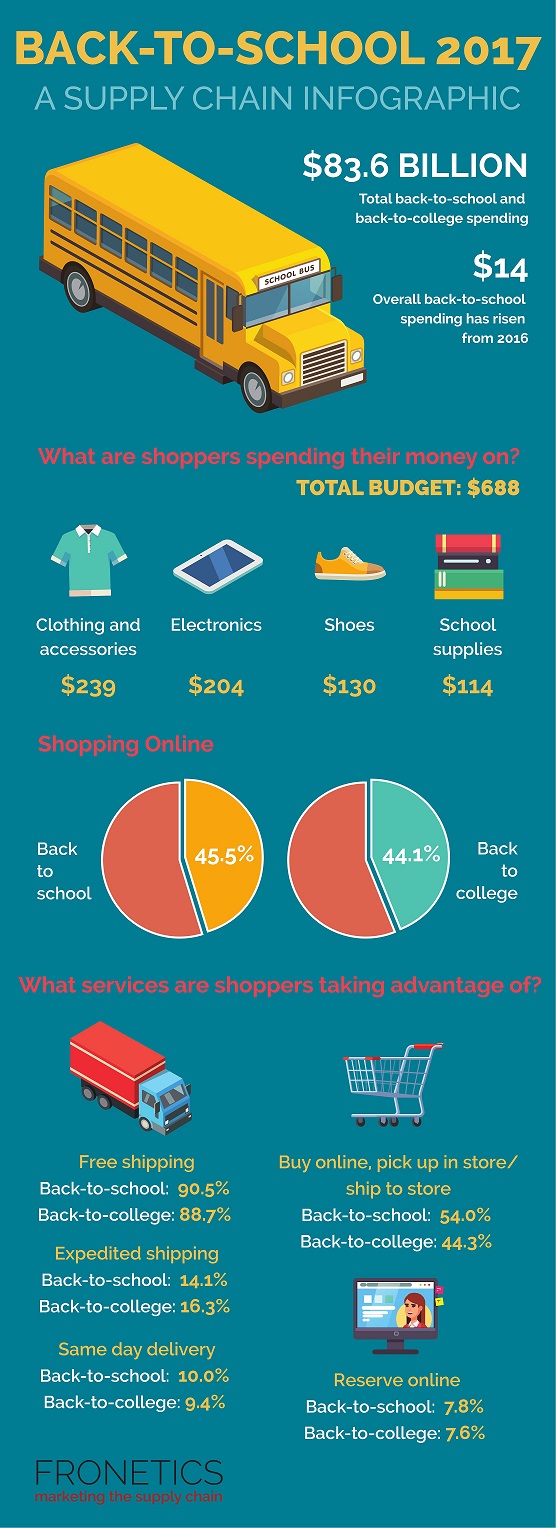
With consumer confidence on the rise, the National Retail Federation predicts that back-to-college and back-to-school spending will hit $83.6 billion in 2017. That whopping total is an all-time high for back-to-college dollars, and the second highest on record for back-to-school spending, and represents and increase of more than 10% from last year.
If you started your shopping three weeks to one month before school starts, you likely found the longest lines: 46.7% of shoppers report that that’s when they planned to hit the shelves for back-to-school shopping, and 34.6% for back-to-college.
The top destinations for back-to-school shoppers are department stores (57.1%), discount stores (54.1%), and clothing stores (46.0%), while back-to-college shoppers prefer online shopping (44.1%), with discount stores (40%) and department stores (38.5%) following in second and third place. A whopping 90.5% of back-to-school shoppers plan to take advantage of free shipping services, with 88.7% doing the same for back-to-college shipping.
Per household, overall back-to-school spending has risen from last year’s average of $674 to $688 in 2017. The NRF predicts that 64% of that total will be spent on apparel and electronics.
Check out our infographic with some interesting facts from the NRF’s 2017 survey below.